Wall Streeters are just Welfare Recipiants in Disguise

Wall Streeters are just Welfare Recipients, in Disguise they just cost more to feed is all.

They are the Rich Welfare bums who need it the least.

Exactly 9 Years Ago Today: Fannie Mae Eases Credit To Aid Mortgage Lending

Lest we forget. History can say a lot.

Fannie Mae Eases Credit To Aid Mortgage Lending

By STEVEN A. HOLMES

September 30, 1999

In a move that could help increase home ownership rates among minorities and low-income consumers, the Fannie Mae Corporation is easing the credit requirements on loans that it will purchase from banks and other lenders.

The action, which will begin as a pilot program involving 24 banks in 15 markets — including the New York metropolitan region — will encourage those banks to extend home mortgages to individuals whose credit is generally not good enough to qualify for conventional loans. Fannie Mae officials say they hope to make it a nationwide program by next spring.

Fannie Mae, the nation’s biggest underwriter of home mortgages, has been under increasing pressure from the Clinton Administration to expand mortgage loans among low and moderate income people and felt pressure from stock holders to maintain its phenomenal growth in profits. In addition, banks, thrift institutions and mortgage companies have been pressing Fannie Mae to help them make more loans to so-called subprime borrowers. These borrowers whose incomes, credit ratings and savings are not good enough to qualify for conventional loans, can only get loans from finance companies that charge much higher interest rates — anywhere from three to four percentage points higher than conventional loans. ”Fannie Mae has expanded home ownership for millions of families in the 1990’s by reducing down payment requirements,” said Franklin D. Raines, Fannie Mae’s chairman and chief executive officer. ”Yet there remain too many borrowers whose credit is just a notch below what our underwriting has required who have been relegated to paying significantly higher mortgage rates in the so-called subprime market.” Demographic information on these borrowers is sketchy. But at least one study indicates that 18 percent of the loans in the subprime market went to black borrowers, compared to 5 per cent of loans in the conventional loan market. In moving, even tentatively, into this new area of lending, Fannie Mae is taking on significantly more risk, which may not pose any difficulties during flush economic times. But the government-subsidized corporation may run into trouble in an economic downturn, prompting a government rescue similar to that of the savings and loan industry in the 1980’s. ”From the perspective of many people, including me, this is another thrift industry growing up around us,” said Peter Wallison a resident fellow at the American Enterprise Institute. ”If they fail, the government will have to step up and bail them out the way it stepped up and bailed out the thrift industry.” Under Fannie Mae’s pilot program, consumers who qualify can secure a mortgage with an interest rate one percentage point above that of a conventional, 30-year fixed rate mortgage of less than $240,000 — a rate that currently averages about 7.76 per cent. If the borrower makes his or her monthly payments on time for two years, the one percentage point premium is dropped. Fannie Mae, the nation’s biggest underwriter of home mortgages, does not lend money directly to consumers. Instead, it purchases loans that banks make on what is called the secondary market. By expanding the type of loans that it will buy, Fannie Mae is hoping to spur banks to make more loans to people with less-than-stellar credit ratings. Fannie Mae officials stress that the new mortgages will be extended to all potential borrowers who can qualify for a mortgage. But they add that the move is intended in part to increase the number of minority and low income home owners who tend to have worse credit ratings than non-Hispanic whites. Home ownership has, in fact, exploded among minorities during the economic boom of the 1990’s. The number of mortgages extended to Hispanic applicants jumped by 87.2 per cent from 1993 to 1998, according to Harvard University’s Joint Center for Housing Studies. During that same period the number of African Americans who got mortgages to buy a home increased by 71.9 per cent and the number of Asian Americans by 46.3 per cent. In contrast, the number of non-Hispanic whites who received loans for homes increased by 31.2 per cent. Despite these gains, home ownership rates for minorities continue to lag behind non-Hispanic whites, in part because blacks and Hispanics in particular tend to have on average worse credit ratings. In July, the Department of Housing and Urban Development proposed that by the year 2001, 50 percent of Fannie Mae’s and Freddie Mac’s portfolio be made up of loans to low and moderate-income borrowers. Last year, 44 percent of the loans Fannie Mae purchased were from these groups. The change in policy also comes at the same time that HUD is investigating allegations of racial discrimination in the automated underwriting systems used by Fannie Mae and Freddie Mac to determine the credit-worthiness of credit applicants.

Compliments of One Mans Blog

Under Fannie Mae’s pilot program, consumers who qualify can secure a mortgage with an interest rate one percentage point above that of a conventional, 30-year fixed rate mortgage of less than $240,000 — a rate that currently averages about 7.76 per cent. If the borrower makes his or her monthly payments on time for two years, the one percentage point premium is dropped.

This means they made a small fortune on the poor for some time. Why is it the poor have to pay more interest? That one percent certainly adds up to a whole lot of profit.

There certainly are those who know how to make money off a stock market crash.

During the Great Depression there were those who made a fortune. Seems the as usual the rich got richer and the poor got very much poorer.

There are those who know very well how to create a crisis and profit from it. I see a pattern emerging.

One does have to wonder (in spite of all the legislation that has been passed over the years) how it is still possible this can happen.

Seems our law makers never really get it right. It could be they really don’t actually do anything to prevent it. Could be they just pretend to fix it.

People become confident things will be OK. They start investing again, until the next crash comes along. Then we all just repeat the same scenario over again. Maybe it’s just me. But I see the wool being pulled over everyone’s eyes yet again.

They mess up and the Government Bails them out. So where is the accountability. Seems anyone in American messes up and Government is there to bail them out. They can be as irresponsible as they want. NO FEAR the Government will give them YOUR MONEY. Meanwhile back at the ranch there are millions living in poverty and many are ending up on the streets every day.

Isn’t that comforting? Yes your Government is taking care of you?

Wall Street bailout: Report from the front

This is almost amusing Poor Suffering Wall Streeters BOY does my heart go out them and all the suffering they have caused. The poor, pathtic, lost souls, that they are.

October 11, 2008

Lehman Brothers Holdings Inc. Chief Executive Richard S. Fuld Jr., wearing tie, is heckled by protesters as he leaves Capitol Hill in Washington after testify before the House Oversight and Government Reform Committee.

AP / Susan Walsh

I don’t fully understand how the $700-billion we are all donating to rescue Wall Street’s executives will be deployed, but I assume it will become clear in a few weeks when we are likely to see a report from the front along these lines: Hundreds of security personnel, some in riot gear, kept order at Congress’ much-anticipated bailout distribution site today on Wall Street. Earlier, dozens of relief trucks loaded with sacks of cash intended for needy financial executives had lumbered through the streets of lower Manhattan before dawn. An estimated 70,000 CEOs, CFOs, COOs, VPs and hedge fund managers hit hardest by the collapse of the credit markets will receive $10 million each in taxpayer money. By 7 a.m., they clogged Wall Street wearing tags issued by their former companies and the crowd was a sea of names like Freddie, Fannie, Lehman, AIG, Washington Mutual, Bear Sterns and Merrill Lynch. Congress had hired emergency-distribution veteran Oxfam International to oversee the operation. Oxfam’s spokesman Jack Rowley said that in the past weeks, needy recipients awaiting the relief drop have been housed in appropriate Manhattan hotels commandeered by the government as holding “camps.” The hotel/camps were chosen in the hopes the executives would be used to the routine, but authorities said conditions had become difficult, with Wall Streeters in some cases forced to share rooms ( try living like poor Americans on the Streets then Whine Boys) at the The Palace, the Four Seasons, The Ritz and the St. Regis. “The hygiene situation is appalling,” said Oxfam’s Rowley, “with the men’s locker-rooms attached to the day spas running out of Clubman aftershave, Armani cologne and Cartier eau de toilette.” ( try living like poor Americans on the Streets then Whine Boys) Rowley said food was also becoming a problem, and his people were putting out an emergency call to restaurants to donate more beef tartare, Dover sole, seared Hudson Valley fois gras, pistachio crusted filet au poivre and wild boar tagliatelle carbonado. ( try living like poor Americans on the Streets then Whine Boys) The denizens of Wall Street, though still among the world’s richest citizens, have been in crisis ever since they bet everything on shaky subprime mortgages , which then predictably collapsed. One executive, who insisted on anonymity, said it is unfair to point the finger of blame at Wall Street. “The middle class let us down,” he told reporters. “We tried to help these $40,000-a-year people by talking them into $3,000-a-month mortgages, which we could bundle into huge hedge investments, and what happens? Two years later they default into foreclosure, cratering our lucrative mortgage-backed securities. I guess that’s gratitude for you.” (OH they were so generous the kindness, the kindness and who are they tring to kid they did it for “profit”.). Congress cut costs at the distribution site by canceling the need for thousands of National Guard members. Instead, in a show of “solidarity with the American needy,” security was provided by a “coalition of the willing,” from such sympathetic states as Switzerland, Macau, Liechtenstein, Barbados, Monaco and the Cayman Islands. Although clad in riot gear, the security personnel also carried folders bulging with deposit slips from their local banks, offering the bailout recipients tax-free havens for their money. Authorities said preparatory operations had gone well, with C-130 cargo planes usually used by USAid to deliver rice to Third World disaster spots having landed at JFK at 2 a.m. They carried the first $70 billion of the $700-billion bailout fund. Waiting trucks were soon in position in lower Manhattan. At exactly 10 a.m., the Oxfam staff opened the truck cargo doors to reveal thousands of sacks bearing the stamp, “Gift to Wall Street from Main Street.” Instantly, the crowd surged forward. Men in Armani Collezioni charcoal 3-button suits with Salvatore Ferragamo belts jockeyed for position next to women in Mariella Burani black crepe blazers with drapped detailing matched with Gucci classic heels. Among them were the CEO’s of Fannie Mae (Daniel H Mudd From Fannie Mae makes 8.79 million a year and owns 18.3 million in shares) and Freddie Mac (Richard F Syron From Freddie Mac makes 3.40 million a year and owns 20.0 million in shares) — who will likely walk away from their companies with over $25 million each, as well as ex Lehman Brothers CEO Dick Fuld, (Better known as Richard S Fuld Jr From Lehman Bros Holdings made 71.90 million a year  and owns $436.8 million in shares).who got $480 million over the years in pay packages.

They all said they appreciated taxpayers helping them out now that they’re out of jobs. (MY  Interpretation of this statement, “Thanking the all day suckers, you the tax payer that is”).

Peacekeepers with bullhorns shouted for calm. Several reporters saw officers with tear gas guns tense up as the crowd began to chant, “Show us the money. . . .” International observers were concerned. “If we don’t get this finished in the next week, the situation will become acute,” said Oxfam veteran Gustav Yves-Pierre. “The risk of money riots is imminent.” He pointed out that many recipients were in arrears on yacht payments and club dues.

One man, Pierre said, told him he feared that if he could not follow through on a $100,000 pledge to the Yale capital campaign, his son would not be accepted early admission, and perhaps not at all, which would interrupt his family’s four-generation membership in Skull and Bones. “That’s why I’m here,” said Yves-Pierre. “Whether it’s the starving in Ethiopia or this, a human being can’t look away when tragedy is unfolding.” Those on the trucks worked feverishly, handing out 110-pound (50-kg) bags of cash, each containing $10 million. As money managers, recipients are expected to invest it and live off the interest, but officials were concerned that with yield rates on treasuries and bonds so low, the $10 million won’t generate enough, and Wall Streeters will have to dip into their new principal to pay for such essentials as Sothebys auctions, Tuscan vacations and caretaking for their Aspen ski houses. Many of those in line found it difficult to wait for hours in the sun and some, on the point of collapse, retreated to their BMWs, and idled with the air conditioning on. As predicted, there was only enough for 10 percent of those in line. It was a poignant sight as tens of thousands headed empty-handed back to their hotel-camps while the luckier recipients struggled to their cars balancing the heavy sacks on their heads. Some relief workers wept openly at the heartbreak. Source

Year of the Bailout

September 09, 2008 

Want a federal bailout? Get in line. Now that the Treasury Department has finally announced its rescue of mortgage giants Fannie Mae and Freddie Mac—at a cost of up to $100 billion each—isn’t it time to start tallying up all this largesse? A hundred billion here, a hundred billion there, maybe it doesn’t seem like much at first. But before you know it, you’ve drained the treasury of the world’s richest country. And besides, more rescues seem to be coming. Here’s a tally of the bailouts so far:

The stimulus package. Maximum taxpayer cost: $150 billion What taxpayers got: Free money, up to $1,200 from the government per household, to spend as they wish. Early research shows most recipients have used the money to pay down debts or boost their savings. Good for them, but bad for the economy, which benefits most in the short-term from spending, not saving.

Bear Stearns. Maximum taxpayer cost: $29 billion. What taxpayers got: Prevented an even worse meltdown in the financial markets—at least for a while.

Fannie Mae and Freddie Mac. Maximum taxpayer cost: $200 billion. What taxpayers get: The mortgage market won’t completely collapse. Interest rates may even drop a little and credit gets a bit easier.

IndyMac and 10 other banks. These insolvent banks had billions in deposits that were taken over by the Federal Deposit Insurance Corp. Taxpayers won’t foot the bill directly, because FDIC takeovers are funded by insurance that banks pay for. But those premiums are likely to rise across the industry, and banks may pass some of that cost onto consumers. What taxpayers get: They don’t have to worry about losing their deposits just because their bank acts reckless. So far, all these bailouts add up to about $400 billion the government could end up doling out to keep key parts of the economy solvent. As the zeroes and the billions mount, we tend to get a bit numb to the magnitude of the number. But it’s big. The savings and loan fiasco of the late 1980s—perhaps the biggest government bailout since the Great Depression—cost taxpayers a mere $130 billion. And $400 billion dwarfs government spending on most other things. It’s equivalent to more than half of the nation’s total annual budget for defense or for Social Security payments. And it’s more than one tenth of all federal spending in a given year. Worse—there’s more to come. Here are some of the bailouts still in the works:

The Detroit automakers. A bill working its way through Congress would commit up to $6 billion in low-interest loans to General Motors, Ford, and Chrysler. Some are pushing for loans of up to $50 billion. Yeah, they’re loans, not grants, and theoretically, the companies would repay them. Unless…something…happens.

More banks. The FDIC says it’s closely watching 117 problem banks at risk of insolvency. Those banks control about $78 billion in assets. Then there’s the daily drama of troubled Lehman Brothers, where investors wait to see whether a white knight will surface, cash in hand, or a Bear Stearns redux takes place. Source

Well we now the Banking bailout cost 810 Billion


The $700 Billion Bailout: One More Weapon of Mass Deception

September 22,2008
By Richard W. Behan
The American economy needs help, but there are other, far more equitable ways to accomplish it.

It is necessary only to assure the financial survival of Wall Street banks and brokerages, the administration’s most loyal supporters and its greatest political contributors — and in large measure the cause of the financial meltdown the country is facing……


Now I am going to retreat to my hoval and eat my bread and water like a good Slave.

Published in: on October 10, 2008 at 11:50 pm  Comments Off on Wall Streeters are just Welfare Recipiants in Disguise  
Tags: , , , , , , , , , , , , , , , , ,

17 Chinese Released from Guantánamo Bay


The Inconvenient Existence of Abdel al Ghizzawi

On Tuesday U.S. District Judge Ricardo M. Urbina ordered the release of 17 Chinese Uighur Muslims from Guantánamo Bay and most likely caused a near-riot in the White House. His order highlights the increasingly muddled nature of the facility’s existence and, if carried out, holds the potential for an avalanche of bad publicity at a very bad time for the President.

First and most importantly, consider the people behind the paper. The Uighurs and one Abdel al Ghizzawi were all found not to be enemy combatants at the same time by tribunals formed under the Military Commissions Act (MCA). The political repercussions must have been obvious because new, more compliant tribunals subsequently ruled that the very same evidence actually made them enemy combatants. The Uighurs were treated as a single group because, um, they are Uighurs (a completely irrelevant similarity under the circumstances) and al Ghizzawi was split off. The Uighurs ended up before Urbina and ordered released. Al Ghizzawi ended up before John Bates and was told he did not even merit medical attention.

In other words, undesirable findings can be reversed by simply convening a more friendly panel (the MCA was presumably written by avid golfers), and the foregone conclusions dressed up as rulings get wildly different treatment in the justice system. Judges have no case law or precedent to guide them, no philosophy to draw on or judicial framework for interpretation. They go by nothing more than their own sense of what seems right, and preside over courts that exist in a jurisprudential vacuum. Lawyers who attempt to work in this system are almost completely blind to what might be effective, and their understandable frustration is hard to miss.

For instance, al Ghizzawi is represented by H. Candace Gorman, who clarified several points for me via email while I was writing this post. She also has shown astonishing persistence in her pro bono efforts to obtain some semblance of justice. However, a quick look at her ongoing chronicle shows just how much she has had to make her approach up as she goes along. I suspect “improvised” ranks just above “incompetent” in the Adjectives You Don’t Want Characterizing Your Defense category, but in this case what other choice is there?

Al Ghizzawi and others languish in Guantánamo because of politics. Election day is less than a month away and there are barely over a hundred days left in the President’s term. Released detainees could create a political disaster on the former and a legal one after the latter. Think about what happens on November 4th if the Uighurs are released in the next week or two. They will be on American soil and probably giving interviews – imagine the news value of a group from the fabled, mythical Gitmo showing up at the end of election season. I suspect there would be tremendous curiosity over what they had to say about their time in U.S. custody. A rigged system declared them noncombatants, so the story of their incarceration without a shred of evidence would look very bad. Maybe not for the immediate aftermath of the capture, but as years dragged on it would be clear they were kept not because of risks to national security but because of their direct experience of administration policy. Based on the limited information we have I imagine we would hear about extended periods of isolation, sleeplessness, sensory deprivation, extremes of cold and heat, stress positions and other abuses. Done individually or at moderate levels they might not seem so bad, but strung together in succession, done with the intent of finding the fabled 79.9 degrees and related on TV by the actual victim it would generally be seen as torture. The result: widespread revulsion at the Republicans’ preferred approach to detainees.

Also, the President clearly must hear the clock ticking. Once he hands over the keys to his successor he will no longer be able to have the Justice Department file emergency appeals, have the Vice President breathe down someone’s neck or make life for a reluctant bureaucrat sufficiently unpleasant as to make a career change look like a good idea. Considering his historic unpopularity he probably should not expect to have any surrogates going to the wall for him either. He will, for all intents and purposes, go into exile. If he cannot shut down or compromise avenues of prosecution right now he will have to rely on the good will of the citizenry and the forbearance of the next players in Washington to keep him from answering for his actions. Both are possible, perhaps likely, but how reassuring is that? Better to crush it now. Expect fireworks.

Pruning Shears

Enemy Combatant is just an invention of the Bush administration. There in actuality, is no such thing. It is not the view of the rest of the world. It is merely a bogus invention to remove the rights of prisoners held there.
If anything they are Prisoners of War that should be protected by the Geneva Convention.
Guantanamo Bay is one of the worst Human Rights Violations conjured up by the Bush administration.

Geneva Convention relative to the Treatment of Prisoners of War

Adopted on 12 August 1949 by the Diplomatic Conference for the Establishment of
International Conventions for the Protection of Victims of War, held in Geneva
from 21 April to 12 August, 1949
Published in: on October 10, 2008 at 1:39 am  Comments Off on 17 Chinese Released from Guantánamo Bay  
Tags: , , , , , , , , ,

Cholera rips through Iraq

By Patrick Cockburn in Baghdad
October 10 2008

Children fill water containers in a former Baghdad army base, now a slum. Cholera has infected many supplies

AFP/GETTY IMAGES

Children fill water containers in a former Baghdad army base, now a slum. Cholera has infected many supplies

A deadly outbreak of cholera in Iraq is being blamed on a scandal involving corrupt officials who failed to sterilise the local drinking water because they were bribed to buy chlorine from Iran that was long past its expiration date.

The centre of the epidemic is in Babil province, south of Baghdad, in the marshy lands east of the Euphrates river, not far from the ruins of ancient Babylon. In Baghdad, where half the six million population has no access to clean drinking water, people are now drinking only bottled or boiled water.

The Iraqi Prime Minister, Nouri al-Maliki, has appointed a commission of inquiry to find out why ineffective chlorine was being used. He is also refusing to release three officials under arrest despite demands from the Islamic Supreme Council of Iraq (ISCI) to which they are linked. In the town of al-Madhatiya, in southern Babil, a councillor involved in buying the chlorine was reportedly released after militiamen connected to ISCI intimidated police into freeing him.

The scandal over the contract is becoming a test case of the Maliki government’s willingness to tackle the pervasive corruption in Iraq where officials see their jobs primarily as a way of enriching themselves through bribes. It is also a test of his ability to exercise central control over ISCI and parties which have been hitherto dominant outside Baghdad.

Cholera is endemic in Iraq but last year there was an epidemic in northern Iraq which was far more serious than anything seen for years. Some 4,700 people, mostly in Sulaimaniyah province, were struck.

This year, the government hoped to stop another outbreak of the disease by repairing shattered water and sanitation stations and putting chlorine in the water supply. An Iraqi government official, who did not want his name published, said the Health Ministry bought $11m (£6.4m) worth of chlorine from Iran for use in the provinces of Babil, Diwaniyah and Kerbala, all on the Euphrates river south of Baghdad.

In the latter two provinces, officials noticed that the chlorine was old and the time during which it could be employed effectively had expired, and refused to use it. But in Babil the chlorine was put in the fresh water supply stations at al-Madhatiyah, al-Hashimiyah and al-Qasim, south-east of the provincial capital, al-Hillah. Soon 222 people were confirmed as having cholera in Babil, in a total of 420 cases of whom seven have died.

The scandal is a reflection of the the way Iraqi politics works. The ruling parties monopolise jobs and contracts. It is impossible to find work at any level in most ministries without a letter of commendation from one of the parties in the government. The enormous Iraqi government apparatus, employing some two million people, is a patronage machine. There are now more state officials than under Saddam, but it is unable to supply electricity, food rations and clean water, despite Iraq’s $80bn in accumulated oil revenues.

The power base of ISCI, the most powerful Shia religious party, is the Shia provinces of southern Iraq between Baghdad and Basra. Political parties are expected to protect their members from arrest. This explains what happened next. The officials arrested in Babil belonged to the Badr Organisation, the militia wing of ISCI. Leaders of the party demanded their release but Mr Maliki refused. Badr militants then turned up at a police station in al-Madhatiya and forced the police to release a councillor apparently involved in purchasing the chlorine.

But the grand Shia coalition which won more than half the seats in the Iraqi parliament in the last election in December 2005 has broken up. Mr Maliki is trying to build up his own Dawa party, using the resources of the state.

He has deepening differences with ISCI which won most of the southern Iraqi provinces. They accuse him of trying to create a power base in what was previously their territory by paying the tribes who belong to government-sponsored “support councils” in southern Iraq. His aim is to get his own candidates elected in the provincial and parliamentary elections next year. “These will be crucial in deciding who will hold power in Iraq in future,” said one senior Iraqi official.

Control of oil revenues gives Mr Maliki a crucial card. Iraq has 50 to 60 per cent unemployment and most jobs are with the state. Salaries of state employees have risen sharply. But the government remains largely dysfunctional aside from its growing military strength. Iraqi journalists are encouraged and paid to write “good news” stories. In Baghdad, people notice there is little mention of the cholera in the media. This provokes fear that the epidemic may be worse than the government admits.

After the invasion: Services in Iraq

* Before the war, Baghdad had electricity between 16 and 24 hours a day. This has dropped to just under 12.

* There was no national mobile phone network, now there are at least 12 million subscribers.

* In April 2007 there were 261,000 internet subscribers. Before the war this number was estimated as 4,500.

* Of the 34,000 doctors registered in pre-war Iraq, 20,000 fled, 2,000 have been killed and 250 kidnapped.

* Registered cars more than doubled, to 3.1 million by October 2005.

Source

US blamed for killing of prominent Shia MP


Secrets of Iraq’s death chamber

Published in: on October 10, 2008 at 1:15 am  Comments Off on Cholera rips through Iraq  
Tags: , , , , , ,

Prime Minister Gordon Brown has condemned Iceland’

Prime Minister Gordon Brown has condemned Iceland’s handling of the collapse of its banks and its failure to guarantee British savers’ deposits.

He said its action were “effectively illegal” and “completely unacceptable”.

The UK government has frozen all UK-held assets of the Icelandic bank Landsbanki after it collapsed.

Iceland‘s prime minister Geir Haarde said it was “not very pleasant” to learn that anti-terror laws were being used to deal with the company.

Landsbanki, one of many banks hit heavily by the global credit crunch, was taken over by the Icelandic government and declared insolvent on Tuesday.

The 300,000 UK customers of its subsidiary IceSave were unable to access their accounts.

‘Further action’

UK Chancellor Alistair Darling later announced that all UK savers affected would be protected.

But the government has not yet offered the same for more than £900m known to have been invested in Icelandic banks by UK councils, police and transport authorities.

In an interview with BBC political editor Nick Robinson, Mr Brown said the government was talking with local authorities about what could be done and intended to recover as much money as possible.

He added: “What happened in Iceland is completely unacceptable. I’ve been in touch with the Icelandic prime minister. I said this is effectively illegal action that they have taken. “We are freezing the assets of Icelandic companies in the United Kingdom where we can. We will take further action against the Icelandic authorities wherever that is necessary to recover money.”

He added: “This is fundamentally a problem with the Icelandic-registered financial services authority – they have failed not only the people of Iceland, they have failed people in Britain.”

Mr Haarde, asked if he felt there was a crisis in relations between Britain and Iceland, said: “I thought so for a few minutes this morning when I realised that a terrorist law was being applied against us.

“That was not very pleasant. I’m afraid that not many governments would have taken that very kindly, to be put in that category and I told the chancellor that we were not pleased with that.”

But he said he had cleared up a number of issues with Mr Darling.

Source

Illegal according to who?

Published in: on October 10, 2008 at 12:28 am  Comments Off on Prime Minister Gordon Brown has condemned Iceland’  
Tags: , , ,

War “Pollution” Equals Millions of Deaths

New stories are added as I find them.

All new links are at the bottom of the page.

Iraq War Pollution Equals 25 Million Cars

Burning Oil in Iraq

Photo: Burning oil fields in Iraq by Shawn Baldwin

The greenhouse gases released by the Iraq war thus far equals the pollution from adding 25 million cars to the road for one year says a study released by Oil Change International, an anti petroleum watchdog.  The group’s main concerns are the environmental and human rights impacts of a petroleum based economy.

The study, released last March on the fifth anniversary of the Iraq War, states that total US spending on the war so far equals the global investment needed through 2030 to halt global warming.

Of course skeptics and oil companies will be right to ask how these numbers were calculated.  The group claims Iraq war emissions estimates come from combat, oil well fires, increaesd gas flaring, increased cement manufacturing for reconstruction, and explosives.

The Report: A Climate of War

Source


“Warfare is inherently destructive of sustainable development. States shall therefore respect international law providing protection for the environment in times of armed conflict and cooperate in its further development, as necessary.” – 1992 Rio Declaration

The application of weapons, the destruction of structures and oil fields, fires, military transport movements and chemical spraying are all examples of the destroying impact war may have on the environment. Air, water and soil are polluted, man and animal are killed, and numerous health affects occur among those still living. This page is about the environmental effects of wars and incidents leading to war that have occurred in the 20th and 21st century.

Timeline of wars

Africa

“My hands are tied
The billions shift from side to side
And the wars go on with brainwashed pride
For the love of God and our human rights
And all these things are swept aside
By bloody hands time can’t deny
And are washed away by your genocide
And history hides the lies of our civil wars” – Guns ‘n Roses (Civil War)

In Africa many civil wars and wars between countries occurred in the past century, some of which are still continuing. Most wars are a result of the liberation of countries after decades of colonialization. Countries fight over artificial borders drawn by former colonial rulers. Wars mainly occur in densely populated regions, over the division of scarce resources such as fertile farmland. It is very hard to estimate the exact environmental impact of each of these wars. Here, a summary of some of the most striking environmental effects, including biodiversity loss, famine, sanitation problems at refugee camps and over fishing is given for different countries.

Congo war (II) – Since August 1998 a civil war is fought in former Zaire, now known as the Democratic Republic of the Congo (DRC). The war eventually ended in 2003 when a Transitional Government took power. A number of reasons are given for the conflict, including access and control of water resources and rich minerals and political agendas. Currently over 3 million people have died in the war, mostly from disease and starvation. More than 2 million people have become refugees. Only 45% of the people had access to safe drinking water. Many women were raped as a tool of intimidation, resulting in a rapid spread of sexually transmitted diseases such as HIV-AIDS. The war has a devastating effect on the environment. National parks housing endangered species are often affected for exploitation of minerals and other resources. Refugees hunt wildlife for bush meat, either to consume or sell it. Elephant populations in Africa have seriously declined as a result of ivory poaching. Farmers burn parts of the forest to apply as farmland, and corporate logging contributes to the access of poachers to bush meat. A survey by the WWF showed that the hippopotamus population in one national park decreased from 29,000 thirty years previously, to only 900 in 2005. The United Nations Educational, Scientific and Cultural Organization (UNESCO) listed all five parks as ‘world heritage in danger’.

Ethiopia & Eritrea – Before 1952, Eritrea was a colony of Italy. When it was liberated, Ethiopia annexed the country. Thirty years of war over the liberation of Eritrea followed, starting in 1961 and eventually ending with the independence of Eritrea in 1993. However, war commenced a year after the country introduced its own currency in 1997. Over a minor border dispute, differences in ethnicity and economic progress, Ethiopia again attacked Eritrea. The war lasted until June 2000 and resulted in the death of over 150,000 Eritrean, and of hundreds of thousands of Ethiopians. During the war severe drought resulted in famine, particularly because most government funds were spend on weapons and other war instrumentation. The government estimated that after the war only 60% of the country received adequate food supplies. The war resulted in over 750,000 refugees. It basically destroyed the entire infrastructure. Efforts to disrupt agricultural production in Eritrea resulted in changes in habitat. The placing of landmines has caused farming or herding to be very dangerous in most parts of the country. If floods occur landmines may be washed into cities. This has occurred earlier in Mozambique.

Rwanda civil war – Between April and July 1994 extremist military Hutu groups murdered about 80,000-1,000,000 Tutsis and moderate Hutus in Rwanda. Over 2,000,000 people lost their homes and became refugees. Rwanda has a very rich environment, however, it has a particularly limited resource base. About 95% of the population lives on the countryside and relies on agriculture. Some scientists believe that competition for scarce land and resources led to violence prior to and particularly after the 1994 genocide. It is however stated that resource scarcity only contributed limitedly to the conflict under discussion. The main cause of the genocide was the death of the president from a plane-crash caused by missiles fires from a camp.

The many refugees from the 1994 combat caused a biodiversity problem. When they returned to the already overpopulated country after the war, they inhabited forest reserves in the mountains where endangered gorillas lived. Conservation of gorilla populations was no longer effective, and refuges destroyed part of the habitat. Despite the difficulties still present in Rwanda particularly concerning security and resource provision, an international gorilla protection group is now working on better conditions for the gorillas in Rwanda.

Somalia civil war – A civil war was fought in Somalia 1991. One of the most striking effects of the war was over fishing. The International Red Cross was encouraging the consumption of seawater fish to improve diets of civilians. For self-sufficiency they provided training and fishing equipment. However, as a consequence of war Somali people ignored international fishing protocols, thereby seriously harming ecology in the region. Fishing soon became an unsustainable practise, and fishermen are hard to stop because they started carrying arms. They perceive over fishing as a property right and can therefore hardly be stopped.

Sudan (Darfur & Chad) – In Sudan civil war and extreme droughts caused a widespread famine, beginning in 1983. Productive farmland in the southern region was abandoned during the war. Thousands of people became refugees that left behind their land, possibly never to return. Attempts of remaining farmers to cultivate new land to grow crops despite the drought led to desertification and soil erosion. The government failed to act for fear of losing its administrative image abroad, causing the famine to kill an estimated 95,000 of the total 3,1 million residents of the province Darfur. As farmers started claiming more and more land, routes applied by herders were closed off. This resulted in conflicts between farmers and rebels groups. In 2003, a conflict was fought in Darfur between Arab Sudanese farmers and non-Arab Muslims. The Muslim group is called Janjaweed, a tribe mainly consisting of nomadic sheep and cattle herders. Originally the Janjaweed were part of the Sudanese and Darfurian militia, and were armed by the Sudanese government to counter rebellion. However, they started utilizing the weapons against non-Muslim civilians. The tribe became notorious for massacre in 2003-2004. In December 2005 the conflict continued across the border, now involving governmental army troops from Chad, and the rebel groups Janjaweed and United Front for Democratic Change from Sudan. In February 2006 the governments of Chad and Sudan signed a peace treaty called the Tripoli Agreement. Unfortunately a new rebel assault of the capital of Chad in April made Chad break all ties with Sudan. The Darfur Conflict so far caused the death of between 50,000 and 450,000 civilians. It caused over 45,000 people to flea the countries of Sudan and Central Africa, into north and east Chad. Most refugees claim they fled civilian attacks from rebel forces, looting food and recruiting young men to join their troops.

America

Pearl Harbor (WWII) – When World War II began, Japan signed the Tripartite Pact with Nazi Germany and Fascist Italy. Consequentially, the United States closed the Panama Canal to Japanese shipping, and initiated a complete oil embargo. Japan, being dependent on US oil, responded to the embargo violently. On December 1941, Japanese troops carried out a surprise attack on Pearl Harbor, Hawaii, aimed at the US Navy stationed there. Despite the awareness that Japan might attack, the US was surprisingly unprepared for the Japanese aggression. There were no aircraft patrols, and anti-aircraft weapons were not manned.

For the attack five Japanese submarines were present in the harbor to launch torpedos. One was discovered immediately, and attacked by the USS Ward. All five submarines sank, and at least three of them have not been located since. As Japanese bombers arrived they began firing at US marine airbases across Hawaii, and subsequently battle ships in Pearl Harbor. Eighteen ships sank, including five battleships, and a total of more than 2,000 Americans were killed in action. The explosion of the USS Arizona caused half of the casualties. The ship was hit by a bomb, burned for two days in a row, and subsequently sank to the bottom. The cloud of black smoke over the boat was mainly caused by burning black powder from the magazine for aircraft catapults aboard the ship.

Leaking fuel from the Arizona and other ships caught fire, and caused more ships to catch fire. Of the 350 Japanese planes taking part in the attack, 29 were lost. Over sixty Japanese were killed in actions, most of them airmen.

Today, three battle ships are still at the bottom of the harbor. Four others were raised and reused. The USS Arizona, being the most heavily damaged ship during the attack, continues to leak oil from the hulk into the harbor. However, the wreck is maintained, because it now serves as part of a war memorial.

World Trade Centre explosion – The so-called ‘War on Terrorism’ the United States are fighting in Asia currently all started with the event we recall so well from the shocking images projected on news bulletins. On September 11, 2001, terrorists flew airplanes into the buildings of the World Trade Centre. It is now claimed that the attack and simultaneous collapse of the Twin Towers caused a serious and acute environmental disaster.

We will live in the death smog for a while,
breathing the dust of the dead,
the 3 thousand or so who turn to smoke,
as the giant ashtray in Lower Manhattan
continues to give up ghosts.
The dead are in us now,
locked in our chests,
staining our lungs,
polluting our bloodstreams.
And though we cover our faces with flags
and other pieces of cloth to filter the air,
the spirits of the dead aren’t fooled
by our masks
.” Lawrence Swan, 05-10-2001

As the planes hit the Twin Towers more than 90.000 litres of jet fuel burned at temperatures above 1000oC. An atmospheric plume formed, consisting of toxic materials such as metals, furans, asbestos, dioxins, PAH, PCB and hydrochloric acid. Most of the materials were fibres from the structure of the building. Asbestos levels ranged from 0.8-3.0% of the total mass. PAH comprised more than 0.1% of the total mass, and PCBs less than 0.001% of total mass. At the site now called Ground Zero, a large pile of smoking rubble burned intermittently for more than 3 months. Gaseous and particulate particles kept forming long after the towers had collapsed.


Aerial photograph of the plume

The day of the attacks dust particles of various sizes spread over lower Manhattan and Brooklyn, for many miles. Fire fighters and medics working at the WTC were exposed, but also men and women on the streets and in nearby buildings, and children in nearby schools. In vivo inhalation studies and epidemiological studies pointed out the impact of the dust cloud. Health effects from inhaling dust included bronchial hyper reactivity, because of the high alkalinity of dust particles. Other possible health effects include coughs, an increased risk of asthma and a two-fold increase in the number of small-for-gestational-age baby’s among pregnant women present in or nearby the Twin Towers at the time of the attack. After September, airborne pollutant concentrations in nearby communities declined.

Many people present at the WTC at the time of the attacks are still checked regularly, because long-term effects may eventually show. It is thought there may be an increased risk of development of mesothelioma, consequential to exposure to asbestos. This is a disease where malignant cells develop in the protective cover of the body’s organs. Airborne dioxins in the days and weeks after the attack may increase the risk of cancer and diabetes. Infants of women that were pregnant on September 11 and had been in the vicinity of the WTC at the time of the attack are also checked for growth or developmental problems.

Asia

Afghanistan war – In October 2001, the United States attacked Afghanistan as a starting chapter of the ‘War on terrorism’, which still continues today. The ultimate goal was to replace the Taliban government, and to find apparent 9/11 mastermind and Al-Qaeda member Osama Bin Laden. Many European countries assisted the US in what was called ‘Operation Enduring Freedom’.

During the war, extensive damage was done to the environment, and many people suffered health effects from weapons applied to destroy enemy targets. It is estimated that ten thousand villages, and their surrounding environments were destroyed. Safe drinking water declined, because of a destruction of water infrastructure and resulting leaks, bacterial contamination and water theft. Rivers and groundwater were contaminated by poorly constructed landfills located near the sources.

Afghanistan once consisted of major forests watered by monsoons. During the war, Taliban members illegally trading timber in Pakistan destroyed much of the forest cover. US bombings and refugees in need of firewood destroyed much of what remained. Less than 2% of the country still contains a forest cover today.

Bombs threaten much of the country’s wildlife. One the world’s important migratory thoroughfare leads through Afghanistan. The number of birds now flying this route has dropped by 85%. In the mountains many large animals such as leopards found refuge, but much of the habitat is applied as refuge for military forces now. Additionally, refugees capture leopards and other large animals are and trade them for safe passage across the border.

Pollution from application of explosives entered air, soil and water. One example is cyclonite, a toxic substance that may cause cancer. Rocket propellants deposited perchlorates, which damage the thyroid gland. Numerous landmines left behind in Afghan soils still cause the deaths of men, women and children today.

Cambodia civil war – In 1966 the Prince of Cambodia began to lose the faith of many for failure to come to grips with the deteriorating economic situation. In 1967 rebellion started in a wealthy province where many large landowners lives. Villagers began attacking the tax collection brigade, because taxes were invested in building large factories, causing land to be taken. This led to a bloody civil war. Before the conflict could be repressed 10,000 people had died.

The rebellion caused the up rise of the Khmer Rouge, a Maoist-extremist organization that wanted to introduce communism in the country. In 1975 the organization, led by Pol Pot, officially seized power in Cambodia. The Khmer considered farmers (proletarians) to be the working class, as did Mao in China earlier. Schools, hospitals and banks were closed, the country was isolated from all foreign influence, and people were moved to the countryside for forced labor. People were obligated to work up to 12 hours a day, growing three times as many crops, as was usually the case. Many people died there from exhaustion, illness and starvation, or where shot by the Khmer on what was known as ‘The Killing Fields’.

The Khmer Rouge regime resulted in deforestation, caused by extensive timber logging to finance war efforts, agricultural clearance, construction, logging concessions and collection of wood fuels. A total 35% of the Cambodian forest cover was lost under the Maoist regime. Deforestation resulted in severe floods, damaging rice crops and causing food shortages. In 1993, a ban on logging exports was introduced to prevent further flooding damage.

In 1979 the Khmer Rouge regime ended with an invasion by Vietnam, and the installation of a pro-Vietnamese puppet government. Subsequently, Thai and Chinese forces attempted to liberate the country from Vietnamese dominance. Many landmines were placed in the 1980’s, and are still present in the countryside. They deny agricultural use of the land where they are placed. In 1992 free elections were introduced, but the Khmer Rouge resumed fighting. Eventually, half of the Khmer soldiers left in 1996, and many officials were captured. Under the Khmer regime, a total of 1.7 million people died, and the Khmer was directly responsible for about 750,000 of those casualties.

Hiroshima & Nagasaki nuclear explosions – Atomic bombs are based on the principle of nuclear fission, which was discovered in Nazi Germany in 1938 by two radio chemists. During the process, atoms are split and energy is released in the form of heat. Controlled reactions are applied in nuclear power plants for production of electricity, whereas unchecked reactions occur during nuclear bombings. The invention in Germany alarmed people in the United States, because the Nazi’s in possession of atomics bombs would be much more dangerous than they already where. When America became involved in WWII, the development of atomic bombs started there in what was called the ‘Manhattan Project’. In July 1945 an atomic bomb was tested in the New Mexico desert. The tests were considered a success, and America was now in possession of one of the world’s deadliest weapons.

In 1945, at the end of World War II and the beginning of the Cold War, nuclear weapons were applied to kill for the first time in Japan. On August 6, a uranium bomb by the name of Little Boy was dropped on Hiroshima, followed by a plutonium bomb by the name of Fat Man on Nagasaki on August 9. The reason Hiroshima was picked was that it was a major military centre. The bomb detonated at 8.15 p.m. over a Japanese Army parade field, where soldiers were already present. Nagasaki was picked because it was an industrial centre. The bomb, which was much larger than that used on Hiroshima, exploded at 11.02 a.m. at an industrial site. However, the hills on and the geographical location of the bombing site caused the eventual impact to be smaller than days earlier in Hiroshima.
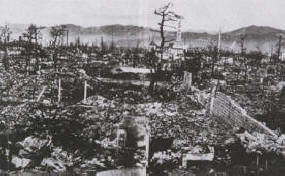
The first impact of the atomic bombings was a blinding light, accompanied by a giant wave of heat. Dry flammable materials caught fire, and all men and animals within half a mile from the explosion sites died instantly. Many structures collapsed, in Nagasaki even the structures designed to survive earthquakes were blasted away. Many water lines broke. Fires could not be extinguished because of the water shortage, and six weeks after the blast the city still suffered from a lack of water. In Hiroshima a number of small fires combined with wind formed a firestorm, killing those who did not die before but were left immobile for some reason. Within days after the blasts, radiation sickness started rearing its ugly head, and many more people would die from it within the next 5 years.

The total estimated death toll:
In Hiroshima 100,000 were killed instantly, and between 100,000 and 200,000 died eventually.
In Nagasaki about 40,000 were killed instantly, and between 70,000 and 150,000 died eventually.

The events of August 6 and August 9 can be translated into environmental effects more literally. The blasts caused air pollution from dust particles and radioactive debris flying around, and from the fires burning everywhere. Many plants and animals were killed in the blast, or died moments to months later from radioactive precipitation. Radioactive sand clogged wells used for drinking water winning, thereby causing a drinking water problem that could not easily be solved. Surface water sources were polluted, particularly by radioactive waste. Agricultural production was damaged; dead stalks of rice could be found up to seven miles from ground zero. In Hiroshima the impact of the bombing was noticeable within a 10 km radius around the city, and in Nagasaki within a 1 km radius.

Iraq & Kuwait – The Gulf War was fought between Iraq, Kuwait and a number of western countries in 1991. Kuwait had been part of Iraq in the past, but was liberated by British imperialism, as the Iraqi government described it. In August 1990, Iraqi forces claimed that the country was illegally extracting oil from Iraqi territory, and attacked. The United Nations attempted to liberate Kuwait. Starting January 1991, Operation Desert Storm began, with the purpose of destroying Iraqi air force and anti-aircraft facilities, and command and control facilities. The battle was fought in Iraq, Kuwait and the Saudi-Arabian border region. Both aerial and ground artillery was applied. Late January, Iraqi aircraft were flown to Iran, and Iraqi forces began to flee.

The Gulf War was one of the most environmentally devastating wars ever fought. Iraq dumped approximately one million tons of crude oil into the Persian Gulf, thereby causing the largest oil spill in history (see environmental disasters). Approximately 25,000 migratory birds were killed. The impact on marine life was not as severe as expected, because warm water sped up the natural breakdown of oil. Local prawn fisheries did experience problems after the war. Crude oil was also spilled into the desert, forming oil lakes covering 50 square kilometres. In due time the oil percolated into groundwater aquifers.

Fleeing Iraqi troops ignited Kuwaiti oil sources, releasing half a ton of air pollutants into the atmosphere. Environmental problems caused by the oil fires include smog formation and acid rain. Toxic fumes originating from the burning oil wells compromised human health, and threatened wildlife. A soot layer was deposited on the desert, covering plants, and thereby preventing them from breathing. Seawater was applied to extinguish the oil fires, resulting in increased salinity in areas close to oil wells. It took about nine months to extinguish the fires.

During the war, many dams and sewage water treatment plants were targeted and destroyed. A lack of possibilities for water treatment resulting from the attacks caused sewage to flow directly into the Tigris and Euphrates rivers. Additionally, pollutants seeped from bombed chemical plants into the rivers. Drinking water extracted from the river was polluted, resulting in widespread disease. For example, cases of typhoid fever have increased tenfold since 1991.

Movement of heavy machinery such as tanks through the desert damaged the brittle surface, causing soil erosion. Sand was uncovered that formed gradually moving sand dunes. These dunes may one day cause problems for Kuwait City. Tanks fired Depleted Uranium (DU) missiles, which can puncture heavy artillery structures. DU is a heavy metal that causes kidney damage and is suspected to be teratogenic and carcinogenic. Post-Gulf War reports state an increase in birth defects for children born to veterans. The impact of Depleted Uranium could not be thoroughly investigated after the Gulf War, because Saddam Hussein refused to cooperate. Its true properties were revealed after the Kosovo War in 2001 (description below). DU has now been identified as a neurotoxin, and birth defects and cancers are attributed to other chemical and nerve agents. However, it is stated that DU oxides deposited in the lungs of veterans have not been thoroughly researched yet. It was later found that this may cause kidney and lung infections for highly exposed persons.

After the Gulf War many veterans suffered from a condition now known as the Gulf War Syndrome. The causes of the illness are subject to widespread speculation. Examples of possible causes are exposure to DU (see above), chemical weapons (nerve gas and mustard gas), an anthrax vaccine given to 41% of US soldiers and 60-75% of UK soldiers, smoke from burning oil wells and parasites. Symptoms of the GWS included chronic fatigue, muscle problems, diarrhoea, migraine, memory loss, skin problems and shortness of breath. Many Gulf War veterans have died of illnesses such as brain cancer, now acknowledged as potentially connected to service during the war.

Iraq & the United States – The war in Iraq started by the United States in 2003 as part of the War on Terrorism causes poverty, resulting in environmental problems. Long-term environmental effects of the war remain unclear, but short-term problems have been identified for every environmental compartment. For example, some weapons are applied that may be extremely damaging to the environment, such as white phosphorus ammunition. People around the world protest the application of such armoury.

Water
Damage to sanitation structures by frequent bombing, and damage to sewage treatment systems by power blackouts cause pollution of the River Tigris. Two hundred blue plastic containers containing uranium were stolen from a nuclear power plant located south of Baghdad. The radioactive content of the barrels was dumped in rivers and the barrels were rinsed out. Poor people applied the containers as storage facility for water, oil and tomatoes, or sold them to others. Milk was transported to other regions in the barrels, making it almost impossible to relocate them.

Air
Oil trenches are burning, as was the case in the Gulf War of 1991, resulting in air pollution. In Northern Iraq, a sulphur plant burned for one month, contributing to air pollution. As fires continue burning, groundwater applied as a drinking water source may be polluted.

Soil
Military movements and weapon application result in land degradation. The destruction of military and industrial machinery releases heavy metals and other harmful substances.

Read more on restoring water systems in Iraq

Israel & Lebanon – In July 2006, Hezbollah initiated a rocket attack on Israeli borders. A ground patrol killed and captured Israeli soldiers. This resulted in open war between Israel and Lebanon.

The war caused environmental problems as Israelis bombed a power station south of Beirut. Damaged storage tanks leaked an estimated 20,000 tons of oil into the Mediterranean Sea. The oil spill spread rapidly, covering over 90 km of the coastline, killing fish and affecting the habitat of the endangered green sea turtle. A sludge layer covers Beaches across Lebanon, and the same problem may occur in Syria as the spill continues to spread. Part of the oil spill burned, causing widespread air pollution. Smog affects the health of people living in the city of Beirut. So far problems limiting the clean-up operation of oil spills have occurred, because of ongoing violence in the region.

Another major problem were forest fires in Northern Israel caused by Hezbollah bombings. A total of 9,000 acres of forest burned to the ground, and fires threaten tree reserves and bird sanctuaries.

Russia & Chechnya – In 1994 the First Chechen War of independence started, between Russian troops, Chechen guerrilla fighters and civilians. Chechnya has been a province of Russia for a very long time and now desires independence. The First War ended in 1996, but in 1999 Russia again attacked Chechnya for purposes of oil distribution.

The war between the country and its province continues today. It has devastating effects on the region of Chechnya. An estimated 30% of Chechen territory is contaminated, and 40% of the territory does not meet environmental standards for life. Major environmental problems include radioactive waste and radiation, oil leaks into the ground from bombarded plants and refineries, and pollution of soil and surface water. Russia has buried radioactive waste in Chechnya. Radiation at some sites is ten times its normal level. Radiation risks increase as Russia bombs the locations, particularly because after 1999 the severeness of weaponry increased. A major part of agricultural land is polluted to the extent that it can no longer meet food supplies. This was mainly caused by unprofessional mini-refineries of oil poachers in their backyards, not meeting official standards and causing over 50% of the product to be lost as waste. Groundwater pollution flows into the rivers Sunzha and Terek on a daily basis. On some locations the rivers are totally devoid of fish. Flora and fauna are destroyed by oil leaks and bombings.

Vietnam war – The Vietnam War started in 1945 and ended in 1975. It is now entitled a proxy war, fought during the Cold War between the United States and the Soviet Union to prevent the necessity for the nations to fight each other directly. North Vietnam fought side by side with the Soviet Union and China, and South Vietnam with the United States, New Zealand and South Korea. It must be noted that the United States only started to be actively involved in the battle after 1963. Between 1965 and 1968 North Vietnam was bombed under Operation Rolling Thunder, in order to force the enemy to negotiate. Bombs destroyed over two million acres of land. North Vietnam forces began to strike back, and the Soviet Union delivered anti-aircraft missiles to North Vietnam. The ground war of US troops against the Viet Cong began. The United States would not retreat from Vietnam until 1973, and during those years extremely environmentally damaging weapons and war tactics were applied.
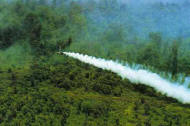
A massive herbicidal programme was carried out, in order to break the forest cover sheltering Viet Cong guerrillas, and deprive Vietnamese peasants of food. The spraying destroyed 14% of Vietnam’s forests, diminished agricultural yield, and made seeds unfit for replanting. If agricultural yield was not damaged by herbicides, it was often lost because military on the ground set fire to haystacks, and soaked land with aviation fuel en burned it. A total of 15,000 square kilometres of land were eventually destroyed. Livestock was often shot, to deprive peasant of their entire food supply. A total of 13,000 livestock were killed during the war.

The application of 72 million litres of chemical spray resulted in the death of many animals, and caused health effects with humans. One chemical that was applied between 1962 and 1971, called Agent Orange, was particularly harmful. Its main constituent is dioxin, which was present in soil, water and vegetation during and after the war. Dioxin is carcinogenic and teratogenic, and has resulted in spontaneous abortions, chloracne, skin and lung cancers, lower intelligence and emotional problems among children. Children fathered by men exposed to Agent Orange during the Vietnam War often have congenital abnormalities. An estimated half a million children were born with dioxin-related abnormalities. Agent Orange continues to threaten the health of the Vietnamese today.

“Drafted to go to Vietnam
To fight communism in a foreign land.
To preserve democracy is my plight
Which is a God…Given…Right.
Greenery so thick with hidden enemies
Agent Orange is sprayed on the trees.
Covering me from head to toe
Irate my eyes, burns through my clothes.
Returned home when my tour was done
To be told “You have cancer, son”.
Agent Orange is to blame
Government caused your suffering and pain.
Fight for compensation is frustrating and slow
Brass cover-up, not wanting anyone to know.
From cancer many comrades have died
Medical Insurance have been denied.
Compensation I now receive
My health I hope to retrieve.
In Vietnam , I was spared my life
Just to be stabbed with an Agent Orange knife” Yvonne Legge, 2001

Today, agriculture in Vietnam continues to suffer problems from six million unexploded bombs still present. Several organisations are attempting to remove these bombs. Landmines left in Vietnam are not removed, because the Vietnamese government refuses to accept responsibility.

Europe

Kosovo war – The Kosovo war can be divided up in two separate parts: a conflict between Serbia and Kosovo, and a conflict between Kosovo and the North Atlantic Treaty Organisation (NATO). The first conflict originated in 1996 from the statement of Slobodan Milocevic that Kosovo was to remain a part of Serbia, and from the resulting violent response of Albanian residents. When Serbian troops slaughtered 45 Albanians in the village of Racak in Kosovo in 1999, the NATO intervened. NATO launched a 4-month bombing campaign upon Serbia as a reply to the massacre at Racak.

The United Nations Environment Programme (UNEP) investigated the environmental impact of the Kosovo war. It was concluded that the war did not result in an environmental disaster affecting the entire Balkan region. Nevertheless, some environmental hot spots were identified, namely Belgrade, Pancevo, Kragujevac, Novi Sad and Bor.

Bombings carried out by the United States resulted in leakages in oil refineries and oil storage depots. Industrial sites containing other industries were also targeted. EDC (1,2-dichloroethane), PCBs en mercury escaped to the environment. Burning of Vinyl Chloride Monomer (VCM) resulted in the formation of dioxin, hydrochloric acid, carbon monoxide and PAHs, and oil burning released sulphur dioxide, nitrogen dioxide, carbon monoxide, lead and PAHs into the air. Heavy clouds of black smoke forming over burning industrial targets caused black rain to fall on the area around Pancevo. Some damage was done to National Parks in Serbia by bombings, and therefore to biodiversity. EDC, mercury and petroleum products (e.g. PCBs) polluted the Danube River. These are present in the sediments and may resurface in due time. EDC is toxic to both terrestrial and aquatic life. Mercury may be converted into methyl mercury, which is very toxic and bio accumulates. As a measure to prevent the consequences of bombing, a fertilizer plant in Pancevo released liquid ammonia into the Danube River. This caused fish kills up to 30 kilometres downstream.

In 1999 when NATO bombed Belgrade, the capital of Serbia, the resulting environmental damage was enormous. Petrochemical plants in suburbs started leaking all kinds of hazardous chemicals into air, water and soil. Factories producing ammonia and plastics released chlorine, hydrochloric acid, vinyl chloride and other chlorine substances, resulting in local air pollution and health problems. Water sources were polluted by oil leaking from refineries. The Danube River was polluted by oil more severely, but this time hydrochloric acid and mercury compounds also ended up there. These remained in the water for a considering period of time and consequently ended up in neighbouring countries Rumania and Bulgaria.

Clean drinking water supplies and waste treatment plants were damaged by NATO bombings. Many people fled their houses and were moved to refugee camps, where the number of people grew rapidly. A lack of clean drinking water and sanitation problems occurred.

Like in the Gulf War, Depleted Uranium (DU) was applied in the Kosovo War to puncture tanks and other artillery. After the war, the United Kingdom assisted in the removal of DU residues from the environment. Veterans complained of health effects. It was acknowledged by the UK and the US that dusts from DU can be dangerous if inhaled. Inhalation of dust most likely results in chemical poisoning.

World War I: Trench Warfare – In 1914, the assassination of archduke Franz Ferdinand of Austria-Hungary resulted in the First World War, otherwise known as The Great War, or WWI. It started with Austria-Hungary invading Serbia, where the assassin came from, and Germany invading Belgium. The war was mostly in Europe, between the Allies and the Central Powers.

Allies: France, United Kingdom, Italy, Belgium, Luxembourg, Russia, Poland, Serbia, Montenegro, Rumania, Albania, Greece, Portugal, Finland, United States, Canada, Brazil, Armenia, Australia, India, New Zealand, South Africa, Liberia, China, Japan, Thailand, Guatemala, Haiti, Honduras, Nicaragua, and Panama
Central Powers: Austria-Hungary, Germany, Turkish Empire, and Bulgaria
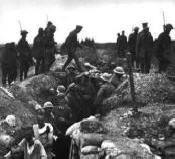
The war was fought from trenches, dug from the North Sea to the border of Switzerland. In 1918 when the war was over, empires disintegrated into smaller countries, marking the division of Europe today. Over 9 million people had died, most of which perished from influenza after the outbreak of the Spanish Flu (see environmental disasters). The war did not directly cause the influenza outbreak, but it was amplified. Mass movement of troops and close quarters caused the Spanish Flu to spread quickly. Furthermore, stresses of war may have increased the susceptibility of soldiers to the disease.

In terms of environmental impact, World War I was most damaging, because of landscape changes caused by trench warfare. Digging trenches caused trampling of grassland, crushing of plants and animals, and churning of soil. Erosion resulted from forest logging to expand the network of trenches. Soil structures were altered severely, and if the war was never fought, in all likelihood the landscape would have looked very differently today.

Another damaging impact was the application of poison gas. Gases were spread throughout the trenches to kill soldiers of the opposite front. Examples of gases applied during WWI are tear gas (aerosols causing eye irritation), mustard gas (cell toxic gas causing blistering and bleeding), and carbonyl chloride (carcinogenic gas). The gases caused a total of 100,000 deaths, most caused by carbonyl chloride (phosgene). Battlefields were polluted, and most of the gas evaporates into the atmosphere. After the war, unexploded ammunition caused major problems in former battle areas. Environmental legislation prohibits detonation or dumping chemical weapons at sea, therefore the cleanup was and still remains a costly operation. In 1925, most WWI participants signed a treaty banning the application of gaseous chemical weapons. Chemical disarmament plants are planned in France and Belgium.

World War II: – World War II was a worldwide conflict, fought between the Allies (Britain, France and the United States as its core countries) and the Axis Powers (Germany, Italy and Japan as its core countries). It started with the German invasion of Poland and Czechoslovakia in 1939, and ended with the liberation of Western Europe by the allies in 1945.

Estimates for the total casualties of the war vary, but most suggest that some 60 million people died in the war, including about 20 million soldiers and 40 million civilians.

World War II: Hunger winter – In late 1944, the allied troops attempted to liberate Western Europe. As they reached The Netherlands, German resistance caused the liberation to be halted in Arnhem, as allied troops failed to occupy a bridge over the River Rhine. As the Dutch government in exile in Britain called for railway strikes, the Germans responded by putting embargo on food transport to the west. This resulted in what is now known as the Hunger Winter, causing an estimated 20,000-25,000 Dutch to starve to death. A number of factors caused the starvation: a harsh winter, fuel shortages, the ruin of agricultural land by bombings, floods, and the food transport embargo. Most people in the west lived off tulip bulbs and sugar beet. Official food rations were below 1000 cal per person per day. In May 1945 the Hunger Winter ended with the official liberation of the west of The Netherlands.

Source

The there is this.  So what do they do with weapons of mass destruction?  Coming to an Ocean Near YOU! The cost in dollars for the pollution caused by war is staggering. The cost to human life is horrendous. The price of war to the Environment is deadly.  This is of course a Global problem.  What you don’t see can hurt you.  If you don’t know it is only because they don’t want you too. They will never tell you the true unless we as a Global community force them to. This will affect our children for many years to come. War is probably one of the worst polluters on the planet.  Stopping the WAR MACHINE is in everyone’s best interest.

Here you find tons of weapons that were dumped into the oceans among other things.

Depleated Uranium Information

The US Dumps staggering amounts of Chemical weapons in the oceans.

THE DEADLINESS BELOW

The US  still air testing bombs in the US.
US Air Testing Bombs

This to is a form of pollution a very deadly one.

Injuries and Deaths From Landmines and Unexploded Ordnance in Afghanistan, 2002-2006

This is part of the war pollution as well.
Uranium Mining, Grand Canyon now at Risk, Dangers, Pollution, History

Plague of bioweapons accidents afflicts the US

US Nuclear Weapons accidents – 1981 report

Added January 9 2009

Israel killing their own by Using Deadly Weapons of Mass Destuction again Gaza

Added November 18 2009

Doctors report “unprecedented” rise in deformities, cancers in Iraq (Photos)

Added January 9 2010

Cancer and Deformities – The Deadly Legacy of the Invasion of Iraq

NATO bombings: Aftermath takes toll on Serbia, now left with DU Poisoning (Radiation and DU fallout maps included.)

Addiction is also part of war pollution. Because of the NATO and US invasion in Afghanistan, Heroin addiction has grown like wildfire around the world. Millions are now addicted to Heroin.

Afghanistan: Troops Guarding the Poppy Fields

Hush’ over Afghan mission must end

Switzerland’s explosive war effort threatens environmental disaster

Pentagon’s Role in Global Catastrophe: Add Climate Havoc to War Crimes and War Pollution

“Military emissions abroad are exempt from national reporting requirements under U.S. law and the U.N. Framework Convention on Climate Change.”

Added January 3 2010

Gaza sees more newborns of malformation

Added January 24 2010

Study finds: Iraq littered with high levels of nuclear and dioxin contamination

Added March 1 2010

2.5 million Iraqi women were widowed by Iraq war

Added March 17 2010

Another Gulf War Syndrome? Burn Pits

Added March 18 2010

More Toxic waste for Veterans to deal with.

Erroneous Reports Deny our Veterans Benefits

Added July 22 2013

Najaf: A toxic “health catastrophe” – US weapons blamed for Iraq’s birth defects

Global gamble: the fightback begins…

October 9 2008

The world’s central banks and governments appear to be running out of ammo in the face of a financial crisis that has been intensifying by the hour.

Even the unprecedented global interest-rate cut of half a percentage point yesterday had only the most limited effect, while the IMF called the credit crisis “the most dangerous shock in mature financial markets since the 1930s” and warned of a recession in the UK and elsewhere next year.

The government action was, as one analyst summed it up, “like throwing a pistol at the problem once you’ve emptied the chamber”.

The longest day in the global economy started at first light in Downing Street as Gordon Brown and the Chancellor, Alistair Darling, went public to announce up to £500bn of new capital to prop up Britain’s ailing banks. Within an hour of the opening of trading, the FTSE 100 index had fallen by 7 per cent,

Then, at lunchtime, news broke that the Federal Reserve, with the Bank of England, the European Central Bank, and the central banks of China, Canada, Sweden and Switzerland had cut their interest rates by a half a percentage point. In Britain, that meant a cut in the base rate from 5 to 4.5 per cent – a day sooner than expected; and the first time such an emergency move has taken place since the September 11 attacks in 2001.

As a result, the US Dow Jones and other indices did rally. But not for long, as trading soon returned to its characteristically febrile, volatile state.

The Dow now stands some 33 per cent below its peak last year and the US Treasury Secretary, Henry Paulson, warned yesterday: “One thing we must recognise – even with the new Treasury authorities – is that some financial institutions will fail.”

Late last night, it emerged that the US Federal Reserve had agreed to provide the insurance giant American International Group (AIG) with a loan of up to $37.8bn (£21.8bn) on top of another for $85bn made last month.

By now, Americans have lost some $2trln (£1.15trln) from their retirement funds – they are “disappearing faster than you can count” in the words of Barack Obama. He echoed the words of Ronald Reagan’s election campaigns, when he asked the voters to ask themselves if they were better off than they were four years ago: “The rate things are going you should ask whether you’re better off than you were four weeks ago.”

The Bank of England’s move and the Treasury’s £500bn package have also failed to reassure in any sustained sense. The FTSE 100 index finished the day extending the huge losses already witnessed this week and this year; down another 5.8 per cent, completing the global round of losses that saw the Tokyo index down 9.4 per cent to a five-year low. Trading in Indonesia and Russia was so chaotic the exchanges were suspended. France’s Cac 40 index ended 6.3 per cent lower and Germany’s Dax lost 5.9 per cent.

In London, traders and investors were encouraged by the sheer scale of the package – £500bn, of which some £400bn can be counted as “new money”, but still fretted that it would not be enough. The Prime Minister told a Downing Street news conference: “Extraordinary times call for the bold and far-reaching solutions that the Treasury has announced.” He said the plan would be funded through increased borrowing but added: “All these are investments being made by the Government which will earn a proper return for the taxpayer.”

Speculation was mounting in Washington last night that Mr Brown and other leaders would join finance ministers for their G7 meeting at the IMF in Washington tomorrow for an impromptu global economic summit.

Some of the most beleaguered British banks reacted well to the news that up to £50bn will be available in the form of government loans and purchases of shares, the price and terms subject to negotiation with the Treasury. Halifax Bank of Scotland, the UK’s largest home lender and the subject of wave after wave of pressure, ended up 24.5 per cent, and Royal Bank of Scotland was 0.8 per cent higher. But shares in Lloyds TSB, due to buy HBOS, fell 7 per cent and Barclays was down 2.4 per cent – all this despite a further £100bn being available in short-term loans from the Bank of England’s Special Liquidity Scheme, on top of the existing outlay of £100bn and an extra £250bn in loan guarantees to encourage banks to lend to each other. Banks will also be made to subscribe to a Financial Services Authority agreement on executive pay.

Yesterday’s unparalleled peace-time extension of state ownership and control, and the interest-rate cut was given only a nervous welcome. Researchers at Capital Economics said: “The provision of massive amounts of liquidity and enhanced depositor protection are all very well, but they do not get to the root of the problem. We are dealing with a crisis of solvency that is not going to disappear until banks are adequately recapitalised. The UK Government has finally got the message, albeit late in the day. But this is not a domestic problem. It is a global problem. And until the financial sector in the world’s largest economy is recapitalised, there will be negative spill-over effects in equity markets around the world.”

Pressure is growing on the US Treasury to take more equity stakes or make more loans to the large American banks and even other, non-bank corporations.

Yet such measures may not be enough to prevent recession and further financial meltdown.

Yesterday was a day when the world woke up to the historic nature of the times, and the realisation that the downturn will almost certainly now turn into recession and may even turn into a slump of a kind not seen since the Great Depression. The real fear is that no bank rescue plan or internationally co-ordinated interest-rate cut or programme of tax reductions and public spending can do much now to stave off the inevitable unemployment and company failures as the credit crunch spreads. The IMF’s latest World Economic Outlook said “the major advanced economies are already in or close to recession” with “a cascading series of bankruptcies, forced mergers and public interventions” battering the West’s banks.

Perhaps the only bright news is the belief that inflation will soon peak and then decline rapidly. Few disagreed with yesterday’s Bank of England statement that: “Inflation is likely to rise further, to above 5 per cent in the next month or two. But inflation should then drop back, as the contribution from retail energy prices wanes and the margin of spare capacity in the economy increases.” On the back of such an upbeat assessment, many City economists see interest rates falling to as low as 2.5 per cent, their lowest since 1951. For those in secure, well-paid work and with good credit ratings, the credit crunch may not hurt too much; for everyone else, the pain will be intense.

The rescue plan at a glance

* Gordon Brown unveils a £500bn package of measures aimed at rescuing the banking system.

* The Bank of England cuts interest rates, from 5 to 4.5 per cent.

* The Government confirms that all UK savers with accounts in the closed Icelandic internet bank Icesave will get all their money back.

* The IMF predicts the UK economy will contract by 0.1 per cent next year. Unemployment will rise to 6 per cent.

* European stock markets close down as investors remain unconvinced that the co-ordinated rate cuts and bank rescues will solve the financial crisis.

Source

US Spending and mismanagement was a contibuter to this problem.

Published in: on October 9, 2008 at 7:43 pm  Comments Off on Global gamble: the fightback begins…  
Tags: , , , , , , , , , , , , , , ,

How Britain’s banks will never be the same again

By Sean Farrell

October 9 2008

The party’s over. Yesterday’s extraordinary set of Government measures to bolster the banking system will change how the sector operates, firmly closing the door on the era of excess in the financial industry.

After more than a year of telling the banks to put their own houses in order, the authorities were finally forced by tumbling share prices and seizure in the money markets to come to the industry’s rescue.

There will be the widely expected industry-wide recapitalisation, with the big seven banks plus Nationwide boosting their safety buffers by about £25bn this year.

But the most important elements were the doubling of the Bank of England’s Special Liquidity Scheme to £200bn and the acceptance of a wider range of collateral and – especially – the Government’s offer to guarantee up to £250bn of their debt. Lack of liquidity was the biggest concern for the banks and if increasing their capital ratios is the price they have to pay for the Government’s largesse then so be it.

The initial £25bn capital boost would take the big eight’s average tier one capital ratio from 9.1 to 10.3 per cent, Keefe Bruyette & Woods analysts calculate. All the big lenders have agreed to get their capital ratios up to the required level, but not necessarily by taking the Government’s money.

HSBC, Abbey Santander and Standard Chartered all said they were participating, but that they would either raise the money internally or in the market. Barclays is also understood to believe it can raise the money from existing investors by issuing preference shares on the same terms the Government would have demanded.

But whether or not they take the Government’s money – paying a reported coupon of 9-12 per cent – the banks will have to hold more capital and will face greater scrutiny of their business risk by the Financial Services Authority, which is throwing its weight around after being caught napping during the boom years.

The Government has not set a common ratio, and instead the FSA will negotiate with – or tell – individual banks about what levels of capital they should hold. They will also have to pay more for the Government’s guarantee of their debt if their business models are judged to be risky – another incentive to toe the line.

Is this the socialisation of the banking system? Not really. But the measures will add to existing pressures that will constrain banks’ businesses and reshape the sector.

Alex Potter, banking analyst at Collins Stewart, says the Government’s drive to improve capital ratios is correct and has echoes of banking regulation under the Bank of England when each bank was given guidance over its capital levels. That system gave way to a free-for-all in recent years where both the level and quality of banks’ capital buffers was allowed to slip as lenders lent more and more against their reserves, moved assets off balance sheet and replaced top-notch shareholder equity with new debt instruments.

“The Government is taking more interest in the banking system and is saying if you want access to these funds you will have to run less risky business models. I’m not sure we are going back to a more boring banking system, but we are going to a system that is not going to get any more interesting,” Mr Potter says.

Banks used to act simply as middle men between depositors with excess funds and borrowers who wanted to buy houses or invest in their businesses. This “maturity transformation” plays a vital role in the economy by using short-term funding for longer term purposes.

But to boost profitability in what is naturally a mature, slow-growth banking market, Britain’s lenders spent the last 10 years gearing up their balance sheets. This meant expanding lending massively and using the booming wholesale markets to offload assets and raise fresh funds. Northern Rock securitised mortgages and used short-term funding to the point where only a quarter of its loans were supported by old-fashioned deposits. Banks with big corporate and markets arms, like Royal Bank of Scotland, expanded in leveraged lending and parcelling up mortgages into structured products that could be sold to investors.

The Government wants to be seen to be bringing the banking industry into line after the years of excess. Shareholders and bosses will be penalised while ordinary taxpayers will be rewarded. The Government said it “will need to take into account dividend policies and executive compensation practices and will require a full commitment to support lending to small businesses and home buyers”.

Paul Niven, head of asset allocation at F&C, says the Government intervention was inevitable and welcome in the short term but that the longer-term implications for the sector are less rosy.

“Banks will have to operate within a much tighter framework. What kinds of loans are they going to have to make and to which businesses and on what criteria? Will it be profitable lending? What is the benefit to a lot of these banks that have investment banks which have generated large profits on the back of proprietary trading? Maybe it is not in the taxpayer’s interests to have them punting their balance sheets around.”

Simon Gleeson, a partner at the law firm Clifford Chance, argues that in the furore over the Government’s capitalisation and liquidity plans the market has missed the more important changes lurking in the banking reform Bill, published yesterday. Because retail depositors will take precedent over commercial lenders to a troubled bank, UK banks will have a far higher cost of borrowing in commercial markets.

“What we end up doing is breaking up the industry,” Mr Gleeson says. “You will have deposit takers which do little else but take deposits and make personal loans, and separate unregulated or lightly regulated entities which do what used to be called investment banking. The 1980s have been declared a mistake.”

The change could threaten the universal banking model in the UK, which is back in fashion in the US after JPMorgan bought Bear Stearns and Merrill Lynch was forced to sell itself to Bank of America. The main British banks that will have to grapple with this problem will be Barclays and Royal Bank of Scotland, which have built up large debt-focused investment banks on top of their core retail banking activities.

Experts warn the Government’s intervention could backfire if it does not secure a similar response from other major global regulators in a new international settlement for the financial system. Giorgio Questa, professor of Finance at Cass Business School, says: “The Government is trying to get political mileage out of using the taxpayer to make good for their mistakes in the last 10 years. They have been abysmal in the conduct of supervision and now they want to interfere again. If England tries to do its own regulation separately from global regulation, it can kiss goodbye to London as a global financial centre.”

Bosses’ pay to be curtailed

After years of cosying up to the City of London, the Labour Government is clamping down on pay in the banking sector. The Treasury said explicitly yesterday that the authorities would look at banks’ pay when deciding whether to support banks with capital injections.

Financial authorities in the US and the UK believe the high pay and bonus culture at banks contributed to the sector’s reckless practices by offering massive rewards for short-term profit. Bonuses in the millions for chief executives and traders alike helped turn the stolid industry of banking into a casino of proprietary trading, overstretched balance sheets and warehousing of dodgy securities.

Those practices created massive profits for banks in the boom years but many have now lost all the gains and the wider economy is paying the price. Yet though their companies may have gone to the wall or come close to oblivion, individual bankers have kept the bonuses that rewarded their excess.

Sir Fred Goodwin, the chief executive of Royal Bank of Scotland, earned £4.1m last year, including a bonus for the bank’s acquisition of ABN Amro, which the bank now admits it overpaid for. Andy Hornby, the boss of HBOS, earned £1.9m in 2007 but his bank was forced to sell itself to Lloyds TSB last month to avoid going bust.

Lloyds own chief executive, Eric Daniels, was paid £2.4m last year.

The Prime Minister said yesterday that the Financial Services Authority would draw up a code covering executive pay at the banks. The move will formalise measures announced earlier this year when the FSA said it would include pay schemes when assessing the riskiness of a bank’s business model.

Watchdogs already exercise control over pay in regulated industries such as the energy sector, Stella Brooks, director at Inbucon, the pay consultant, says. It is easier for those regulators because they control pricing and companies know that excessive pay can be punished with lower prices.

Banks are also more complicated because their chief executive’s pay is often vastly outstripped by earnings of top traders or merger advisers. The most high-profile disclosed bonus in the City is that of Bob Diamond, the president and investment banking chief at Barclays. Mr Diamond earned £250,000 in salary last year but was paid a £6.5m cash bonus, with share options taking his total remuneration to £18.5m.

Peter Hahn, a fellow at Cass Business School, argues that changing banks’ pay structure to ward against short-term excess is simple. Simply align chief executives’ pay more closely to risk and they will do the rest of the work to make sure they get a bonus at the end of the year.

The banks have insisted for years that they operate in international markets and that their chief executives are in constant danger of being poached by US banks for far higher rewards. But that argument is harder to make with banks in the US reporting massive losses and a big backlash against excessive pay and pay-offs for chief executives.

“If banks try to use that argument now, that is when the regulator turns round and says, ‘Fine’,” Ms Brooks says.

Critics of the Government have said that its claim to be clamping down on City pay is political posturing that will be conveniently forgotten because the country relies on financial services’ pay to drive the economy and provide tax revenue. The Centre for Economic and Business Research has forecast that City-type bonuses will fall to £5bn this year, from £8.5bn in 2007. That spells bad news for the UK’s finances, which CEBR calculates could have received about £3bn from last year’s bonus pool.

Source

Published in: on October 9, 2008 at 11:11 am  Comments Off on How Britain’s banks will never be the same again  
Tags: , , , , , , , , , ,

Council millions at risk in Icelandic banks

By Joe Sinclair
October 9, 2008

Britain’s local authorities came under fire today after it emerged that millions of pounds of council taxpayers’ money invested in Icelandic banks is at risk.

Critics branded the investments an “absolute disgrace” and said those responsible should consider their positions.

One authority – Kent County Council – has £50 million deposited in Icelandic banks while more than 20 others are thought to have exposure running into millions of pounds.

Barnet Council in north London is thought to have in the region of £27 million deposited and Westminster Council said it had £17 million with Icelandic institutions.

Transport for London said it has a £40 million deposit with Kaupthing Singer & Friedlander, which has been placed into administration.

Mark Wallace, campaign director at the TaxPayers’ Alliance, said: “People will be shocked that the councils had this money stashed away in the first place.

“Every year we hear that councils don’t have enough money and need to raise taxes but it seems they have had sufficient excess tax to salt tens of millions of pounds away.

“The fact that they have invested this money and seem to have lost it is even more shocking and is sadly yet another reminder of the poor financial management in local councils.

“In short, they should not have stashed this money in the first place and they simply weren’t equipped to try to be clever in the markets with it.”

He continued: “It’s an absolute disgrace. If the councils can’t get their money back, the people who took these excesses should seriously consider their positions as councillors.”

Edward Welsh, of the Local Government Association (LGA), insisted councils acted along “prudent lines” by spreading their money across several financial institutions at home and abroad. But he admitted the money was now “at risk”.

Mr Welsh told BBC Breakfast: “Councils are large employers, they have large wage bills to pay off, they collect large amounts of money in council tax.

“The reason why this money has been put in these banks is to try to reduce risk by putting their money in as many banks as possible .

“In a world where the global banking system is under such enormous pressure, it’s perhaps not surprising that a council has been caught out in this way.”

He said councils follow government guidance and use independent financial advice but the financial “world is changing as we speak”.

He said of the money: “We don’t know it’s lost, we know it’s at risk. That’s why we are speaking to the Treasury, that’s why we want to find out what we can do to try and get that money back.”

The LGA has urged Government to guarantee them against any losses.

Chancellor Alistair Darling announced yesterday he will protect the savings of private investors in Icelandic banks.

He said local authorities were “more of an informed investor”.

“But this situation is evolving, we are trying to sort the matter out with the Icelandic government,” he said

Prime Minister Gordon Brown promised legal action against the Icelandic authorities to recover the funds.

Conservatives said town halls faced a “massive financial shock”, threatening council tax hikes or cuts in local services.

The LGA insisted that frontline services should not be affected by any losses.

London public authorities are thought to face exposure of around £200 million, according the umbrella organisation London Councils.

At least eight borough councils in the capital are thought to be affected – Westminster (£17 million), Havering (£12.5 million), Sutton (£5.5 million), Barnet (£27 million), Brent (£15 million), Hillingdon, Haringey and Bromley.

London Councils’ chairman Merrick Cockell said: “It is essential that the Chancellor provides local authorities with a guarantee that their investments will be protected alongside personal investments.

“While nobody could have anticipated the collapse of what were once safe deposits, the Government must now act swiftly to safeguard these assets and protect London’s council taxpayers.”

Nick Chard, cabinet member for finance at Kent County Council, said the issue would have “no impact” on the council’s services – but warned smaller authorities might not be able to avoid cuts.

He said: “In Kent there will be no impact on council services but the concern I have is for some of the smaller authorities. It may well have some impact there.”

The council had “followed the protocols absolutely to the letter” in deciding, on professional advice, to invest in the banks, which were highly-rated until just a week ago, he said.

North East Lincolnshire Council has £2.5 million on deposit with Landsbanki out of a total of £90 million of investments, a spokeswoman said.

Alan Madin, executive director of corporate services, said: “The council and our treasury advisers are awaiting further information on the support for Landsbanki from the Icelandic government who are aware of the reputational risks should Iceland’s second largest bank default on foreign loans.

“It is clear that deposits due in the next few weeks are unlikely to be repaid on the due date but it is too soon to speculate on the size of any ultimate loss of capital.

“A delay in repayment is manageable without impact on council services and the council carries a level of self insurances that would help cushion a loss should any occur.”

Gateshead Council said it had money invested in a UK subsidiary of Landsbanki, but was unable to give an exact figure.

Derek Coates, strategic director of finance, said: “We are therefore seeking clarification from the administrators and our financial advisers about the situation.”

LGA deputy chief executive John Ransford said: “This is a very fast-moving situation. It is changing all the time, and we need to talk to Government to make sure we act sensibly in the interests of local taxpayers and making sure services are preserved.

“This is public money – it’s your money and my money – we need to treat this in exactly the same way as individual investors in these banks.”

Shadow local government secretary Eric Pickles said: “Councils have been actively encouraged, and indeed praised, by Whitehall to undertake these kinds of investment.

“Local government finances are now at risk and people will be concerned about their local services and council tax bills. The Government needs to stop dithering and clear up this uncertainty.”

Mr Pickles told BBC Radio 4’s Today programme that the sums involved could exceed £1 billion and some district councils had large proportions of their cash tied up in the banks.

Liberal Democrat local government spokeswoman Julia Goldsworthy said: “The easiest way for the Government to reassure local taxpayers is to make clear how local authority funds will be protected.

“Ultimately this is council taxpayers’ money at risk and these are funds which are essential for the delivery of local services.”

North Lincolnshire Council said that it had £2 million invested with Landsbanki and and a further £3.5 million with its subsidiary, Heritable.

A spokeswoman said: “We invested the money in line with the council’s approved treasury policy and at a time when markets were much more stable.

“At this point in time we don’t know whether the money is totally lost, partly lost or secure and are awaiting confirmation. But it does not affect the council’s ability to pay staff and creditors.”

Hillingdon Council in west London said a total of £20 million was invested with Icelandic banks – £5 million with Landsbanki and £15 million with Heritable.

Westminster Council said its £17 million deposited in Icelandic institutions was a small percentage of total investment.

The council said it had £300 million-worth of investment at home and abroad with reserves of £70 million.

The council’s budget requirement is £224 million, with £48 million of that funded via council tax.

A spokesman said: “It’s very much business as usual at Westminster.

“Westminster Council has been awarded the highest accolades from the Audit Commission over recent years with regard to the standards of its front-line services, financial management and the value for money we offer our residents.”

Cornwall County Council said the £5 million invested with the Icelandic bank Landsbanki was from total investments of £360 million.

Dorset County Council has deposits in the form of temporary loans to Landsbanki and Heritable totalling £28.1 million.

The council made the fixed-term deposits months ago when the two banks had a high credit rating and repayment was due at various times over the next eight months.

The council said it would not cause “significant cash flow problems” in the short term but there would be budget implications if the cash is not recovered.

County council leader Angus Campbell said: “The council has followed Government guidelines and deposited its cash balances with a wide range of banks to ensure that any risk is minimised.

“We will continue to press the Government to protect our investment and take every possible step to recover this money.”

The county council manages the cash balances for itself and the Dorset County Pension Fund, which in total comprise £225 million.

Perth and Kinross Council said it has £1 million invested with Glitnir bank.

A spokeswoman said: “We have a short-term investment with Glitnir. We will continue to monitor the situation closely.”

Source

Published in: on October 9, 2008 at 10:56 am  Comments Off on Council millions at risk in Icelandic banks  
Tags: , , , , , , , , , ,

NATO to consider talks with the Taliban?

An Afghan soldier holds his weapon at a check point in Arghandab district, recaptured from the Taliban militants, in Kandahar province, south of Kabul, Afghanistan on Sunday June 22, 2008. (AP / Musadeq Sadeq)An Afghan soldier holds his weapon at a check point in Arghandab district, recaptured from the Taliban militants, in Kandahar province, south of Kabul, Afghanistan on Sunday June 22, 2008. (AP / Musadeq Sadeq)

Oct. 8 2008

LONDON — When NATO defence ministers meet in Budapest on Thursday, they will face a worsening situation in Afghanistan and vexing questions about whether the war can be won.

Increasingly, military commanders and political leaders are asking: Is it time to talk to the Taliban?

With U.S. and NATO forces suffering their deadliest year so far in Afghanistan, a rising chorus of voices, including U.S. Defence Secretary Robert Gates and the incoming head of U.S. Central Command, have endorsed efforts to reach out to members of the Taliban considered willing to seek an accommodation with President Hamid Karzai’s government.

“That is one of the key long-term solutions in Afghanistan, just as it has been in Iraq,” Gates told reporters Monday. “Part of the solution is reconciliation with people who are willing to work with the Afghan government going forward.”

Gen. David Petraeus, who will become responsible for U.S. military operations in Afghanistan as head of U.S. Central Command on Oct. 31, agreed.

“I do think you have to talk to enemies,” Petraeus said Wednesday at an appearance at the Heritage Foundation in Washington, when asked about potential dialogue with the Taliban.

“You’ve got to set things up. You’ve got to know who you’re talking to. You’ve got to have your objectives straight,” he said. “But I mean, what we did do in Iraq ultimately was sit down with some of those that were shooting at us. What we tried to do was identify those who might be reconcilable.”

In terms of Afghanistan, he said: “The key there is making sure that all of that is done in complete co-ordination with complete support of the Afghan government — and with President Karzai.”

But entering negotiations with the Taliban raises difficult issues.

It is not clear whether there is a unified Taliban command structure that could engage in serious talks, and the group still embraces the hardline ideology that made them pariahs in the West until their ouster from power in 2001.

During its 1996-2001 rule, Afghan women and girls were barred from attending school or holding jobs, music and television were banned, men were compelled to wear beards, and artwork or statues deemed idolatrous or anti-Muslim were destroyed.

In an assault that provoked an international outcry, Taliban fighters blew up two giant statues of Buddha that had graced the ancient Silk Road town of Bamiyan for some 1,500 years.

Seven years after the U.S. invasion, what was originally considered a quick military success has turned into an increasingly violent counterinsurgency fight.

An unprecedented number of U.S. troops — about 32,000 — are in Afghanistan today, and the Pentagon plans to send several thousand more in the coming months. Gates is expected to press for additional troops and money for the fight in Afghanistan at this week’s NATO meeting.

At least 131 U.S. troops have died in Afghanistan this year, surpassing the previous annual high of 111 in 2007. An additional 100 troops from other NATO countries have died in 2008.

Canada, which has some 2,500 troops in southern Kandahar province, has lost 23 soldiers so far this year.

NATO commander says peacemaking up to Afghan gov’t

Speaking in London on Monday, U.S. Gen. John Craddock, NATO’s supreme operational commander, said he is open to talks with the Taliban as long as any peacemaking bid is led by the Afghan government, not western forces.

“I have said over and over again this is not going to be won by military means,” Craddock said, adding that NATO’s goal is to create a safe environment so responsibility for security can be transferred to Afghan authorities.

The French foreign minister, Bernard Kouchner, added his voice to the rising chorus, saying Tuesday it was “desirable” to have direct talks between the Afghan government and the Taliban, and offering to host any such meeting.

The problem, say some analysts, is identifying who within the Taliban can be a reliable negotiating partner.

“The Taliban are no longer a monolithic force; with whom do you negotiate if you want to talk with the Taliban?” asked Eric Rosenbach, executive director of the Center for International Affairs at Harvard’s Kennedy School.

Rather than high-level, high-profile negotiations, “the Afghan government should pursue talks with individual commanders and warlords” who have renounced violence, he said.

“This approach is much more likely to succeed, will further fracture the opposition, and will place the Afghan government in a position of strength for future negotiations.”

Charles Heyman, editor of Armed Forces of the United Kingdom, said there is widespread agreement that the original U.S. and British goal of building a liberal, western-style democracy in Afghanistan is not attainable because the Taliban never were routed or forced to disband.

“There is going to be an accommodation with the Taliban whether people like it or not,” he said. “Everyone knows this is going to be very, very difficult.”

He said the West’s long-term interest would be served by ensuring that al-Qaida doesn’t have a presence in Afghanistan. That would mean making sure any future Afghan leadership, even if it includes Taliban elements, understands that it will come under sustained attack if it allows al-Qaida to set up training camps there.

Ayesha Khan, an associate fellow at the Chatham House research group in London, said it is possible that clerics close to fugitive Taliban leader Mullah Omar could meet with Afghan government representatives.

“This desire to engage the Taliban started last year and has gained momentum,” she said. “The British government is involved in strategizing it. They are trying to separate the more moderate Taliban from the more extremist ones.”

Source

US military admits killing 33 civilians in Afghanistan air strike

October 9. 2008

The US military has admitted killing 33 civilians in an air strike on a village in Afghanistan in August, far more than it has previously acknowledged.

Following the attack on August 22 on Azizabad, in Heart province, the Afghan government claimed that 90 civilians, mainly women and children, were killed, a figure backed by the UN.

Until now the US has estimated that that no more than seven civilians died in the attack. It launched an inquiry after it emerged that film recorded on mobile phones showed rows of bodies of children and babies in a makeshift morgue.

The inquiry found that of the 33 dead civilians, eight were men, three women and 12 children. The 10 others were undetermined. It also claimed that 22 Taliban fighters were killed in the attack.

The inquiry dismissed the Afghan government’s estimate as over reliant on statements from villagers.

“Their reports lack independent evidence to support the allegations of higher numbers of civilian casualties,” the US report said. A spokesman for the Afghan government said it stood by its estimate.

The US expressed regret for the civilian losses but blamed the Taliban for having chosen to take up fighting positions near civilians.

“Unfortunately, and unknown to the US and Afghan forces, the (militants) chose fighting positions in close proximity to civilians,” the report said.

The acting commander of US forces in the Middle East, lieutenant general Martin Dempsey, said the attack was based on credible intelligence and was made in self defence.

“We are deeply saddened at the loss of innocent life in Azizabad. We go to great lengths to avoid civilian casualties in Afghanistan in all our operations, but as we have seen all too often, this ruthless enemy routinely surround themselves with innocents,” he said.

US central command said its investigation was based on 28 interviews resulting in more than 20 hours of recorded testimony from Afghan government officials, Afghan village elders, officials from nongovernmental organisations, US and Afghan troops, 236 documents and 11 videos.

The issue of civilian deaths has outraged Afghans and strained relations with foreign forces in Afghanistan to help fight the insurgency. Afghan president Hamid Karzai has warned US and NATO for years that they must stop killing civilians on bombing runs against militants, saying the deaths undermine his government and the international mission.

Following the raid on Azizabad Nato’s commander in Afghanistan, General David McKiernan, issued a revised tactics and procedures for air and ground assaults against insurgents.

Source

Published in: on October 9, 2008 at 9:44 am  Comments Off on NATO to consider talks with the Taliban?  
Tags: , , , , , , , , , , , , , , , ,

Bank of Canada among nations to cut interest rate

Oct. 8 2008

Major Canadian banks are not passing along the Bank of Canada’s half-point cut to the lending rate and instead are cutting their prime rates by just a quarter of a percentage point.

The move comes as a surprise, as the big banks normally always follow the central bank’s cuts, even if they say they can’t afford it.

Canada slashed its key lending rate to 2.5 per cent Wednesday, one of many central banks making the move around the world.

Toronto-Dominion Bank was the first institution in Canada to make a cut Wednesday, cutting their prime rate to 4.5 per cent. The other major Canadian banks followed throughout the day.

The snub of the federal government has not gone unnoticed.

Finance Minister Jim Flaherty has called for a news conference early Thursday morning, where it is believed he will take questions to address concerns about the economy.

Sherry Cooper, BMO Capital Markets chief economist, said that the big banks simply couldn’t afford the cut.

“We’re all hording cash and as soon as that happens there is very little that the central bank or government can do directly,” Cooper told CTV News.

She added it would take a year to 18 months before the effects of the rate cuts could be seen.

The United States, the United Kingdom, Europe, Switzerland, Sweden, China and Hong Kong also cut their lending rates Wednesday trying to bolster the wheezing global economy.

The unprecedented move came as markets around the world struggled to navigate the turbulent global economy, with many offering bailouts to try and keep their economies going.

Oliver Bernard, the International Monetary Fund’s Chief Economist, said that with the global moves to cut rates the “risk of a Great Depression is nearly nil.”

Markets close up

The Toronto stock market managed to close up 225.84 points Wednesday in its first positive showing in five days.

Canada’s S&P/TSX finished the day at 10,055.39 points. On Tuesday, the TSX had lost more than 400 points and on Monday, it lost 573 points, slipping below 10,000 for the first time in three years.

Despite gains made by the TSX on Wednesday, New York’s Dow Jones industrial index finished down 189.01 points to 9,258.1. The Nasdaq composite index lost 14.55 points to 1,740.33, and the S&P 500 index dropped 11.29 points to 984.94.

BNN’s Michael Kane said the rate cut move fits with efforts by many nations to shore up their banking institutions.

England, for example, partly nationalized its banks on Wednesday to help provide stability. The British government’s efforts cost $87.5 billion.

“The event that occurred here today with the co-ordinated interest rate cut should support what the Bank of England did by buying into its banks to stabilize that situation, and other governments are making similar moves as well,” Kane said.

However, he pointed out that inter-bank lending is still at a virtual standstill, and the interest rate for those loans has not yet been adjusted.

Adam Taylor of the Canadian Taxpayers Federation said Wednesday’s interest cut shows nations are now recognizing they need to combine forces to solve the problem.

“I think it’s recognition that the global economy needs all the countries in the global economy to come together, to work together when they need to, and this is a good move and one that should allay some of the fears that are out there,” he told CTV’s Canada AM.

Earlier Wednesday, Flaherty said the Bank of Canada has already taken steps to protect the economy, such as boosting the availability of funding to banks and widening the range of collateral it will accept — as well as the co-ordinated interest rate cut announced on Wednesday.

“This significant action will provide timely support for the Canadian economy,” Flaherty said.

“I welcome the strong international co-ordination that central banks have displayed throughout the financial crisis, most clearly expressed in the co-ordinated rate cut today. This same commitment to co-operation needs to be reflected by finance ministers.”

Early Wednesday, markets in Europe tumbled amid ongoing fears over credit markets.

And in Asia, the Japanese Nikkei had its worse day since the stock market crashed in 1987.

Source

Published in: on October 9, 2008 at 9:20 am  Comments Off on Bank of Canada among nations to cut interest rate  
Tags: , , , , , , , ,

Stock Market, History,Causes and Affects

History of U.S. Stock Market Crashes


The Crash of 2000

From 1992-2000, the markets and the economy experienced a period of record expansion. On September 1, 2000, the NASDAQ traded at 4234.33. From September 2000 to January 2, 2001, the NASDAQ dropped 45.9%. In October 2002, the NASDAQ dropped to as low as 1,108.49 – a 78.4% decline from its all-time high of 5,132.52, the level it had established in March 2000.

Causes of the Crash:

  1. Corporate Corruption. Many companies fraudulently inflated their profits and used accounting loopholes to hide debt. Corporate officers enjoyed outrageous stock options that diluted company stock;
  2. Overvalued Stocks. There were numerous examples of companies making significant operating losses with no hope of turning a profit for years to come, yet sporting a market capitalization of over a billion dollars;
  3. Daytraders and Momentum Investors. The advent of the Internet enabled online trading –a new, quick, and inexpensive way to trade the markets. This revolution led to millions of new investors and traders entering the markets with little or no experience;
  4. Conflict of Interest between Research Firm Analysts and Investment Bankers. It was common practice for the research arms of investment banks to issue favorable ratings on stocks for which their client companies sought to raise capital. In some cases, companies received highly favorable ratings, even though they were actually in serious financial trouble.

A total of 8 trillion dollars of wealth was lost in the crash of 2000.

Following the Crash:

  1. New Rules for Daytraders. Under the new rules that were introduced, investors need at least $25,000 in their account to actively trade the markets. In addition, new restrictions were also placed on the marketing methods daytrading firms are allowed to use;
  2. CEO and CFO Accountability. Under the new regulations, CEOs and CFOs are required to sign-off on their statements (balance sheets). In addition, fraud prosecution was stepped up, resulting in significantly higher penalties;
  3. Accounting Reforms. Reforms include better disclosure of corporate balance sheet information. Items such as stock options and offshore investments are to be disclosed so that investors may better judge if a company is actually profitable;4. Separation between Investment Banking and Brokerage Research. A major reform was introduced to avoid conflicts of interest in the financial services industry. A clear split between the research and investment banking arms of brokerage houses was mandated.

The Crash of 1987

The markets hit a new high on August 25, 1987 when the Dow hit a record 2722.44 points. Then, the Dow started to head down. On October 19, 1987, the stock market crashed. The Dow dropped 508 points or 22.6% in a single trading day. This was a drop of 36.7% from its high on August 25, 1987.

Causes of the Crash:

  1. No Liquidity. During the crash, the markets were not able to handle the imbalance of sell orders;
  2. Overvalued Stocks;
  3. Program Trading and the Use of Derivative Securities Software. Large institutional investment companies used computers to execute large stock trades automatically when certain market conditions prevailed. Some analysts claim that the program trading of index futures and derivatives securities was also to blame.

During this crash, 1/2 trillion dollars of wealth were erased.

Following the Crash:

  1. Uniform Margin Requirements. New margin requirements were introduced to reduce the volatility for stocks, index futures, and stock options;
  2. New Computer Systems. Stock exchanges changed to new computer systems that increase data management effectiveness, accuracy, efficiency, and productivity;
  3. Circuit Breakers. The New York Stock Exchange and the Chicago Mercantile Exchange instituted a circuit breaker mechanism, which halts trading on both exchanges for one hour should the Dow fall more than 250 points in a day, and for two hours, should it fall more than 400 points.

The Crash of 1929

On September 4, 1929, the stock market hit an all-time high. Banks were heavily invested in stocks, and individual investors borrowed on margin to invest in stocks. On October 29, 1929, the stock market dropped 11.5%, bringing the Dow 39.6% off its high.

After the crash, the stock market mounted a slow comeback. By the summer of 1930, the market was up 30% from the crash low. But by July 1932, the stock market hit a low that made the 1929 crash. By the summer of 1932, the Dow had lost almost 89% of its value and traded more than 50% below the low it had reached on October 29, 1929.

Causes of the Crash:

  1. Overvalued Stocks. Some analysts also maintain stocks were heavily overbought;
  2. Low Margin Requirements. At the time of the crash, you needed to put down only 10% cash in order to buy stocks. If you wanted to invest $10,000 in stocks, only $1,000 in cash was required;
  3. Interest Rate Hikes. The Fed aggressively raised interest rates on broker loans;
  4. Poor Banking Structures. There were few federal restrictions on start-up capital requirements for new banks. As a result, many banks were highly insolvent. When these banks started to invest heavily in the stock market, the results proved to be devastating, once the market started to crash. By 1932, 40% of all banks in the U.S. had gone out of business.

In total, 14 billion dollars of wealth were lost during the market crash.

Following the Crash:

  1. The Securities and Exchange Commission (SEC) was established;.
  2. The Glass-Stegall Act was passed. It separated commercial and investment banking activities. Over the past decade though, the Fed and banking regulators have softened some of the provisions of the Glass-Stegall Act;
  3. 3. In 1933, the Federal Deposit Insurance Corporation (FDIC) was established to insure individual bank accounts for up to $100,000.

Source


Have Plunging Stocks Killed Private Accounts in Social Security?

By Dean Baker

Until the recent fall in stock prices, many people viewed the stock market as a money tree that created wealth out of nothing. This was the atmosphere in which the idea of private accounts within Social Security gained popularity. The crash has helped to clear people’s thoughts.

In reality, the stock market does not create wealth. Wealth is created when we are better able to produce goods and services. Putting Social Security dollars in the stock market through individual accounts does not increase the nation’s productive capacity by one iota, compared with putting the same dollars into the Social Security trust funds. As the crash shows, individual accounts only add risk.

Many proponents of private accounts actually want to cut benefits. Since Social Security is fully solvent until 2041, and the shortfalls projected for later years are comparable to past shortfalls, benefit cuts seem hard to justify. But if politicians want to advocate cuts in benefits, they should be forced to do so explicitly, and not hide behind the Enron-like accounting of private accounts.

The market crash also clarified which part of the retirement system needs fixing. Millions of workers who saw much of their retirement savings disappear in the crash are now very glad that they can still count on their “Social Security“. On the other hand, we now recognize that the system of private pensions is in disarray.

Pensions have been manipulated to their administrators’ benefit and are subject to high fees, and many workers lack pension coverage altogether. If the Bush commission’s individual accounts were offered as a voluntary add-on to Social Security—instead of taking money from Social Security revenues and cutting benefits to make up for the lost revenues—they could be very useful. Such accounts would instantly make a low-cost, fully portable, defined contribution pension plan available to every worker in the country.

Dean Baker is the co-director of the Center for Economic and Policy Research and co-author of Social Security: The Phony Crisis (University of Chicago Press, 1999).

Source


Stock Market History

History of stock market trading in the United States can be traced back to over 200 years ago. Historically, The colonial government decided to finance the war by selling bonds, government notes promising to pay out at profit at a later date. Around the same time private banks began to raise money by issuing stocks, or shares of the company to raise their own money. This was a new market, and a new form of investing money, and a great scheme for the rich to get richer. A little futher on the history tumeline, more specifically in 1792, a meeting of twenty four large merchants resulted into a creation of a market known as the New York Stock Exchange(NYSE). At the meeting, the merchants agreed to meet daily on Wall Street to daily trade stocks and bonds.

Further in history, in the mid-1800s, United States was experiencing rapid growth. Companies needed funds to assist in expansion required to meet the new demand. Companies also realized that investors would be interested in buying stock, partial ownership in the company. History has shown that stocks have facilitated the expansion of the companies and the great potential of the recently founded stock market was becoming increasingly apparent to both the investors and the companies.

By 1900, millions of dollars worth of stocks were traded on the street market. In 1921, after twenty years of street trading, the stock market moved indoors.

History brought us the Industrial Revolution, which also played a role in changing the face of the stock market. New form of investing began to emerge when people started to realize that profits could be made by re-selling the stock to others who saw value in a company. This was the beginning of the secondary market, known also as the speculators market. This market was more volatile than before, because it was now fueled by highly subjective speculation about the company’s future.

This was the pretext for appearance of such stock market giants as NYSE. History books tell us that the reason the NYSE is so highly regarded among stock markets was primarily because they only trade in the very large and well-established companies. It acted as a more stable investment alternative, for people interested in throwing their capital into the stock market arena. The smaller companies making up the stock market formed into what eventually became the American Stock Exchange (AMEX). Contrary to the 80-year old history, today the NYSE, AMEX, NASDAQ and hundreds of other exchange markets make a significant contribution to the national and global economy.

The growth in the number of market participants led the government to decide that more regulation of the stock market was needed to protect those investing in stock. History was made in 1934, when following the Great Crash, Congress passed the Securities and Exchange Act. This act formed the Securities and Exchange Commission (SEC), which, through the rules set out by the act and succeeding amendments, regulates American stock market trading with the help of the exchanges. It also includes overseeing the requirements for a company to issue stock shares to the public and ensures that the company offers relevant information to potential investors. The SEC also oversees the daily actions of market exchanges and how they trade the securities offered.

Although historically, investing in stocks was a “hobby” for the rich, an average person too soon came to realize the value of the investing in stocks vs. traditional assets like land or a house.

Source

Panic Affect

Various explanations for large price movements have been promulgated. For instance, some research has shown that changes in estimated risk, and the use of certain strategies, such as stop-loss limits and Value at Risk limits, theoretically could cause financial markets to overreact.

Other research has shown that psychological factors may result in exaggerated stock price movements. Psychological research has demonstrated that people are predisposed to ‘seeing’ patterns, and often will perceive a pattern in what is, in fact, just noise. (Something like seeing familiar shapes in clouds or ink blots.) In the present context this means that a succession of good news items about a company may lead investors to overreact positively (unjustifiably driving the price up). A period of good returns also boosts the investor’s self-confidence, reducing his (psychological) risk threshold.

Another phenomenon—also from psychology—that works against an objective assessment is group thinking. As social animals, it is not easy to stick to an opinion that differs markedly from that of a majority of the group. An example with which one may be familiar is the reluctance to enter a restaurant that is empty; people generally prefer to have their opinion validated by those of others in the group.

In one paper the authors draw an analogy with gambling. In normal times the market behaves like a game of roulette; the probabilities are known and largely independent of the investment decisions of the different players. In times of market stress, however, the game becomes more like poker (herding behavior takes over). The players now must give heavy weight to the psychology of other investors and how they are likely to react psychologically.

The stock market, as any other business, is quite unforgiving of amateurs. Inexperienced investors rarely get the assistance and support they need. In the period running up to the recent Nasdaq crash, less than 1 percent of the analyst’s recommendations had been to sell (and even during the 2000 – 2002 crash, the average did not rise above 5%). The media amplified the general euphoria, with reports of rapidly rising share prices and the notion that large sums of money could be quickly earned in the so-called new economy stock market. (And later amplified the gloom which descended during the 2000 – 2002 crash, so that by summer of 2002, predictions of a DOW average below 5000 were quite common.)

Irrational behavior

Sometimes the market tends to react irrationally to economic news, even if that news has no real effect on the technical value of securities itself. Therefore, the stock market can be swayed tremendously in either direction by press releases, rumors, euphoria and mass panic.

Over the short-term, stocks and other securities can be battered or buoyed by any number of fast market-changing events, making the stock market difficult to predict.

A stock market crash is often defined as a sharp dip in share prices of equities listed on the stock exchanges. In parallel with various economic factors, a reason for stock market crashes is also due to panic. Often, stock market crashes end speculative economic bubbles.

There have been famous stock market crashes that have ended in the loss of billions of dollars and wealth destruction on a massive scale. An increasing number of people are involved in the stock market, especially since the social security and retirement plans are being increasingly privatized and linked to stocks and bonds and other elements of the market.

Source


Greed Is Fine. It’s Stupidity That Hurts.

By Steven Pearlstein

During financial crises like this one, after people have had their fill of discussions about margin calls and credit-default swaps, they experience a strong desire to have the whole thing put in some larger and more human context. Invariably they come around to some variation of, “Isn’t this really just a story about excessive greed?”

I’ve never really figured out how to answer that question. In a capitalist economy like ours, the basic premise is that everyone is motivated by a healthy dose of economic self-interest — the shopper looking for the best bargain on tomatoes and the farmer looking to get the highest price for his produce, the grocery clerk looking to earn the highest wages for restocking shelves and the investor looking to earn the biggest profit from Safeway stock. Without some measure of greed and the tension it brings to most economic transactions, capitalism wouldn’t be as good as it is in allocating resources and spurring innovation.

Perhaps that’s why most definitions of greed refer to an excessive desire for wealth that is beyond what anyone really needs or deserves. The obvious problem with that, of course, is that those are terribly subjective criteria. Do you draw the greed line at two cars, a three-bedroom house, two weeks at the beach in the summer and college tuition for the kids? Or is it at seven houses, 50 pairs of designer shoes, a yacht, two Bentleys and a Renoir?

Others suggest that for greed to really be greed, the money or goods that are desired have to be denied to somebody else who might want, need or deserve them. A landowner who gets rich by overcharging tenant farmers who can barely feed and clothe their families — he’s obviously greedy. But somehow the owner of a restaurant in the Hamptons who overcharges his millionaire patrons for lobster salad and foie gras is a lot less greedy.

In many minds, greed may have less to do with the amount of wealth or possessions someone has, or aspires to have, than it does with the way in which it is earned. Even before they decided to give away most of their money, nobody seemed to begrudge Bill Gates or Warren Buffett their billions or criticize them for their “unbridled” greed. That seems to have a lot to do with the fact that Gates and Buffett made their money on the basis of their own ingenuity, skill and hard work. On the other hand, when people line up to buy tickets to a Powerball lottery with a $10 million payout, we don’t consider them particularly greedy just because they want to get rich through dumb luck.

If the person who wins that lottery, however, doesn’t send some of that money to his struggling Aunt Mildred or offer to fix up the local Little League field, most people would call him greedy. But no matter how many millions the overpaid corporate chief executive gives away to charity, in the minds of many, greed will always be his middle name.

Which brings us to the now widespread belief that the cause of the current financial crisis has been “the greed on Wall Street.” Both John McCain and Barack Obama believe that. So do Joe Biden and Sarah Palin. A clip search of major publications over the past month turns up about 2,700 stories that contained the words “Wall Street” and “greed.” The month before, there were less than 200.

If there is a surprise here, it is that anyone should be surprised by the level of greed on Wall Street. Wall Street is nothing if not an organized system of greed, a high-stakes game in which the object is to take advantage of customers and counterparties by buying pieces of paper from them at less than they are really worth and selling them to others for more than they are worth. And while it’s hard to see a grand social purpose in all that, it has proven a relatively efficient process for connecting people who have money with the households and businesses that want to borrow it.

The big problem with Wall Street isn’t that it’s greedy– it’s that it keeps making the same mistakes over and over. Each cycle, the masters of finance start out with reasonably good products and good intentions, only to get swept away by their success. They become arrogant, take too many risks and begin to believe their own marketing spiels. Then, when the cycle turns against them and the risks turn sour, they try to cover it up and begin lying to their customers, to regulators and to each other. Trust erodes, and the whole thing collapses.

In the populist “greed” fantasy, it is ordinary people who are the losers while the Wall Street bigwigs walk off with all the loot. But in the real life version, most of the bigwigs lose as well. They lose their jobs, their stock becomes worthless, their reputations are ruined. They spend the next several years shelling out $700 an hour to lawyers to defend themselves against lawsuits and regulatory inquiries and $250 to psychiatrists to help figure out where they went wrong. Bottom line: They wind up worse off than they would have been if they had simply done their jobs well, put their customers first and managed their companies for the long term.

To some, that may be a story of greed. To me, it looks more like old-fashioned incompetence.

Source


Privatization of Social Security can leave you without any retirement savings.

Investing in the Stock market is like gambling. If you can’t afford to loose it you don’t want to invest. The markets can crash anytime.

Who profits?

There are some who do profit from market crashes. I would assume those who probably created the panic, in the first place.

Profit certainly can be made from a stock market crash. Maybe one of these days someone will take the time to find out Who?

When you find out who, then you have the criminals.

Why do they do it?

For profit of course.

When will they be stopped?

Well when the power hungry, rich, greedy manipulative, liers are caught and when Governments around the world, finally do something to stop them.

Until then they will let you win for a while and then steal your hard earned money.

Personally it seems they manipulate a bunch of innocent folks into investing in the market, then after they have invested a whole lot of money, it crashes.

Those who manipulated the innocent investors into buying into the market, make the profits from it.

There seems to be a growing pattern emerging.

The stock market is somewhat like a Casino.

The owners, operators and the very wealthy are the House.

You are the gambler hoping, to make a fortune.

Like a Casino let you win for a little while.

Then they take all your money.

That is the pattern that seems to be emerging.

Just an observation.

The Stock Market was created by the wealthy, for the wealthy and controlled by the wealthy.

So what has changed since it’s creation other then nothing?

Published in: on October 8, 2008 at 9:52 pm  Comments Off on Stock Market, History,Causes and Affects  
Tags: , , , , , , , , , , , , , , , , ,

£50bn ($88bn)UK Bailout Plan Announced

The UK government has announced details of a rescue package for the banking system worth up to £50bn ($88bn).

It will initially make the extra capital available to eight of the UK’s largest banks and building societies in return for preference shares in them.

It is “designed to put the British banking system on a sounder footing”, said Prime Minister Gordon Brown.

But the FTSE 100 in London fell 4%. HBOS shares rose 52% but Barclays fell 8% and Standard Chartered dropped 13%.

The key points of the plan are:

  • Banks will have to increase their capital by at least £25bn and can borrow from the government to do so.
  • An additional £25bn in extra capital will be available in exchange for preference shares.
  • £200bn will be available in short-term loans from the Bank of England, up from £100bn.
  • Up to £250bn in loan guarantees will be available at commercial rates to encourage banks to lend to each other.
  • To participate in the scheme banks will have to sign up to an FSA agreement on executive pay and dividends.

Special company

Much of the current crisis has been caused by the banks’ unwillingness to lend to each other, so the government hopes that if those loans can be guaranteed then lending will resume.

“This is beginning a process of un-bunging a big problem where banks won’t lend to each other for long periods,” Mr Darling said.

The lenders that have confirmed they will take part in aspects of the scheme are Abbey, Barclays, HBOS, HSBC, Lloyds TSB, Nationwide Building Society, Royal Bank of Scotland and Standard Chartered.

The Treasury said that other banks and building societies would be able to apply for inclusion in the plan.

Possible profit

Preference shares pay a fixed rate of interest instead of a dividend, which has to be paid before other shareholders receive anything, but they do not carry voting rights.

Taxpayers may even end up making a profit from the shares, but that is by no means guaranteed.

BBC business editor Robert Peston said there would be strings attached for banks that take the government money.

“Taking taxpayers’ money will not be a licence to trade as normal,” he said.

Negotiations will take place with each participating institution that will require them to extend normal credit lines to homeowners and small businesses, in addition to rules on executive pay and dividends to other shareholders.

‘Stop the panic’

It is hoped that the deal will get the money markets going again and assure the future of the banking system.

“They’ve got additional capital now if they want it, they’ve got an unlimited source of liquidity,” said Terry Smith, chief executive of the money brokers, Tullett Prebon.

“That certainly should stop the panic in terms of people wondering whether or not the banks are safe.”

The deal has also been welcomed by the banks.

“The government’s announcement represents a very real and serious intention on the part of the authorities, following consultation with the banking industry, to bring stability and certainty to the UK banking system,” HBOS said in a statement.

Barclays, Lloyds TSB and RBS also issued statement welcoming it.

HSBC also welcomed the plan but said it did not intend to use the recapitalisation scheme.

Published in: on October 8, 2008 at 10:50 am  Comments Off on £50bn ($88bn)UK Bailout Plan Announced  
Tags: , , , , , , , , , , , ,

Asian stocks plunge on fears of global recession

An investor points at the stock price monitor at a private security company in Shanghai, China on Tuesday, Oct. 7, 2008. (AP / Eugene Hoshiko)
Oct. 8 2008
The Associated Press
TOKYO — A meltdown in confidence strangled Asian stock markets Wednesday on accelerating fears that the widening financial crisis could spawn a global recession.

After a miserable day on Wall Street when the Dow Jones industrials lost more than 500 points, investors from Tokyo to Mumbai, Seoul to Sydney dumped shares in a broad regional sell-off.

Anxious investors in Tokyo sent shares into a free-fall, with the benchmark Nikkei 225 stock average plunging 9.4 percent — its biggest drop in 21 years — to 9,203.32, a five-year low.

“Selling on Wall Street triggered further selling in Tokyo. It’s like a chain reaction,” said Kazuhiro Takahashi, general manager at Daiwa Securities SMBC Co. Ltd. “No one knows the bottom of the ongoing financial crisis, and investors were really spooked by growing uncertainty over the global credit crisis.”

Accelerating the pessimism were doubts that finance ministers and central bankers from the Group of Seven nations would unveil any effective measures at their meeting in Washington Friday.

Indonesian authorities shut down trading for the day on the country’s exchange after the key index plunged more than 10 percent, driven by huge losses in commodities stocks. Investors dismissed comments by the central bank governor Tuesday that Indonesia will avoid the worst of the global credit crisis. They also reacted negatively to a quarter-point rate hike announced Tuesday to rein in inflation.

“What is happening is panic selling to an extent that it is irrational,” said Irvin Patmadiwiria, the head of investments at PT Lautan Dana Investment Management in Jakarta.

Hong Kong’s de factor central bank said it would slash its benchmark interest rate by 1 percentage point to 2.5 percent to help ease the credit crunch.

The move by the Hong Kong Monetary Authority, effective Thursday, is a break from the territory’s traditional pattern of closely tracking the U.S. Federal Funds target rate, now at 2 percent. The HKMA revised its formula for calculating its base rate from 150 basis points above the prevailing U.S. fed funds rate to 50 basis points.

“One has to do extraordinary things at extraordinary moments,” said Jacky Choi, a Hong Kong-based fund manager at Value Partners Ltd., which manages about $5 billion in Asia.

Russian news agencies say Moscow’s MICEX stock exchange, where most of Russia’s trading takes place, has shut until Friday after losing more than 14 percent in the first half-hour of trading Wednesday.

It was a brutal day across Asia.

Hong Kong’s blue chip Hang Seng index shed 5.2 percent, and India’s Sensex sank 4.3 percent. Seoul’s Kospi lost 5.8 percent, Taiwan’s key index fell 5.8 percent, and Singapore’s benchmark tumbled 5.5 percent.

Australia’s benchmark S&P/ASX200 closed down 5 percent, wiping out gains Tuesday after the country’s central bank cut its key interest rate by a bigger-than-expected 1 percentage point.

“People are very, very nervous that Europe will get belted tonight as they didn’t see a lot of the late losses in the U.S. session, and people just think it’s going to get worse,” said Ric Klusman, an institutional dealer with Aequs Securities in Sydney.

In New York Tuesday, the Dow lost more than 5 percent despite efforts by the Federal Reserve to reinvigorate the dormant credit markets by invoking emergency powers to lend money to companies outside the financial sector and buy up mounds of commercial paper, the short-term debt that firms use to pay for everyday expenses like salaries and supplies.

Federal Reserve Chairman Ben Bernanke warned in a speech Tuesday that the financial crisis could prolong the difficulty the economy is facing. While his remarks were widely regarded as a sign that an interest rate cut could be in the offing, Wall Street appeared little comforted and focused on his downbeat assessment.

The downturn bodes ill for major Asian exporters dependent on the U.S. for a big chunk of their business.

Shares of Toyota Motor Corp. plunged 11.6 percent Wednesday, as investors recoiled on reports that operating profit at Japan’s top automaker would fall 40 percent this fiscal year through March.

The automaker’s operating profit is expected to total about 1.3 trillion yen ($12.8 billion), short of the 1.6 trillion yen forecast ($15.8 billion), according to the Nikkei financial daily. It may also miss its global sales target of 9.5 million units this year, the paper said.

Other Japanese carmakers were also dragged down on the news, as well as a wilting dollar. Honda Motor Co. lost 10.3 percent, and Nissan Motor Co. was off 9.9 percent.

In currencies, the dollar briefly fell below 100 yen for the first time in six months. It sank as low as 99.58 yen and was trading at 100.45 yen Wednesday afternoon in Asia. The euro gained to $1.3652 compared with $1.3550.

Source

Published in: on October 8, 2008 at 10:38 am  Comments Off on Asian stocks plunge on fears of global recession  
Tags: , , , , ,

A Crisis Made in the Oval Office

This is the first time in the history of the United States that the president has sought to provoke a financial panic to get legislation passed through Congress. While this has proven to be a successful political strategy – after the House of Representatives finally passed the bank bail-out plan today – it marks yet another low point in American politics.

It was incredibly irresponsible for George Bush to tell the American people on national television that the country could be facing another Great Depression. By contrast, when we actually were in the Great Depression, President Roosevelt said: “We have nothing to fear, but fear itself.”

It was even more irresponsible for President Bush to seize on the decline in the stock market five days later as evidence that his bailout was needed for the economy. President Bush must surely understand, as all economists know, that the daily swings in the stock market are driven by mass psychology and have almost nothing to do with the underlying strength in the economy.

The scare tactics of President Bush, Henry Paulson, the Treasury secretary, and Ben Bernanke, chairman of the Federal Reserve, created sufficient panic, so that by the time of the first vote on the emergency package in Congress, much of the public believed that the defeat of the bail-out may actually have had serious consequences for the economy. Millions of people have changed their behaviour because of this fear, with many pulling money out of bank and money market accounts, and adjusting their financial plans in other ways.

This effort to promote panic is especially striking since the country’s dire economic situation is almost entirely the result of the Bush administration’s policy failures. First and foremost, the decision of Paulson and Bernanke (and previously Alan Greenspan) to ignore the housing bubble, allowed for the growth of an $8tn bubble, which is now collapsing.

It is the collapse of this bubble – which has already destroyed more than $4tn in housing wealth, and is likely to destroy another $4tn over the next year – that is at the root of the economy’s problems. While competent economists were warning of the bubble and the dire consequences of its collapse, the top officials in the Bush administration were celebrating the rise in homeownership rates.

The Bush administration made the crisis even worse by deregulating Wall Street. This led to the huge over-leveraging of financial institutions, which has vastly complicated the country’s economic policies. It is especially disturbing that Secretary Paulson personally profited from these policies, earning millions of dollars in compensation from Goldman Sachs during his years there as its chief executive.

The collapse of the housing bubble, while falling short of the magnitude of the Great Depression, is likely to lead to the worst recession since the second world war. Repairing the damage caused by this bubble will be a long and difficult process. Cleaning up the damage to the political system from President Bush’s unprecedented fear campaign may prove to be even more difficult.

Source

Published in: on October 8, 2008 at 8:55 am  Comments Off on A Crisis Made in the Oval Office  
Tags: , , , , , , , , , , , , ,

Retirement Savings Lose $2 Trillion in 15 Months

By Nancy Trejos

October 8, 2008

The stock market’s prolonged tumble has wiped out about $2 trillion in Americans’ retirement savings in the last 15 months, a blow that could force workers to stay on the job longer than planned, tighten their wallets and possibly further stall an economy reliant on consumer spending, Congress’s top budget analyst said yesterday.

For many Americans, pensions and 401(k) plans are their only form of savings. The dwindling away of these assets — about a 20 percent decline overall — is another setback at a time when many consumers are grappling with higher gas and food prices, more credit card debt, declining home values and less access to loans.

Unlike Wall Street executives, American families don’t have a golden parachute to fall back on,” said Rep. George Miller (D-Calif.), chairman of the House Committee on Education and Labor. “It’s clear that Americans’ retirement security may be one of the greatest casualties of this financial crisis.”

Even defined-benefit, or pension, plans, which are traditionally considered more stable, have been hit hard by the stock market’s volatility, losing 15 percent of their assets over the past year, Peter R. Orszag, director of the Congressional Budget Office, told the House panel.

Despite the losses, companies will still be obligated to pay out the same pensions promised to employees but will have to recoup the extra costs in other ways, Orszag said. “When pension assets decline in 401(k) plans, the burden is on the workers,” he said. “When pension plan assets decline in defined benefit plans, the burden is on the firm to make up the difference. The firm will have to pass those costs on to their workers, to their shareholders or to consumers.”

Defined-benefit plans are company-sponsored programs that provide retirement payouts based on an employee’s salary and tenure. The company shoulders the bulk of the investment decisions and risk. Defined-contribution plans, such as 401(k)s, turn those tasks over to the worker and are largely subject to the whims of the stock market.

Increasingly, employers have been switching workers into defined-contribution plans. The federal government has also pushed 401(k) plans heavily, approving a law late last year that makes it easier for employers to automatically enroll their employees in them and other similar retirement plans.

Defined-contribution plans tend to be more heavily weighted in stocks, either through individual holdings or mutual funds. As a result, said Orszag, “the value of assets in defined-contribution plans may have declined by slightly more than that of assets in defined-benefit plans.”

For the first nine months of 2008, the percentage loss in average account balances among 401(k) participants was between 7.2 and 11.2 percent, according to the Employee Benefit Research Institute‘s analysis of more than 2 million plans.

Older employees between the ages of 56 and 65 who had the fewest years on the job were the least affected, while those 36 to 45 years old with the longest tenures suffered the steepest declines, said Jack L. VanDerhei, research director for the D.C.-based institute. Younger workers tend to have more stocks in their portfolios while older employees move toward safer investments such as bonds, VanDerhei explained.

The findings exacerbate a complaint among many workers and academics about 401(k) and similar plans that are so heavily tied to the stock market. Are they really the best retirement vehicles for workers?

“The loss of retirement security is a reversal of fortune and the result of very specific flawed governmental policies that have been biased toward 401(k) plans, rather than the result of technological change or the logical consequences of global economic trends,” Teresa Ghilarducci, a professor of Economic Policy Analysis at the New School for Social Research, testified before the committee.

Other academics and analysts say 401(k) plans are beneficial to employees because they allow them to take control of their retirements.

Jerry Bramlett, president of consulting firm BenefitStreet, said 401(k) participants should resist the urge to pull money out of stocks because that would only lock in their losses.

“Markets do go up and down and 401(k) participants must try to remember to think long-term,” he said.

Many investors have been buying low-yielding Treasury bills in recent months because they are considered less volatile. Bramlett cautioned against that because it would leave them vulnerable to inflation.

That said, 401(k) participants should evaluate their portfolios to make sure their money is spread out among both stock and fixed-income investments. They should also make sure they do not have too much of their own company’s stock.

Public pensions also have suffered. The assets held by state and local governments’ pension plans declined by more than $300 billion between the second quarter of 2007 and the second quarter of 2008, according to the Federal Reserve. About 60 percent of public pension funds are invested in stocks, 30 percent in domestic fixed-income securities, 5 percent in real estate, and the remaining 5 percent in other products.

Miller called the findings “very cataclysmic for middle-class families.”

Several analysts who testified at the hearing said the most vulnerable workers are those nearing retirement, who have large balances in their retirement plans that are now shrinking. Tighter home budgets are also crimping workers’ retirement savings. According to a survey released yesterday by AARP, 20 percent of baby boomers stopped contributing to their retirement plans in the past year because they have had trouble making ends meet.

Already, more and more workers are delaying retirement, a trend that analysts and economists expect to accelerate thanks to the state of the economy. The fraction of people age 55 and older who work full time grew from about 22 percent in 1990 to nearly 30 percent in 2007, according to the Bureau of Labor Statistics.

By 2016, the bureau predicts, the number of workers age 65 and over will soar by more than 80 percent, and they will make up 6.1 percent of the total labor force. In 2006, they accounted for 3.6 percent of active workers.

Published in: on October 8, 2008 at 4:51 am  Comments Off on Retirement Savings Lose $2 Trillion in 15 Months  
Tags: , , , , , , , , ,

Guess What AIG did after the Bailout? Party Time?

AIG Spa Trip Fuels Fury on Hill

Pressing Executives to Concede Mistakes, Lawmakers Blast Them About Bonuses


By Peter Whoriskey

October 8, 2008

For some people at AIG, the insurance giant rescued last month with an $85 billion federal bailout, the good times keep rolling

Joseph Cassano, the financial products manager whose complex investments led to American International Group‘s near collapse, is receiving $1 million a month in consulting fees.

Former chief executive Martin J. Sullivan, whose three-year tenure coincided with much of the company’s ill-fated risk-taking, is receiving a $5 million performance bonus.

And just last week, about 70 of the company’s top performers were rewarded with a week-long stay at the luxury St. Regis Resort in Monarch Beach, Calif., where they ran up a tab of $440,000.

At a House committee hearing yesterday, Rep. Henry A. Waxman (D-Calif.) showed a photograph of the resort, which overlooks the Pacific Ocean, and reported expenses for AIG personnel including $200,000 for rooms, $150,000 for meals and $23,000 for the spa.

“Less than a week after the taxpayers rescued AIG, company executives could be found wining and dining at one of the most exclusive resorts in the nation,” Waxman said in kicking off an angry hearing of the House Committee on Oversight and Government Reform. “We will ask whether any of this makes sense.”

“They were getting their manicures, their pedicures, massages, their facials while the American people were paying their bills,” thundered Rep. Elijah E. Cummings (D-Md.).

The gathering was planned before the bailout as a reward for life insurance agents, a company spokesman said, and fewer than 10 AIG executives were present.

The hearing promised and delivered strident condemnations of the two AIG executives the committee had invited to testify. Sullivan served as chief executive from 2005 to 2008; Robert B. Willumstad served as chief executive from June until September, and before that was chairman of the board.

“Shame on you, Mr. Sullivan,” said Rep. Jackie Speier (D-Calif.), noting that Sullivan was not giving up any of his $5 million performance bonus.

Over and over, the committee members vented outrage at having the federal government bail out the company, referring frequently to their angry constituents.

But neither Sullivan nor Willumstad acknowledged making any mistakes.

“Looking back on my time as CEO, I don’t believe AIG could have done anything differently,” Willumstad said.

Sullivan blamed “a global financial tsunami” and the “mark-to-market” accounting rules, which require businesses to value assets at market value, even if no sale is imminent.

“I have spent my entire adult life in service to AIG, and I am heartbroken at what has happened,” he told the committee.

The committee members, barely concealing their frustration, seemed stunned by the duo’s refusal to find fault with their own performances.

“Don’t you think the management has some responsibility for what went on there?” Rep. John F. Tierney (D-Mass.) said at one point, his voice incredulous.

Sullivan responded that when they learned there was trouble with their investments, they put controls in place.

Tierney then questioned whether, at their compensation levels, the manager should have been “ahead of the curve” on such troubles.

“This is a fundamental failure of management,” Tierney said, exasperated.

The executives sat stone faced.

The House committee, which took on executive compensation at bankrupt Wall Street firm Lehman Brothers on Monday, has received “tens of thousands” of pages of documents from AIG, Waxman said.

Those documents show that AIG executives may have played a more significant role in the company’s collapse than either of the two executives let on, Waxman said.

On Dec. 5, 2007, Sullivan told investors “we are confident in our marks and the reasonableness of our valuation methods.”

But just a week before, PricewaterhouseCoopers, AIG’s auditor, had warned Sullivan that the company “could have a material weakness relating to these areas,” according to minutes from the company’s audit committee.

Moreover, as early as March federal regulators blamed lax management.

“We are concerned that the corporate oversight of AIG Financial Products . . . lacks critical elements of independence, transparency and granularity,” the Office of Thrift Supervision wrote to the company on March 10.

Just as frustrating to the committee members, Sullivan and Cassano seemed to have been rewarded for their performance, even though the company plunged under their stewardship.

AIG lost more than $5 billion in the last quarter of 2007 because of its risky financial products division, Waxman said.

Yet in March 2008 when the company’s compensation committee met to award bonuses, Sullivan urged the committee to ignore those losses, which should have slashed bonuses.

But the board agreed to ignore the losses from the financial products division and gave Sullivan a cash bonus of more than $5 million.

The board also approved a new contract for Sullivan that gave him a golden parachute of $15 million, Waxman said.

As for Cassano, the executive in charge of the company’s troubled financial products division, he received more than $280 million over the past eight years. Even after he was terminated in February as his investments turned sour, the company allowed him to keep as much as $34 million in unvested bonuses and put him on a $1 million-a-month retainer.

He continues to receive $1 million a month, Waxman said.

Asked why they didn’t fire Cassano, Sullivan said they needed to “retain the 20-year knowledge of the transactions.”

“What would he have had to have done for you to fire him?” Waxman said.

Source

After Bailout, AIG Executives Head to Resort

Peter Whoriskey

Less than a week after the federal government offered an $85 billion bailout to insurance giant AIG, the company held a week-long retreat for its executives at the luxury St. Regis Resort in Monarch Beach, Calif., running up a tab of $440,000, Rep. Henry Waxman (D-Calif.) said today at the the opening of a House committee hearing about the near-failure of the insurance giant.

Showing a photograph of the resort, Waxman said the executives spent $200,000 for rooms, $150,000 for meals and $23,000 for the spa.

“Less than a week after the taxpayers rescued AIG, company executives could be found wining and dining at one of the most exclusive resorts in the nation,” Waxman said. “We will ask whether any of this makes sense. ”

The committee will ask the company’s executives about their multimillion-dollar pay packages — some of which they continue to receive — as well as who bears responsibility for the company’s high-risk investment portfolio, which led to its near collapse just weeks ago.

“They were getting their manicures, their pedicures, massages, their facials while the American people were paying their bills,” thundered Rep. Elijah E. Cummings (D-Md.), of the executive retreat at the Monarch Resort.

The House committee, which took on executive compensation at bankrupt Wall Street firm Lehman Brothers yesterday, has received “tens of thousands” of pages of documents from AIG, Waxman said.

Those documents show that as the company’s risky investments began to implode, the company altered its generous executive pay plan to pay out regardless of such losses.
AIG lost over $5 billion in the last quarter of 2007 due its risky financial products division, Waxman said. Yet in March 2008, when the company’s compensation committee met to award bonuses, Chief Executive Martin Sullivan urged the committee to ignore those losses, which should have slashed bonuses.

But the board agreed to ignore the losses from the financial products division and gave Sullivan a cash bonus of over $5 million. The board also approved a new compensation contract for Sullivan that gave him a golden parachute of $15 million, Waxman said.

Joseph Cassano, the executive in charge of the company’s troubled financial products division, received more than $280 million over the last eight years, Waxman said. Even after he was terminated in February as his investments turned sour, the company allowed him to keep up to $34 million in unvested bonuses and put him on a $1 million-a-month retainer. He continues to receive $1 million a month, Waxman said.

Waxman also looked skeptically at the executives’ defense that the troubles in the business had to do with larger economic forces and not their own bad decisions.
When a former AIG auditor, Joseph St. Denis, expressed concerns, Cassano told him “I have deliberately excluded you from the valuation … because I was concerned that you would pollute the process,” according to Waxman.

St. Denis resigned in protest.

PricewaterhouseCoopers, AIG’s auditor, told the company in March 2008 that the “root cause” of AIG’s problems was that people assessing risk did not have enough access to the financial products division, where the risky investments originated.
Waxman further suggested that Sullivan had deliberately misled investors.

On Dec. 5, 2007, Sullivan expressed confidence to investors. But a week before, PricewaterhouseCoopers warned Sullivan that the company “could have a material weakness relating to these area,” committee members said.

Source

Published in: on October 8, 2008 at 4:31 am  Comments (2)  
Tags: , , , , , , , , , , ,

Europe catches America’s financial disease

October 7 2008

Iceland and Russia launched major efforts Tuesday to keep important banks afloat as the American financial tsunami crashed onto European shores.

Tuesday morning, the Reykjavik-based government of Prime Minister Geir Haarde dumped the directors of Landsbanki and took over the country’s second-largest bank.

Landsbanki, whose chair owns the West Ham United English football club, had stopped depositors from withdrawing their own money, a sure sign of a bank in financial difficulty.

Iceland also lent the country’s biggest bank, Kaupthing, $745 million to help the bank stay afloat.

In addition, the national financial authority stopped trading in the nation’s six biggest banks in a bid to prevent the further erosion of their share prices.

Finally, the government received a $5.95-billion US loan from Russia to bolster its foreign currency reserves, a necessary commodity for trade and international investment.

Iceland’s moves signal that a financial crisis economy watchers believed was largely contained to U.S. lending institutions is spreading as fast as a bottle of spilt ink.

“Over this period the Icelandic banks have grown hugely and their liabilities are now equivalent to many times Iceland’s GNP. Under all normal circumstances larger banks would be more likely to survive temporary difficulties, but the disaster which is now engulfing the world is of a different nature, and the size of the banks in comparison with the Icelandic economy is today their main weakness,” Haarde said in an address to his countrymen on Monday.

Europe’s financial pains

Russia has had troubles of its own since the beginning of September.

The country’s main stock indices have lost substantial value, including the RTS, which is down 60 per cent since May, as investors reacted badly to the ongoing global financial dislocation and slumping oil prices, a factor that hits crude producing countries such as Russia especially hard.

As well, banks in France, Germany, the United Kingdom and Ireland have in recent weeks been taken over or otherwise bailed out by national governments.

These institutions, which often have lower amounts of cash on hand than their American counterparts, have been unable to write off large amounts of now-worthless asset-backed commercial borrowing without destroying their financial balance sheets.

Europe’s financial paralysis has forced governments to come up with huge amounts of fiscal aid.

On Monday, for example, the German government stepped in with a $75 billion plan to help the country’s largest mortgage lender.

Deposit deal

In a bit of good news Tuesday, European governments agreed to $75,000 as the maximum financial deposit they would guarantee.

The deal eased complaints after a series of countries — Ireland, Greece, Germany, Austria and Denmark — essentially said they would make good most monies deposited in their banks.

Other nations griped that the move placed pressure on their lenders since customers now had an incentive to give their cash to financial institutions domiciled in those five countries.

Source

Published in: on October 8, 2008 at 2:38 am  Comments Off on Europe catches America’s financial disease  
Tags: , , , , , , , , , , , , , , , ,

Iceland government seizes control of Landsbanki

David Teather

October 07 2008

The Icelandic government this morning seized control of Landsbanki, the second-largest bank in the country, and sought to secure a €4bn loan from Russia as it worked to avert a financial meltdown.

The government moved quickly to use sweeping powers over the country’s banks granted in the Reykjavik parliament last night. The board of directors at Landsbanki has been dismissed and the bank put into receivership. The government has also loaned €500m to Kaupthing, the biggest bank in Iceland.

UK savers trying to access their Landsbanki-run Icesave accounts this morning were faced with a message telling them the bank was unable to process requests for deposits or withdrawals. Icesave offered competitive rates and has more than 200,000 accounts in the UK. The first €22,000 (roughly £17,000) held in the accounts is secured under an Icelandic compensation scheme, and the remainder up to £50,000 is guaranteed by the British government.

On state radio, commerce and banking minister Bjorgvin Sigurdsson sought to reassure people in Iceland that the bank would remain open and continue to run as normal.

The Landsbanki chairman and a large shareholder in the bank is Bjorgolfur Gudmundsson, the owner of West Ham United football club.

In an address broadcast on Icelandic television last night, prime minister Geir Haarde announced plans to rush through the emergency bill, supported by opposition parties, allowing the government to push through mergers between the battered banks or force them into bankruptcy.
“We were faced with the real possibility that the national economy would be sucked into the global banking swell and end in national bankruptcy,” he said.

There was some confusion about whether the loan from Russia had been agreed. Iceland’s central bank said in a statement that it had been informed by the Russian ambassador that Iceland would be given a €4bn loan and that it had been agreed by the Russian prime minister, Vladimir Putin. The bank said Haarde had approached the Russians about a loan some months ago.

But the Russian state news agency separately quoted the deputy finance minister, Dmitry Pankin, as saying there had been no formal approach from Iceland and that no decision had been made. The Icelandic bank then updated its statement to say that negotiations would begin “in the next few days”.

The Icelandic Financial Services Authority said it had taken control of Landsbanki to “guarantee a functioning domestic banking system”.

The fate of Iceland, which has extensive interests in the UK, is seen as a warning for the rest of the world, after a long boom fuelled by debt, a dependence on its banking industry and a buoyant housing market.

Time appeared to be running out for Iceland to deliver a solution to the financial crisis yesterday as its currency, the krona, slumped 30% against the euro, accelerating a decline that has been taking place over the past year.

The emergency bill would also allow the government to take over housing loans held by the banks.

The Icelandic government now has control of two of the biggest three banks in the country — the only one remaining in private hands is Kaupthing.

Last week, Landsbanki sold the bulk of its international operations, including the London-based Landsbanki Securities, the former Teather & Greenwood, to smaller rival Straumur-Burdaras, to try to bolster its capital base. But with the wholesale markets closing down, banks are finding it difficult to raise the short-term funding necessary for their day-to-day operations, especially when there is nervousness about an institution’s stability.

Kaupthing and Straumur-Burdaras said in a statement this morning that they continued to operate as normal and had no indication that the government intended to intervene.

The financial regulator yesterday suspended shares in Iceland’s main banks to prevent panic selling. The government also followed Ireland and Germany by guaranteeing all domestic deposits in Icelandic savings accounts.

Concerns about the Icelandic economy grew stronger last week after the government seized control of the third-largest bank, Glitnir, taking a 75% stake in return for €600m (£466m). Haarde warned Icelanders at the time of “the inevitable cut in living standards” to come.

The falling currency, which closed at a record low of 230 Icelandic krona to the euro, is worsening the crisis for the banks, which are shouldering large overseas debts, and for many thousands of individuals in Iceland who were encouraged to take out loans in foreign currencies.

In Iceland, there is widespread fear. Sigridur Dogg Audunsdottir, a local government worker in Reykjavik said everyone in the country was “holding their breath”. Yesterday, she withdrew cash from the bank all the way to her overdraft limit to make sure her family had enough to live on. “It is just unimaginable. It is so dark and gloomy, we have never experienced anything like this. I took out my money just to be safe, because I felt I had to do something. We’ve all been living ahead of ourselves, so in many ways this was inevitable. People here have been so obsessed with money. Iceland is like a nouveau riche country.

“I am not blaming the people. The problem seems to be oversized banks in a small economy. We trusted the banks and they encouraged us to borrow money.”

A collapse in Iceland would severely dent confidence in the broader financial markets. But it could also affect Britain, with the main banks funding a string of companies and entrepreneurs, including Robert Tchenguiz, a large investor in Sainsbury’s, chef Gordon Ramsay and property tycoons the Candy brothers.

One of Iceland’s biggest companies, Baugur, has stakes in a swath of the British high street, including House of Fraser, Karen Millen, Oasis and Whittard of Chelsea. One of the biggest credit insurance firms has stopped covering suppliers to Baugur-controlled stores. In a statement over the weekend, it reiterated that most of the funding of its businesses comes from international banks and that it has little exposure to the disaster-struck Icelandic economy.

Haarde is said to have approached other Nordic governments to see if their central banks might be prepared to inject liquidity into the Icelandic system. Haarde said the banks had agreed at the weekend to sell some overseas assets and bring the cash back to Iceland.

The country’s pension funds, which have assets of €12bn, are also being encouraged to repatriate cash.
Kaupthing holds deposits for thousands of UK savers through its Kaupthing Edge account. Kaupthing Edge is covered by the UK government guarantee on deposits up to £50,000. A spokeswoman for Kaupthing said there had been no rush to close accounts.

Richard Portes, an expert on Iceland at the London Business School, said the government had made a mistake by nationalising Glitnir, creating fear in the markets instead of just providing it with liquidity.
“You have the same law of unintended consequences that you had in the case of Lehman Brothers,” he said. “The Iceland problem was immediately vastly exaggerated.”

He said the Icelandic banks had been unfairly targeted. “The world is a little unjust. They don’t hold any toxic papers. The assets they will have to sell are perfectly good assets. They have been prudently managed and haven’t been excessively dependent on the wholesale money markets compared to anyone else,” he said.

Iceland has undergone a remarkable transformation in the past couple of decades, from an economy largely based on fishing to one of the richest in Europe, driven by its biggest banks after deregulation of the banking system. The banks grew rapidly on borrowing and have assets eight times Iceland’s GDP. But the party has come to an end, with the krona losing more than half its value against the euro in the past 12 months, inflation at 12% and interest rates at 15.5%.

Source

Published in: on October 7, 2008 at 9:11 pm  Comments Off on Iceland government seizes control of Landsbanki  
Tags: , , , , , , , , , ,

Icelands, Icesave freezes deposits and withdrawals

Hilary Osborne and Miles Brignall

October 07 2008

The internet bank Icesave has suspended all deposits and withdrawals from customers’ accounts after the Icelandic authorities stepped in to rescue its parent company Landsbanki.

Landsbanki’s other UK operation Heritable Bank has also stopped savers making withdrawals and is no longer offering mortgages.

Between them the two brands have more than 300,000 customers in the UK, with Icesave winning savers with its high interest rates on savings accounts and Isas.

Today a statement on its website said: “We are not currently processing any deposits or any withdrawal requests through our Icesave internet accounts. We apologise for any inconvenience this may cause our customers. We hope to provide you with more information shortly.”

Although Landsbanki is set to continue trading as normal in Iceland, it is not clear what will happen to Icesave or Heritable Bank in the UK, but the Financial Services Compensation Scheme has said it is preparing for the bank to go into default.

A message on its website tells consumers: “The Financial Services Authority in the UK has reported that Icesave is now expected to go into insolvency proceedings in Iceland and this would trigger an FSCS default.”

Yesterday, Icesave’s website went down and its UK call centre is reported to have received unprecedented volumes of calls from savers worried about the safety of their cash.

But a spokeswoman for the group insisted that call volumes had been normal and the website was down due to technical difficulties.

Concerns about the Icelandic economy came to a head yesterday, and the Icelandic government last night presented an emergency bill giving it sweeping powers over the nation’s banks.

This morning the Icelandic Financial Supervisory Authority (IFSA) announced it was taking control of Landsbanki, as it became the latest victim of the credit crunch.

The IFSA said domestic deposits were fully guaranteed by the government, and that “Landsbanki’s domestic branches, call centres, cash machines and internet operations will be open for business as usual”.

Guarantees

The 100% guarantee does not extend to UK savers, who would have to apply for compensation both in Iceland and the UK, and would only be able to recover up to £50,000.

The first €20,000 (£16,264) they hold is protected under the Icelandic government’s scheme, and the remainder up to £50,000 by the UK Financial Services Compensation Scheme (FCSC).

A spokesman for Landsbanki said 95% of Icesave’s customers had deposited less than £50,000, so would be fully protected by the FCSC.

At the start of 2008, Heritable had around £900m on deposit from UK savers.

It used the money to provide specialist finance for property developments, and some residential mortgages. All new lending appears to have been suspended.

Unlike, the savers who had their money in an Icesave, all Heritable savers’ money is covered by the FSCS up to £50,000 (£100,000 for joint accounts) in the event that Landsbanki ceases to exist.

Trading normally

As news of Landsbanki’s failure emerged representatives of Kaupthing, the other major Icelandic bank with a significant UK savings operation, were desperately trying to halt a Northern Rock-style run.

By mid-morning concerned savers were deluging the bank’s retail division Kaupthing Edge’s call centre keen to establish whether the bank was still trading, and in many cases to move their money.

The call centre number has been permanently engaged all morning.

Kaupthing Edge, which is thought to have at least 150,000 UK savers on its books, had been offering some of the most attractive savings rates in the market for the past few months.

A spokeswoman for the firm said: “Kaupthing has not been nationalised and is still trading normally. Yes, people are concerned, but I stress there is no reason to move your money. There is no reason to panic.”

She added: “All savers’ money is covered to £50,000 by the Financial Services Compensation Scheme (FSCS) and nothing has changed today in this respect. The company is processing all requests to move money in the normal way.”

Source

Case study: Nick Stringer stands to lose his retirement fund after locking it away in an Icesave account

Published in: on October 7, 2008 at 9:06 pm  Comments Off on Icelands, Icesave freezes deposits and withdrawals  
Tags: , , , , , , , ,

Questions the Government faces over banking guarantees

October 6, 2008

The Government is facing increased pressure to follow its European counterparts in pledging 100 per cent protection for UK savers.

What has the German government pledged?

Chancellor Angela Merkel vowed that the federal government would guarantee all private savings accounts in German banks. Finance minister Peer Steinbrueck said that from today German citizens need not worry about “a single euro of their deposits” during the global financial crisis.

Is Germany the only country to offer such a promise?

No. Last week Ireland said all money held in savings accounts at six institutions – Allied Irish Banks, Bank of Ireland, Anglo-Irish Bank, Irish Life and Permanent, Irish Nationwide Building Society and the Educational Building Society – will be guaranteed in their entirety.

Greece has likewise guaranteed its depositors’ savings.

What is the situation in the UK?

In the UK, savings of £50,000 are covered under the Financial Services Compensation Scheme (FSCS). The limit relates to deposits with an organisation, regardless of how many accounts the customer holds. The limit had, until recently, been set at £35,000 but as a result of the current crisis, ministers agreed to up the ceiling.

Can UK citizens benefit from the announcements in other countries?

Yes. Three Irish banks – Allied Irish Bank, Anglo Irish Bank and Bank of Ireland – have branches in the UK. These will be covered by the Irish Government’s guarantee and British citizens can open accounts with relative ease at branches in the UK. In addition, the Post Office’s savings products are run by Bank of Ireland, giving customers 100% protection.

There is also nothing stopping UK customers opening up an account with a bank branch in Ireland. Although it may be harder, as many will want you to appear in person to open the account.

How have British banks responded? Aren’t they at a disadvantage?

On Wednesday the British Bankers’ Association (BBA) challenged the Irish government, claiming that the guarantee was anti-competitive, especially for banks in Northern Ireland. It fears that UK savers will move their money to Irish banks in a bid to benefit from the guarantee offered.

But don’t some institutions in the UK already offer 100 per cent protection?

Yes. When Northern Rock collapsed, the UK Government made an exception to end the run on the bank, ensuring that all of the Rock’s savers will have deposits covered in their entirety.

National Savings & Investment, which is backed by the Treasury, also offers complete protection on people saving through its products.

And Bradford & Bingley savings are safe while part of the collapsed bank goes through the process of being transferred to Santander, owners of Abbey.

So, if ministers pledged complete protection for Northern Rock and Bradford & Bingley, what’s to say they won’t do the same if another bank fails?

Nothing. The whole question in many experts’ view is purely theoretical. It would, it is argued, be almost inconceivable for the Government to let savers lose their money as a result of a bank failing.

Unlike more risky investments, people are not given explicit warnings that they could lose their savings – the whole stability of the banking system depends on the belief that money is safe in the bank.

If people started to lose money, it would lead to instability on a grand scale and a return to a run on the banks as panicked savers attempt to move cash out.

So why don’t the Government just follow the German and Irish lead and guarantee all savings?

Because it shifts liability from the banks to the taxpayers. And we are talking about a lot of money. Estimates suggest it would mean a risk running into the trillions of pounds – that is £1,000,000,000,000s. This would place a huge burden on public finances.

And it could be the “thin end of the wedge”, some fear. Bank’s business customers may be next in asking for their money to be covered.

An 100 per cent guarantee could also impact on the Government’s ability to raise funds which in turn could hit public spending. The theory has it that with a promise to protect all savings, people would be less willing to buy into secure state-backed bonds.

The main attraction of Government “gilt-edged” bonds is that they are seen as one of the safest places you can put money.

If bank saving accounts are covered by a Government guarantee this will no longer be the case. As such they would be deemed to be less attractive, especially as they currently offer a return which is less than that of a top savings account.

Source

Published in: on October 7, 2008 at 8:54 pm  Comments Off on Questions the Government faces over banking guarantees  
Tags: , , , , , , , , , , , , ,

EU leaders tear up rules of Eurozone

By John Lichfield in Paris
October 6, 2008

Public spending curbs and rules against state subsidies will be thrown – temporarily – out of the window to rescue European banks from the abyss of the global financial crisis, EU leaders agreed at the weekend. Leaders of the four largest European Union economies – Britain, France, Germany and Italy – came up with no EU-wide magic formula, or rescue package, to defend the buckling European financial system.

They did agree, however, that national governments should be at liberty to take drastic action to shore up their own financial institutions, busting EU limits on national budgets and flouting European rules against public subsidies if necessary. Meeting in Paris, the Big Four insisted that national governments must “consult” their European partners before taking action which could harm rival banks in other countries. This was a rebuke to Ireland’s decision last week to guarantee all bank savings for two years but also, implicitly, a recognition that other nations may have to take similar action.

But they accepted that the rules of the Stability and Growth Pact – the eurozone rules requiring that national budget deficits should be progressively reduced to zero – should be relaxed. This was a silver lining in the crisis for the French government. Even before the financial meltdown, Paris had been struggling to meet its commitment to balance its budget by 2012.

EU laws forbidding state subsidies to private companies would also be “applied in a flexible manner” (ie suspended), the summit decided. At France’s insistence it was agreed that there should be “punishments”, not golden parachutes, for the bosses of financial institutions which needed state bailouts.

The Big Four also called for urgent action to change EU accounting rules which are accused of deepening the crisis by encouraging stock-market speculation against banks.

The decision by the Big Four was portrayed by French officials as a significant lurch away from the free-market doctrine which has dominated EU economic policy for the past two decades.

French officials nevertheless claimed the summit as a victory for the can-do and interventionist instincts of the French President, Nicolas Sarkozy. The four leaders signed a declaration backing his plan for an emergency global economic summit next month to “rebuild the world’s financial system”. Previously, international reaction to this idea had been lukewarm at best.

The mini-summit also agreed a plan by Mr Brown to create a €12bn (£9.3bn) – and potentially €24bn – EU fund to aid small businesses.

Source

Published in: on October 7, 2008 at 8:50 pm  Comments Off on EU leaders tear up rules of Eurozone  
Tags: , , , ,

The £2trillion question for British economy

By Ben Russell, political correspondent, and Tony Paterson in Berlin

October 6 2008

Gordon Brown is under intense pressure to guarantee all savings in British bank accounts after Germany and Denmark became the latest European countries to make the move.

Treasury officials were scrambling to discover the extent of the response by the German leader, Chancellor Angela Merkel, to the deepening financial crisis, which immediately sparked speculation that other European nations would be forced to follow suit. Late last night, the Danish government guaranteed all bank deposits as part of a deal to set up a 35bn Danish kroner (£3.6bn) liquidation fund.

Until now, the Chancellor of the Exchequer, Alistair Darling, has only gone as far as raising the guaranteed deposits from £35,000 to £50,000. Britain’s banks hold about £2 trillion (or £2,000bn) in private and corporate deposits – close to double the UK’s annual GDP. Personal deposits account for £900bn.

The Prime Minister will chair the first meeting today of the Government’s economic war cabinet. It will have to find a response to Germany’s decision, which follows moves by Ireland and Greece to ward off the financial crisis by offering savers unlimited protection. The UK Government is likely to have been angered by these unilateral actions but will probably follow suit to prevent the large-scale flow of capital out of the country.

Ms Merkel, however, had previously said that she was opposed to moves by other countries to do exactly what she condoned yesterday.

Over the weekend, Peter Mandelson, the former EU trade commissioner who is now the Business Secretary, said unilateral moves by individual countries to guarantee bank deposits could “spark a new wave of economic nationalism”. He added: “People have to realise that selective or national approaches could lead markets to look to parts of the financial system in a distorted way.”

Ms Merkel’s surprise announcement was made hours before the German government and banks agreed a €50bn salvage plan for Germany’s Hypo Real Estate Bank, the country’s second-biggest commercial property mortgage bank. Talks over a €35bn rescue plan collapsed earlier in the day, before an extra €15bn was found.

“We will not allow the problems of one financial institution to affect the entire system,” said Ms Merkel. “We are saying to all savings account holders that your deposits are safe. The government guarantees this.”

Nick Clegg, the Liberal Democrat leader, called for a pan-European system of deposit guarantees. “Germany is Europe’s economic superpower,” he said. “Ireland’s action last week to guarantee all deposits made a common European approach to deposit guarantees necessary. Germany’s decision today makes it completely unavoidable.”

The German decision comes just days after the Irish government issued its own blanket guarantee for commercial and private bank deposits. This sparked international protests as funds began to pour into Irish banks and prompted the Treasury to raise the guarantee on British deposits from £35,000 to £50,000.

Ed Mayo, the chief executive of the Government’s new consumer watchdog, Consumer Focus, said Britain should follow Ireland’s example and underwrite all individual holdings with its national banks. “The best way to build consumer confidence is by giving absolute rights,” he said.

Mr Darling signalled yesterday he was ready to pump billions of pounds of taxpayers’ money into Britain’s banks as he pledged to take “pretty big steps that we wouldn’t take in ordinary times” as it emerged that contingencies being considered by Treasury officials include buying stakes in a host of banks. The Chancellor said the Treasury was ready to offer further help to individual banks in difficulty. Ms Merkel’s decision will dominate the first meeting of the Government’s National Economic Council today.

A Treasury source said the Government’s £50,000 guarantee for savers remained unchanged. He said officials were clarifying the extent of the German guarantee before deciding on Britain’s response. The German announcement was not mentioned during talks in Paris between leaders of the four biggest European economies, when Britain, Germany, Italy and France agreed to co-operate to support financial institutions.

Tomorrow, the Government will publish its Banking Bill, designed to streamline emergency legislation passed to allow the nationalisation of Northern Rock.

Brown’s National Economic Council

Gordon Brown: Prime Minister and council chairman

Alistair Darling: Chancellor of the Exchequer and deputy chairman

David Miliband: Foreign Secretary

Peter Mandelson: Business Secretary

John Denham: Innovations, Universities and Skills Secretary

Ed Balls: Children’s Secretary

Ed Miliband: Energy and Climate Change Secretary

Hilary Benn: Environment, Food and Rural Affairs Secretary

James Purnell: Work and Pensions Secretary

Hazel Blears: Communities Secretary

Jim Murphy: Scottish Secretary

Paul Murphy: Welsh Secretary

Shaun Woodward: Northern Ireland Secretary

Yvette Cooper: Chief Secretary to the Treasury

Margaret Beckett: Housing minister

Lord Drayson: Science minister

Paul Myners: minister for the City

Baroness Vadera: minister for Economic Competitiveness and Small Business

Stephen Carter: minister for Communications, Technology and Broadcasting

The council will meet in the Cobra meeting room in the basement of the Cabinet Office. The windowless briefing room has been established for meetings that tackle national crises.

Source

Published in: on October 7, 2008 at 8:44 pm  Comments Off on The £2trillion question for British economy  
Tags: , , , , , ,

US Spending and Revenues 1902 to 2008 and 2011

Just added Statics on Debt for 2011 at bottom of page.

In 1915 there were no revenues from Income Tax.

Well that was because no one paid any Income Tax.

45% revenue was spent on Defense (war).

In 1916 there were Income tax revenues.  I guess someone between 1915 and 1916 figured they needed to tax peoples income.


Over 47% revenue was spent on Defense (war).

It is all rather interesting to see how income Revenues and Spending compares from year to year however.

One can track the changes in social spending as well. Do visit the Source, you will find it all rather interesting.

IN 2008

Amounts in $ billion

About one quarter of the Budget is Spent on Defense ( War) 728.7,

Add that to interest paid 243.9 on money that was borrowed.

War + Interest = about one third of the spending.

Total spending is 2,931.2

Revenue however is only 2,521.2

They are of course spending more then they receive in Revenue, as a result are running a deficit, meaning they will have to borrow money to cover their spending.

This means also more interest will have to be paid the following year or years.

This adds to the Debt for future generations.

Go to source for 1902 to 2008 and see how things have changed over the years.

Source

Who they have borrowed money from?

Who do the American people owe?

Foreign owners of US Treasury Securities (April 2008) Nation (in billions of dollars) are

Japan 592.2

Mainland China 502

United Kingdom 251.4

Oil exporters 153.9

Brazil 149.5

Caribbean banking centers 115.4

Luxembourg 84.8

Hong Kong 63.1

Russia 60.2

Norway 45.3

Germany 44

Republic of China (Taiwan) 42.6

Switzerland 42.5

South Korea 40.5

Mexico 38

Singapore 33.3

Turkey 31.1

Thailand 27.9

Canada 24

Ireland 18.5

Netherlands 15.5

Sweden 13.1

Egypt 12.7

Belgium 12.5

Poland 12.5

Italy 10.6

India 10.5

All other 154.2

Grand Total 2,601.8 =About 25 %

Source

Other creditors include

Venezuela,

Indonesia,

Iran,

Iraq,

Saudi Arabia,

The United Arab Emirates,

Libya

Nigeria.

Source

About 52% is the privately owned Federal Reserve

What is interesting about this, Bush is working on convincing Americans to go to war with some of the very people that have lent the US money. Now isn’t that SPECIAL??

Now if you look at this way, it is a bit easier to understand. I like to simplify things. Sometimes when you simplify it is easier to grasp the concept of a senerio.

So you lend your neighbor money, then he bad mouths you to all the other neighbor, then comes and blows your house up.

He kills your wife, kids, aunts uncles, cousins. grandparents and a few of your friends.

Then says he did it to rescue them, from the mean nasty father namely you.

Of course what the rest of the neighbors didn’t know,

You were nice enough to lend the murder money.

They actually thought he the murder was a nice guy.

He sure could BS his way into their hearts and minds.

He even took some of the money you lent him and paid one of the other neighbors money, to help him blow up your house.

Well you know sooner or latter the rest of the neighbors will find out what he did and yes he should go to jail.

Not much of a neighbor is he. Not someone you really want as a friend.

Turns out a whole lot of other neighbors, lent him money too.

Oh yes it gets more interesting all the time.

He also went around bad mouthing them too. Well the nerve of him.

He was also trying to get some of the other neighbors, to go blow their houses up too.

What and S.O.B.

Well everyone finally had a neighborhood meeting and found out what was really going on.

They found out the murder was a drug dealing, drug doing, low life, lier.

Boy is everyone pissed off when they find out the truth.

Well wouldn’t you be a bit angry or downright furious?

Think about it?

Anyway Back to the task at hand.

The national debt equates to $30,400 per person U.S. population, or $60,100 per head of the U.S. working population, as of February 2008.

Of course now that the Bailout Bill of about 810 billion has been implemented keeping in mind &00 Billion + $110 Billion in other areas and the 612 billion for Defense Spending has been put in place that will increase substantially. More borrowing, more interest, More Debt.

This is also like dating a drug addict. They just can’t quit. Their drug of choice is War.

Now from what I understand they will to save money, cut anything but Defense spending as a matter of fact it has grown year after year and has become a staggaring burden to the American people. So if they tell you they need to cut social spending or pension plans that is pure BS if anything should be cut it would be Defense spending. War is not a nessesity.

If they try blaming their problems on the Poor which have been doing for years it is not now or ever was the poor it was always War that drove the American people into deficit and debt. Because of their war addiction they have also created poverty not only in America but in the countries they have invaded.

Because of absolute mismanagement, the American people are being driven onto the streets and becoming homeless. The middle class are becoming the poor. Children are going hungry. Innocent people are dieing due to lack of Health Care. For others their debts due to medical bills or job losses are also causing them to lose their homes.They are the new homeless folks. You could be next. You could end up on welfare. Many have because of mismanagement.

Cause and affect. If you know the cause you can cure the problem.

Military Industrial Complex 2.0


Pentagon can’t find $2.3 trillion

World Wide Network of US Military Bases

Map Military Bases

The shaded countries are one which have a U.S. military presence through bases and/or a significant number of troops in 2005. They have more now.

Department of Defense, Base Structure Report, FY2005 Baseline and Active Duty Military Personnel Strengths by Regional Area and Country as of December 31, 2005.

A Study of the History of US Intelligence Community Human Rights Violations and Continuing Research

in Investigative Research

By Peter Phillips, Lew Brown and Bridget Thornton

This research explores the current capabilities of the US military to use electromagnetic (EMF) devices to harass, intimidate, and kill individuals and the continuing possibilities of violations of human rights by the testing and deployment of these weapons. To establish historical precedent in the US for such acts, we document long-term human rights and freedom of thought violations by US military/intelligence organizations. Additionally, we explore contemporary evidence of on-going government research in EMF weapons technologies and examine the potentialities of continuing human rights abuses.

Just added November 2 2011

Who owns US Debt for 2011

MAJOR FOREIGN HOLDERS OF TREASURY SECURITIES (in billions of dollars), HOLDINGS AT END OF PERIOD

Last Column on the right is

% change, June 2010 to April 2011

Country                                   April,11    Jan,11      June,10       %                 

China, Mainland 1,152 1,155 1,112 3.6
Japan 907 886 800 13.4
United Kingdom 333 278 94 252.4
Oil Exporters 222 216 210 5.4
All Other 199 194 199 -0.1
Brazil 207 198 164 26.3
Carib Bnkng Ctrs 138 166 179 -22.8
Hong Kong 122 128 137 -10.7
Taiwan 154 157 152 1.7
Russia 125 139 168 -25.4
Switzerland 112 108 106 5.5
Canada 88 86 36 144.3
Luxembourg 78 83 98 -19.7
Thailand 61 56 36 70.0
Germany 61 61 52 17.4
Singapore 60 58 53 13.1
Ireland 40 44 56 -27.8
Korea, South 31 32 37 -16.8
India 42 41 35 18.9
Mexico 27 34 33 -19.3
France 20 30 24 -16.1
Belgium 32 32 35 -9.2
Egypt 14 21 25 -45.6
Turkey 38 33 26 47.5
Poland 27 26 26 6.6
Italy 25 25 23 9.3
Norway 21 19 15 37.0
Netherlands 24 25 25 -4.5
Colombia 20 20 16 20.7
Israel 19 20 18 5.5
Sweden 21 17 18 21.6
Philippines 24 23 20 19.5
Chile 19 15 12 55.0
Australia 13 15 18 -28.8
Malaysia 12 11 11 8.1
Total 4,489 4,453 4,070 10.3

Source

Another source  had a few other details mot in the above one.

$14 Trillion in Debt, But Who Owns All That Money?

Jul 22 2011,

Hong Kong

Total Holdings of US Treasuries: $121.9 billion

Percent of US Debt that they own: 0.9%

Social Security Trust Fund

Total Holdings of US Treasuries: $2.67 trillion

Percent of US Debt that they own: 19%

The Old-Age and Survivors Insurance (OASI) and Disability Insurance (DI) Trust Funds invest exclusively in special issue bonds that are only available to the Social Security trust fund. These are not publicly traded securities, but they still constitute a huge amount of debt.

The Privately owned Federal Reserve

The Treasury owes the Fed $1.63 trillion in Treasuries, much of which were bought for the Quantitative Easing programs.

That’s 11.3% of US debt, much more than China.

China

Total Holdings of Treasuries: $1.16 trillion

Percent of US Debt that they own: 8%

 US Households

Total Holdings of US Treasuries: $959.4 billion

Percent of US Debt that they own: 6.6%

The ‘Household Sector’ does include hedge funds, by the way

Japan

Total Holdings of Treasuries: $912.4 billion

Percent of US Debt that they own:

State and Local Governments

Total Holdings of US Treasuries: $506.1 billion

Percent of US Debt that they own: 3.5%

Private Pension Funds
Total Holdings of US Treasuries: $504.7 billion

Percent of US Debt that they own: 3.5%

United Kingdom
Total Holdings of Treasuries: $346.5 billion

Percent of US Debt that they own: 2.4%

Money Market Mutual Funds

Total Holdings of US Treasuries: $337.7 billion

Percent of US Debt that they own: 2.4%

State, Local, and Federal Retirement Funds

Total Holdings of US Treasuries: $320.9 billion

Percent of US Debt that they own: 2.2%

Commerical Banks

Total Holdings of US Treasuries: $301.8 billion

Percent of US Debt that they own: 2.1%

Mutual Funds
Total Holdings of US Treasuries: $300.5 billion

Percent of US Debt that they own: 2%

Oil Exporting Countries

Total holdings of Treasuries: $229.8 billion

Percent of US Debt that they own: 1.6%

Oil exporters include Ecuador, Venezuela, Indonesia, Bahrain, Iran, Iraq, Kuwait, Oman, Qatar, Saudi Arabia, the United Arab Emirates, Algeria, Gabon, Libya, and Nigeria.

Brazil
Total Holdings of Treasuries: $211.4 billion

Percent of US Debt that they own: 1.5%

Taiwan

Total Holdings of US Treasuries: $153.4 billion

Percent of US Debt that they own: 1.1%

Caribbean Banking Centers

Total Holdings of US Treasuries: $148.3 billion

Percent of US Debt that they own: 1%

The Bahamas, Bermuda, Cayman Islands, Netherlands Antilles and Panama, and British Virgin Islands all function as offshore financial centers. Of course, they invest in Treasury Securities as well.

 Source

Food Stamp Participation Increases as Economy Lags

By Michael E. Ruane


October 4, 2008

Almost a million more people participated in the federal government’s food stamp program for the needy between April and July, according to the U.S. Department of Agriculture, which oversees the program.

The latest federal statistics indicate that nationally, participation in the low-income nutrition supplement program rose from 28.08 million in April to 29.05 million in July, the last month for which the figures are available, a department spokeswoman said.

The July figure is the highest since the all-time peak of 29.8 million in November 2005, in the wake of Hurricanes Katrina and Rita, spokeswoman Jean Daniel said.

She said the current national numbers probably reflect economic troubles, such as the spring flooding in the Midwest, that were at work in the early summer and spring. There often is a delay of a few months after a crisis before people sign up for the program.

“From a historical perspective, it’s usually a lag time of two to three months,” she said.

Experts said yesterday that the figures also reflect the broader national economic distress.

“The economic downturn is the obvious reason that most people are turning to the food stamps program at this point,” said Colleen M. Heflin, an assistant professor at the Truman School of Public Affairs at the University of Missouri. “I think it’s a much better barometer of the pain on Main Street than the larger economic barometers.”

James P. Ziliak, a visiting fellow at the Brookings Institution and director of the Center for Poverty Research at the University of Kentucky, said low-income families are “turning to the food stamp program for assistance because they’re having difficulty making ends meet” as a result of stagnant wages and rising prices for gas and other essentials.

“The food stamps program is quite sensitive to changes in the overall macroeconomy,” he said.

In the Washington area, food stamp use has risen sharply over the past year.

The District had a 9.2 percent jump, from 83,000 in July 2007 to almost 91,000 in July this year.

In Maryland, participation went up 14.9 percent over the same period, from 324,000 in July 2007 to almost 373,000 this past July.

And the number of Virginia residents in the program rose 7.5 percent, from 517,000 in July 2007 to 556,000 in July this year.

Nationally, the numbers have been rising steadily for several years, despite periodic dips. There were 25.5 million participants in July 2005; almost 26 million in July 2006; and 26.6 million in July 2007.

Food stamp use also spiked after the national economic recession of 1990-91, rising from an average of about 20 million people a month in fiscal 1990 to an average of 27 million a month in 1994 and then falling to 17 million in 2000, according to the statistics. The yearly numbers started heading up again with the recession of 2001.

The USDA’s Daniel said the economic upheavals of the past few weeks, such as the 159,000 jobs the economy lost last month, probably will not be reflected until the November numbers become available in late fall.

She attributed the increases in foot stamp use to rising economic troubles, improved program outreach, and more people who are eligible deciding to participate. Only about 67 percent of those eligible take advantage of the program, she said.

She said a certain public stigma remains regarding food stamps, even though a debit card has replaced the old stamps and, as of Wednesday, the program has a new name: the Supplemental Nutrition Assistance Program (SNAP).

The program, which dates to 1964, is the largest federal nutrition initiative for low-income households, according to the USDA. It is available to people with low incomes and limited resources. Almost half of the participants are children.

More information can be obtained at http://www.fns.usda.gov/snap or by calling 1-800-221-5689.

Source

According to the United States Department of Agriculture, statistics for the food stamp program are as follows:

  • 51 percent of all participants are children (18 or younger), and 65 percent of them live in single-parent households.
  • 55 percent of food stamp households include children.
  • 9 percent of all participants are elderly (age 60 or over).
  • 79 percent of all benefits go to households with children, 14 percent go to households with disabled persons, and 7 percent go to households with elderly persons.
  • 36 percent of households with children were headed by a single parent, the overwhelming majority of whom were women.
  • The average household size is 2.3 persons.
  • The average gross monthly income per food stamp household is $640.
  • 41 percent of participants are white; 36 percent are African-American, non-Hispanic; 18 percent are Hispanic; 3 percent are Asian, 2 percent are Native American, and 1 percent are of unknown race or ethnicity.

An annual report released by the USDA about the composition of households participating in the Food Stamp Program is identified as the Characteristics Report.

Published in: on October 7, 2008 at 4:27 am  Comments Off on Food Stamp Participation Increases as Economy Lags  
Tags: , , , , , , ,

U.S. DOD to Fund Pro-American Publicity in Iraqi Media

IRAQ: U.S. to Fund Pro-American Publicity in Iraqi Media

by Karen DeYoung and Walter Pincus,
October 3rd, 2008

The Defense Department will pay private U.S. contractors in Iraq up to $300 million over the next three years to produce news stories, entertainment programs and public service advertisements for the Iraqi media in an effort to “engage and inspire” the local population to support U.S. objectives and the Iraqi government.

The new contracts — awarded last week to four companies — will expand and consolidate what the U.S. military calls “information/psychological operations” in Iraq far into the future, even as violence appears to be abating and U.S. troops have begun drawing down.

The military’s role in the war of ideas has been fundamentally transformed in recent years, the result of both the Pentagon’s outsized resources and a counterinsurgency doctrine in which information control is considered key to success. Uniformed communications specialists and contractors are now an integral part of U.S. military operations from Eastern Europe to Afghanistan and beyond.

Iraq, where hundreds of millions of dollars have been spent on such contracts, has been the proving ground for the transformation. “The tools they’re using, the means, the robustness of this activity has just skyrocketed since 2003. In the past, a lot of this stuff was just some guy’s dreams,” said a senior U.S. military official, one of several who discussed the sensitive defense program on the condition of anonymity.

The Pentagon still sometimes feels it is playing catch-up in a propaganda market dominated by al-Qaeda, whose media operations include sophisticated Web sites and professionally produced videos and audios featuring Osama bin Laden and his lieutenants. “We’re being out-communicated by a guy in a cave,” Secretary Robert M. Gates often remarks.

But Defense Department officials think their own products have become increasingly imaginative and competitive. Military and contractor-produced media campaigns, spotlighting killings by insurgents, “helped in developing attitudes” that led Iraqis to reject al-Qaeda in Iraq over the past two years, an official said. Now that the insurgency is in disarray, he said, the same tools “could potentially be helpful” in diminishing the influence of neighboring Iran.

U.S.-produced public service broadcasts and billboards have touted improvements in government services, promoted political reconciliation, praised the Iraqi military and encouraged Iraqi citizens to report criminal activity. When national euphoria broke out last year after an Iraqi singer won a talent contest in Lebanon, the U.S. military considered producing an Iraqi version of “American Idol” to help build nonsectarian nationalism. The idea was shelved as too expensive, an official said, but “we’re trying to think out of the box on” reconciliation.

One official described how part of the program works: “There’s a video piece produced by a contractor . . . showing a family being attacked by a group of bad guys, and their daughter being taken off. The message is: You’ve got to stand up against the enemy.” The professionally produced vignette, he said, “is offered for airing on various [television] stations in Iraq. . . . They don’t know that the originator of the content is the U.S. government. If they did, they would never run anything.”

“If you asked most Iraqis,” he said, “they would say, ‘It came from the government, our own government.’ ”

The Pentagon’s solicitation for bids on the contracts noted that media items produced “may or may not be non-attributable to coalition forces.” “If they thought we were doing it, it would not be as effective,” another official said of the Iraqis. “In the Middle East, they are so afraid they’re going to be Westernized . . . that you have to be careful when you’re trying to provide information to the population.”

The Army’s counterinsurgency manual, which Gen. David H. Petraeus co-wrote in 2006, describes information operations in detail, citing them among the “critical” military activities “that do not involve killing insurgents.” Petraeus, who became the top U.S. commander in Iraq early last year, led a “surge” in combat troops and information warfare.

Some of the new doctrine emerged from Petraeus’s own early experience in Iraq. As commander of the 101st Airborne Division in northern Nineveh province in 2003, he ensured that war-ravaged radio and television stations were brought rapidly back on line. At his urging, the first TV programs included “Nineveh Talent Search” and a radio call-in show hosted by his Arabic interpreter, Sadi Othman, a Palestinian American.

Othman, a former New York cabdriver employed by Reston-based SOS International, remained at Petraeus’s side during the general’s subsequent Iraq deployments; the company refers to him as a senior adviser to Petraeus.

SOSi has been one of the most prominent communications contractors working in Iraq, winning a two-year $200 million contract in 2006 to “assist in gathering information, conducting analysis and providing timely solutions and advice regarding cultural, religious, political, economic and public perceptions.”

“We definitely believe this is a growth area in the DOD,” said Julian Setian, SOSi’s chief operating officer. “We are seeing more and more requests for professional assistance in media-related strategic communications efforts, specifically in gauging of perceptions in foreign media with regard to U.S. operations.”

The four companies that will share in the new contract are SOSi, the Washington-based Lincoln Group, Alexandria-based MPRI and Leonie Industries, a Los Angeles contractor. All specialize in strategic communications and have done previous defense work.

Defense officials maintained that strict rules are enforced against disseminating false information. “Our enemies have the luxury of not having to tell the truth,” Undersecretary of Defense Eric Edelman told a congressional hearing last month. “We pay an extremely high price if we ever even make a slight error in putting out the facts.”

Contractors require security clearances, and proof that their teams possess sufficient linguistic abilities and knowledge of Iraqi culture. The Iraqi government has little input on U.S. operations, although U.S. officials say they have encouraged Iraqis to be more aggressive in molding public support.

The Pentagon is sensitive to criticism that it has sometimes blurred the lines between public-affairs activities and unattributed propaganda. As information operations in Iraq expanded, some senior officers warned that they risked a return to psychological and deception operations discredited during the Vietnam War.

In 2006, the Pentagon’s inspector general found that media work that the Lincoln Group did in Iraq was improperly supervised but legal. The contractor had prepared news items considered favorable to the U.S. military and paid to place them in the Iraqi media without attribution. Then-Defense Secretary Donald H. Rumsfeld told reporters that his initial reaction to the anonymous pay-to-publish program was “Gee, that’s not what we ought to be doing.”

On Aug. 21, the day before bids on the new contract were closed, the solicitation was reissued to replace repeated references to information and psychological operations with the term “media services.”

Senior military officials said that current media placement is done through Iraqi middlemen and that broadcast time is usually paid. But they said they knew of no recent instance of payment to place unattributed newspaper articles. The officials maintained that news items are now a minor part of the operation, which they said is focused on public service promotions and media monitoring.

But a lengthy list of “deliverables” under the new contract proposal includes “print columns, press statements, press releases, response-to-query, speeches and . . . opinion editorials”; radio broadcasts “in excess of 300 news stories” monthly and 150 each on sports and economic themes; and 30- and 60-minute broadcast documentary and entertainment series.

Contractors will also develop and maintain Web sites; assess news articles in the Iraqi, U.S. and international media; and determine ways to counter coverage deemed negative, according to the contract solicitation the government posted in May. Polls and focus groups will be used to monitor Iraqi attitudes under a separate three-year contract totaling up to $45 million.

While U.S. law prohibits the use of government money to direct propaganda at U.S. audiences, the “statement of work” included in the proposal, written by the U.S. Joint Contracting Command in Iraq, notes the need to “communicate effectively with our strategic audiences (i.e. Iraqi, pan-Arabic, International, and U.S. audiences) to gain widespread acceptance of [U.S. and Iraqi government] core themes and messages.”

Lawmakers have often challenged the propriety of the military’s information operations, even when they take place outside the United States. The Pentagon itself has frequently lamented the need to undertake duties beyond combat and peacekeeping, and Gates has publicly questioned the “creeping militarization” of tasks civilians traditionally perform.

In 2006, President Bush put the State Department in charge of the administration’s worldwide “strategic communications,” but the size of the military’s efforts dwarf those of the diplomats. State estimates it will spend $5.6 million on public diplomacy in Iraq in fiscal 2008. A provision in the fiscal 2009 Defense Authorization Bill has called for a “close examination” of the State and defense communications programs “to better formulate a comprehensive strategy.”

Some inside the military itself have questioned the effectiveness of the defense program. “I’m not a huge fan” of information operations, one military official said, adding that Iraqi opinions — as for most people — are formed more by what they experience than by what they read in a newspaper, hear on the radio or see on billboards.

“A lot of money is being thrown around,” he said, “and I’m not sure it’s all paying off as much as we think it is.”

Source

DOD paying for propaganda is more like it. Tax payers of course are footing the bill for this. What a waste of tax dollars considering the poverty and economic state in the US.

Published in: on October 6, 2008 at 4:37 am  Comments (1)  
Tags: , , , ,

Bush Threatened Nations That Did Not Back Iraq War and Free Trade

Lest we have forgotten, Did You Know?

US President George W. Bush threatened nations with retaliation if they did not vote for a UN resolution backing the Iraq war, according to a transcript published Wednesday of a conversation he had with former Spanish prime minister Jose Maria Aznar. 0926 08

In the transcript of a meeting on February 22, 2003 — a month before the US-led invasion of Iraq — published in the El Pais daily, Bush tells Aznar that nations like Mexico, Angola, Chile and Cameroon must know that the security of the United States is at stake.

He says during the meeting on his ranch in Texas that Angola stood to lose financial aid while Chile could see a free trade agreement held up in the US Senate if they did not back the resolution, the left-wing paper said.

The confidential transcript was prepared by Spain’s ambassador to the United States at the time, Javier Ruperez, the paper said.

Prior to the US-led invasion of Iraq on March 20, 2003, Washington unsuccessfully lobbied the 15 members of the UN Security Council for a second resolution paving the way for military action against Iraq if Saddam Hussein failed to comply with demands to disarm.

But during the meeting with Aznar, Bush made it clear the US would invade Iraq by the end of March 2003 whether or not there was a UN resolution to authorize it, El Pais reported.

“We have to get rid of Saddam. There are two weeks left. In two weeks we will be ready militarily. We will be in Baghdad at the end of March,” Bush said in the transcript which was translated into Spanish by the newspaper.

Victory would come “without destruction”, he added.

The meeting between Aznar and Bush came just days after a massive protest in Madrid by more than a million people against the invasion which Aznar’s conservative government backed.

Aznar tells Bush in the transcript that he needed Washington’s help to get Spanish public opinion behind the invasion. He adds that he is worried by Bush’s optimism.

“I am optimistic because I believe I am right. I am at peace with myself,” Bush responded.
Copyright © 2007 Agence France Presse

The Jordan Free Trade Agreement (FTA) was signed on October 24, 2000. It was America’s third free trade agreement, and the first ever with an Arab state. The Jordan FTA achieves significant and extensive liberalization across a wide spectrum of trade issues. It will eliminate all tariff and non-tariff barriers to bilateral trade in virtually all industrial goods and agricultural products within ten years

Jordan’s Sweatshops: The Carrot or the Stick of US Policy?

By Aaron Glantz

February 26, 2003

Syed Adil Ali walks across the ground floor of the two story Silver Planet textile mill outside the Jordanian capital, Amman. The Pakistani national points at a multi-colored pile of clothes ready to be shipped to the United States.

“This is an order for Wal-Mart,” he says. “It’s shorts. Boy’s shorts. We export for all the big US retailers. Target, Wal-Mart and JC Penny.”

While the world focuses on a potential war on Iraq and the future of country’s vast untapped oil resources, US companies of a different kind are rapidly extending their influence throughout the Arab world. Under the terms of its 1994 peace agreement with Israel and its newly inked Free Trade Agreement with the United States, Iraq’s neighbor Jordan has seen a massive increase in clothing manufacturing for the US market.

Qualified Industrial Zones

Three years ago, not a single textile mill in Jordan exported to the big US retailers. Today, there are more than 40 thousand workers, toiling in more than 60 factories producing solely for the US market. Washington inserted a provision into Jordan’s 1994 peace agreement with Israel giving Jordan permission to export products duty free to the United States, provided at least eight percent of their industrial inputs come from Israel. These special factories are located in Jordan’s Qualified Industrial Zones (QIZs).

“The QIZs are very important to the American government,” says Zaid Marar, spokesperson for the Al-Tajamout QIZ which houses the Silver Planet factory. “Jordan is a buffer state between Israel and its hostile Arab neighbors so its very important that Jordan’s economy be linked with the U.S. economy.”

Late last year, Assistant Deputy Secretary of State Elizabeth Cheney paid a visit to the Al-Tajamout compound. The State Department official is also the daughter of Vice President Dick Cheney. “Jordan is a strategic tool for both the US and Israel,” Marar says, noting the importance of the visit.

And yet, Jordanians own almost none of the factories. Most are owned and operated by entrepreneurs from China, Taiwan, Korea, India, Pakistan or the Philippines who import workers from over-seas. Of the some 40 thousand workers employed in these Qualified Industrial Zones, fewer than half are Jordanian. Ninety percent are women under the age of 22, and almost all of them pay the minimum wage, about $3.50 a day.

Factory owner Syed Adil Ali says his factory only contracts Sri Lankan girls. “They are very peace minded girls,” he says. “I found some kind of problem with the boys. They made some kind of union, some kind of disturbance in the factory. So we prefer the girls.”

There is no union at Syed’s factory which earns more than 2 million dollars a year in profits. He is planning on adding a third floor and hundreds more workers.

Poor Living and Working Conditions

Zaid Marar drives his blue BMW around the Al-Tajamout Qualified Industrial Zone. The public relations official displays the living quarters for the thousands of foreign workers housed at the industrial park. He says the dormitories comply with the minimum human rights standards permitted by US retail giants.

“There are 80 people per floor, ten rooms in each,” Marar explains. “There are eight people per room and five and a half square feet of space for each according to J.C. Penny’s specifications.”

Syed Adil Ali’s work force of 600 is housed in one of these army-barracks style buildings. They are required to live on the factory grounds — far away from the city. Because of their sixty five-hour workweek, the workers rarely leave the complex. The company provides for their basic needs. For most of these workers, the company even supplies their only source of food and drinking water.

Immigrant Workers Have Few Rights

Close to 50 Indian men stand outside one of Amman’s main police stations where they tried to file a complaint against their employer. Apparently their grievance fell on deaf ears. One of the workers shakes his head. “Jordan is very bad,” he says. “(There are) no rules, no factory rules.”

The workers say their boss at the Al-Tajamout Qualified Industrial Zone refused to pay them for three months, refused to feed them for a week and then fled Jordan for the Philippines. Their factory, Tamashi Industries, manufactured the Simply Basic line of children’s clothing for Wal-Mart. “Three months no pay, no food,” screams one of the workers. “Bad, bad, bad, very bad.”

The workers make significantly more than they would in India. Here, the average wage in a garment factory is about $3.50 a day, compared to about $2.50 a day in India. But in Jordan, the workers have no rights.

Factory owners work with agents in South and East Asia to locate workers interested in coming to work in Jordan. They apply to the Jordanian Ministry of Labor for visas which restrict them to working only for the factories that bring them. Then, they buy the worker a one-way ticket to Amman. When the employer is finished with the worker, he buys the worker a ticket home. When employees try to start a union, as 120 Bangladeshis did last month, they are summarily deported.

Because the owner fled the country, the Indian workers from Tamashi Industries are stuck in Jordan with no work permit and no way to get home. “I want to go back to India,” one of the workers says standing in front of the police station, “But I have no ticket, no ticket. No work permit to work.”

Under New Management

Tamashi Industries will reopen under the ownership of Elias Jamil Bashara. The Filipino businessman is the brother of Levana Fadicaram, the man who skipped the country without paying his workers. The factory has a new name now, Alven Fashion Manufacturing, but the building, the machines, and even the office telephone number are the same. The biggest concern for the factory manager, Mazen Baghdadi, is the four weeks of lost production time caused by the chaos.

“But soon we will have an order for Wal-Mart or Target and we will start up again,” he notes cheerfully.

Baghdadi says the company is looking for a new crop of foreign workers. “We had some Indian workers but they left,” he says. He says he doesn’t know which country the next group of workers will come from, “Maybe China, maybe the Philippines, Sri Lanka or Bangladesh.”

Free Trade Carrot and Sanctions Stick

Jordan’s Textile Trade Union has no problem with the current situation. The union’s President, Falthalla Omrani flew to Washington for the Free Trade Agreement’s signing ceremony. “You have to start somewhere,” he says. “Jordan needs foreign investment. We need factories.” Analysts here say that for decades the government has controlled unions here, with more militant activists languishing in prison for years.

Overwhelmingly, though, Jordanians oppose both the Free Trade Agreement with the United States and the peace treaty with Israel. Most Jordanians would like to bring back the trading regime that was in place before George Bush Sr. declared war on Iraq in 1991. Before the Gulf War sanctions, Jordan ran a brisk $1.2 billion trade with Iraq. Now, that trade has been cut by more than half. The official unemployment rate is 20 percent. Most observers think the real rate is much higher.

In the Bacca Palestinian refugee camp outside Amman, locally owned factories that used to sell to Iraq are shuttered, their work-force laid off, their equipment for sale.

Navri Sarisi is President of a community center at the Bacca Camp. Like many people here, he believes the United States is trying to set up a relationship between Israel and Jordan similar to the one between United States and Mexico. He notes the minimum wage in Israel is eight times the minimum wage in Jordan.

“The trade agreements came by force of the United States,” he says, “and the best example are these Qualified Industrial Zones. The Israelis are investing money in very cheap labor where people work long hours. They are getting free access to the U.S. market duty free and customs free and this contributed largely to the collapse of the locally based industry.”

When the US launched its war on Iraq in 1991, Jordan took a massive hit. King Hussein refused to support the American invasion and in retaliation the Bush Senior Administration cut off all US aid. With trade with Iraq a fraction of it once was, the country has been forced to turn to the West — to Israel and the United States — for economic partners. Critics worry that this comes at a high political cost.

“The government (of King Abdullah) is trying to shift Jordan from a pro-Arab country to a country that gives in to what Bush wants and what (Israeli Prime Minister Ariel) Sharon.” says leading opposition politician Laith Spilat.

Dr. Ibrahim Aloosh is more blunt. The US trained economist publishes an on-line magazine called the Free Arab Voice. “They’re turning Jordan into a colony for the United States and the Zionist entity,” he explains. “And if you say Iraq won’t be next you got to be kidding me.”

Aaron Glantz, Producer of Free Speech Radio News, is currently reporting on the war on Iraq from Turkey and Jordan

Source

JORDAN: An Ugly Side of Free Trade – Sweatshops

Workers from Bangladesh said they paid $1,000 to $3,000 to work in Jordan, but when they arrived, their passports were confiscated, restricting their ability to leave and tying them to jobs that often pay far less than promised and far less than the country’s minimum wage.

by Steven Greenhouse and Michael BarbaroThe New York Times
May 3rd, 2006

Propelled by a free trade agreement with the United States, apparel manufacturing is booming in Jordan, its exports to America soaring twentyfold in the last five years.

But some foreign workers in Jordanian factories that produce garments for Target, Wal-Mart and other American retailers are complaining of dismal conditions � of 20-hour days, of not being paid for months and of being hit by supervisors and jailed when they complain.

An advocacy group for workers contends that some apparel makers in Jordan, and some contractors that supply foreign workers to them, have engaged in human trafficking. Workers from Bangladesh said they paid $1,000 to $3,000 to work in Jordan, but when they arrived, their passports were confiscated, restricting their ability to leave and tying them to jobs that often pay far less than promised and far less than the country’s minimum wage.

“We used to start at 8 in the morning, and we’d work until midnight, 1 or 2 a.m., seven days a week,” said Nargis Akhter, a 25-year-old Bangladeshi who, in a phone interview from Bangladesh, said she worked last year for the Paramount Garment factory outside Amman. “When we were in Bangladesh they promised us we would receive $120 a month, but in the five months I was there I only got one month’s salary � and that was just $50.”

The advocacy group, the National Labor Committee, which is based in New York, found substandard conditions in more than 25 of Jordan’s roughly 100 garment factories and is set to release a report on its findings today. Its findings were supported in interviews with current and former workers.

Such complaints have dogged the global apparel industry for years, even as it has adopted measures intended to improve working conditions in factories that produce clothing for American and European consumers. But the abusive conditions that the guest workers described show how hard it is to control sweatshops as factories spring up in new places, often without effective monitoring in place.

In recent years, Jordan has become a magnet for apparel manufacturers, helped by the privileged trade position that the United States has given it, first because of its 1994 peace accord with Israel and then because of a free trade agreement signed with Washington in 2001.

Jordan’s apparel industry, which exported $1.2 billion to the United States last year, employs tens of thousands of guest workers, mainly from Bangladesh and China.

In interviews this week, five Bangladeshis who used to work in Jordanian apparel factories and four who still do had similar tales of paying more than $1,000 to work in Jordan, of working 90 to 120 hours a week, of not being paid the overtime guaranteed by Jordanian law, of sleeping 10 or 20 to a small dorm room. The National Labor Committee helped arrange interviews with the Bangladeshi workers, who spoke through interpreters.

The largest retailer in the United States, Wal-Mart, and one of the largest clothing makers, Jones Apparel, confirmed yesterday that they had discovered serious problems with the conditions at several major Jordanian factories.

In addition, a factory monitor for a major American company confirmed that Jordanian factories routinely confiscated their guest workers’ passports, doctored wage and hour records and coached employees to lie to government and company inspectors about working conditions. The monitor asked not to be identified because the company had not given authorization to speak publicly.

Beth Keck, a spokeswoman for Wal-Mart, said the company did not own or manage factories, but tried to improve working conditions in Jordan and elsewhere. “It is a continuous challenge, not just for Wal-Mart but for any company,” she said, noting that the most commonly observed problems included failure to pay proper wages, “egregious hours,” and “use of false or insufficient books or documentation.”

Charles Kernaghan, executive director of the National Labor Committee, which has exposed mistreatment in factories in Central America and China, said he was shocked by what he discovered in Jordan.

“These are the worst conditions I’ve ever seen,” he said. “You have people working 48 hours straight. You have workers who were stripped of their passports, who don’t have ID cards that allow them to go out on the street. If they’re stopped, they can be imprisoned or deported, so they’re trapped, often held under conditions of involuntary servitude.”

Mr. Kernaghan said Bangladeshi workers had contacted his organization to complain about working conditions in Jordan. He then traveled to Jordan and met quietly with dozens of workers. He said American companies, despite their monitoring efforts, were often slow to uncover workplace abuses because workers were coached to lie to them or were scared to speak out. Moreover, factories often send work out to substandard subcontractors without notifying American retailers.

Several factory owners in Jordan insisted that they treated their workers properly.

“Some people are always making allegations,” said Karim Saifi, the owner of United Garment Manufacturing, a factory near Amman that workers criticized for long hours and wage violations. “As far as we know, we follow all the labor laws here. If we were not abiding by all of the local Jordan laws, we would not be able to operate.”

Several foreign apparel workers said that while their factories required them to stay until midnight, the Jordanian workers were usually allowed to leave at 4 p.m.

Two large industrial zones outside Amman are thriving, having geared themselves to the American apparel market. They have attracted dozens of garment manufacturers, some with 200 workers, some with 2,000, that say they produce clothes for J. C. Penney, Sears, Wal-Mart, Gap and Target.

“It would be wrong to think that problems at a few places are representative of the 102 apparel factories in my country,” said Yanal Beasha, Jordan’s trade representative in Washington.

Jordan’s ambassador to the United States, Karim Kawar, said “If there are any violations of our labor laws, we certainly take it seriously.”

Mr. Beasha said Jordanian government inspectors monitor the working conditions in factories. But several guest workers said factory managers hid abuses by coaching workers to lie. Mr. Beasha said the Jordanian government cared about the welfare of foreign guest workers, noting that it enforced overtime laws and recently increased the minimum wage for citizens and guest workers.

But Mohammed Z., who has worked for more than a year at the Paramount Garment Factory, said that even though he worked more than 100 hours a week � normally from 7 to midnight seven days a week � the company refused to pay him overtime when he did not meet production targets. He asked that his last name be withheld for fear of retribution.

Having paid $2,000 to work in Jordan, he said, in an interview from Amman, “I’m not earning enough to repay my loan or to support my wife and son.”

Unhappy that his passport has been confiscated, he said: “My identity has been taken by the company. I have no freedom because I have no freedom to move to other places.”

Mohammed Saiful Islam, 30, a Bangladeshi who was production manager at Western Garment, said that several times the workers had to work until 4 a.m., then sleep on the factory’s floor for a few hours, before resuming work at 8 a.m.

“The workers got so exhausted they became sick,” he said. “They could hardly stay awake at their machines.”

Mr. Saiful, who is in the United States to highlight poor working conditions in Jordan, pointed to a yellow and black fleece sweatshirt that he said his factory made. It had an Athletic Works label made for Wal-Mart, selling for $9.48.

“Sometimes when companies sent in monitors, the workers were instructed what to say,” Mr. Saiful said.

Mohamed Irfan, who in a telephone interview from Jordan said he was Western’s owner, said, “The workers get the minimum wage, and all times, there is no problem in our factory.”

Mohamed Kasim, Paramount’s owner, said his factory also paid its workers properly. Mr. Kasim and other factory managers said workers received free room and board and sometimes medical care.

But several workers said that when they were sick they did not receive medical care, but were instead punished and had their pay docked.

Several Bangladeshis said there were terrible conditions at factories that made clothes for Wal-Mart and Jones Apparel, which owns brands like Gloria Vanderbilt and Jones New York.

Ms. Keck, the Wal-Mart spokeswoman, said company inspectors recently identified “serious violations” of its labor rules at three Jordanian factories. At Honorway Apparel Jordan, for example, which manufactures sleepwear for Wal-Mart, inspectors found employees working off the clock, managers who refused to pay overtime and wages that “could not be verified,” Ms. Keck said. At the Ivory Garment Factory, which Wal-Mart ceased working with two years ago, inspectors found “egregious working hours.”

Joele Frank, a spokeswoman for Jones Apparel, said the company had also found “serious problems” at the Ivory Garment Factory, which produces Gloria Vanderbilt clothing, and said it would “monitor the situation closely.” A spokesman for Sears Holding, said the company was investigating potential problems at Honorway, which produces clothes for Kmart, a division of Sears Holding.

A Kohl’s spokeswoman denied workers’ accusations that clothing sold by the company was made at several Jordanian factories with poor conditions. Target said it worked with only one factory that has come under criticism� Al Safa Garments, which Wal-Mart recently cited for labor violations.

Many retailers said their policy was, after discovering violations, to work with a factory to improve conditions, rather than automatically withdraw their business. Wal-Mart says it gives factories a year to fix serious problems, reinspecting them every 120 days.

“Our business with the factory is the only leverage we have to push for improvement,” Ms. Keck said.

After The New York Times asked about the accusations on Monday, Wal-Mart dispatched two inspectors to Jordan.

Hazrat Ali, 25, who worked from September 2004 to March 2005 at the Al Shahaed factory, said he sometimes worked 48 hours in a row and received no pay for the six months.

“If we asked for money, they hit us,” he said.

Nasima Akhter, 30, said that the Western factory gave its workers a half-glass of tea for breakfast and often rice and some rotten chicken for lunch.

“In the four months I was in Jordan, they didn’t pay us a single penny,” she said. “When we asked management for our money and for better food, they were very angry at us. We were put in some sort of jail for four days without anything to eat. And then they forced us to go back to Bangladesh.”

It’s all rather interesting isn’t it.  Free Trade is more like a prison for the people in Jordan.

Slave Camps? I all them.

Bush also forced Jordan to back the Iraq war.

Just a few forgotten memories.

Published in: on October 6, 2008 at 3:09 am  Comments (1)  
Tags: , , , , ,

Europeans Angry at their Money being Used for Bailouts

Gordon Brown and other European Union leaders called last night for a global economic summit to ‘rebuild the world’s financial system’ as they held emergency talks on how to prevent a repeat of the current international credit crisis.

At a hastily convened meeting in Paris, French President Nicolas Sarkozy said the heads of the EU’s four biggest economies – Germany, France, the UK and Italy – were united on the need to call all leading economic nations together to create ‘a new financial world just as Bretton Woods did 60 years ago’.

The summit, planned for next month, is expected to include the G8 leading industrial nations, as well as India, China, South Africa, Brazil and Mexico. Sarkozy, who called last night’s meeting in his role as EU President, said it was time for governments to clamp down on speculators and restore a moral element to the heart of a regime that had failed.

‘We need to literally rebuild the international financial system. We want to lay the foundations of entrepreneurial capitalism, not speculative capitalism,’ he said.

As part of a rolling programme of announcements, the EU’s ‘big four’ agreed to release £12bn of emergency aid to ailing small businesses across the EU immediately, and a further £12bn as soon as possible after that. The European Investment Bank had said the money would be released gradually over the next four years.

Calling for a more co-ordinated response to the credit crisis, Brown said international co-operation on regulation was needed. ‘We are seeing, in addition to the national action we are taking, that these global problems about oil, about the credit crunch, need global solutions,’ he said. ‘I think in the next few weeks we have got to show how we can do more in Britain and across Europe to help small businesses, as well as households, through what is a difficult economic time but where I believe Britain can lead the way out of the difficulties.’

Action was needed, and would be taken, to protect all solvent banks in the EU. ‘I want the message to go out from this meeting today that no sound solvent bank should be allowed to fail for lack of liquidity,’ Brown added. The meeting’s main pledges on restoring sound financial systems will be looked at next week by finance ministers from all 27 EU states during talks in Luxembourg.

Germany repeated its opposition to the use of taxpayers’ funds to help ailing banks after calls from France for a European equivalent of the $700bn US bail-out agreed on Friday night. Germany’s Economy Minister, Michael Glos, said such a €300bn rescue fund was a non-starter. ‘I do not think it can be justified in this situation to ask the state to restore trust that has been gambled away with large-scale debt relief plans financed by tax money,’ he said.

Fortis bank HQ

The deal includes Fortis’ stake in ABN Amro.

The Netherlands will take full control of the Dutch operations of ailing European bank Fortis in a deal worth 16.8bn euros ($23.2bn; £13.1bn).

On Sunday, the Netherlands, Belgium and Luxembourg governments injected 11.2bn euros into the bank, which has a heavy presence in all three countries.

The Dutch government transaction on Friday does not affect Fortis’ Belgian and Luxembourg operations.

Fortis was the first European bank to fall victim to the credit crisis.

Analysts say the bank’s biggest mistake was joining in – along with Britain’s Royal Bank of Scotland and Spain’s Santander – in the 70bn euro purchase of the Dutch bank ABN Amro last year.

The Dutch government will also take Fortis’ interest in ABN Amro.

As part of Sunday’s action, the three Benelux governments took a 49% stake in Fortis countries in their respective countries.

The Belgian government said on Friday it would retain the 49% stake in Fortis’ Belgian operations it took on Sunday.

Hypo Real Estate headquarters in Munich, Germany (file image)

Hypo Real Estate is Germany’s second biggest property lender

A top German bank is on the brink of collapse after a 35bn euro ($48bn; £27.2bn) rescue plan collapsed.

Germany’s second-largest commercial property lender, Hypo Real Estate, said a banking consortium had withdrawn their support for the deal.

Correspondents say its failure will put further strain on financial institutions in other countries.

The news came after EU leaders at a Paris summit refused to commit to a US-style rescue plan for banks.

Hypo Real Estate, which has large amounts of bad debt, has suffered from the credit squeeze in international markets.

The bank said a consortium of German financial institutions involved in a government-led rescue plan pulled out of the negotiations after refusing to come up with nearly 35bn euros ($50bn; £28bn) for a bail-out.

The reasons why the consortium pulled out are unclear but a Hypo Real Estate spokesman said the property lender was fighting for its survival.

Some analysts are saying the bank will not last more than a few days without a rescue package, so action must be taken before the markets open on Monday.

Another meeting of government representatives and private bankers is expected to take place on Sunday.

Executive ‘sanctions’

Correspondents say if Hypo Real Estate does collapse it could plunge already volatile markets even further into debt.

News of the failed plan came as leaders of the major European economies met in the French capital for talks hosted by President Nicolas Sarkozy.

Britain, Germany, Italy and France all agreed to work together to support financial institutions but did not agree to set up a big rescue fund similar to that of the US.

They decided instead to seek a relaxation of the EU rules governing the amount of money individual states can borrow.

The leaders also issued a joint call for a G8 summit “as soon as possible” to review the rules governing financial markets.

Mr Sarkozy announced a series of other measures – including unspecified action against the executives of failed banks.

Speaking after the meeting at a joint news conference, he said the four had agreed that the leaders of a financial institution that had to be rescued should be “sanctioned”.

The French president added: “Each government will operate with its own methods and means, but in a co-ordinated manner.”

Meanwhile German Chancellor Angela Merkel called on EU countries not to take steps at home that could cause problems for other member states.

The Irish and Greek governments have been criticised within the EU for deciding to act independently by guaranteeing to protect all savings deposited in their banks.

‘Trial by fire’

UK Prime Minister Gordon Brown, meanwhile, called on European leaders to send the message that “no sound, solvent bank should be allowed to fail through lack of liquidity”.

European Commission President Jose Manuel Barroso, right, points to the Elysee Palace stairs as French President Nicolas Sarkozy, left, watches on 4 October 2008

EU leaders are under pressure to contain the financial contagion

He also said the meeting had agreed to ask the European Investment Fund to release 15bn euros ($21bn; £12bn) in loans to help small businesses operate.

The head of the International Monetary Fund (IMF), Dominique Strauss-Kahn, had earlier urged EU action, saying the financial crisis was presenting Europe with a “trial by fire”.

He held talks with Mr Sarkozy before the EU leaders’ meeting and said although the EU was a more complex organisation than the US, Europe needed to take “concerted collective action”.

Mr Strauss-Kahn said it had to be “indicated to the markets… that European countries will not react as every man for himself”.

He also said he would be scaling back his world economic growth forecasts.

Calls for European action followed the bail-out of both Bradford and Bingley in the UK and Fortis Bank by the governments of Belgium, Luxembourg and the Netherlands.

But the president of the European Parliament has criticised the summit, warning that the leaders of Europe’s four largest economies have no power to decide for the entire European Union.

Published in: on October 5, 2008 at 11:06 am  Comments (2)  
Tags: , , ,

The End of the American order

KEVIN CARMICHAEL ,  From Saturday’s Globe and Mail

October 10 2008

OTTAWA — Before U.S. Treasury Secretary Henry Paulson was pressed into becoming the fire chief of the financial crisis, he had a good thing going as an economic missionary.

Basking in what he liked to call “the strongest global economy” of his business lifetime, Mr. Paulson, who joined President George W. Bush’s administration in June, 2006, embraced with zeal an aspect of his new job with roots in Cold War diplomacy.

In his two years as Treasury Secretary before financial markets came totally unhinged this summer, Mr. Paulson conducted more official business in China than he did in New York. He has visited as many cities in Latin America as he has cities in the United States of America. He rolled through Calcutta, New Delhi and Mumbai in three days in October, 2007; two weeks later, he spent five days in Africa.

The places changed, but the message stayed the same: American-style banking, unencumbered by regulation and open to U.S. financial institutions, is the surest way to create wealth.

“An open, competitive and liberalized financial market can effectively allocate scarce resources in a manner that promotes stability and prosperity far better than government intervention,” Mr. Paulson told an auditorium full of officials in Shanghai in March, 2007.

Mr. Paulson’s brand of capitalism isn’t promoting much stability these days, and prosperity isn’t a word that jumps to mind as policy makers from Canada to Japan to France scramble to avert a global economic recession.

The Made in America financial crisis has seriously undermined the U.S.’s standing as the undisputed leader of the international economy, posing the first serious threat to U.S. hegemony since the height of the Soviet Union.

After decades of strong-arming governments in Asia, Latin America and Eastern Europe to keep the state out of the economy, the U.S. government in September put up $285-billion (U.S.) to nationalize mortgage giants Fannie Mae and Freddie Mac and insurer American International Group Inc.

That’s nothing compared with the $700-billion Mr. Paulson got from Congress yesterday to purge the financial system of the bad debt at the root of the credit crisis. With governments saving failing banks in Europe, stock markets plunging in China and exports slowing in Brazil, the world is in no mood to take economic lessons from the U.S. government.

“There is a real element of anger and frustration around the planet that this is a U.S.-originated problem with global repercussions,” John Manley, a finance and foreign affairs minister under former prime minister Jean Chrétien, said in an interview. “The world will be looking for a loss of hubris from the United States as a result of this.”

America has dominated global economic affairs virtually unopposed since the collapse of the Berlin Wall, an era marked by the acceleration of global free-trade agreements, the confirmation of the dollar as the world’s de facto currency, and the rise of Wall Street as the world’s financial centre.

The U.S. and Britain dictated the Bretton Woods agreement in 1944, establishing the International Monetary Fund and the World Bank. The U.S. became the largest shareholder in the global institutions, which built their headquarters side by side in Washington. Unsurprisingly, the American vision of private ownership and unfettered markets dominated the prescriptions those agencies imposed on weaker economies in return for financial aid. That culminated in the Washington Consensus, a term coined in the 80s to encompass policies such as privatization, lower taxes and deregulation.

These days, countries can’t distance themselves fast enough from the Washington way of economic management.

“The world is on the edge of the abyss because of an irresponsible system,” French Prime Minister François Fillon said on the eve of a gathering of European Union leaders to discuss the financial turmoil.

German Finance Minister Peer Steinbrueck predicted the end of the U.S.’s status as the “superpower of the global financial system.” Chinese officials are rethinking their embrace of globalization, and Colombian President Alvaro Uribe said the U.S. must ensure the situation doesn’t get any worse.

“The Anglo-American model has suffered a big setback,” John Snow, who preceded Mr. Paulson as treasury secretary and is now chairman of private equity firm Cerberus Capital Management, said in an interview. “We don’t have the moral authority we might have had a few years ago to get others to follow our model.”

Other nations appear ready to assume a more assertive role in the global economy.

French President Nicolas Sarkozy, current President of the European Union, wants to host a summit of the world’s major economies next month to consider global rules for financial markets. Germany’s Mr. Steinbrueck, whose push for stricter oversight of hedge funds and private equity firms last year was blocked by Mr. Paulson, will be a ready ally.

“The whole spectrum of options for regulation is now open again,” said Glen Hodgson, chief economist at the Conference Board of Canada and an IMF official. “You only have moral authority when you have your own house in order.”

A new era of global financial regulation – however appropriate given the serious gaps exposed by the credit crunch – will increase costs for businesses and slow global economic growth.

Say what you will about U.S.-style capitalism, its ability to produce wealth is unchallenged. The world economy expanded at an average annual rate of 3.9 per cent over the past decade, as more emerging market nations embraced free-market ideals. Over the previous 10 years, global growth averaged 3.5 per cent.

There’s a risk that countries such as China and India could become more reluctant to ease barriers to international investors, especially in the financial sector.

“It’s a possibility that you see countries become more protectionist,” said Mr. Manley, who is now a senior counsel at law firm McCarthy Tétrault LLP. “That’s going to slow growth.”

There’s an element of schadenfreude in the world’s criticism of the U.S. government’s role in the financial meltdown.

After all, nobody likes a bully, which is essentially the approach American officials have taken to international negotiations for decades, said John Curtis, a former chief economist at Canada’s Trade Department. “They can be insensitive at times to others’ interests,” said Mr. Curtis, who is now a distinguished fellow at the Waterloo, Ont.-based Centre for International Governance Innovation.

Still, Mr. Curtis and others said it would be a mistake to get carried away with the idea that we’re witnessing the death of the American empire.

The U.S. hardly has a monopoly on economic crises, and the German and French governments, among others, have had to put up billions of their own to save several European banks from collapse, which has muted their criticisms of the U.S.

“I don’t think any country is in position to say they have the right regulatory system,” said James Barth, a senior fellow at the Sana Monica, Calif.-based Milken Institute and a former chief economist at the U.S. Office of Thrift Supervision. “One has to be careful to say the U.S. has a terrible financial system and that capitalism doesn’t work because of this particular situation.”

One reason the U.S. can’t be counted out is that Americans are used to such calamities.

Mr. Paulson would often tell his audiences that the U.S. copes with a financial crisis every decade or so because the country’s entrepreneurs get too greedy and overreach. The cleanup is wrenching, but the country’s economy is left stronger as a result, Mr. Paulson argued. The country’s rebound from the collapse of the dot.com bubble is perhaps the most recent example of Mr. Paulson’s creative destruction thesis.

There’s also the sheer size of the U.S. economy. The spread of the Wall Street crisis to other continents is a graphic example of how much the rest of the world still depends on America for their economic growth. The U.S.’s gross domestic product is three times the size of that of Japan, the world’s second biggest economy, and is four times the size of China’s.

The U.S. dollar still makes up more than 60 per cent of the world’s currency reserves, according to IMF data.

“They are so big, you can’t get along without them,” said Mr. Curtis, who also served at the IMF. “They are pre-eminent, they are no longer dominant.”

The U.S.’s standing in the world of global finance may well be determined by the outcome of Mr. Paulson’s $700-billion rescue package.

Observers marvel at the speed with which Mr. Paulson and U.S. Federal Reserve chairman Ben Bernanke developed the plan after earlier efforts failed to reverse the credit squeeze. It took years to sort out the mess created by the defaults of Argentina and Brazil.

If the U.S. can save its banks faster than the Europeans save theirs, Mr. Paulson will restore some of his department’s reputation abroad, said Daniel Drezner, a political science professor at Medford, Mass.-based Tufts University and a former Treasury Department economist.

But gone are the days when a U.S. treasury secretary will automatically be seen as the smartest guy in the room.

“It’s tough to tell other countries you should privatize and liberalize when you are going the other way,” Mr. Drezner said. “The Washington consensus is dead.”

Source

Privatization benefits only those who operate the corporations etc. It does not benefit anyone else. Everything in the end becomes more expensive.

Like Health Care for example. Those profits made by Insurance companies eat up a lot of money. Government run Health Care is more efficient and more cost effective by a long shot. Of course private companies that have tried and have succeeded in some countries have driven up the cost of Health Care and should be eliminated.

Government run systems have no need to advertise so money is not wasted there. The cost of advertising is massive.

You also don’t have to hire a Lawyer to get treatment, because your insurance companies says no. Universal Health Care is something that needs to be protected at all cost.

Social agencies like Welfare, is another thing that should not now, or ever be privatized.

Child protection agencies, should never be privatized.

Prisons should, never be privatized.

Electricity should, never be privatized.

Water should, never be privatized and numerous other things should always be operated by the Governments for the protection of services to the people.

It also keeps the price of services much lower.

Never believe privatizing anything will save you money.

That is a lie always was and always will be.

Governments have no need for profit to feed shareholders.

Their only share holders they have to protect, are the people of their countries.

That is the Governments Jobs to serve and protect the people of their country.

Capitalism just doesn’t work as we have seen. If anything it has caused a world wide epidemic of problems.

Massive problems. Cleaning up this mess is going to take a long time.

Free Trade Agreements should also be revisited as well and changes to them should be turned in to Fair Trade and be absolutely sure it benefits the people and not the Corporations.  Corperations should be regulated so they are not allowed to pollute or sue governments and numerous other restrictions should be implemented to protect all the people around the world.

Trade Agreements, as they stand now are geared giving profit and control to Corporations and do little if anything to protect people or to enhance their standard of living.  If anything they cause an increase in poverty.  Ask Farmers,  in  countries around the world how Free Trade has helped them. Many have gone out of Business. Problems as these have to be rectified. The sooner the better.

Related

A Crisis Made in the Oval Office

Guess What AIG did after the Bailout? Party Time?

Europeans Angry at their Money being Used for Bailouts

Europe catches America’s financial disease

Europe catches America’s financial disease

EU, Iceland, Canada Suffering Fall Out, Caused By US Crisis

EU leaders come up short on economic crisis plan

Oct. 4 2008

CTV News Staff

The leaders of Europe’s most powerful economies agreed Saturday to stave off potential financial peril by backstopping their weakened banking system, but they stopped short of announcing a sweeping, U.S.-style bailout package.

Still, Germany, Britain, France and Italy pledged to work together as shrinking financial stocks continued to hammer European markets and credit shortages threatened to freeze up businesses across the continent.

Optimism over the European Union pledge, however, was dimmed by news that a US$48 billion plan to save one of Germany’s top banking institutions had fallen apart Saturday.

Economic worries in Europe have been exacerbated by a difference of opinion on how best to combat the problems. Greece and Ireland have already broken with the rest of the EU and decided to shore up bank savings.

The leaders, who were in Paris Saturday at the behest of French President Nicolas Sarkozy, also called for an emergency meeting of the Group of Eight nations – which includes Canada – to coordinate a global response to what is now a worldwide crisis.

The urgent call for a G8 meeting underscores the growing threat of a deep global recession, but stands in stark contrast to comments by Conservative Leader Stephen Harper that Canada’s economy will weather the economic storm.

While Harper maintains that Canada’s banking system is secure, opposition leaders like the Liberals’ Stephane Dion have accused Harper of having no plan to deal with the mounting economic threat.

The European agreement – which includes German Chancellor Angela Merkel, French President Nicolas Sarkozy, British Prime Minister Gordon Brown, and Italian Premier Silvio Berlusconi – comes a day after U.S. President George Bush signed into law a bi-partisan, US$700 billion package that aims to thaw freezing credit markets and kick-start a sputtering economy.

“We have to make sure Europe takes its responsibilities like the United States,” said Dominique Strauss-Kahn, the head of the International Monetary Fund, on Saturday.

Over the past week alone, European countries have been forced to spend billions of dollars to ensure banks stay afloat.

Strauss-Kahn added that the financial plague, which began on Wall Street with toxic mortgage debt and has quickly spread to the world economy, amounts to “trial by fire” for Europe’s money markets, which have grown increasingly interrelated over the past decade.

Recently, worry that evaporating credit would leave European banks unable to shoulder their debts led to a drop in share prices that has forced governments from London to Berlin to intervene with aid packages.

Worse, many European countries were already facing an economic slowdown leading up to the current crisis.

Though France initially wanted to dump funds into a European Union reserve for struggling banks, Germany’s economic minister Michael Glos said in an interview with the Bild am Sonntag newspaper that banks themselves should take the lead in shoring up market confidence.

“In this situation, I don’t think it’s defensible to demand the state restore the trust that has been gambled away with large-scale debt write-offs using tax money,” he said.

Wall Street’s woes around the world

Meanwhile, British Prime Minister Gordon Brown has said that more attention should be given to the economy as a whole, including a US$21 billion contingency package for small businesses.

Still, Brown said at the Paris summit that creating stability should be paramount.

“People will be very clear that every country represented here today will want to do whatever is necessary to secure the stability of the system and to ensure the safety of hardworking families and businesses in each of our countries,” Brown said.

Wall Street’s troubles have also spread to Asia, where investors are reeling from falling stock prices and shrinking credit markets

In Hong Kong along for example, investments linked to Lehman Brothers, which filed for bankruptcy last month, were valued at around $2 billion.

In recent weeks, officials have fielded close to 4,000 calls from investors complaining about Lehman Brothers investments, The Associated Press reported.

Elaine Law, who dumped more than $70,000 of her family’s savings with Lehman Brothers, said she could lose all of it.

“We were very confident about the market,” said Law, 59.

“Who would have thought it would dive and a big bank like Lehman would collapse?”

With reports from The Associated Press

Source.


PhotoIceland’s Prime Minister Geir Haarde

Tiny island nation pays price for rapid growth

JANE WARDELL,  The Associated Press

LONDON — As the world suffers a hangover from the financial excesses of the past few years, the tiny island nation of Iceland has a bigger headache than most.The Nordic country was until recently lauded for its rapid generation of wealth despite its small size, as deregulation of domestic financial markets in the 1990s fuelled a stock market boom that underpinned an acquisition spree by cash-rich Icelandic banks and other companies.

But that success could become its downfall. The banking sector has grown to dwarf the rest of the economy with assets valued at nine times annual gross domestic product of €14-billion ($19 billion U.S.), leaving Iceland heavily exposed to the global credit squeeze.

A decision by the government this week to take over the country’s third-largest bank prompted major credit rating agencies to downgrade both Iceland’s government and its four major banks.

Iceland’s krona tumbled more than 20 per cent against the U.S. dollar this week, spurred partly by speculation that the central bank will struggle to bail out any more failing commercial banks after its rescue of Glitnir.

“Iceland is a standout case,” said Venla Sipila, a senior economist at Global Insight in London, which downgraded the country’s sovereign rating.

“The situation looks really volatile because it is so dependent on external developments now.”

With a population of just 320,000 people, the remote island nation between Europe and Canada has punched far above its weight in recent years, shifting from its mainstay fishing industry into an international investment force.

The Iceland Stock Exchange, or ICEX, was Europe’s top-performing market in 1994, leaving Icelandic companies with a large liquidity pool. Kaupthing, Iceland’s biggest bank, has doubled in size every year since 1996.

Another standout success was retailing investment group Baugur, which has expanded from one discount store in 1989 to a company that owns or has stakes in dozens of major retailers — including enough to make it Britain’s largest private company — and employs more than 50,000 people.

In Canada, HF Eimskipafelag Islands has done $1.1-billion (Canadian) in acquisitions in the cold-storage business in the past two years, buying the Atlas Cold Storage Income Trust and Versacold Income Fund, and also owns Dutch-based Daalimpex beheer, one of Europe’s biggest cold-storage operators.

But the qualities that made Iceland attractive to foreign investors and funded its expansion — essentially making it one big Viking hedge fund — are suddenly not as sought after.

A major concern is that some of Iceland’s banking liabilities will migrate on to the government’s balance sheet.

Part of problem is that Iceland’s tiny size has led to a high level of cross-ownership between banks and companies, which creates a house-of-cards scenario.

“There is still a number of cross-shareholdings … which increases the risk of contagion,” said Alexandre Birry, a director at Fitch Ratings in London.

Those worries were highlighted by the decision of investment firm Stodir, which has a major holding in Glitnir, to apply for temporary protection from creditors after the nationalization — and just before it had been due to take a 39 per cent stake in Baugur.

The risk that the crisis could spread like wildfire led to rumours this week that Baugur would be forced to sell overseas businesses to survive.

That prompted a rare public statement from the usually tight-lipped company, saying that while market conditions are tough “it is business as usual.”

The krona is also suffering from a withdrawal by a falloff in what are called carry trades — where investors borrow cheaply in a country with low rates, such as Japan, and invest in a country with higher returns — and often risks.

Prime Minister Geir Haarde has said that the Glitnir bailout is not the end of the banking crisis in Iceland, but he has so far shunned suggestions that Iceland join the euro currency, which analysts say could provide a measure of protection.

In the longer term, Iceland is putting faith in its growing hydroelectric and geothermal energy industries to carry it through the credit squeeze and back to growth — aluminum products are expected to overtake the traditional marine products industry in terms of revenue this year.

But with a current account deficit out of control, inflation running at more than 12 per cent and interest rates at a record 15.5 per cent, it first has to ride out a rocky patch.

Source

The gloom spreads north

KONRAD YAKABUSKI, VIRGINIA GALT, GREG KEENAN AND NORVAL SCOTT ,  From Saturday’s Globe and Mail

MONTREAL, TORONTO AND CALGARY — Rick Lafleur is walking away from his home in Windsor, Ont., unable to renew his mortgage. Customers won’t even talk to Newfoundland manufacturer Lorne Janes as their lenders tighten the screws. New Brunswick Finance Minister Victor Boudreau fears a budget deficit may be inevitable as a collapsing stock market whacks government pension funds and the province’s export-driven economy falters further.Across the country, even in the seemingly unsinkable resource towns of the Prairies, the grim prospect of a U.S.-led global recession and credit crunch has exited the abstract realm of the financial markets and landed with a thud on the kitchen tables of average Canadians.

In most parts of the country, house prices are flat or falling – they were down 6 per cent in the city of Toronto in September over the previous year – and down with them is the net worth of millions of debt-loaded consumers. They are in poor financial shape to weather an economic downturn that is already forcing some financial institutions to review the creditworthiness of existing borrowers.

Central Canada’s manufacturing sector, already reeling from about 400,000 job losses since 2003, is bracing for an even bloodier downturn than was expected only a few weeks ago. But it is hardly alone in its misery, as evidence mounted this week that the commodity price boom that has fuelled some provincial economies and filled government coffers is out of gas.

How bad it all gets depends largely on whether the $700-billion (U.S.) bailout package passed Friday by the U.S. Congress – which aims to take bad mortgage-related loans off bank balance sheets – meets its goal of getting financial institutions to start lending again. The deep integration of global financial markets – and particularly of Canadian and U.S. ones – means that it’s not just the fate of the American economy, which lost 159,000 jobs last month, that hangs in the balance.

“Canadian banks are borrowing and lending in the same credit markets as U.S. banks, so if the credit markets seize up in the U.S., they’re going to seize up in Canada, too,” McGill University economics professor Christopher Ragan explained.

Lender skittishness is a major worry for the Bank of Canada, which Friday massively boosted the amount of cash it plans to make available to the financial system to $20-billion from $8-billion, in a bid to unclog frozen money markets.

Still, there are no guarantees that its actions, along with similar moves by central banks around the world, will be enough to avert a protracted credit crunch. That would exacerbate the economic slowdown that had already been threatening Canadian jobs, Prof. Ragan added. “It will mean that the recession will be deeper. And any extension of a U.S. downturn is just an extension of the amount of time they’re not buying Canadian wood and Canadian car parts.”

It’s already too late for Mr. Lafleur, in Windsor, where auto-sector job losses pushed the unemployment rate to the highest of any Canadian city at 9.6 per cent in August. Although he and his wife have both found new jobs after losing their last ones at a Chrysler car dealership and General Motors plant, respectively, their house is now worth less than the mortgage on it.

Mr. Lafleur’s lender, Xceed Mortgage Corp., has tightened its credit conditions and recently told Mr. Lafleur it would not renew the $155,000 mortgage on his modest 50-year-old bungalow because the property is now worth about 25 per cent less than that amount.

“I’m being told, no, they’re not going to renew, because they are pulling out of Ontario and, secondly, because the loan-to-value was out of sync … because of the economy and Windsor is pretty bad,” Mr. Lafleur said.

It’s a big switch from a few years ago when lenders were falling over themselves to offer a mortgage to almost any homeowner or buyer who asked for one. Indeed, Mr. Lafleur was not required to retain any equity in his property when he remortgaged it five years ago.

“I was getting married and I needed 100-per-cent financing. They said fine, no problem. Got the mortgage,” Mr. Lafleur said.

Xceed, meantime, has problems of its own and has tightened its credit after being caught up in the subprime mortgage crisis that has convulsed the United States housing market. Xceed and a handful of subprime mortgage lenders in Canada had used asset-backed commercial paper to fund their mortgage portfolios. Then the bottom fell out of the ABCP market, which is now being restructured.

“Xceed had to change its business model to where it no longer underwrites mortgages that do not qualify for the Canada Mortgage and Housing Corp. [insurance],” Xceed spokesman Richard Wertheim said.

In June, Finance Minster Jim Flaherty tightened the criteria for mortgage insurance provided by government-owned CMHC, requiring buyers to provide a down payment of at least 5 per cent. He also made the CMHC stop insuring mortgages amortized over a period of more than 35 years, in effect killing the budding 40-year mortgage market that had been popular with first-time buyers seeking to keep their monthly payments to a minimum. Both moves were aimed at preventing the kind of housing bubble that has now burst south of the border, but they may have come too late to prevent a similar rash of mortgage defaults in Canada.

Many homeowners who got mortgages under the laxer rules that existed a few years ago could find themselves in trouble at renewal time. If they have not improved their financial situations to the point where they would qualify for a more traditional mortgage, Xceed for one is turning them down, Mr. Wertheim said.

Times aren’t just getting tougher for homeowners. Home builders face bleaker prospects, too. Across Canada, jobs in the construction sector have accounted for virtually all – 99.4 per cent – of total employment growth so far this year, according to Statistics Canada data. One in 12 Canadians is now directly employed in the sector, the largest share on record.

Residential activity, which constitutes about half of the total construction market, is already cooling after a decade of growth. Now, limited access to credit is threatening to curb the start of big new infrastructure and commercial projects.

Financing “at this point in time will be very tough, so they will definitely be impacted,” said Michael Clifford, Canadian tax leader for engineering and construction at PricewaterhouseCoopers. “The banks are being cautious, so the whole scenario leads to people waiting and seeing.”

For Canadian manufacturers, the credit crisis is the third stage of a triple whammy. They have already been battered by the surge in the value of the Canadian dollar and the spike in prices of such key commodities as steel and plastic.

Companies are hunkering down, scrapping expansion projects and cutting employees. The decline in the prices of some of Canada’s key commodities, such as oil and fertilizer, could help ease their pain, since it has sent the Canadian dollar lower. But that might not matter much as a U.S. recession erodes demand for Canadian manufactured goods.

Mr. Janes, president of Newfoundland-based Continental Marble of Canada, is already getting the cold shoulder from his customers in Florida, Maryland and California. “The reply I’m getting now is, ‘Lorne, save the phone call, don’t call any more until this sorts out,’” said Mr. Janes, whose 12-employee company manufactures equipment to produce moulded stone countertops.

Across the country in Annaheim, Sask., Gurcan Kocdag has been feeling the pinch for more than a year. The U.S. downturn – new housing starts have fizzled – means fewer lumber trucks heading south, slowing demand for the trailers Mr. Kocdag’s Doepker Industries makes. The 60-year-old company has already cut the work force at its three Saskatchewan plants by about 200 people to 325 in the past year.

“It’s not just manufacturers,” Mr. Kocdag said. “Everybody who supplies services to the transportation industry – our customers, our customers’ customers, their customers. Everybody in the value chain is significantly affected.”

Falling commodity prices – which have helped knock about 25 per cent off the Toronto Stock Exchange’s benchmark index from its summer peak – have not yet eroded the confidence of Saskatchewan Premier Brad Wall. After all, despite dropping 50 per cent from its summer peak of $147, oil is still trading higher than it was a year ago.

“We are not going to be immune to what’s happening around the world,” Mr. Wall said. “But even with the drop in oil, it brings it down to $94. Our government was only elected less than a year ago and it wasn’t over $90.”

Across the border in Alberta, however, there are concerns that the U.S. downturn will be so severe that oil prices will fall further still. Together with spiralling costs for oil sands projects, it could make any new developments economically questionable, capping the province’s boom.

The consortium behind the giant Fort Hills oil sands project revealed last month that its development costs had grown by more than 50 per cent in little more than a year. With the credit crunch, investors have assumed it will be hard for UTS Energy Corp., a junior partner in the consortium, to raise the cash to fund its 20-per-cent stake. The company’s stock has dive-bombed to just over $1 from $6 a share in June.

But while some oil sands projects may be delayed or pulled, that would only slow the breakneck pace of Alberta’s oil boom, rather than stop it. Companies plan their multibillion-dollar investments on long-term price projections that still support development.

The short-term picture looks bleaker for Alberta’s natural gas sector. While larger companies – flush with cash from 2008’s previously sky-high prices – say they’ll be unaffected by any downturn, junior firms, which rely on raising funds through debt and equity, won’t be able to easily find the cash they need to grow.

“Junior companies will not be able to get the cash to do drilling this year,” said Roger Soucy, president of the Petroleum Services Association of Canada. “At best, the forecast [for drilling next year] is flat, and it could drop.”

With neighbours losing homes or jobs, even consumers not directly affected by a downturn are likely to be rattled by what’s happening around them.

“It’s more likely than not that consumers are going to be more anxious, more concerned and less likely to spend going into the Christmas season,” said Kyle Murray, director of the school of retailing at the University of Alberta. “And if consumers, en masse, just hold off on buying those things like cars and houses, that also has a real negative impact on the economy in the short term. So none of that really bodes well.”

It all means finance ministers across the country will likely be facing lower revenues from income and sales taxes, while expenditures on unemployment and welfare benefits could balloon. That could push many governments – including Ottawa, which had a relatively slim $2.9-billion surplus in the first four months of the fiscal year – into the red.

“A deficit is something that’s certainly in the cards right now [for New Brunswick],” Mr. Boudreau said in an interview Friday.

In its March budget, the government projected a tiny $19-million surplus, on spending of $7.2-billion, “so there’s not a whole lot of cushion” if the economy slips into recession, he added. On top of that, government pension funds have been sideswiped by sliding stock prices, forcing the province to top up shortfalls with its own cash.

Each of the federal party leaders has insisted that he or she would not run a deficit if elected on Oct. 14, despite pledges of billions in new spending. But Prof. Ragan thinks their “no-deficit religion” is wrong-headed.

“The last thing you would want when the economy slows down is to intentionally raise taxes or cut spending just to stay out of a deficit,” he said. “It’s bad economics and I suspect [the party leaders] know it.”

Ottawa’s budget deficit exploded to $41-billion in 1992-93, in the wake of the last big recession, up from $28-billion in 1989-90. But subsequent moves to eliminate the deficit and pay down the federal debt – which now represents about 30 per cent of gross domestic product, down from a peak of 70 per cent – means Ottawa has room to prime the pump.

“One of the reasons it was so important to bring down the deficit and debt was so that in bad times you would have a little bit of fiscal room to manoeuvre,” Prof. Ragan said. “Well, the rainy day has arrived.”

With a report from Tavia Grant in Toronto

Source

Published in: on October 5, 2008 at 9:02 am  Comments Off on EU, Iceland, Canada Suffering Fall Out, Caused By US Crisis  
Tags: , , , , , , , , ,

A little problem with Capitalism

The financial crisis gripping the U.S. isn’t an anomaly. We just have short memories

By Thomas Walkom

What’s happening now on Wall Street is seen as a new story. It is not. It is a very old one.

Karl Marx wrote about it; so did John Maynard Keynes. More recently, tycoon George Soros has pronounced on it, as has the redoubtable Economist, a decidedly pro-free market financial magazine.

This old story is quite simple: Capitalism is unstable. It is an economic system that can be ruthlessly productive. But is also one of wheels within wheels – internal contradictions Marx called them – that can, and regularly do, spin out of control.

Marx, a German philosopher suffering from boils, saw these contradictions as opportunities; he figured that capitalism’s self-destruction would lead to a better world.

Keynes, a British economist who liked to speculate in foreign currency over his morning tea and toast, saw them as problems that could destroy a world he rather liked. The welfare state edifice that bears his name was designed in the post-1945 period to, literally, save capitalism from itself.

Banks would be regulated to keep financiers from scamming the economy into the ground. Labour unions would be encouraged, in order to give workers a stake in the status quo and inoculate them against radical politics.

The rich would agree to government tax-and-spend policies, knowing that – in the end – it’s always better to feed the poor than have them slit your throat.

It was a giant, unspoken bargain – forced by the Depression of the `30s, tempered by war and hammered into shape under the threat of Communism.

For a long time, it worked.

But the great bargain could never resolve those inconsistencies inherent in the world economy. Over time, new forces came into play.

The very foreign investment that allowed U.S.-based firms to prosper in the post-1945 world encouraged rivals to develop: first West Germany and Japan, latterly China and the European Union.

Throughout the industrial West, unionized workers cushioned by the full-employment policies of the welfare state demanded and won pay hikes that exceeded their productivity gains. Which is why, in the `70s, inflation took off.

Meanwhile, the collapse of Communism and the discrediting of revolutionary politics removed pressure from employers. Why bother forging a great bargain with your workers if they don’t pose a threat?

And so came phase one of the retrenchment – the destruction of the welfare state. In England, it began as Thatcherism, in the U.S. Reaganomics. Both leaders set out to limit trade union power in their respective countries. Both did so, Thatcher by facing down the miners, Reagan by firing unionized air controllers.

Their aim was not traditional fiscal conservatism. Indeed, under Reagan, U.S. federal finances spiralled into deficit.

Rather it was to alter the balance of forces within society. Reagan’s tax cuts were designed to help the rich; Thatcher’s monetarism focused on squeezing wages.

In Canada, we had Paul Martin and Mike Harris – similar policies but on a different scale.

As a result, the income gap widened throughout much of the industrial world. The rich got richer; the middling classes lagged; the poor got poorer.

Phase two involved the dismantling of the very financial safeguards erected after the debacle of the `30s. The specifics varied from country to country, but the aim was the same: Deregulate financial industries so they would centralize and focus their tremendous resources into new, more profitable areas.

In the U.S., financial deregulation involved scrapping laws that had protected small depositors – which led in the late `80s to the collapse of so-called savings and loans banks.

This in turn caused the U.S. government to engineer its first big post-1945 bailout.

In Canada, deregulation led to the scrapping of a system that had kept various portions of the financial industry isolated from one another. Under the new regime, insurers, trust companies and investment dealers merged and melded. Lending restrictions were eased.

Phase three was sparked, ironically, by the industrial world’s very success in fighting inflation. As inflation went down so did returns offered through standard investment channels. Investors seeking higher returns began to search out riskier – and better-paying – options.

And so came the fascination with so-called new financial instruments. Many households were satisfied with nothing more exotic than mutual funds. But for well-heeled individuals and firms, the new frontier was far more exotic: derivatives, hedge funds, index funds, collateralized debt obligations.

All worked on the venerable principle of leverage: Putting in a little in order to earn a lot. Alas, as we should have remembered from the `30s, leverage only works when the economy is going up. When things start to falter, a leveraged asset can become an intolerable millstone.

In the end, the private equity companies and sub-prime mortgage buyers were doing much the same thing: borrowing money they couldn’t afford to repay, in the hope that whatever assets they purchased would keep rising in value.

It was a gigantic ponzi scheme that couldn’t possibly last. And it didn’t.

So, now we’re back at square one. The system is near collapse. U.S. Federal Reserve chief Ben Bernanke may remember his history (he’s an authority on the depression of the `30s). But few others do.

On television, a baffled U.S. President George W. Bush resembles the proverbial deer caught in the headlights. Here in Canada, Prime Minister Stephen Harper insists that this country’s fundamentals are fine, a sentiment that, while true, is largely irrelevant in the context of a potential world collapse.

American taxpayers are understandably miffed at being asked to bail out the entire global capitalist system. Right now, their ire is aimed at Wall Street tycoons. But in their hearts, they recognize that this isn’t much of a deal.

The $700-billion (U.S.) bailout may save the financial system. But after ordinary people have anted up the cash, will their reward be nothing more than a return to the way things were? Even politicians are beginning to recognize that any lasting solution must deal with more than the barebones economics of the crisis.

Ironically, what they are groping for is the kind of solution that we’ve spent the past 40 years dismantling. It’s time for another grand bargain – not necessarily the one that gave us the post-war welfare state, but one that delivers a similar quid pro quo. And it will go something like this: We’ll save your damned old capitalism; we’ll let you have the big houses and big salaries (although not necessarily quite as big as they were). But in return, you’ll have to give us something back – on jobs, on wages, on the things that we need to live a civilized life. Nor will we let you destroy everything we hold dear just so you can make a buck.

And don’t give us all that free-market guff. Because we know, just as you know, that at times of great stress, the free market doesn’t work. This crisis has reminded us of that.

Source


We haven’t reached bottom yet

Think the current financial crisis is bad? A first-hand account reminds us just what `Depression’ meant

Serious people – economists and historians and investment analysts – say the U.S. financial crisis has parallels to the crisis that precipitated the Great Depression.

Many other serious people, of course, reject the comparison. And even the pessimists do not claim that bread lines and mass destitution are imminent. But even if only for the sake of education, it is instructive to remember what the 1930s were like.

In this partial excerpt from the January 1932 edition of The New Masses, a Marxist publication, writer Meridel Le Sueur describes the wretchedness of the existences of women in Minneapolis.

I am sitting in the city free employment bureau. It’s the woman’s section. We have been sitting here now for four hours. We sit here every day, waiting for a job. There are no jobs. Most of us have had no breakfast. Some have had scant rations for over a year. Hunger makes a human being lapse into a state of lethargy, especially city hunger. Is there any place else in the world where a human being is supposed to go amidst plenty without an outcry, without protest, where the boldest steal or kill for bread, and the timid crawl the streets, hunger like the beak of a terrible bird at the vitals?

We sit looking at the floor. No one dares think of the coming winter. There are only a few more days of summer. Everyone is anxious to get work to lay up something for that long siege of bitter cold. But there is no work. Sitting in the room we all know it. That is why we don’t talk much. We look at the floor dreading to see that knowledge in each other’s eyes. There is a kind of humiliation in it. We look away from each other. We look at the floor. It’s too terrible to see this animal terror in each other’s eyes …

Most of the women who come here are middle-aged, some have families, some have raised their families and are now alone, some have men who are out of work. Hard times and the man leaves to hunt for work. He doesn’t find it. He drifts on. The woman probably doesn’t hear from him for a long time. She expects it. She isn’t surprised. She struggles alone to feed the many mouths. Sometimes she gets help from the charities. If she’s clever she can get herself a good living from the charities … if she’s proud then she starves silently, leaving her children to find work, coming home after a day’s searching to wrestle with her house, her children …

She has lost all her furniture now along with the dream. A married friend whose husband is gone gives her a bed for which she pays by doing a great deal of work for the woman. She comes here every day now sitting bewildered, her pudgy hands folded in her lap. She is hungry. Her great flesh has begun to hang in folds. She has been living on crackers. Sometimes a box of crackers lasts a week. She has a friend who’s a baker and he sometimes steals the stale loaves and brings them to her.

A girl we have seen every day all summer went crazy yesterday at the YW. She went into hysterics, stamping her feet and screaming.

She hadn’t had work for eight months. “You’ve got to give me something,” she kept saying. The woman in charge flew into a rage that probably came from days and days of suffering on her part, because she is unable to give jobs, having none …

“We can’t recommend you like that,” the harnessed YWCA woman said, knowing she was starving, unable to do anything …

A scrub woman whose hips are bent forward from stooping with hands gnarled like water-soaked branches clicks her tongue in disgust. No one saves their money, she says, a little money and these foolish young things buy a hat, a dollar for breakfast, a bright scarf. And they do. If you’ve ever been without money, or food, something very strange happens when you get a bit of money, a kind of madness. You don’t care. You can’t remember that you had no money before, that the money will be gone. You can remember nothing but that there is the money for which you have been suffering. Now here it is. A lust takes hold of you. You see food in the windows. In imagination you eat hugely; you taste a thousand meals. You look in windows. Colours are brighter; you buy something to dress up in. An excitement takes hold of you. You know it is suicide but you can’t help it. You must have food, dainty, splendid food and a bright hat so once again you feel blithe, rid of that ratty gnawing shame.

“I guess she’ll go on the street now,” a thin woman says faintly and no one takes the trouble to comment further. Like every commodity now the body is difficult to sell and the girls say you’re lucky if you get 50 cents.

It’s very difficult and humiliating to sell one’s body …

I’ve lived in cities for many months broke, without help, too timid to get in bread lines. I’ve known many women to live like this until they simply faint on the street from privations, without saying a word to anyone. A woman will shut herself up in a room until it is taken away from her, and eat a cracker a day and be as quiet as a mouse so there are no social statistics concerning her.

I don’t know why it is, but a woman will do this unless she has dependents, will go for weeks verging on starvation, crawling in some hole, going through the streets ashamed, sitting in libraries, parks, going for days without speaking to a living soul like some exiled beast, keeping the runs mended in her stockings, shut up in terror in her own misery, until she becomes too supersensitive and timid to even ask for a job …

Not one of them but looks forward to starvation, for the coming winter. We are in a jungle and know it. We are beaten, entrapped. There is no way out. Even if there were a job, even if that thin acrid woman came and gave everyone in the room a job for a few days, a few hours, at 30 cents an hour, this would all be repeated tomorrow, the next day and the next. Not one of these women but knows, that despite years of labour there is only starvation, humiliation in front of them.

Source

Published in: on October 4, 2008 at 10:00 am  Comments Off on A little problem with Capitalism  
Tags: , , , ,