Ontario man’s Gaza trip an extended nightmare, he is trapped in Gaza

Nehad Al-Hajsale, the London, Ont. man who has been trapped in Gaza since early November, is seen with his daughter in this undated family handout photo.

Nehad Al-Hajsale, the London, Ont. man who has been trapped in Gaza since early November, is seen with his daughter in this undated family handout photo.

Dalia Salim, the wife of Nehad Al-Hajsale, who has been trapped in Gaza since early November, appears on CTV's Canada AM from 'A' studios in London, Ont., Wednesday, Dec. 31, 2008.

Dalia Salim, the wife of Nehad Al-Hajsale, who has been trapped in Gaza since early November, appears on CTV’s Canada AM from ‘A’ studios in London, Ont., Wednesday, Dec. 31, 2008.

Nehad Al-Hajsale, the London, Ont. man who has been trapped in Gaza since early November, is seen with his wife, Dalia Salim, and their daughter in this undated family handout photo.

Nehad Al-Hajsale, the London, Ont. man who has been trapped in Gaza since early November, is seen with his wife, Dalia Salim, and their daughter in this undated family handout photo.


Ontario man’s Gaza trip an extended nightmare

December 31 2008

A London, Ont. man’s trip to the Gaza Strip to visit his ailing father has turned into an extended nightmare.

Nehad Al-Hajsalem has been trapped in Gaza since early November, and his family is growing increasingly desperate to bring him home safely.

An Israeli aerial bombing campaign on Gaza is now in its fifth day, with close to 400 people killed in the attacks.

Al-Hajsalem’s wife, Dalia Salim, told CTV’s Canada AM she worries for her husband’s safety, saying just getting through by phone is a challenge.

“It’s quite hard,” Salim said. “You have to call at least 10 times for the phone to pick up. But I do talk to him and it’s pretty scary. I can hear all the bombs, I can hear emergency sirens going by, I can hear helicopters, the loud zooming sound of them. It’s all so frightening.”

Al-Hajsalem, a permanent resident of Canada, travelled to Gaza when he learned the border with Egypt would be opened for several days in early November.

He had planned to visit his father who was dying from liver cancer, then return to Canada.

Al-Hajsalem’s father died on Nov. 23, but the Gaza border has once again been closed and Al-Hajsalem hasn’t been allowed to leave the territory.

Salim said her husband’s status as a permanent resident means Foreign Affairs can do little to help him.

Her final hope — of securing passage for Al-Hajsalem aboard an aid ship making trips from Cyprus to Gaza — fell apart yesterday.

The ship, which had made several recent trips to Gaza, had agreed to take Al-Hajsalem as a passenger back to Cyprus.

However, the ship wasn’t allowed to land in Gaza.

“That was basically our last hope, but that boat never made it to Gaza. Israeli navy ships hit it from the side and made it go back to Lebanon, so basically my only hope is gone,” Salim said.

According to a report from The Associated Press, the SS Dignity, a ship carrying international peace activists and medical supplies, was damaged by the Israeli navy Tuesday, and forced to head to Lebanon.

Israeli Foreign Ministry spokesman Yigal Palmor said the ship ignored an Israeli radio order to turn back as it approached Gaza early Tuesday.

According to Palmor, the vessel tried to outmaneuver the Israeli navy ship and crashed into it, lightly damaging both vessels, before the Dignity was turned back.

Crew and passengers aboard the ship dispute the account, however, claiming it was rammed by the navy ship.

The ship was carrying close to four tons of medical supplies organized by Free Gaza, a group that has made five aid trips to Gaza, despite a blockade imposed by Israel on Gaza.

Source

The entire population is being held hostage by Israel.

Nothing can get in and no one can get out. Israel has everyone trapped and is killing them systematically.  What is wrong with this picture?

These people have nothing to fight back with. They just wait until they are killed. Death is the only way out of Gaza.

Don’t be fooled by reports that the US is asking for a halt in the bombing that is pure BS. Then again most Americans will believe the propaganda they usually do. The Bush Administration as par usual are lieing. They actually blocked the UN plan to stop the bombing.  So that in it self tells me they are full of #%$@.

Seems Israel is having an election soon and they want to win so killing hundreds of innocent people is the way to get “Re-Elected”.  How sick can a bunch of murderers get?

This much like What Hitler did except instead of using the Gas Chambers they are just bombing them. These people are trapped. They can’t escape. So the difference is what?

Palestinians  have been cut off food and supplies for weeks. Anyone who thinks Israel has justification is dead wrong. They have done everything imaginable to kill Palestinians in the past and now it’s just Genocide as Hitler did.

This blockade is nothing new it is old and it is cruelty beyond comprehension.

Even the UN seems to un- able to do anything. So what the hell good are they if they can’t stop the murders?  Meanwhile the US who is pretending to do something are in fact the ones who are stopping them.

Well the US needs a good slap up the side of the head as does Israel.

  1. Both are guilty of war crimes.
  2. Both are guilty of Genocide.
  3. Both are guilty of crimes against humanity.
  4. Both are  guilty of murder.
  5. Both are liers.
  6. Both are Terrorist nations as far as I am concerned.

They terrorize everyone in their path.

Israel ‘rammed’ medical aid boat headed to Gaza

Leaders Lie, Civilians Die, Israelis-Palestinians

US Veto Blocks UN Anti-Israel Resolution

Global protests against Israel

Israel Used Internationally Banned Weaponry in Massive Airstrikes Across Gaza Strip

Iran preps humanitarian aid ship to Gaza Strip

Israel blocks foreign media from Gaza

Israel and the US have lied  many times this is just one example of it. Anything that will create a good war is what they both do? The profiteers love the Warmongers.

‘The USS Liberty’: America’s Most Shameful Secret
by Eric S. Margolis

May 2, 2001

NEW YORK – On the fourth day of the 1967 Arab Israeli War, the intelligence ship ‘USS Liberty’ was steaming slowly in international waters, 14 miles off the Sinai Peninsula. Israeli armored forces were racing deep into Sinai in hot pursuit of the retreating Egyptian army.

‘Liberty,’ a World War II freighter, had been converted into an intelligence vessel by the top-secret US National Security Agency, and packed with the latest signals and electronic interception equipment. The ship bristled with antennas and electronic ‘ears’ including TRSSCOMM, a system that delivered real-time intercepts to Washington by bouncing a stream of microwaves off the moon.

‘Liberty’ had been rushed to Sinai to monitor communications of the belligerents in the Third Arab Israeli War: Israel and her foes, Egypt, Syria, and Jordan.

At 0800 hrs, 8 June, 1967, eight Israeli recon flights flew over ‘Liberty,’ which was flying a large American flag. At 1400 hrs, waves of low-flying Israeli Mystere and Mirage-III fighter-bombers repeatedly attacked the American vessel with rockets, napalm, and cannon. The air attacks lasted 20 minutes, concentrating on the ship’s electronic antennas and dishes. The ‘Liberty’ was left afire, listing sharply. Eight of her crew lay dead, a hundred seriously wounded, including the captain, Commander William McGonagle.

At 1424 hrs, three Israeli torpedo boats attacked, raking the burning ‘Liberty’ with 20mm and 40mm shells. At 1431hrs an Israeli torpedo hit the ‘Liberty’ midship, precisely where the signals intelligence systems were located. Twenty-five more Americans died.

Israeli gunboats circled the wounded ‘Liberty,’ firing at crewmen trying to fight the fires. At 1515, the crew were ordered to abandon ship. The Israeli warships closed and poured machine gun fire into the crowded life rafts, sinking two. As American sailors were being massacred in cold blood, a rescue mission by US Sixth Fleet carrier aircraft was mysteriously aborted on orders from the White House.

An hour after the attack, Israeli warships and planes returned. Commander McGonagle gave the order. ‘prepare to repel borders.’ But the Israelis, probably fearful of intervention by the US Sixth Fleet, departed. ‘Liberty’ was left shattered but still defiant, her flag flying.

The Israeli attacks killed 34 US seamen and wounded 171 out of a crew of 297, the worst loss of American naval personnel from hostile action since World War II.

Less than an hour after the attack, Israel told Washington its forces had committed a ‘tragic error.’ Later, Israel claimed it had mistaken ‘Liberty’ for an ancient Egyptian horse transport. US Secretary of State, Dean Rusk, and Joint Chiefs of Staff head, Admiral Thomas Moorer, insisted the Israeli attack was deliberate and designed to sink ‘Liberty.’ So did three CIA reports; one asserted Israel’s Defense Minister, Gen. Moshe Dayan, had personally ordered the attack.

In contrast to American outrage over North Korea’s assault on the intelligence ship ‘Pueblo,’ Iraq’s mistaken missile strike on the USS ‘Stark,’ last fall’s bombing of the USS ‘Cole’ in Aden, and the recent US-China air incident, the savaging of ‘Liberty’ was quickly hushed up by President Lyndon Johnson and Defense Secretary Robert McNamara.

The White House and Congress immediately accepted Israel’s explanation and let the matter drop. Israel later paid a token reparation of US $6 million. There were reports two Israeli pilots who had refused to attack ‘Liberty’ were jailed for 18 years.

Surviving ‘Liberty’ crew members would not be silenced. They kept demanding an open inquiry and tried to tell their story of deliberate attack to the media. Israel’s government worked behind the scenes to thwart these efforts, going so far as having American pro-Israel groups accuse ‘Liberty’s’ survivors of being ‘anti-Semites’ and ‘Israel-haters.’ Major TV networks cancelled interviews with the crew. A book about the ‘Liberty’ by crewman James Ennes’ was dropped from distribution. The Israel lobby branded him ‘an Arab propagandist.’

The attack on ‘Liberty’ was fading into obscurity until last week, when intelligence expert James Bamford came out with Body of Secrets, his latest book about the National Security Agency. In a stunning revelation, Bamford writes that unknown to Israel, a US Navy EC-121 intelligence aircraft was flying high overhead the ‘Liberty,’ electronically recorded the attack. The US aircraft crew provides evidence that the Israeli pilots knew full well that they were attacking a US Navy ship flying the American flag.

Why did Israel try to sink a naval vessel of its benefactor and ally? Most likely because ‘Liberty’s’ intercepts flatly contradicted Israel’s claim, made at the war’s beginning on 5 June, that Egypt had attacked Israel, and that Israel’s massive air assault on three Arab nations was in retaliation. In fact, Israel began the war by a devastating, Pearl-Harbor style surprise attack that caught the Arabs in bed and destroyed their entire air forces.

Israel was also preparing to attack Syria to seize its strategic Golan Heights. Washington warned Israel not to invade Syria, which had remained inactive while Israel fought Egypt. Bamford says Israel’s offensive against Syria was abruptly postponed when ‘Liberty’ appeared off Sinai, then launched once it was knocked out of action. Israel’s claim that Syria had attacked it could have been disproved by ‘Liberty.’

Most significant, ‘Liberty’s’ intercepts may have shown that Israel seized upon sharply rising Arab-Israeli tensions in May-June 1967 to launch a long-planned war to invade and annex the West Bank, Jerusalem, Golan and Sinai.

Far more shocking was Washington’s response. Writes Bamford: ‘Despite the overwhelming evidence that Israel attacked the ship and killed American servicemen deliberately, the Johnson Administration and Congress covered up the entire incident.’ Why?

Domestic politics. Johnson, a man never noted for high moral values, preferred to cover up the attack rather than anger a key constituency and major financial backer of the Democratic Party. Congress was even less eager to touch this ‘third rail’ issue.

Commander McGonagle was quietly awarded the Medal of Honor for his and his men’s heroism – not in the White House, as is usual, but in an obscure ceremony at the Washington Navy Yard. Crew member’s graves were inscribed, ‘died in the Eastern Mediterranean..’ as if they had be killed by disease, rather than hostile action.

A member of President Johnson’s staff believed there was a more complex reason for the cover-up: Johnson offered Jewish liberals unconditional backing of Israel, and a cover-up of the ‘Liberty’ attack, in exchange for the liberal toning down their strident criticism of his policies in the then raging Vietnam War.

Israel, which claims it fought a war of self defense in 1967 and had no prior territorial ambitions, will be much displeased by Bamford’s revelations. Those who believe Israel illegally occupies the West Bank and Golan will be emboldened.

Much more important, the US government’s long, disgraceful cover-up of the premeditated attack on ‘Liberty’ has now burst into the open and demands full-scale investigation. After 34 years, the voices of ‘Liberty’s’ dead and wounded seamen must finally be heard.

Source

Many years ago thing were much different then they are now.

palistine-19461

First List Releast Of Palestinian Victims In “Cast Lead Massacre”
December 31 2008

By Hiyam Noir

GAZA – On Wednesday the Palestinian Health Ministry released a list of 187 Palestinians killed during the first two days of the Israelis Cast Lead Massacre across Gaza Strip

The director of the Health Ministry’s Public Relations department in Gaza,Dr Omar Nasr, reveal that the death toll through out Wednesday after noon,have exceeded 390 including 31 children,the health ministry are collecting all the names of the slain and the many wounded.

In the coming days details of how many civilians were killed and injured ,will be presented to international humanitarian organizations,these files are evidence when judical legal proceedings will begin against the Israelis.

The following list identified the first 187 victims of the Israeli onslaught as:

Ibrahim Al-Jamaj
Isma’il Al-Husari
Isma’il Salem
Isma’il Ghneim
Eyman Natour
Eyhab Ash-Shaer
Ibrahim Mahfoudh
Abu Ali Ar-Rahhal
Ahmad Al-Halabi
Ahmad Al-Kurd
Ahmad Al-Lahham
Ahmad Al-Hums
Ahmad At-Talouli
Ahmad Zu’rub
Ahmad Abu Jazar
Ahmad Radwan
Ahmad ‘Udah
Ahmad Abu Mousa
Ahmad Tbeil
Adham Al-Areini
Osama Abu Ar-Rus
Osama Abu Ar-Reish
Osama Darweish
Ashraf Ash-Sharabasi
Ashraf Abu Suhweil
Amjad Abu Jazar
Ameen Az-Zarbatli
Anas Hamad
Anwar Al-Bardini
Anwar Al-Kurd
Ayman Abu Ammouna
Ayman An-Nahhal
Ibrahim Abu Ar-Rus
Basil Dababish
Bassam Makkawi
Bilal Omar
Bahaa Abu Zuhri
Tamir Qreinawi
Tamir Abu Afsha
Tawfiq Al-Fallit
Tawfiq Jabir
Thaer Madi
Jabir Jarbu’
Hatim Abu Sha’ira
Hamid Yasin
Husam Ayyash
Hasan Baraka
Hasan Abid Rabbo
Hasan Al-Majayda
Hussein Al-A’raj
Hussein Dawood
Hussein ‘Uroq
Hakam Abu Mansi
Hamada Abu Duqqa
Hamada Safi
Hamdan Abu Nu’eira
Haydar Hassuna
Khalid Zu’rub
Khalid Abu Hasna
Khalid An-Nashasi
Khalid Shaheen
Raed Dughmush
Rami Ash-Sheikh
Raafat Shamiyya
Riziq Salman
Rif’at Sa’da
Rafiq Na’im
Ramzi Al-Haddad
Ziyad Abu ‘Ubada
Sarah Al-Hawajiri
Salim Abu Shamla
Salim Qreinawi
Sa’id Hamada
Salim Al-Gharir
Suheil Tambura
Shadi Sbakhi
Shahada Quffa
Shahada Abd ar-Rahman
Sabir Al-Mabhouh
Suhayb Abu ‘Iffat
Suhayb Abd al-‘aal
Tal’at Salman
Tal’at Basal
‘Aasim Ash-Shaer
‘Aasim Abu Kamil
Abid Ad-Dahshan
Abd ar-Raziq Shahtu
Abd as-Sami’ An-Nashar
Abdul-Fattah Abu ‘Uteiwi
Abdul-Fattah Fadil
Abdullah Juneid
Abdullah Al-Ghafari
Abdullah Rantisi
Abdullah Wahbi
Arafat Farajallah
Azmi Abu Dalal
Isam Al-Ghirbawi
‘Alaa Al-Qatrawi
‘Alaa Al-Kahlout
‘Alaa ‘Uqeilan
‘Alaa Nasr Ar-Ra’i
Ali Awad
Imab Abu Al-Hajj
Omar Darawsha
Omran Ar-ran
Anan Ghaliya
Gharib Al-Assar
Fayiz Riyad Al-Madhoun
Fayiz Ayada Al-Madhoun
Fayiz Abu Al-Qumsan
Camellia Al-Bardini
Ma’moun Sleim
Mazin ‘Ulayyan
Muhammad Al-Ghimri
Muhammad Al-Halabi
Muhammad Asaliyya
Muhammad Az-Zatma
Muhammad Az-ahra
Muhammad Gaza
Muhammad An-Nuri
Muhammad Abu Sabra
Muhammad Abu ‘Amir
Muhammad Abu Libda
Muhammad Hboush
Muhammad Al-Mabhouh
Muhammad Sha’ban
Muhammad Abu ‘Abdo
Muhammad Salih
Muhammad Tabasha
Muhammad Al-Habeil
Muhammad Abdullah Aziz
Muhammad Abdul-Wahhab Aziz
Muhammad Awad
Muhammad Abd An-Nabi
Muhammad Salih
Muhammad An-Najari
Muhammad Hamad
Muhammad Barakat
Muhammad Muhanna
Mahmoud Al-Khalidi
Mahmoud Abu Harbeid
Mahmoud Abu Matar
Mahmoud Abu Tabour
Mahmoud Abu Nahla
Mustafa Al-Khateib
Mustafa As-Sabbak
Mu’ein Hamada
Mu’ein Al-Hasan
Mumtaz An- Najjar
Mansour Al-Gharra
Nasser Al-Gharra
Nahidh Abu Namous
Nabil Al-Breim
Nathir Al-Louqa
Ni’ma Al-Maghari
Na’im Kheit
Na’im Al-Kafarna
Na’im Al-Anzi
Nimir Amoum
Hisham Rantisi
Hisham Al-Masdar
Hisham Abu ‘Uda
Hisham ‘Uweida
Humam An-Najjar
Hanaa Al-Mabhouh
Haytham Hamdan
Haytham Ash-Sher
Wadei’ Al-Muzayyin
Wasim Azaza
Walid Abu Hein
Walid Jabir Abu Hein
Yasser Ash-Shaer
Yasser Al-Lahham
Yahya Al-Hayik
Yahya Sheikha
Yahya Mahmoud Sheikha
Yousif Thabit
Yousif Al-Jallad
Yousif Sha’ban
Yousif Diab
Yousif Al-Anani
Yousif An-Najjar
Younis Ad-Deiri

Source

Palestinian History, A Chronology

In 1882 Baron Edmond de Rothschild of Paris starts financial backing for Jewish settlement in Palestine.

They even had a Rothschild involved in it. Same with the Federal Reserve in the US. How special is that? And of course Britain was in it up to their ears, as is the US now.

There is along history behind the take over of Palestine.

Published in: on December 31, 2008 at 8:01 pm  Comments Off on Ontario man’s Gaza trip an extended nightmare, he is trapped in Gaza  
Tags: , , , , , , , , , , , , ,

Pro-Obama Haitian-Americans want help

Pro-Obama Haitian-Americans want help
December 30 2008

LAUDERHILL, Fla.,

Haitian-American leaders who turned out the vote for U.S. President-elect Barack Obama in Florida say they expect him to help ease crises in their homeland.

Members of a Broward County, Fla., branch of Haitians for Obama, which worked hard to canvass ethnic communities for the president-elect, say that while immigration and the economy are big issues for them, they also expect Obama’s administration to work more closely with Haitian leaders to help their impoverished native country, the South Florida Sun-Sentinel reported Tuesday.

“Our country is in a permanent crisis,” group member Aude Sicard told the newspaper. “We’re not simply asking for humanitarian aid, but we want this country to send technicians and engineers and see a true path for development in Haiti.”

Saying they’ll continue to build on the activism established to elect Obama, the Haitian-Americans have vowed to continue to lobby for temporary protected status, which would grant undocumented Haitian immigrants in the right to work in the United States legally until their homeland becomes more stable, the Sun-Sentinel said.

Source

U.S. Haiti policy senseless, deadly
By Myriam Marquez
December 31, 2008

Two years ago, Louiness and Sheryl Petit-Frere were newlyweds celebrating their good fortune. Both from Haiti, they had found love and each other in Miami.

Today, Louiness, a 31-year-old baker, waits at the Glades detention facility in Central Florida to be sent to a country he hasn’t seen in a decade, where no one waits for him.

His 27-year-old bride in Miami tries to make sense of a senseless immigration law that would deport an otherwise law-abiding, working man because he had an old asylum petition denied.

Never mind that he is married to a U.S. citizen, that he had, in good faith, filed for legal status and had shown up for the interview at the Citizenship and Immigration Services office when he was hauled away like a common criminal.

Petit-Frere’s mother and five siblings are all permanent U.S. residents, including his brother, Sgt. Nikenson Peirreloui, a U.S. Marine with a war injury to show for his two tours in Iraq. But none of that matters.

The U.S. government deems it imperative to deport Petit-Frere, who has no criminal record, to a place decimated by four back-to-back storms this summer, with thousands of starving, dehydrating children left homeless and adults facing no prospects for jobs.

“It seems terrible,” his mother, Francina Pierre, told me Saturday while she waited for her daughter-in-law to get off work as a grocery store clerk.

“He has nobody left in Haiti,” she said. “My mom died, my dad died, my sister died. And my two brothers live here. One is a U.S. citizen and the other is a permanent resident. We have no more family living in Haiti, no more.”

The Bush administration had sensibly put deportations to Haiti on hold after a succession of hurricanes and tropical storms destroyed parts of the island, leaving thousands without work or home. But the president stopped short of granting temporary protected status, or TPS, to Haitians living in the United States without proper documentation.

Natural disasters generally qualify for TPS consideration — as Central Americans with TPS can attest. But Haitians can never seem to catch a break.

U.S. immigration officials decided recently that it would be just dandy to deport Haitians while recovery efforts on their part of Hispaniola proceed in spurts and stops, as children die of malnutrition and mudslides continue to impede reconstruction.

“How can this nation in good conscience send children and families to face the terrible conditions that exist in Haiti?” Cheryl Little, the Florida Immigrant Advocacy Center’s executive director, said in a statement. “People could die because of this decision.”

She’s not crying wolf.

The conditions in Haiti cry out for solutions — not asinine deportations that only exacerbate an already untenable situation.

As President Bush looks through his list of pardons to wipe the slate clean for criminals, he should move to do more for the common man, people like Louiness Petit-Frere. Why not grant TPS for Haitians who have no criminal record, so they can stay and work here until conditions improve in their country?

Those who do have family in Haiti can send money and goods back to help the reconstruction and rev up the economy.

TPS was designated for catastrophic situations like Haiti’s. There’s no reason to deny Haitians TPS. Only racist excuses.

Source

Thrice-built house embodies Haiti aid shortfalls
By JONATHAN M. KATZ
December 30 2008

GONAIVES, Haiti

The farmer camps in a crude tent of broken sandbags as he guards the foundation of his destroyed home and his last possessions: a pickax, a hoe and some charcoal.

This is the third time Olisten Elerius is preparing to build his tiny cinderblock house. Four years ago, Tropical Storm Jeanne flooded it and drowned his father, sister and nephew. Then, late this summer, Tropical Storm Hanna swallowed it along with his daughter and another sister. It could happen again.

After Jeanne struck in 2004, more than $70 million in aid went to immediate relief such as food, medical aid and jobs, but little went to flood control, according to an Associated Press review of relief spending. Despite pledges to prevent such devastation in the future, few projects to build drains, fix roads and stop erosion were even attempted.

In other parts of Haiti, U.S. officials launched an ambitious flood control project. But it took 3 1/2 years to plan and was not placed in Gonaives because of a lack of funding.

So when four major storms hit within a month this year, nothing stopped the La Quinte River from roaring over its banks again. It inundated farmers like Elerius on its way to the center of Gonaives, where men, women and children swam for miles through swirling waters to escape. The storms killed 793 people and caused $1 billion in damage.

“The authorities were always coming here to take pictures and measure things,” Elerius said. “The words in their mouths said they would help, but they never did anything.”

Top officials agree that efforts fell short.

“I think we were very successful in getting Gonaives back on its feet,” Alexandre Deprez, an official for the U.S. Agency for International Development, said of the work after Jeanne. “But it is true that we didn’t put the time and the resources to do what needs to be done in the longer term.”

___

Haiti’s floods are not natural disasters, but a direct result of widespread deforestation, erosion and poverty. Farmers cut trees for charcoal and plant shallow-rooted crops. Rains that would be forgotten elsewhere can kill thousands.

In 2004, Elerius was working in the neighboring Dominican Republic when Tropical Storm Jeanne came twisting like a wounded animal out of the northern sky, sending a wall of water through his cinderblock home and sweeping away his father, sister and nephew. Gonaives residents fled to their rooftops as rivers broke their banks, overflowing morgues with bloated corpses.

A horrified world pledged to help. Elerius returned home just as the money and the white SUVs of non-governmental organizations began flowing into Gonaives, in the north of Haiti.

The U.N. appealed for $37 million in flood relief. Washington would donate more than $45 million, first for emergency food and supplies and then through USAID for the two-year, $34 million Tropical Storm Jeanne Recovery Program.

Disaster officials, newspapers and aid workers called for well-planned, well-financed, long-term aid. Haitian officials told the agencies to spend the money on projects that would save lives: secure rivers, fix roads, design better canals, build homes with better drainage to the sea.

But the U.N. member states, distracted by the Indian Ocean tsunami four months later, raised less than half their funding target.

Work was hampered by violence and insecurity. The Inter-American Development Bank provided about $10 million in loans, mostly for construction of a small drainage system. That project was abandoned by Haitian contractors after bandits stole the cement and steel, IDB representative Philippe Dewez said.

Washington sent money mostly for short-term projects: cleanup, restoration and repair of basic services such as schools, health clinics, roads, bridges and homes. In 2005, the U.S. Government Accountability Office reported that U.S. organizations cleared more than 2 million cubic feet of mud and restored the livelihoods of 48,000 people. But the GAO said they failed to meet an already reduced target for houses and completed no roads or bridges.

Elerius rebuilt his family’s flimsy home at Mapou, a flat plain on the outskirts of the city, just 50 feet from the La Quinte River after it descends from barren mountains toward the sea.

On the denuded hillside, USAID said projects to grow plant cover and build terraces have restored 3,700 acres of the La Quinte watershed — 2 percent of the basin. But few trees are visible, and local officials said most saplings were eaten by goats.

Corruption watchdogs with Transparency International said public funds — nobody seems to know exactly how much — were distributed with little oversight by the U.S.-backed interim government.

Soon after Jeanne, USAID commissioned a study of Haiti’s watersheds, which led to an ambitious $18 million effort to reduce flooding. Work did not begin until February 2008.

The report recommended action in high-risk flood areas, including Gonaives. But the U.S. Congress only gave enough money for the agency to start in two smaller, less populated watersheds — Limbe in the north and Mountrouis in the west, both more than 40 miles away from Gonaives. Some money went to a project on a Port-au-Prince river this year.

“With the funding that we were given we said to ourselves, ‘Why go into a place where you’re not going to make a difference?’ ” Deprez told The Associated Press. “Go into a place where you can focus and make a difference and test the approach that was recommended.”

It will take five years to know the effects of the pilot flood-control programs. Officials then hope to replicate them elsewhere.

But the storms didn’t wait.

___

Starting in mid-August, Tropical Storm Fay hit Haiti, followed by Gustav, Hanna and Ike. They destroyed thousands of homes, devastated crops and set the country back decades. Starving families, whose plight had fueled April riots, got even hungrier.

On the dark afternoon of Sept. 2 in Gonaives, there was no warning as mountain run-off began to gather in ravines. Officials were not given orders to evacuate, and in any case no plan was in place. There was nobody to clear fallen trees that had jammed a bridge on the La Quinte River and caused it to divert the day before.

Elerius was in town getting supplies when he heard radio reports about a new storm. Even as rain fell in Gonaives, radio broadcasts in Port-Au-Prince, the capital, repeated predictions that it would veer to the north, away from Haiti.

It was only word of mouth that sent Elerius running home. There he found the river had again become an ocean, his family submerged and his house disintegrating.

He dived into the water and pulled his mother and 4-year-old son Jonslay to safety. Then he yelled for his 6-year-old daughter, Joniska, and his 21-year-old little sister, Jimele.

Neither called back.

This time, without a network of roads that could withstand the flooding, Gonaives was trapped. A Haitian-funded causeway needed to connect it to the capital, 80 miles away across the cactus plain of Savanne Desolee, was left half-finished, denying scores of families a way out. Refugees climbed its scaffolding to escape the rising waters.

Others were stranded on their rooftops. It took four days for the U.N. to bring in ample food aid by ship.

Some development workers say the reduced death toll this year — in the hundreds instead of thousands — validates their efforts. But survivors and local officials say more survived this time because the memory of Jeanne sent them running for higher ground.

Today in Gonaives, homeless families crowd tent neighborhoods. Men scrounge for fish in stagnant floodwaters. Schoolgirls wear sunglasses and surgical masks to block the clouds of dirt that cover the city. The road to Port-au-Prince is still blocked by an enormous lake.

As former Gonaives disaster management coordinator Faustin Joseph said, “Everybody failed.”

The craggy roads of Gonaives are filled again with white SUVs. The U.N. issued a $107 million appeal, of which it has raised about half, and is now requesting $20 million more. The World Food Program has delivered more than 11,000 tons of food. The Haitian government has set aside $198 million for rebuilding roads, fortifying river beds and restoring agriculture.

The U.S. government pledged more than $30 million in immediate relief. Another $96 million from Congress is on its way.

President Rene Preval told the U.N. General Assembly in September he feared that “once this first wave of humanitarian compassion is exhausted, we will be left as always, truly alone, to face new catastrophes and see restarted, as if in a ritual, the same exercises of mobilization.”

Some in Gonaives have become restless.

“If things go like they did after Jeanne again, and it looks like people are doing nothing, we might get up and start burning things down,” said Odrigue Toussaint, 40, who has not worked since he lost his motorcycle to Hanna. “We will let the authorities know it can’t happen again.”

Elerius sent his son, mother and siblings to live with neighbors. He never found the bodies of his sister and daughter.

He sleeps on the dirty ground under the plastic tent. Inside it’s stiflingly hot during the day but cooler at night.

The La Quinte River gouged a shallow canyon through what was once his farmland, where he planted onions, plantains and potatoes. The topsoil washed to the streets of Gonaives, encasing the city in mud.

Haitian construction crews put the river back into its bed a week after Hanna, just as they did after Jeanne, and built temporary levies with gravel and sandbags that Elerius pilfered to make his tent. The bags were falling apart anyway, he said.

The farmer who keeps losing everything is resigned.

“Whatever they do now we’ll accept it,” Elerius said. “I just wish they would have already done more.”

Source

The Rebirth of Konbit in Haiti

Haiti’s road to ruin

Starvation slams Haiti: Kids dying after 4 storms ravage crops, livestock

Haitian children died from severe malnutrition

Trial of shoe throwing Iraqi journalist postponed

This undated portrait made available Monday, Dec. 15, 2008 by his family shows Iraqi journalist Muntadar al-Zeidi. al-Zeidi who threw his shoes at U.S. President Bush.

This undated portrait made available Monday, Dec. 15, 2008 by his family shows Iraqi journalist Muntadar al-Zeidi. al-Zeidi who threw his shoes at U.S. President Bush.

A shoe is raised during a protest against the Bush's visit in the Shiite stronghold of Sadr City in Baghdad, Iraq, Monday. Dec. 15, 2008. (AP / Karim Kadim)

A shoe is raised during a protest against the Bush’s visit in the Shiite stronghold of Sadr City in Baghdad, Iraq, Monday. Dec. 15, 2008. (AP / Karim Kadim)

In an image taken from video, a man throws a shoe at U.S. President George W. Bush during a news conference with Iraq Prime Minister Nouri al-Maliki in Baghdad, on Sunday, Dec. 14, 2008. (APTN)

In an image taken from video, a man throws a shoe at U.S. President George W. Bush during a news conference with Iraq Prime Minister Nouri al-Maliki in Baghdad, on Sunday, Dec. 14, 2008. (APTN)

Trial of shoe throwing Iraqi journalist postponed
December 30 2008

BAGHDAD
A court Tuesday postponed the trial of a journalist who hurled his shoes at President George W. Bush in anger over the U.S. invasion and occupation of Iraq, an act of protest that made him an international celebrity.

The court’s decision to review the charges against Muntadhar al-Zeidi comes as Iraq prepares after nearly six years to end America’s costly grip over the country and give U.S. troops three years to pack up and leave.

Thursday will also see the official handover of the most potent symbol of U.S. occupation, when Iraq takes formal control of the Green Zone — a heavily fortified enclave surrounded by cement walls that extends over 4 square miles of downtown Baghdad and encompasses the U.S. Embassy and the seat of the Iraqi government.

But in the most telling sign of the changes that are sweeping over Iraq, Tuesday’s second anniversary of Saddam Hussein’s hanging went by almost unnoticed — a near-forgotten footnote in a war that has claimed the lives of more than 4,200 Americans and tens of thousands of Iraqis.

The anniversary was not even marked in Saddam’s hometown of Tikrit, where the insurgency quickly took hold after the 2003 U.S.-led invasion.

The trial of al-Zeidi was to begin Wednesday on charges of assaulting a foreign leader, which his defense team said carried a maximum sentence of 15 years. But a spokesman for Iraq’s Higher Judicial Council, Abdul-Sattar Bayrkdar, told The Associated Press it was postponed pending an appellate court ruling on whether the charges should be reduced to simply insulting Bush.

The Iraqi journalist threw his shoes at Bush during a Dec. 14 joint news conference with Prime Minister Nouri al-Maliki. Thousands demonstrated for al-Zeidi’s release and hailed his gesture.

Two of al-Zeidi’s lawyers said they hoped the reduced charges, which carry a maximum sentence of three years, would allow al-Zeidi to be released on bail. No date was set for the appellate court ruling.

“There is a difference between assault and insult; al-Zeidi wanted to express his objection to the occupation. So the case is within the context of an insult and not an intention to kill,” his lawyer Diaa al-Saadi told the AP.

First lady Laura Bush said Sunday that she thinks people should view the incident as an “assault.”

The case transformed al-Zeidi from a little-known TV journalist into an international celebrity for defying Bush, but it also embarrassed al-Maliki who was standing next to the president when the shoes were thrown.

Last week, al-Maliki sought to undermine the journalist’s popularity by saying he had confessed that the mastermind of the attack was a militant known for slitting his victims’ throats.

Al-Maliki said that in a letter of apology to him, al-Zeidi wrote that a known militant had induced him to throw the shoes. The alleged instigator has never been identified and neither al-Maliki nor any of his officials have provided a further explanation. The letter was not made public.

The journalist’s family denied the claim and alleged that al-Zeidi was tortured into writing the letter.

His act and the ensuing uproar over his custody and alleged abuse in detention come at a time when Iraq is preparing to end the occupation he was protesting. Starting Thursday, the 146,000 U.S. forces in Iraq will be operating under a new security agreement that gives Iraqi authorities a role in approving and overseeing American military operations.

The new pact also requires that U.S. troops withdraw from Baghdad and other cities by the end of June and leave the country entirely by Jan. 1, 2012.

The changes are made more easy by the sharp decline in violence around Iraq. The drop is mostly attributed to an inflow of thousands of U.S. troops into Iraq two years ago, a decision by mostly Sunni tribesmen to switch allegiances away from al Qaeda in Iraq and a campaign to dampen militant Shiite extremists.

Although the years following the invasion were marked by daily acts of violence that killed untold thousands of Iraqis, the U.S. military said recently that attacks have dropped from 180 a day in 2007 to about 10 a day in 2008. They have said the murder rate had declined to below prewar levels, about one per 100,000 people.

Also Tuesday, the U.S. military said control of about 20,000 mostly Sunni volunteers — many of them former insurgents — in four provinces, including the troubled Diyala region where troops continue to fight al Qaeda and other insurgents, would be handed over to the Iraqi government on Thursday.

About 100,000 joined forces with the U.S. two years ago and were perhaps the most significant factor in turning the tide against al Qaeda in Iraq.

The U.S. military managed and paid the volunteers, but began handing over control of the groups to the Iraqi government in October. The Iraqi government has promised to absorb 20 percent of the volunteers into its security forces and pay the rest until it can find them civilian jobs.

The groups have been a key factor in helping reduce violence in the past two years, but the movement has been slower to take hold in Diyala, an ethnically and religiously diverse province where the insurgency remains entrenched despite recent setbacks. There are fears the movement could also turn against the government if they are not satisfied.

“That’s where we have had some tension, more tension than other places, between the Sons of Iraq and U.S. forces,” Gen. Ray Odierno told AP recently. “We’re monitoring and watching very closely.”

Odierno said ultimately the success of the transition will depend on the Iraq government finding “honorable employment” for the Sunni volunteers.

Source

Number Of Iraqis Slaughtered Since The U.S. Invaded Iraq “1,297,997”

Number of U.S. Military Personnel Sacrificed (Officially acknowledged) In America’s War On Iraq “4,219”

http://icasualties.org/oif/

Shoe Bush? JANUARY 19th

Family says journalist who threw shoes at Bush beaten into apologizing

Shoe-tossing journalist was abused, Iraqi judge says

Protesters shake shoes at US Embassy in London

White House Protesters Throw Shoes at Bush Effigy

Dec 17: Peace Activists Take Shoes to White House in Solidarity with Shoe-Throwing Iraqi Journalist

3 petitions please sign Join the Calls to release Iraqi Journalist Muntadhar Al-Zaydi

Israel ‘rammed’ medical aid boat headed to Gaza

The crew of the vessel SS Dignity along with journalists, raise their hands before a press conference at the Lebanese journalist syndicate in Beirut, Lebanon, Tuesday, Dec. 30, 2008. (AP / Mahmoud Tawil)

The crew of the vessel SS Dignity along with journalists, raise their hands before a press conference at the Lebanese journalist syndicate in Beirut, Lebanon, Tuesday, Dec. 30, 2008. (AP / Mahmoud Tawil)

Israel ‘rammed’ medical aid boat headed to Gaza
December 30 2008

BEIRUT, Lebanon
A boat carrying international peace activists and medical supplies to the embattled Gaza Strip was turned back and damaged by the Israeli navy on Tuesday, Israel and organizers of the trip said.

The vessel, called SS Dignity, was greeted by a small cheering crowd as it pulled into the southern Lebanese port of Tyre with clear marks of damage near the prow. Its foiled aid trip came as Israel was waging a major bombardment of Gaza on that has killed more than 360 people since Saturday, aiming to halt Hamas rocket attacks into Israel.

Israeli Foreign Ministry spokesman Yigal Palmor said an Israeli navy ship intercepted the boat, which he said ignored an Israeli radio order to turn back as it approached Gaza early Tuesday.

Palmor saids the boat tried to outmaneuver an Israeli navy ship and crashed into it, lightly damaging both vessels. The navy then escorted the boat out into the territorial waters of Cyprus.

But passengers and crew aboard the SS Dignity disputed the Israeli account, saying the Israeli vessel rammed the ship.

“We were prevented from entering Gaza … by Israeli patrol boats that tracked us for about 30 minutes. They shone their spotlight on us and then all of a sudden they rammed us approximately three times, twice in the front and once in the side,” said former U.S. Representative Cynthia McKinney who was aboard the boat.

“Communications from the Israelis indicated that we were involved in terrorist activities … I presume that’s why they rammed our boat,” she added.

The boat’s British captain, Denis Healey, said the Israeli action came “without any warning, or any provocation.” Organizers said the boat was in international waters — 90 miles off the coast of Gaza –when the Israeli navy intercepted it.

The 66-foot (20-meter) yacht Dignity set off from Cyprus on Monday with almost 4 tons of Cypriot-donated medical supplies, including surgical equipment and antibiotics, as well as 16 passengers from the U.S., Cyprus, Britain, Australia, Ireland and elsehwhere, organizers said.

The trip was organized by the Free Gaza group, which has made five deliveries of aid by boat to Gaza since August, defying a blockade imposed by Israel when Hamas won control of the territory in June 2007.

Source

So the people aboard the ship trying desperately to deliver much  needed medical supplies to Gaza are “Terrorists” are they?

Israel is crying wolf yet again. This is very typical of the Israeli mind set however. Rather reminds me of George Bushes wolf cry’s.

Leaders Lie, Civilians Die, Israelis-Palestinians

US Veto Blocks UN Anti-Israel Resolution

Global protests against Israel

Israel Used Internationally Banned Weaponry in Massive Airstrikes Across Gaza Strip

Iran preps humanitarian aid ship to Gaza Strip

Published in: on December 30, 2008 at 11:02 pm  Comments Off on Israel ‘rammed’ medical aid boat headed to Gaza  
Tags: , , , , , , , , , , , , , , ,

Leaders Lie, Civilians Die, Israelis-Palestinians

A Palestinian woman walks past a destroyed Hamas police compound after an Israeli air strike

A Palestinian woman walks past a destroyed Hamas police

compound after an Israeli air strike

An Israeli air strike in the northern Gaza Strip

An Israeli air strike in the northern Gaza Strip

Palestinians carry the wounded to hospital, left, after Israel launched a second day of air strikes on the Gaza Strip

Palestinians carry the wounded to hospital, left, after Israel launched

a second day of air strikes on the Gaza Strip

An explosion is seen after an Israeli air strike in the northern Gaza Strip

An explosion is seen after an Israeli air strike in the northern

Gaza Strip

Palestinians look at a destroyed Hamas police compound

Palestinians look at a destroyed Hamas police compound

A destroyed Hamas police compound

A destroyed Hamas police compound

Smoke rises over the main Hamas security complex

Smoke rises over the main Hamas security complex

Smoke rises after an Israel air strike

Smoke rises after an Israel air strike

Palestinian fire fighters extinguish a fire

Palestinian fire fighters extinguish a fire

A Palestinian boy walks past a destroyed al-Shifa mosque

A Palestinian boy walks past a destroyed al-Shifa mosque

Smoke rises after an Israel air strike

Smoke rises after an Israel air strike

A Hamas policeman shouts in front of a burning building

A Hamas policeman shouts in front of a burning building

A Palestinian man inspects the destroyed house of the governor in Gaza City

A Palestinian man inspects the destroyed house of the

governor in Gaza City

A Palestinian man looks at a destroyed building of the Islamic University in Gaza City

A Palestinian man looks at a destroyed building of the Islamic

University in Gaza City

A Palestinian man smokes a cigarette in front of the rubble of a destroyed mosque following an Israeli air strike in the Jabalia refugee camp, northern Gaza Strip

A Palestinian man smokes a cigarette in front of the rubble

of a destroyed mosque following an Israeli air strike in

the Jabalia refugee camp, northern Gaza Strip

Palestinian firemen extinguish fire from a building following an Israeli air strike in Gaza City

Palestinian firemen extinguish fire from a building following an

Israeli air strike in Gaza City

A wounded Palestinian policeman gestures while lying on the ground as other men look for survivors outside the Hamas police headquarters

A wounded Palestinian policeman gestures while lying on

the ground as other men look for survivors outside the

Hamas police headquarters

Palestinians inspect the rubble of the presidential building, the office of president Mahmoud Abbas which is now under Hamas control, after it was destroyed by an Israeli air strike

Palestinians inspect the rubble of the presidential building,

the office of president Mahmoud Abbas which is now

under Hamas control, after it was destroyed by an Israeli air strike

Palestinian inspect a building after it was destroyed by an Israeli air strike

Palestinian inspect a building after it was destroyed by an Israeli

air strike

Fire and smoke rise from a destroyed building as Palestinians carry a victim of an Israeli air strike that targeted Buriej refugee camp in the central Gaza Strip

Fire and smoke rise from a destroyed building as Palestinians

carry a victim of an Israeli air strike that targeted Buriej refugee

camp in the central Gaza Strip

Palestinian civil defence workers use a hose in an attempt to control a fire consuming a building following a fresh Israeli air strike in Rafah town in the southern Gaza Strip

Palestinian civil defence workers use a hose in an attempt to control

a fire consuming a building following a fresh Israeli air strike

in Rafah town in the southern Gaza Strip

Leaders Lie, Civilians Die, and Lessons of History are Ignored

By Robert Fisk

December 29 2008

We’ve got so used to the carnage of the Middle East that we don’t care any more – providing we don’t offend the Israelis. It’s not clear how many of the Gaza dead are civilians, but the response of the Bush administration, not to mention the pusillanimous reaction of Gordon Brown, reaffirm for Arabs what they have known for decades: however they struggle against their antagonists, the West will take Israel’s side. As usual, the bloodbath was the fault of the Arabs – who, as we all know, only understand force.

Ever since 1948, we’ve been hearing this balderdash from the Israelis – just as Arab nationalists and then Arab Islamists have been peddling their own lies: that the Zionist “death wagon” will be overthrown, that all Jerusalem will be “liberated”. And always Mr Bush Snr or Mr Clinton or Mr Bush Jnr or Mr Blair or Mr Brown have called upon both sides to exercise “restraint” – as if the Palestinians and the Israelis both have F-18s and Merkava tanks and field artillery.

Hamas’s home-made rockets have killed just 20 Israelis in eight years, but a day-long blitz by Israeli aircraft that kills almost 300 Palestinians is just par for the course.

The blood-splattering has its own routine. Yes, Hamas provoked Israel’s anger, just as Israel provoked Hamas’s anger, which was provoked by Israel, which was provoked by Hamas, which … See what I mean? Hamas fires rockets at Israel, Israel bombs Hamas, Hamas fires more rockets and Israel bombs again and … Got it? And we demand security for Israel – rightly – but overlook this massive and utterly disproportionate slaughter by Israel. It was Madeleine Albright who once said that Israel was “under siege” – as if Palestinian tanks were in the streets of Tel Aviv.

By last night, the exchange rate stood at 296 Palestinians dead for one dead Israeli.

Back in 2006, it was 10 Lebanese dead for one Israeli dead. This weekend was the most inflationary exchange rate in a single day since – the 1973 Middle East War? The 1967 Six Day War? The 1956 Suez War? The 1948 Independence/Nakba War? It’s obscene, a gruesome game – which Ehud Barak, the Israeli Defence Minister, unconsciously admitted when he spoke this weekend to Fox TV. “Our intention is to totally change the rules of the game,” Barak said.

Exactly. Only the “rules” of the game don’t change. This is a further slippage on the Arab-Israeli exchanges, a percentage slide more awesome than Wall Street’s crashing shares, though of not much interest in the US which – let us remember – made the F-18s and the Hellfire missiles which the Bush administration pleads with Israel to use sparingly.

Quite a lot of the dead this weekend appear to have been Hamas members, but what is it supposed to solve? Is Hamas going to say: “Wow, this blitz is awesome – we’d better recognise the state of Israel, fall in line with the Palestinian Authority, lay down our weapons and pray we are taken prisoner and locked up indefinitely and support a new American ‘peace process’ in the Middle East!” Is that what the Israelis and the Americans and Gordon Brown think Hamas is going to do?

Yes, let’s remember Hamas’s cynicism, the cynicism of all armed Islamist groups. Their need for Muslim martyrs is as crucial to them as Israel’s need to create them. The lesson Israel thinks it is teaching – come to heel or we will crush you – is not the lesson Hamas is learning. Hamas needs violence to emphasise the oppression of the Palestinians – and relies on Israel to provide it. A few rockets into Israel and Israel obliges.

Not a whimper from Tony Blair, the peace envoy to the Middle East who’s never been to Gaza in his current incarnation. Not a bloody word.

We hear the usual Israeli line. General Yaakov Amidror, the former head of the Israeli army’s “research and assessment division” announced that “no country in the world would allow its citizens to be made the target of rocket attacks without taking vigorous steps to defend them”. Quite so. But when the IRA were firing mortars over the border into Northern Ireland, when their guerrillas were crossing from the Republic to attack police stations and Protestants, did Britain unleash the RAF on the Irish Republic? Did the RAF bomb churches and tankers and police stations and zap 300 civilians to teach the Irish a lesson? No, it did not. Because the world would have seen it as criminal behaviour. We didn’t want to lower ourselves to the IRA’s level.

Yes, Israel deserves security. But these bloodbaths will not bring it. Not since 1948 have air raids protected Israel. Israel has bombed Lebanon thousands of times since 1975 and not one has eliminated “terrorism”. So what was the reaction last night? The Israelis threaten ground attacks. Hamas waits for another battle. Our Western politicians crouch in their funk holes. And somewhere to the east – in a cave? a basement? on a mountainside? – a well-known man in a turban smiles.

Source

US Veto Blocks UN Anti-Israel Resolution

Global protests against Israel

Israel Used Internationally Banned Weaponry in Massive Airstrikes Across Gaza Strip

Iran preps humanitarian aid ship to Gaza Strip

Published in: on December 30, 2008 at 7:28 am  Comments Off on Leaders Lie, Civilians Die, Israelis-Palestinians  
Tags: , , , , , , , , , , , , , , , , , , ,

US Veto Blocks UN Anti-Israel Resolution

US Veto Blocks UN Anti-Israel Resolution

December 28, 2008

The UN Security Council has been unable to force an end to Israeli attacks against Gaza due to the intervention of the United States.

Washington once again used its veto powers on Sunday to block a resolution calling for an end to the massive ongoing Israeli attacks against the Gaza Strip. The council has only been able to issue a ‘non-binding’ statement that calls on Israel to voluntarily bring all its military activities in the besieged region to an immediate end.

The statement comes as Israel has begun a fresh wave of air strikes on Gaza on Sunday, killing at least six people.  At least 230 people were killed and 800 wounded in similar attacks on Saturday.  The number of Palestinians deaths has so far risen to 271.

The council called on the parties to address the humanitarian crisis in the territory but has not criticized the Israeli air attacks. Croatian UN Ambassador Neven Jurica read out the non-binding statement on behalf of the 15-member body that “called for an immediate halt to all violence” and on the parties “to stop immediately all military activities.” “The members of the Security Council expressed serious concern at the escalation of the situation in Gaza,” he said, as the president of the council.

The council also requested the opening of border crossings into Gaza to address the serious humanitarian and economic needs in Gaza and to ensure medical treatment and a continuous supply of food and fuel.

US representative to the UNSC, Zalmay Khalilzad, defended the Israeli move, saying Tel Aviv has the right to self-defense. “I regret the loss of any of all innocent life,” he said, adding that Hamas rockets precipitated this situation.

Palestinian fighters in the Gaza Strip say they fire rockets into Israel in retaliation for the daily Israeli attacks against them. Unlike the state-of-the-art Israeli weapons and ammunition, the home-made Qassam rockets rarely cause casualties.

The US, a staunch ally to Israel, has so far vetoed over 40 anti-Israeli resolutions sought by the council since 1972.

Since 2004, Washington has prevented the adoption of four other resolutions that called for Tel Aviv to halt its operations in the Gaza Strip.

Source

Seems the US is just as responsible for the deaths of the  Palestinians as is Israel. The US is preventing peace. They are just a guilty as Israel.

Leaders Lie, Civilians Die, Israelis-Palestinians

Global protests against Israel

Published in: on December 30, 2008 at 6:57 am  Comments Off on US Veto Blocks UN Anti-Israel Resolution  
Tags: , , , , , , , , , , , , ,

December 29 Reports:Global protests against Israel

The Ceasefire was broken by Israel when their armed forces carried out several attacks on November the 4th 2008 resulting in the death of 6 Palestinians

Hamas had not fired a rocket since June 19 2008 ( when the Ceasefire between Israel and Hamas was finalized) and only resumed after the Israeli attacks. Israels claim of Self Defense is a lie.

Also added  Protests from January 2nd, 3rd, 4th at the bottom of the page.

December 29, 2008 – 11:13AM

A Palestinian woman mourns the death of loved one following the attacks.

Demonstrators in cities around the world on Sunday marched in protest against the Israeli air strikes on the Gaza Strip that have killed nearly 300 people in the Palestinian territory.

British police made 10 arrests as a demonstration outside the Israeli embassy in London turned violent. Riot police moved in after people tore down the barriers keeping them back from the embassy.

Earlier on Sunday, British Foreign Secretary David Miliband called for an “urgent ceasefire and immediate halt to all violence” in Gaza.

A call to “urgently halt” the military action also came from Russian Foreign Minister Sergei Lavrov who spoke to his Israeli counterpart Tzipi Livni.

The top diplomats in Italy and Spain, Franco Frattini and Miguel Angel Moratinos, also spoke by telephone with Livni who said Israel would try “to limit the suffering of the people of Gaza”, the Italian foreign ministry said.

French President Nicolas Sarkozy, whose country currently holds the European Union presidency, told Palestinian Authority president Mahmud Abbas by telephone of his grave concerns about the escalating violence in the region and the need for both sides to stop their aggressions.

Pope Benedict XVI on Sunday denounced the violence between Israel and Hamas-controlled Gaza, and urged everyone involved in the “tragic situation in the Middle East” to strive for humanity and wisdom.

The UN chief added his voice to the UN Security Council’s call for an immediate end to hostilities and urged Israel to allow humanitarian aid into the poverty-stricken territory.

UN Secretary-General Ban Ki-moon “deplores that violence is continuing today, and he strongly urges once again an immediate stop to all acts of violence”, his spokeswoman Michele Montas said in a statement.

While the outgoing Bush administration has blamed Hamas “thugs” for provoking the Israeli offensive by firing rockets into the Jewish state from Gaza, a top aide to Barack Obama was more measured, saying the president-elect is “committed” to achieving peace in the Middle East.

Recognising the special relationship between the United States and Israel, Obama will work closely with the Israelis, David Axelrod said in an interview on CBS television.

“But he will do so in a way that will promote the cause of peace, and work closely with the Israelis and the Palestinians on that – toward that objective,” said Axelrod.

Around European capitals, Danish police arrested a man on the fringes of a protest march in Copenhagen after he threw a petrol bomb at officers. Police said the rally drew about 700 people, though organisers put the number closer to 2,000.

In Paris, about 200 people gathered on the Champs Elysees, while across the city in the northern district of Barbes, an area with a high concentration of north Africans, police said 1,300 others had joined an anti-Israel protest.

In Madrid, hundreds of people demonstrated outside the Israeli embassy, brandishing placards reading “Israel terrorist”, “Stop state terrorism” and “No to the Palestinian holocaust”.

The largest single protest of about 8,000 people took place in Egypt on the streets of the southern city of Assiut. Some 4,000 protesters rallied in the capital Cairo, while a demonstration in the Mediterranean port city of Alexandria drew a similar number, a security official said.

Lebanese Hezbollah chief Hassan Nasrallah urged Egyptians in their “millions” to take to the streets to force their government to open the country’s border with Gaza, to help save Palestinians from the Israeli bombardments.

Another major showing of anti-Israeli sentiment was seen in Turkey where thousands of people joined demonstrations in about a dozen Turkish cities.

In Syria, protesters burned Israeli and American flags as thousands demonstrated in central Damascus. Security was tight around the US embassy, which lies some two kilometres from the scene of the protest in the Syrian capital.

Demonstrators also burned Israeli flags in the Jordanian capital Amman, where hundreds of people led by Islamist lawmakers gathered to demand the closure of the Israeli embassy.

With Egypt, Jordan is one of only two Arab governments to have signed peace treaties with Israel.

The Israeli bombardment of Hamas targets in Gaza has killed more than 280 people since Saturday, the Jewish state’s biggest offensive against the Palestinian territory since its capture in the 1967 Middle East war.

British aid agency Oxfam warned of a looming humanitarian crisis in Gaza if the Israeli bombardments do not cease.

The International Committee of the Red Cross (ICRC) said in a statement: “The influx of war wounded has put a tremendous strain on Gaza’s already overburdened hospitals, which are in dire need of medical equipment.”

Source

Egyptians Protest Against Israel, Own Government Over Gaza Attacks
By JOSEPH MAYTON

SOLIDARITY — Egyptians participate in a pro-Gaza rally outside the headquarters of a doctors’ union in Cairo on Dec. 28. (MaanImages via Newscom)

CAIRO — It is the only story in the Arab world: Gaza’s battering at the hands of Israeli planes. Across the region, frustration continues to grow as hundreds of Gazans die and hundreds more are injured in the three days of bombing by the Israeli air force despite international calls to end the violence. In Egypt, thousands of protesters continue to pour onto the streets to voice their anger at Israel’s actions as well as their own government, highlighting how deep the chasm as run.

At a demonstration Monday, Egyptian protesters called for an immediate end to Israeli “aggression” and asked for all “to boycott the Jewish state.” Reports indicated that tens of thousands of people made their way to the streets to demonstrate against the Israeli military action in Gaza and against what they deemed as President Hosni Mubarak‘s “inaction” to help bring the situation to an end.

Ironically, the demonstration on Monday and another over the weekend in Cairo are reminiscent of the action taken by Egyptians two and a half years ago when Israel began what turned into a month-long war against Hezbollah in Lebanon. Thousands went to the streets in 2006, and even larger numbers are heeding opposition leaders’ calls for action this time.

“Showing solidarity with besieged Palestinians by means of words and action is not a crime, but a duty that should be upheld by all freedom-loving people,” senior Brotherhood member Mohammed Morsi said on the movement’s Web site.

The protests showed how far reaching the conflict has run within the Arab world. In Egypt, the Muslim Brotherhood went to the streets alongside secular activists in their calls for an end to the Israeli “holocaust in Gaza.”

“It is horrible that we are out on the streets and demanding something be done, while the Arab leaders are sitting in their palaces doing nothing. I hold them responsible for what is going on,” one protester told the Middle East Times.

Images of the wounded and dead continue to bombard Arab television and have heightened the tension between citizen and state. Arabs feel their governmental leaders are not doing enough to pressure Israel to end the attacks, which the United Nations has condemned.

Leading Kifaya member, Karima el-Hefnawy, said at an earlier demonstration that the violence is a “natural result of the treason and collaboration of the Arab regimes with America and Israel who want to generally wipe out any resistance in Gaza.”

She continued to show her anger over Israeli Foreign Minister Tzipi Livni‘s recent visit to Egypt.

“What made the Egyptian foreign minister invite her at such timing? Did she come to tell him she was going to bomb Gaza the following day so that he agrees? This is what had happened and he didn’t dare say there was going to be bombardment of Gaza.”

Egypt’s foreign ministry, which according to a Ha’aretz newspaper report, knew of the planned assault against Gaza days before the incursion began and approved, has lashed out against the Jewish state, calling on Israel to stop the “murder” of Palestinian civilians.

“We call for an immediate end to Israeli military operations. We cannot allow these attacks to continue. We cannot permit the murder of Palestinians,” Foreign Minister Ahmed Abul Gheit said on state television.

“We summoned the Israeli ambassador and we said we refuse this aggression,” foreign ministry spokesman Hossam Zaki added.

Abul Gheit talked with his U.S., Russian and French counterparts – Condoleezza Rice, Sergei Lavrov and Bernard Kouchner – and urged them to call for an end to Israeli operations that should be “reciprocal” with Hamas, a statement said.

Mubarak condemned “the Israeli military aggression on the Gaza Strip and blames Israel, as an occupying force, for the victims and the wounded.”

At least 300 people have already been killed in the three days of bombing in Gaza, with well over 1,000 wounded. According to Egyptian state television, an Egyptian police officer was killed at the Rafah border crossing as a result of Israeli bombing. Independent news agencies said he was killed in a firefight while trying to stop Palestinians from passing through a breach in the wall, a result of Israeli bombing.

Mark Regev, the Israeli foreign ministry spokesman, said that bombing along the Egyptian border is an attempt to curtail the smuggling of weapons into Gaza.

Source

Police arrest 12 protesting against Israel in Central Jakarta
December 29 2008

Police arrested 12 protesters rallying against Israel’s attacks in Gaza at the Hotel Indonesia circle on Monday for not having permission to hold a demonstration, kompas.com has reported.

The 12 are Agung, Ahmad, Arsilan, Ferry, Gempar, Mulyana, Oji, Oking, Okta, Sayidan Muhamad, Umar and Zainal. Some are members of Indonesian Muslim Students Action Unity (KAMMI) and students at Darma Tirta University in Banten and the University of Indonesia.

Ferry from Darma Tirta said Monday he and his friends were facing charges for organizing the rally.

The police had not given permission to the students to stage a rally because they had not informed police about their plans. Police said the rally was unofficial and had violated city ordinances because it was staged on a holiday.

Ferry said he and the other students were talking with the police to get permission to continue protesting through the afternoon.

The demonstrators were opposing Israel’s attacks on Hamas facilities in Palestine that have claimed 300 lives so far.

Source

Protests against Israeli assault on Gaza in pictures
December 29 2008

Beirut- From Beirut to Jakarta in the east and Houston Texas, USA in the west , demonstrators took to the streets across the Arab and Muslim worlds in protests against Israel’s deadly bombardment of the Gaza Strip. Over 345 Palestinians have been killed so far during the first 3 days of the assault .

Tens of thousands of Lebanese Hezbollah supporters protested Israel’s air assault on the Gaza Strip. In a speech addressed to the protesters Hezbollah leader Hassan Nasrallah attacked the United States and Egypt and called for a third intifada ( uprising ) not only in Palestine but in the Arab world as well. Egyptian Foreign Minister Ahmed Abul Gheit on Monday accused Nasrallah of “declaring war on the Egyptian People” but said “the Egyptian People would confront this war.”

Some of the demonstrations were peaceful but some others were violent .A protest in the occupied West Bank turned deadly, when one Palestinian demonstrator was killed in clashes with police.

A demonstration in the northern Iraqi city of Mosul was also marred by bloodshed when a suicide bomber on a bicycle blew himself up among the crowd, killing one person and wounding 16, police said.

Here are pictures of some of the demonstrations courtesy of AP and Reuters photographers :

gaza- protests - jordan 1.jpg
Jordanians shout anti-Israel and U.S. slogans during a protest against the Israeli attacks on Gaza, in Amman December 29, 2008.

gaza protest - cairo 1.jpg
Demonstrators protest against the Israeli air strikes in Gaza, in front of the journalists’ syndicate in Cairo December 29, 2008. Israeli aircraft killed more than 345 Palestinians in the deadliest violence in the territory in decades.
gaza protest Lebanon 1.jpg
A Palestinian flag flutters in the wind, as people protest in the southern suburb of Dahiyeh, Lebanon, Monday, Dec. 29, 2008. Tens of thousands of Lebanese Hezbollah supporters poured into the streets south of Beirut to protest Israel’s air assault on targets in the Gaza Strip

gaza protest baharin 1.jpg
Several hundred Bahrainis raising Palestinian flags and images of killings in the Gaza Strip pray, cry and shout during a demonstration Sunday, Dec. 28, 2008, in Muharraq, Bahrain.

gaza protest yemen 1.jpg
Women take part in an anti-Israeli protest in Sanaa December 29, 2008. The posters read, “Relieve Gaza”

gaza protest -istanbul 1.jpg
Demonstrators shout slogans in Istanbul December 28, 2008 during a protest against Israeli attacks on Gaza.

gaza protest  syria 1.jpg Thousands of Syrian and Palestinians demonstrated on Sunday, Dec. 28, 2008, at the Youssef al-Azma square in Damascus, Syria, in a show of protest against the Israeli assault against Hamas-ruled Gaza Strip. Hamas leader Khaled Mishaal is based in Damascus

Source

December 30 2008

Protesters took to the streets of Europe’s capital cities on Monday in demonstrations against Israel’s assault on Gaza.

In Greece, riot police fired tear gas to stop protesters from hurling rocks at the Israeli Embassy in Athens during a rally.

In London, some 600 protesters gathered outside the Israeli Embassy waving flags as the police looked on.

In Berlin, about 2,000 Palestinians and their supporters formed a protest. Men and women held Palestinian flags, chanted slogans against Israel and waved banners denouncing the Israeli operation in Gaza.

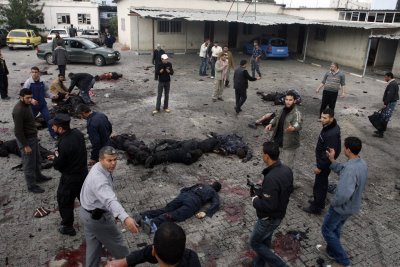
Israeli warplanes continue to bomb the Gaza Strip for the third day. Ten more Palestinians have been killed in the attacks taking the toll to 330.

Several people have been seriously injured. The air strikes flattened government buildings in Gaza City and the Islamic University has been struck once again.

According to the United Nation figures, 320 Palestinians have died so far. UN Secretary General Ban Ki-moon has called for immediate ceasefire.

Israel has launched more than 300 airstrikes, and its military has said naval vessels have also bombarded targets from the sea.

Meanwhile, several groups across the world have united to send aid and  supplies to the troubled Gaza region. On Monday, a group of international activists said they would try to defy an Israeli naval blockade and send a boat with medical supplies to Palestinians in Gaza.

The group has successfully made five deliveries of aid by boat to Gaza since August, defying the blockade Israel imposed when Hamas won control of the territory in June 2007.

Organisers acknowledged that the Israeli Navy may try to stop the boat but they said the need for aid “outweighs the risks” of entering a war zone.
Source

Israel Used Internationally Banned Weaponry in Massive Airstrikes Across Gaza Strip

Back in November

Israel blocks foreign media from Gaza

U.N.: Israel won’t allow food aid to enter Gaza

Israel has done everything humanly possible to destroy the Palestinians. This has been ongoing for a very long time.

Aid to Israel should be stopped and a boycott isn’t such a bad idea either before they murder all the Palestinians, which is their goal it seems. All weapons of mass destruction should also be stopped from entering Israel as well.  The US gives money in aid to Israel, aid which buys weapons of mass destruction.  Weapons they use to terrorize the Palestinians and their neighbors.  They are starving and murdering the Palestinians.

Much of the media and others are blaming the wrong people.

Israel is anything but the innocent victim as some have made them out to be.  They are in fact the guilty war criminals.  They have become the enemy they hated most. They are now the exterminators. They rate right up there with Bush and his cronies exterminating Iraqis. They are not so different. The Iraqis were starved and treated horrifically  just as the Palestinians have been. Now it seems  the “shock and awe” is now being implemented against the Palestinians. There is no real difference.

US tax dollars are paying for this.

Not a very proud day to be American.

Protests Sunday Jan 4

Sunday Jan 4 Reports: US protests against Attack in Gaza

Sunday Jan4 Reports: Protests around the World Against Gaza assault

Protests Sat Jan 3

Saturday Jan 3 Reports:US protests against Israels attacks on Gaza

Saturday Jan 3  Reports:Canadian Protesters march in support of Palestinians

Saturday Reports on: Demonstrations Against Israels attacks on Gaza, January 3, 2009

Friday Jan 2  Reports:Muslims around the world protest Gaza assault

Published in: on December 30, 2008 at 2:51 am  Comments Off on December 29 Reports:Global protests against Israel  
Tags: , , , , , , , , , , , , , , , , , , , , , , , ,

Israel Used Internationally Banned Weaponry in Massive Airstrikes Across Gaza Strip

Hiyam Noir reports from the war zone in Gaza. We thank her and her colleague, photographer Fady Adwan, for risking their lives to report the truth from Gaza.

photo by Fady Adwan, December 27, 2008

photo by Fady Adwan, December 27, 2008

December 27 2008

GAZA
On Saturday noon in the first wave of air strikes, the Israelis targeted Gaza City government buildings. Casualties are confirmed and include the Commander of Gaza Police Force Tawfiq Jabir, the Commander of Security and Protection Services in Gaza police, Ismail Al-Ja’bari and the Governor of the Al-Wusta (central) Districts Ahmad Abu Aashur. Islam Shahwan, a Hamas police spokesman, said that the Israeli attacks have destroyed most of the Gaza Strip police headquarters and that a police graduation ceremony was being held during the Israeli assault.

Following the first wave of Israeli air strikes, that killed at least 156 and injured over 200 Palestinians (Ed. note: updated numbers since Hiyam wrote this, reported in some western media: at least 200 dead and 300 injured – end note), Palestinian medical sources said in a press statement during Saturday afternoon that at least 80 of the wounded has arrived to hospital in “bits and parts” and the Head of the Gaza Emergency and ambulance department in the Ministry of Health, Mu’awieyah Hasaneen confirm that medical crews and rescue workers are still pulling dozens of people from underneath rubble. Hasaneen have pledged to all Arab governments, to send medications and operating supplies to Gaza, saying most of the injured were too badly injured to be moved outside the Gaza Strip. Hospital corridors are filled with bodies and gourneys, and in the local morgues there is no space to for all the bodies.

Leaders and citizens of Arab countries condemned Israeli air strike on Saturday. A few minutes after the first 30 Israeli air strikes at noon on Saturday, an Egyptian official said that the Israeli missile attacks was “an unprecedented massacre.” Hosni Mubarak, the Egyptian president condemned the attacks, demanded that the ceasefire between the Palestinian resistance in Gaza and the Israeli army to be renewed. “Egypt will forge ahead with its contacts to create a favorable atmosphere in renewing the truce and attaining inter-Palestinian reconciliation in a bid to end the suffering of the Palestinian people”, a statement from the Mubarak’s office said.

Fouad Seniora, the Lebanese prime minister called the Israeli operations “tragic and criminal”. A statement from the Seniora’s office “strongly denounces and rejects the criminal operation in the Gaza Strip.” The Lebanese prime minister called on the Arab League and other heads of state to immediately convene in an emergency session to adopt a “united Arab stand to face the Israeli aggression.” Seniora also called upon United Nations security council to adopt “deterring and necessary measures against Israel for its continuous violations of Palestinian and Arab human rights”.

The Gaza operation plan was architectured on Wednesday. Ehud Barak and Ehud Olmert ordered the air strikes on Gaza, Saturday morning, the assaults on Gaza Strip are intended to last throughout Saturday and perhaps into Sunday. The two Zionist leaders asserted that Israel has prepared for an operation that could take several weeks. Preparations have also been taken to contain any expected response in the West Bank. Ehud Barak and his chief of staff, Gabi Ashkenazi, are supervising the air strikes, which they say – will “continue until the Israel has achieved its goals”. Israeli sources asserted that the operation does not aim to topple Hamas, but “we will stop homemade projectiles,” the statement said, warning for ” tougher images” in the Gaza Strip in the coming days.

A member of the executive committee in the PLO Taysir Khaled, accused Israel of using weapons in Gaza that are banned internationally and condemned the Israeli attack. He called for immediate intervention to stop the Israelis military actions, which he said have been in performance for months. In Jenin Al-Aqsa Brigades ( Fatah) said in a statement that their fighters are in a state of high alert and “would not be handcuffed,” and would retaliate “in the right place at the right time.”

The Al-Quds Brigades ( Islamic Jihad) asserted that they are in high alert and that the Israelis will pay a severe toll for their heavy handed attacks. The Islamic Jihad leader, Khaled Al-Batsh, said that the Israeli attack is a declaration to “open war” against the Palestinian people, intended “to repress the Palestinian resistance.” Hamas spokesman Fawzi Barhoum asked the Palestinian people to “remain patient in the light of Israeli crimes ” – he called for a massive response to the Israelis air strikes that have killed at least 200 Gaza residents, and wounded over 200. Barhoum stated that there will be a renewal of Palestinian operations within Israel.

Source

Israel needs to stop these attacks. This is murder. What Israel is doing is a crime. Not everyone in the world agrees with what they are doing.  There are many who believe they are committing criminal acts of genocide. These are crimes against humanity and war crimes.  The United Nations should find a way to stop this.

All aid to Israel should be stopped. They only use it to kill.

There are a Number of Videos Here not for the faint of heart.

Iran preps humanitarian aid ship to Gaza Strip

Israeli teenagers jailed for refusing to serve in army

Published in: on December 28, 2008 at 5:15 am  Comments Off on Israel Used Internationally Banned Weaponry in Massive Airstrikes Across Gaza Strip  
Tags: , , , , , , , , , , , , , , , , ,

Iran preps humanitarian aid ship to Gaza Strip

December 27 2008

An Iranian freighter carrying tons of humanitarian equipment destined for the Gaza Strip will set sail from the Islamic Republic on Saturday, Iranian media reported on Friday.

The Iranian Red Crescent Society organized the shipment which it says will reach the Gaza shoreline in defiance of the Israeli military blockade imposed on the territory since Hamas’ ascendancy to power.

“The ship will carry medicine and foodstuffs including rice, flour, sugar as well as six tons of medicine for the impoverished population of Gaza,” said Hamed Taheri Jebelli, a spokesman for Iran’s Red Crescent Society on Thursday.

“Despite the Zionist regime’s opposition … this consignment will leave Bandar Abbas for Palestine on Saturday and will arrive in 12 days,” a provincial Red Crescent director, Ahmad Navvab, was quoted as telling the French news agency AFP.

“The cargo contains over 2,000 tons of food, medicine and appliances and it will be accompanied by 12 Iranian doctors and relief workers,” he told AFP.

Earlier this month, the Red Crescent said it aimed to send a 1,000-ton shipment of grain, sugar, oil and medicine to the aid-dependent land.

Source

Israel’s ‘Crimes Against Humanity’

Gaza Families Eat Grass as Israel Blocks Food Aid

Israeli teenagers jailed for refusing to serve in army

Published in: on December 27, 2008 at 6:05 am  Comments Off on Iran preps humanitarian aid ship to Gaza Strip  
Tags: , , , , , , , , ,

Top Ten Myths About Iraq, 2008

By Juan Cole
December 26, 2008

1. Iraqis are safer because of Bush’s War. In fact, conditions of insecurity have helped created both an internal and external refugee problem:

‘ At least 4.2 million Iraqis were displaced. These included 2.2 million who were displaced within Iraq and some 2 million refugees, mostly in Syria (around 1.4 million) and Jordan (around half a million). In the last months of the year both these neighbouring states, struggling to meet the health, education and other needs of the Iraqi refugees already present, introduced visa requirements that impeded the entry of Iraqis seeking refuge. Within Iraq, most governorates barred entry to Iraqis fleeing sectarian violence elsewhere.’

2. Large numbers of Iraqis in exile abroad have returned. In fact, no great number have returned, and more Iraqis may still be leaving to Syria than returning.

3. Iraqis are materially better off because of Bush’s war. In fact, A million Iraqis are “food insecure” and another 6 million need UN food rations to survive. Oxfam estimated in summer, 2007, that 28% of Iraqi children are malnourished.

4. The Bush administration scored a major victory with its Status of Forces Agreement. In fact, The Iraqis forced on Bush an agreement that the US would withdraw combat troops from Iraqi cities by July, 2009,and would completely withdraw from the Country by the end of 2011. The Bush administration had wanted 58 long-term bases, and the authority to arrest Iraqis at will and to launch military operations unilaterally.

5. Minorities in Iraq are safer since Bush’s invasion. In fact, there have in 2008 been significant attacks on and displacement of Iraqi Christians from Mosul. In early January of 2008, guerrillas bombed churches in Mosul, wounding a number of persons. More recently, some 13,000 Christians have had to flee Mosul because of violence.

6. The sole explanation for the fall in the monthly death rate for Iraqi civilians was the troop excalation or surge of 30,000 extra US troops in 2007. In fact, troop levels had been that high before without major effect. The US military did good counter-insurgency in 2007. The major reason for the fall in the death toll, however, was that the Shiites won the war for Baghdad, ethnically cleansing hundreds of thousands of Sunnis from the capital, and turning it into a city with a Shiite majority of 75 to 80 percent. (When Bush invaded, Baghdad was about 50/50 Sunni and Shiite). The high death tolls in 2006 and 2007 were a by-product of this massive ethnic cleansing campaign. Now, a Shiite militiaman in Baghdad would have to drive for a while to find a Sunni Arab to kill.

7. John McCain alleged that if the US left Iraq, it would be promptly taken over by al-Qaeda. In fact, there are few followers of Usamah Bin Laden in Iraq. The fundamentalist extremists, if that is what McCain meant, are not supported by most Sunni Arabs. They are supported by no Shiites (60% of Iraq) or Kurds (20% of Iraq), and are hated by Iran, Syria, Turkey, and Jordan, who would never allow such a takeover.

8. The Iraq War made the world safer from terrorism. In fact, Iraq has become a major training ground for extremists and is implicated in the major bombings in Madrid, London, and Glasgow.

9. Bush went to war in Iraq because he was given bad intelligence about Saddam Hussein’s weapons of mass destruction capabilities. In fact, the State Department’s Intelligence & Research (I & R) division cast doubt on the alarmist WMD stories that Bush/Cheney put about. The CIA refused to sign off on the inclusion of the Niger uranium lie in the State of the Union address, which made Bush source it to the British MI6 instead. The Downing Street Memo revealed that Bush fixed the intelligence around the policy. Bush sought to get up a provocation such as a false flag attack on UN planes so as to blame it on Iraq. And UN weapons inspectors in Feb.-Mar. of 2003 examined 100 of 600 suspected weapons sites and found nothing; Bush’s response was to pull them out and go to war.

10. Douglas Feith and other Neoconservatives didn’t really want a war with Iraq (!). Yeah, that was why they demanded war on Iraq with their 1996 white paper for Bibi Netanyahu and again in their 1998 Project for a New American Century letter to Clinton, where they explicitly called for military action. The Neoconservatives are notorious liars and by the time they get through with rewriting history, they will be a combination of Gandhi and Mother Teresa and the Iraq War will be Bill Clinton’s fault. The only thing is, I think people are wise to them by now. Being a liar can actually get you somewhere. Being a notorious liar is a disadvantage if what you want to is get people to listen to you and act on your advice. I say, Never Again.

See also my article in The Nation, “Iraq: The Necessary Withdrawal,” and this piece in the Toronto Star.

Juan Cole is President of the Global Americana Institute – Visit his website http://www.juancole.com/

Source

Published in: on December 27, 2008 at 5:37 am  Comments Off on Top Ten Myths About Iraq, 2008  
Tags: , , , , , , , , , , , , , , , , , , ,

IMF confirmed international loan to Latvia

By Nina Kolyako, BC, Riga,
December 24 2008

Yesterday evening, the International Monetary Fund’s (IMF) board confirmed an international loan to Latvia.

Latvia will receive EUR 7.5 billion (LVL 5.27 billion) worth of financial support, writes LETA.

The European Union plans to allocate a medium-term loan to Latvia worth up to EUR 3.1 billion (LVL 2.18 billion).

Also participating in issuing Latvia the loan is the International Monetary Fund (IMF) – EUR 1.7 billion (LVL 1.19 billion), Sweden, Denmark, Finland and Norway – EUR 1.8 billion (LVL 1.27 billion), and the World Bank – EUR 0.4 billion (LVL 0.28 billion).

The European Reconstruction and Development Bank, the Czech Republic, Poland and Estonia will allocate Latvia another EUR 0.5 billion (LVL 0.35 billion), which is a total of EUR 7.5 billion (LVL 5.27 billion).

The loan will be issued to Latvia gradually over the next three years.

Source

Published in: on December 27, 2008 at 4:38 am  Comments Off on IMF confirmed international loan to Latvia  
Tags: , , , , , , , , , , , , ,

Shoe Bush? JANUARY 19th

Why Shoe Bush?

By David Swanson,

Our president stood in a nation he had illegally invaded and occupied, where his actions had caused over 1.2 million deaths, 5 million people forced out of their homes, millions more deprived of electricity or clean water and afraid to walk the streets. He stood smiling in a nation he had transformed into a living hell, a place where everyone had seen loved ones and neighbors killed. And when Muntadar Al-Zeidi threw two shoes at him, our president remarked “I don’t know what his beef is.”

But billions of people around the world believed that the pretended obliviousness of George W. Bush to the pain and suffering he was inflicting had gone on as long as they could stand if not much longer, and Al-Zeidi became a hero overnight. His two shoes punctured the Bush veil of separation, the distance Bush pretends to imagine exists between his decisions and the human limbs scattered in the sand of his colony. And while the U.S. media pretended to wonder whether the water torture was “really” torture, the United States and its puppet government in Iraq inflicted on Al-Zeidi one of the more commonly employed torture techniques of the Bush regime: they beat him and broke his bones.

In an ideal world, it would be enough to present the evidence of crimes for Bush, Cheney, and their criminal subordinates to be prosecuted and convicted. In this world, we’ve presented that evidence for years, and we are still in a climate in which Bush and Cheney blissfully admit their crimes, apparently believing that they render prosecution less likely by declaring their own crimes acceptable. While lies may take hold more easily the bigger they are, big lies also collapse quickly, as when a child points to a naked emperor, or a journalist throws his shoes.

We have a president-elect who can save himself from engaging in criminal wars and occupations, in torture and other war crimes, in warrantless spying and other violations of our Constitution, only by prosecuting the actions of his predecessor. Not to prosecute is itself a crime. If we are going to persuade the president elect, we must first persuade the U.S. media, and the U.S. media is not attracted by facts and information. The U.S. media is attracted by throwing shoes.

Bush’s last act is expected to be the unprecedented pardoning of crimes he authorized. This has never before been done, and to do so is to drop all claim to being a nation of laws. Thanks to the example set by Al-Zeidi, since emulated by people all over the world, we will know exactly how to make our response visible when those pardons come.

Join us at the White House at 11 a.m. on January 19th

Full calendar of events in DC in January

ABOUT THE SHOES FOR BUSH ACTION

On Monday, January 19th on President Bush’s last day in office, people will gather at 11:00am at a site near the White House (TBA) for what will be a cathartic action of hurling shoes at the White House. We will be acting in the spirit of Mutadhar Al-Zaidi, the journalist who threw his shoes at Bush during a press conference on behalf of the widows, orphans and all those killed in Iraq, and in solidarity with the Iraqi people as well as all of those who have suffered under the Bush regime.

To watch Bush leave office and not be held accountable for war crimes and impeachable offenses is like rubbing salt into the wound.

This action may not take away all of the pain suffered during the Bush regime but we will get satisfaction from the statement the act makes. The shoe hurling will be a historic marker. The visual of thousands of people hurling shoes at the White House as Bush leaves office will go around the globe and the people all over the world will let out a collective cheer. Please join us in being part of history!

If you will be in DC for the Inaugural, please bring an extra pair of shoes with you and join us! If possible collect shoes from your friends and meet us at 11:00 at a location to be announced. Please check back on this site.

Organizers are setting up SHOE COLLECTION HUBS and we need your assistance. Please volunteer to have your residence be a place for people to bring their shoes. Then people who are driving to DC can bring the shoes with them.
Please visit our SHOE COLLECTION HUB page on this web site.

OR you may mail your shoes to SHOES FOR BUSH
PO BOX (forthcoming) Kennebunk, ME  04043
There are no bomb sniffing dogs at our post office! Only a very annoyed post master.

We will be transporting your shoes in a U-Haul to DC.

Please consider writing a note to put in your shoes as we will be reading them at the assembly site. Artists—be creative make art with your shoes.

After the action all shoes will be donated to the needy in the Washington DC area.

SHOES FOR BUSH ACTION


Join the Calls to release Iraqi Journalist Muntadhar Al-Zaydi

Senate Report Links Bush to Detainee Homicides; Media Yawns

Cheney admits authorizing detainee’s torture

Why We Must Prosecute Bush And His Administration For War Crimes

Published in: on December 24, 2008 at 7:25 am  Comments Off on Shoe Bush? JANUARY 19th  
Tags: , , , , , , , , , , , , , ,

Family says journalist who threw shoes at Bush beaten into apologizing

QASSIM ABDUL-ZAHRA

December 22, 2008

BAGHDAD – Prime Minister Nouri al-Maliki moved Monday to undermine the popularity of the Iraqi journalist who threw his shoes at President George W. Bush.

In a posting on his website, Al-Maliki claimed journalist Muntadhar al-Zeidi has apologized for the attack and confessed to carrying it out at the behest of a known militant.

However, the journalist’s family says al-Zeidi was tortured into apologizing for throwing his shoes at Bush – a gesture considered a major insult in Iraqi culture – and has told a brother that he would do it again if he had the chance.

Meanwhile, tensions over the case also spilled into parliament, as a move to oust the chamber’s abrasive Sunni speaker delayed a key decision on whether non-U.S. foreign troops will be allowed to stay in Iraq beyond New Year’s Eve.

Al-Maliki said that in a letter of apology to him, Muntadhar al-Zeidi wrote that a known militant had induced him to throw the shoes.

“He revealed … that a person provoked him to commit this act, and that person is known to us for slitting throats,” al-Maliki said on the prime minister’s website. The alleged instigator was not named and neither al-Maliki nor any of his officials would elaborate.

The journalist’s family denied the claim and alleged that al-Zeidi was coerced into writing the letter, in which he was said to have requested a pardon for “the big and ugly act that I perpetrated.”

Al-Zeidi’s brother Dhargham said that it was “unfair” of al-Maliki to make the allegation about the throat-slitter and described the prime minister as “a sectarian man who is destroying the Iraqi people.”

Earlier, another brother said he met the journalist in prison. “He told me that he has no regret for what he did and that he would do it again,” Uday al-Zeidi told The Associated Press.

He said he visited his brother Sunday and found him missing a tooth and with cigarette burns on his ears. He also said his brother told him that jailers also doused him with cold water while he was naked.

“When I saw him yesterday, there were bruises on his face and body,” Uday al-Zeidi told AP Television News.

“He told me that they used an iron bar to hit him when they took him out of the press conference room. He told me that he began screaming and thought all those at the press conference would have heard his voice.”

The investigating judge, Dhia al-Kinani, has said that the journalist was beaten around the face and eyes when he was wrestled to the ground after throwing the shoes at Bush during a Dec. 14 news conference in Baghdad’s fortified Green Zone. The judge said al-Zeidi’s face was bruised but he did not provide a further description.

There has been no independent corroboration that al-Zeidi was abused in jail.

Al-Zeidi’s trial on charges of assaulting a foreign leader is scheduled to begin Dec. 31. A conviction would carry a sentence of up to two years in prison. Al-Kinani said last week that he does not have the legal option to drop the case and that al-Zeidi can receive a pardon only if he is convicted.

The hurling of the shoes turned the little-known Iraqi journalist into an international celebrity and led to huge street demonstrations in support of him both at home and abroad, including Canada.

It also brought to a head a simmering dispute between the Iraqi parliament’s abrasive, erratic Sunni speaker and Kurdish and Shiite lawmakers seeking to oust him.

The speaker, Mahmoud al-Mashhadani, had irked legislators during a boisterous debate over the case last week by insulting some of them and saying, “There is no honour in leading this parliament” and threatening to resign.

On Monday, legislators unsuccessfully tried to vote al-Mashhadani out of office. Instead they gave him until Tuesday to resign or face an ouster vote later that day.

After the heated closed-door session, al-Mashhadani attempted to force the body to withdraw its opposition to him by threatening to call a recess until Jan. 7 – a week after the UN mandate expires on Dec. 31 for non-U.S. foreign troops to remain in Iraq. He backed down after opposition legislators gathered enough signatures to force a vote against him.

Britain plans to withdraw its 4,000 troops from southern Iraq by the end of May. Australia, El Salvador, Estonia and Romania also have far smaller contingents. U.S. troops can remain in Iraq until the end of 2011 under a separate agreement reached this year.

Shiite and Kurdish legislators believe they have the required 139 votes in the 275-member parliament to remove al-Mashhadani. If he is ousted, he will be replaced by one of his two deputies, and parliament can then approve the resolution.

Two years ago, the Shiite bloc ousted al-Mashhadani after a string of outbursts, but his fellow Sunnis forced them to reinstate him.

Al-Mashhadani clashed with Kurdish legislators this year over whether the oil-rich city of Kirkuk should be incorporated into the semi-autonomous Kurdish territory. Kurds wanted the city included, but al-Mashhadani supported Arabs and Turkomen who opposed the idea.

Source

Join the Calls to release Iraqi Journalist Muntadhar Al-Zaydi

Shoe-tossing journalist was abused, Iraqi judge says

Protesters shake shoes at US Embassy in London

White House Protesters Throw Shoes at Bush Effigy

Dec 17: Peace Activists Take Shoes to White House in Solidarity with Shoe-Throwing Iraqi Journalist

Iraqi MPs reject UK exit deal

Published in: on December 24, 2008 at 12:35 am  Comments Off on Family says journalist who threw shoes at Bush beaten into apologizing  
Tags: , , , , , , , , , , ,

Madoff investor found dead of possible suicide, authorities say

December 23 2008

By ADAM GOLDMAN

NEW YORK

The founder of an investment fund that lost millions with Bernard Madoff was found dead Tuesday at his Madison Avenue office of a possible suicide, authorities said.

Authorities found the body of Rene-Thierry Magon de la Villehuchet just before 8 a.m. ET at his office of Access International Advisors, located on Madison Avenue a couple of blocks from Rockefeller Center.

A French newspaper is reporting that the 65-year-old de la Villehuchet committed suicide. The New York medical examiner spokeswoman says it has not determined the cause of death yet.

Madoff is accused of running a US$50-billion Ponzi scheme that wiped out investors around the world, with big funds like de la Villehuchet’s $1.4-billion Access International Advisers being especially hard hit.

A former business partner said that de la Villehuchet came from a long line of aristocratic Frenchmen, with the Magon part of his name referring to one of France’s most powerful families.

His fund enlisted intermediaries with links to the cream of Europe’s high society and jet set to garner clients. Among them was Philippe Junot, a French businessman and friend who is the former husband of Princess Caroline of Monaco.

De la Villehuchet, the former chairman and CEO of Credit Lyonnais Securities USA, was also known as a keen sailor who regularly participated in regattas and was a member of the New York Yacht Club.

He lived in an affluent suburb in Westchester County with his wife. There was no answer Tuesday at the family’s two-story house, which has a majestic view of a pond.

“He’s irreproachable,” said Bill Rapavy, who was Access International’s chief operating officer before founding his own firm in 2007.

De la Villehuchet’s death came as swindled investors began looking for ways to possibly recoup their losses. Hedge funds, which lost big to Madoff, are also coming up against investor lawsuits, since they had a fiduciary responsibility to protect their clients.

A handful of lawsuits have already been filed, all claiming that the hedge funds failed to properly vet Madoff and overlooked some red flags that could have steered them away.

Associated Press Writers Rachel Beck and Joe Bel Bruno in New York and Jim Fitzgerald in New Rochelle, N.Y., contributed to this report.

Source

FBI diverts anti-terror agents to Bernard Madoff $50 billion swindle

Madoff house arrest ordered as European banks reel

Madoff victims threaten legal action

UK: Council’s pension fund ‘caught up in Bernard Madoff’s Wall Street fraud’

Bank billions at risk from Wall Street Fraud

Published in: on December 23, 2008 at 11:59 pm  Comments Off on Madoff investor found dead of possible suicide, authorities say  
Tags: , , , , , , ,

Did Contractor Expose Troops To Toxin?

American Soldiers Are Dying Of Lung Cancer – And May Have Been Knowingly Exposed

December 22, 2008

By Armen Keteyian

WASHINGTON

The military contractor Kellogg Brown and Root, known as KBR, has won more than $28 billion in U.S. military contracts since the beginning of the Iraq war. KBR may be facing a new scandal. First, accusations its then-parent company Halliburton was given the lucrative contract. And later, allegations of shoddy construction oversight that resulted in Americans getting electrocuted. Now, some other American soldiers say the company knowingly put their lives at risk, CBS News chief investigative correspondent Armen Keteyian exclusively reports.


In April of 2003, James Gentry of the Indiana National Guard arrived in Southern Iraq to take command of more than 600 other guardsmen. Their job: protect KBR contractors working at a local water plant.

“We didn’t question what we were doing, we just knew we had to provide a security service for the KBR,” said Battalion Cmdr. Gentry.

Today James Gentry is dying from rare form of lung cancer. The result, he believes, of months of inhaling hexavalent chromium – an orange dust that’s part of a toxic chemical found all over the plant.

At least one other Indiana guardsman has already died from lung cancer, and others are said to be suffering from tumors and rashes consistent with exposure to the deadly toxin.

“I’m a nonsmoker. I believe that I received this cancer from the southern oil fields in Iraq,” he said.

Now CBS News has obtained information that indicates KBR knew about the danger months before the soldiers were ever informed.

Depositions from KBR employees detailed concerns about the toxin in one part of the plant as early as May of 2003. And KBR minutes, from a later meeting state “that 60 percent of the people … exhibit symptoms of exposure,” including bloody noses and rashes.


Read an Indiana court complaint against KBR, including evidence and images.


Gentry says it wasn’t until the last day of August in 2003 – after four long months at the facility – that he was told the plant was contaminated.

“We would never have been there if we would have known,” Gentry said.

A new internal Army investigation obtained exclusively by CBS News says the Army’s medical response was “prompt and effective.” But even after a briefing Monday, Indiana Sen. Evan Bayh says that KBR has a lot to answer for.

“Look, I think the burden of proof at this point is on the company,” Bayh said. “To come forward and very forthrightly explain what happened, why we should trust them, and why the health and well-being of our soldiers should continue to be in their hands.”

In a statement, the company told CBS News: “We deny the assertion that KBR harmed troops and was responsible for an unsafe condition.”

The company says it notified the Army as soon as it identified the toxin.

Still, some Indiana guardsmen say they only just learned of the risk.

“I didn’t know I was exposed to a deadly carcinogen until five years later when I received a letter,” said Indiana National Guardsman Jody Aistrop.

This is far from the first time the multi-billion dollar contractor has been accused of questionable conduct at Iraq. In addition to convictions for bribery, it’s alleged KBR provided contaminated water to troops. The company denies all charges.

“It’s going to cost American lives, I’m afraid,” Gentry said. “I love them. I love my men so much.”

So much so Gentry says he will urge each and every one of them get tested for the cancer that he fears is taking his life.


If any Indiana National Guardsmen want more information on whether or not they were exposed in Southern Iraq to sodium dichromate, they should call this Indiana National Guard hotline: 1-800-237-2850, ext. 3128.

Source

Homeless Nepalese in Baghdad are victims of Human trafficking

Published in: on December 23, 2008 at 1:45 pm  Comments Off on Did Contractor Expose Troops To Toxin?  
Tags: , , , , , , , , , , , , , , ,

Israeli teenagers jailed for refusing to serve in army

Israeli teenagers jailed for refusing to serve in army
December 18 2008

Peace activists in Israel and around the world are participating on Wednesday in a day of action to call on Israeli authorities to release teenagers imprisoned for refusing to serve in the army for reasons of conscience.

Tamar Katz, Raz Bar-David Varon and Yuval Oron-Ofir are three conscientious objectors who are all serving their third prison sentences. At least six other teenagers – male and female – have been jailed in recent months for refusing to enlist and at least two more, both young women, are at risk of imminent imprisonment.

Their refusal stems from their opposition to the Israeli military occupation of the Occupied Palestinian Territories (OPT) and to the practices of the Israeli army there. They believe that by enlisting they would participate in committing human rights abuses in which they want no part.

Amnesty International has added its voice to the campaign. The organization considers these teenagers to be prisoners of conscience and calls for their immediate and unconditional release.

Tamar Katz, aged 19, has already spent 50 days in jail and is serving her third prison sentence. In her declaration of refusal she stated:

“I am not willing to become part of an occupying army… I am not willing to become one of those holding the gun pointed indiscriminately at Palestinian civilians, and I do not believe that such actions could bring any change except ever more antagonism and violence in our region.”

She has been held in isolation and deprived of family visits as punishment for refusing to wear a military uniform in prison.

Eighteen-year-old Raz Bar-David Varon, also serving her third prison term, said on the day of her arrest:

“I have witnessed this army demolishing, shooting and humiliating people whom I did not know… It hurts me when people, Palestinians, are being so brutally assaulted, and it hurts me when they later turn their hatred towards me because of it. I wasn’t born to serve as a soldier who occupies another… My responsibility is to refuse.”

Yuval Oron-Ofir was jailed for the third time on 14 December. The 19-year-old explained his reasons for refusing to enlist:

“There is another way, which is not the way of war. This is the path of dialogue, of understanding… of peace. This is why I shall not join an army behind whose actions I cannot stand and whose behavior I cannot justify.”

Teenagers who refuse to enlist because they do not want to find themselves in a situation where they may contribute to or participate in committing human rights abuses are generally sent to jail for months.

There is no civilian service alternative to military draft in Israel and, although a “conscience committee” exists within the Israeli army, exemption is only usually granted to those who refuse to serve on religious grounds. Those who make it known that they are unwilling to enlist on grounds of conscience – because they are pacifist or oppose the army’s practices in the OPT – are routinely imprisoned.

At the same time, Israeli soldiers who commit grave human rights violations, including war crimes, such as unlawful killings of unarmed civilians, reckless shelling of densely populated residential areas or wanton destruction of homes, are routinely granted impunity.

“Such a policy sends the wrong message to Israeli society and to young people in particular,” said Donatella Rovera, Amnesty International’s researcher on Israel and the Occupied Palestinian Territories. “All conscientious objectors should be given the opportunity to present the grounds of their objection to a decision-making body which is impartial and independent.

“Amnesty International calls on the Israeli authorities to ensure that such a body is established, and in the meantime to immediately and unconditionally release the conscientious objectors currently detained and not to imprison others.”

Source

Americans support conscientious objectors to IDF military service by sending 20,000 letters to Barak

By Natasha Mozgovaya
December 21 2008

WASHINGTON
Conscientious objectors who refused to serve in the Israel Defense Forces received an unprecedented shot in the arm from North American Jewry yesterday, when demonstrators protested against their detention by presenting 20,000 letters from Diaspora Jews demanding their release.

Dozens of activists tried to deliver the letters to Defense Minister Ehud Barak at a demonstration outside his office in Tel Aviv.
Many letters came from a Web site called Jewish Voice for Peace, which features a video in which the objectors explain in English why they refused to enlist.

Although most American Jews are politically aligned with the liberal left, IDF service is generally viewed as an unassailable duty. Thus, there has never been a concentrated effort to lobby Israelis to evade conscription.

The Jewish Voice for Peace has recruited actor Ed Asner, historian and author Howard Zinn, and folk singer Ronnie Gilbert to the cause.

“The recent election of anti-war candidate Barack Obama, who by the way received some 80% of the Jewish vote, was evidence of the American people’s disenchantment with war and occupation,” said Cecilie Surasky, the communications director for Jewish Voice for Peace. “Seven years and untold lives and dollars later, there is almost total agreement in the U.S. that our venture in Iraq has been an unqualified disaster.”

Gilbert called on Israel to change its policies.

“I am an old-time peace activist,” he said. “I have marched and pleaded against the cruel occupation for years. The presence of the Shministim [the Hebrew term for Israeli youths who refuse enlistment] makes me ashamed of sometimes feeling that Israel will never change. You are the change.”

Zinn, a scholar who is no stranger to controversy, called the objectors courageous for their actions.

“I’ve been thinking a lot about courage,” Zinn wrote in his letter. “Right now, while I’m snug and fed this Thanksgiving holiday in the comfort of my home, halfway around the world a group of teenagers is sitting in a jail cell today, demonstrating the very definition of courage and sacrifice. It’s frustrating. Humbling. And I’m damn glad to have the chance to do something big about it.”

Surasky said she was not concerned that the campaign would be viewed as interference in internal Israeli affairs.

“For years, money from Jewish American organizations supported the settlements in Israel. It’s logical for dovish organizations like Jewish Voice for Peace to support the Shministim, who represent the values that we wish Jews and Israel would represent everywhere – authentic commitment to the value of human lives. Especially in the days of Hanukkah. They are a small light which shines bright in days of great darkness.”

The Jewish Voice for Peace internet site offers a ready-made text which users can send to Barak after filling out their email addresses, their names and other details.

“I support the Shministim and their right to peacefully object to military service,” the standard letter reads. “I call for the release of those teenagers who have been jailed for their principled refusal to serve in an army which occupies the Palestinian Territories. The imprisonment of these conscientious objectors is a violation of their human rights and contrary to International Law.”

The letter continues: “I am inspired by these caring students and their counterparts in Palestine, whose nonviolent resistance to the Occupation points the way to a just peace and security for all people in the region. They are our best hope for the future. I urge you to heed them, and not punish them.”

The IDF objectors also received a show of support from 25 American objectors who refused to fight in the Middle East.

“We, soldiers in the U.S. Army who refused to fight in Afghanistan and Iraq, demonstrate our solidarity with the Israeli Shministim,” they wrote. “The War on Terror, like the Israeli occupation, is fueled by racism and dehumanization.”

Source

The teenagers are right, Israel is committing crimes against humanity. Starvation is a crime.

Israel starving Palestinians: UN

‘POLITICAL CRISIS’:

The UN Relief and Works Agency fears that irreversible damage is being done as the latest statistics reveal the level of deprivation in the Gaza Strip

December 22, 2008

Impoverished Palestinians on the Gaza Strip are being forced to scavenge for food on rubbish dumps to survive as Israel’s economic blockade risks causing irreversible damage, international observers said.

Figures released last week by the UN Relief and Works Agency reveal that the economic blockade imposed by Israel on Gaza in July last year has had a devastating impact on the local population. Large numbers of Palestinians are unable to afford the high prices of food being smuggled through the Hamas-controlled tunnels to the Strip from Egypt and last week were confronted with the suspension of UN food and cash distribution as a result of the siege.

The figures collected by the UN agency show that 51.8 percent — an “unprecedentedly high” number of Gaza’s 1.5 million population — are now living below the poverty line. The agency has announced that it had been forced to stop distributing food rations to the 750,000 people in need and had also suspended cash distributions to 94,000 of the most disadvantaged who were unable to afford the high prices being asked for smuggled food.

“Things have been getting worse and worse,” the agency’s Chris Gunness said yesterday. “It is the first time we have been seeing people picking through the rubbish like this looking for things to eat. Things are particularly bad in Gaza City where the population is most dense.”

“Because Gaza is now operating as a ‘tunnel economy’ and there is so little coming through via Israeli crossings, it is hitting the most disadvantaged worst,” he said.

Gunness also expressed concern about the state of Gaza’s infrastructure, including its water and sewerage systems, which have not been maintained properly since Israel began blocking shipments of concrete into Gaza, warning of the risk of the spread of communicable diseases both inside and outside of Gaza.

“This is not a humanitarian crisis,” he said. “This is a political crisis of choice with dire humanitarian consequences.”

The revelations over the escalating difficulties inside Gaza were delivered a day after the end of the six-month ceasefire between Israel and Gaza’s Hamas rulers, which had been brokered by Egypt in June, and follow warnings from the World Bank at the beginning of December that Gaza faced “irreversible” economic collapse.

The deteriorating conditions in Gaza emerged as former British prime minister Tony Blair, Middle East envoy for the Quartet — US, Russia, the UN and the EU — warned yesterday that Israel’s economic blockade, which had been imposed a year and a half ago when Hamas took power on the Gaza Strip, was reinforcing rather than undermining the party’s hold on power. Blair said the collapse of Gaza’s legitimate economy under the impact of the blockade had allowed the emergence of an alternative system based on smuggling through the Hamas-controlled tunnels. Hamas “taxed” the goods smuggled through the tunnels.

It was because of this that Blair wrote to Israeli Prime Minister Ehud Olmert earlier this month demanding that Israel permit the transfer of cash into Gaza from the West Bank.

Calling for a change in policy over Gaza, Blair said: “I don’t think that the current situation is sustainable; I think most people who would analyze it think the same.”

Blair’s comments came as an Israeli air strike against a rocket squad killed a Palestinian militant yesterday, the first Gaza death since Hamas formally declared an end to a six-month truce with Israel.

Also on Saturday, a boat carrying a Qatari delegation, Lebanese activists and journalists from Israel and Lebanon sailed into Gaza City’s small port in defiance of a border blockade. It was the fifth such boat trip since the summer. The two Qatari citizens aboard the Dignity are from the government-funded Qatar Authority for Charitable Activities.

“We are here to represent the Qatar government and people,” delegation member Aed al-Kahtani said. “We will look into the needs of our brothers in Gaza, and find out what is the most appropriate way to bring in aid.”

The arrival of the delegation reflects the growing anger in the Arab world over the Gaza siege.

On Friday, thousands of people joined a rally in Beirut organized by Lebanon’s Hezbollah movement against Israel’s blockade of the Gaza Strip.

Addressing the Beirut crowd, Hezbollah deputy leader Sheikh Naim Kassem called on Arab and Islamic governments to act to help lift the Gaza blockade, and urged Egypt to take an “historic stance” by opening its border crossing with Gaza.

“Silence on the [Gaza] blockade is disgraceful. Silence on the blockade amounts to participation in the [Israeli] occupation,” Kassem said.

Source

Israel’s ‘Crimes Against Humanity’

FBI diverts anti-terror agents to Bernard Madoff $50 billion swindle

December 22 2008

Brian A Pounds/Connecticut Post

From left; Doug Chavenello, president of Firefighters Union Local 1426, and Bob Smith, secretary, listen to the meeting of the Joint Retirement Board at Independence Hall in Fairfield. The town’s pension fund may have lost over $40 million in a scheme by Wall Street hedge fund manager Bernard Madoff

The FBI has been forced to transfer agents from its counter-terrorism divisions to work on Bernard Madoff’s alleged $50 billion fraud scheme as victims of the biggest scam in the world continue to emerge.

Only ten days after Mr Madoff confessed to his two sons that he had created a giant fraud, the FBI and the Securities and Exchange Commission (SEC), the Wall Street regulator, have narrowed the focus of their inquiries to ascertain which individuals and funds helped him. They are questioning other employees of Madoff Securities and are also examining the role of feeder funds that provided Mr Madoff with clients and capital.

It is understood that the US authorities believe it would have been impossible for the financier to have sustained a fraud of such magnitude over a number of years without significant assistance.

While the FBI and SEC trawled through documentation seized from three floors of the Manhattan headquarters of Mr Madoff, 70, more individuals and organisations who had fallen prey to the scheme were discovered. Members of the Fifth Avenue Synagogue, on the wealthy Upper East Side of Manhattan, are estimated to have lost about $2 billion (£1.4 billion) between them. Of these Ira Rennert, the chairman of the synagogue board, had about $200 million invested in the fund.

It is believed that J. Ezra Merkin, the president of the synagogue, introduced clients to Mr Madoff and gave him access to prominent Jewish charities and universities. The fund of Mr Merkin, Ascot Partners, had about $1.8 billion invested in the schemes.

At the weekend it emerged that Burt Ross, a former banker at LF Rothschild, and once the mayor of Fort Lee, New Jersey, was another victim. Mr Ross estimated that he had lost about $5 million, the bulk of his personal wealth.

Two classes of victim are emerging in the Madoff scandal: those who had a direct relationship with him and fund of funds investors, where one hedge fund invests in another. The biggest of the latter – so far – appears to be Walter M. Noel, who founded Fairfield Greenwich Group in 1983. Mr Noel marketed his investment services to the upper crust of the financial elite, introducing his international clients to Madoff funds.

Mr Noel ran his business from Connecticut, but about 95 per cent of his business was derived from overseas money. It is estimated that Fairfield Greenwich stands to lose $7.5 billion from the collapse of the Madoff scheme.

At the other end of the spectrum the town pension scheme in Fairfield, Connecticut — apparently unconnected to the fund belonging to Mr Noel – suffered a $45 million loss for its firefighters, police officers and teachers.

American regulators have sought to compile evidence against Mr Madoff, who is now electronically tagged and this weekend was placed on 24-hour curfew in his East 64th Street New York apartment.

The FBI and SEC are under increasing pressure from Washington to explain how they could have allowed a scam of such magnitude to operate and flourish – especially after a preliminary inquiry within the SEC found that it had been tipped off several times in the past decade about Mr Madoff’s schemes.

Harry Markopolos, a derivatives expert who once worked for a rival fund, spent ten years urging the SEC to investigate Mr Madoff. In numerous reports, including a 19-page document written in November 2005 entitled The World’s Largest Hedge Fund is a Fraud, Mr Markopolos picked apart the investment strategy of Mr Madoff.

Some claims by Mr Markopolos were anecdotal – “I have spoken to the heads of various Wall Street equity derivative trading desks and every single one of the senior managers I spoke with told me that Bernie Madoff was a fraud” – but vast chunks of his accusations involve detailed analysis of Mr Madoff’s investment strategy. He questions the way that Mr Madoff charged for commissions and alleges that Mr Madoff used the names of leading investment banks such as UBS and Merrill Lynch to lend credibility to his schemes.

He also claims that the overall investment strategy of Mr Madoff would have been impossible to carry out. Mr Madoff sought to lure investors with the promise of 12 per cent returns by buying blue-chip stocks and insuring against the possibility that their value would fall by selling derivatives – a process known as hedging. Mr Markopolos argues, however, that for Mr Madoff to have fulfilled such a strategy he would have regularly done more business than the entire New York market in those securities.

Barack Obama, the President-elect, has accused US regulators of being “asleep at the switch” after it emerged that Mr Madoff had been questioned by the SEC in 2006 but no fraud had been discovered.

Mr Madoff’s business has now been liquidated. He has been charged on one count of fraud and awaits trial.

THE BIGGEST LOSERS

Fairfield Greenwich Group (investment management firm) $7.5 billion

Tremont Group (hedge fund) $3.3 billion

Banco Santander (Spanish bank) $2.87 billion

Bank Medici (Austrian bank) $2.1 billion

Ascot Partners (hedge fund founded by J. Ezra Merkin) $1.8 billion

Access International Advisors (New York investment advisers) $1.4 billion

Fortis Bank Nederland (Dutch bank) $1.35 billion

Union Bancaire Privée (Swiss bank) $1 billion

HSBC (British bank) $1 billion

RBS (British bank) $599 million

Natixis (French investment bank) $554 million

Carl Shapiro (founder of Kay Windsor) $545 million

BNP Paribas (French bank) $431 million

BBVA (Spanish bank) $369 million

Man Group (British hedge fund) $360 million

Reichmuth & Co (Swiss private bank) $327 million

Nomura (Japanese broker) $304 million

Maxam Capital Management (fund of funds based in Connecticut) $280 million

EIM (European investment firm) $230 million

Aozora Bank (Japanese bank) $137 million

AXA (French insurer) $123 million

Yeshiva University (private, New York) $110 million

UniCredit (Italian bank) $92 million

UBI Banca (Italian bank) $86 million

Swiss Life Holding (Swiss insurer) $78.9 million

Great Eastern Holdings (Singapore insurer) $64 million

Nordea Bank (Swedish bank) $59 million

M&B Capital Advisers (Spanish broker) $52.8 million

Hyposwiss (Swiss private bank) $50 million

Banque Bénédict Hentsch & Cie (Swiss private bank) $48.8 million

Fairfield, Connecticut (town pension fund for firefighters, policemen and teachers) $42 million

Source

Bad for investors, good for lawyers

City regulators probe Madoff’s London firm

Madoff’s UK arm holding £100m assets

Madoff house arrest ordered as European banks reel

IoS Christmas Appeal: In Zimbabwe, porridge once a day makes you a lucky girl

At an early childhood centre children play, learn and, most importantly, eat. But for many, this will be their only meal

Children eat at the centre supported by Save the Children in north-western Zimbabwe

Children eat at the centre supported by Save the Children in
north-western Zimbabwe

December 21 2008

The 36 children attending an early childhood centre in north-west Zimbabwe were lucky, and they knew it. They were wearing their best clothes – even if, as in the case of three-year-old Milesh, this meant a shirt that, while clean, was shredded at the back.

Hundreds of thousands of Zimbabwean children the same age are on the brink of starvation, and millions are losing their education as the collapse in government services closes school after school. All are at risk from the cholera epidemic. But Milesh and friends were looking forward not only to playing and learning together, but to getting what for many of them would be their only meal of the day – a plate of porridge.

The children waited patiently under a tree, clapping and singing while the food was prepared. They could not have been more orderly as they came forward, were given a plate and carried it carefully back into the shade. As soon as they were sitting down, the porridge – a special formula called corn-soya blend, or CSB, fortified with minerals and sweetened with sugar – disappeared in seconds.

Save the Children is helping more than 1,000 pre-school children in Zimbabwe in this way, but such is the chaos in the country that it is having to feed the centre’s helpers, too. “It would be very difficult for me to travel here on an empty stomach,” said one. She was scanning the pupils to see who was missing, and was not surprised that Godgave, four, was absent.

“Godgave is an orphan, and lives with his widowed grandmother,” said the helper. “They are very poor. He is often too weak from hunger – he comes for one or two days, then he is away sick. We go and check on him, but we have no food to carry to him.” In such a state any childhood disease, let alone cholera, could take his life.

Some of the children at the centre showed signs of malnutrition. While most rushed around once they had eaten, playing on the slide and the climbing frame, Milesh’s six-year-old sister Zineth hovered near those with food, until an adult gave her a half-eaten portion of CSB. She made instant work of it. When workers later checked the children’s weight-to-height ratio, Zineth was one of seven who fell into the red zone on the chart, showing she was malnourished. Milesh and 12 others were in the green zone, indicating normal development. Another 16 came up yellow, which meant that of the 36 children at the centre that day, 23 were either suffering from malnutrition or were close to it.

It is not uncommon in Africa for boys in a family to be favoured over girls at times of hardship, but when we accompanied Zineth and Milesh home, their grandfather Mathias denied it was intentional. “We want to treat the children the same,” he said. “But when we have very little food, we give it to the youngest. It’s not because he is a boy.”

Mathias and his wife Mary have brought up their daughter’s three children since she died five years ago and her husband deserted them soon afterwards. “We haven’t had sadza [a mash, made from maize meal, that is Zimbabwe’s staple food] for three days,” he said. “We’ve been eating wild fruits and begging a little maize meal from our neighbours. We got a few cupfuls, which we gave to the children to eat. We had nothing for ourselves.”

The United Nations estimates that more than five million Zimbabweans, roughly half of them children, urgently need food aid. Save the Children is preparing to set up emergency feeding centres for children under five, where even the severely malnourished can be rescued with a special food called Plumpynut. Neither of these programmes will benefit Mathias and his family, however, because they have livestock, and others are worse off.

“We have three donkeys, which we use to plough our field,” he said. “We didn’t get any seeds when they were given out, but we managed to barter some with a neighbour, in exchange for ploughing his field. We’re living each day as it comes. It’s hard for the children – they see others getting food and toys at Christmas, but we have nothing.” His wife added: “When they ask us about the situation, we have no answers. We feel very helpless.”

This story is being repeated across Zimbabwe. Millions are suffering, through no fault of their own, as the nation falls into chaos. Unless we help them, they have no cause for hope.

Source

CLICK HERE TO DONATE TO THE IoS APPEAL

Death toll tops 1,100 from Zimbabwe cholera

Zimbabwe Appeal: First cholera. Now it’s malaria and anthrax

Zimbabwe declares national health emergency

Zimbabwe: Doctors Without Borders/Médecins Sans Frontières

Save the Children Donates To Zimbabwe Crisis

Zimbabwe runs out of water-Public desperation is increasing

Now anthrax takes toll on the starving in Zimbabwe

Zimbabwe’s cholera epidemic hits 10,000 to 11,000 and rising

Published in: on December 21, 2008 at 7:38 pm  Comments Off on IoS Christmas Appeal: In Zimbabwe, porridge once a day makes you a lucky girl  
Tags: , , , , , , , , , , ,

Luxury for generals but hovels for the soldiers

Millions spent on top officers’ homes while lower ranks miss out

By Jonathan Owen and Brian Brady
December 21 2008

Millions of pounds are being spent annually on dozens of luxurious homes complete with domestic staff, including cooks, cleaners and gardeners, for Army top brass. More than £4.4m was spent on “official service residences” last year, according to new figures disclosed by the Ministry of Defence under Freedom of Information rules.

The figures have provoked anger among politicians and campaigners who called the amounts “horrendous” last night and contrasted them with “appalling” accommodation conditions faced by most ordinary soldiers.

Bob Russell, the Liberal Democrat MP for Colchester, said many rank-and-file troops were returning from fighting in Iraq and Afghanistan to “sub-standard” housing. “Married soldiers are coming home to find their families living in conditions that are not up to acceptable standards,” he said.

Julie McCarthy, chief executive of the Army Families Federation, condemned the millions spent. “The amount of money is horrendous,” she said. “We’ve got units coming back from overseas and we don’t have sufficient houses in the right area, so have people being spread to the four winds.”

The Liberal Democrat Defence spokesman Nick Harvey said: “The Government is quite creative in describing the amounts it is spending on housing, as the lion’s share is going on the running costs of existing accommodation. What they are providing for the top brass shows a clear difference in how they regard the different ranks.”

Referring to accommodation issues in his Christmas message to troops this year, General Sir David Richards, Commander-in-Chief, Land Forces, admitted there is “much more still to do” and assured soldiers “we will maintain firm pressure to deliver in this area”.

But while many soldiers face spending years in crumbling homes badly in need of repair, the head of the British Army, General Sir Richard Dannatt benefits from living in a residence that could cost up to £256,000 a year to run. Sir Richard has the use of the late Diana, Princess of Wales’s former apartment at Kensington Palace in London while his successor-in-waiting, General Sir David Richards, enjoys the trappings of Bulford Manor.

“Occupants of official service residences hold posts that require them to entertain and accommodate guests,” the MoD said in a statement. “Expenditure is kept under close scrutiny and tight control.”

The MoD refused to disclose detailed figures for individual officers but it is understood the maximum senior officers are expected to contribute towards their accommodation is less than £9,000 a year. Even senior officers who do not live in an official residence can still live in expensive properties at little cost. The Assistant Chief of the General Staff pays just £100 towards a rent bill of more than £1,400 a month, it was revealed last year. By contrast, an average soldier living in a three-bed semi-detached house has to pay around £400 in rent and council tax each month.

Thousands of soldiers are living in poor quality accommodation, and low-paid troops are near the “UK definition of poverty”, according to military sources. Opening new barracks at Catterick, North Yorkshire, last month, the Defence minister Kevan Jones said there had been a “legacy of under-funding in Armed Forces housing”.

Source

I think the top brass shoud have to reveal all they get. No secrets allowed there. The public has thr right to know.  So the excuse is they need the residents for entertaining. I bet the tax payer pays for those wonderful parties as well. I bet they have fabulous retirement parties for the top brass too. Like they are just so special. Oh yes the top Brass get treated like kings and the  soldiers get treated like dirt.

I have a few opinions on this  but Cursing and Swearing is not my typical style.

But I am thinking…………………and believe me, they are  not nice thoughts. Lets just say I am not impressed. Seems to me someone needs a few good smacks up the side of the head.

Iraqi MPs reject UK exit deal

December 21 2008

By Kim Sengupta and Brian Brady

Basra:

Parliamentary vote on mandate for British forces could leave them without legal cover next month. Kim Sengupta in Basra and Brian Brady report

Britain’s exit strategy from Iraq suffered a setback yesterday when the country’s parliament rejected a draft law paving the way for withdrawal of forces by the end of July. The reversal was embarrassing for both Gordon Brown and the Iraqi Prime Minister, Nouri al-Maliki, after the two leaders publicly declared last week that an agreement had been reached on the pullout.

Foreign Office sources admitted that unless the law receives formal Iraqi approval by the end of this month, when the United Nations mandate for the occupation expires, the vote could lead to British troops being confined to base, because they would not have the legal authority to do anything else in Iraq. However, officials attempted to dampen speculation that the resolution could have such a dramatic impact, and insisted that the problem was “procedural”.

A Foreign Office spokesman said: “We have worked closely with the government of Iraq to ensure that there is a firm legal basis for the presence of our forces in 2009. We will now discuss with the government of Iraq what the vote in the Council of Representatives means for the proposed legal basis for the UK and other forces, and look at the options.”

The possibility of British troops operating in a legal limbo from January was increased by Mr Maliki’s refusal even to start talks with the UK until after the Iraqi parliament approved the US deal on 27 November. This reflected his anger at what he saw as Britain’s surrender of Basra to Shia militias last year.

Early this month the Secretary of State for Defence, John Hutton, warned: “I won’t hesitate to pull [British forces] out. They have to be [legally] protected, and the way things stand at the moment they will not be.” His Conservative shadow, Liam Fox, said the Iraqi vote “raises serious questions”. If another vote failed, Britain would have to ensure alternative arrangements were in place by the end of the month.

The immediate effect of the vote by the MPs to reject the draft law by 80 votes to 68 is that the UK, Australia, Romania, Estonia, El Salvador and Nato would not technically have legal authority for any use of force in Iraq, even in self-defence, after the end of the month. Yesterday’s was the first reading of the bill in the Council of Representatives, or parliament. It is now due to be sent back to Mr Maliki’s cabinet for amendments, with another vote due next week. Some MPs want the law dropped and replaced with an international agreement similar to the deal with the US, which lays down the terms for its withdrawal of 140,000 troops from Iraq by 2011.

Nassir al-Issawi, an MP allied to the radical Shia cleric Muqtada al-Sadr, who wants foreign troops to leave at once, said: “What the parliament did today, rejecting the bill, was a great national achievement. We believe that British forces and all other forces should pack their things.”

Fariad Rawndouzi, a Kurdish MP, said many of his colleagues were also unhappy with the formulation of the bill, and wanted it to resemble the “status of forces” agreement between the US and Iraq more closely.

Senior officers at the British base in Basra said a team of Foreign Office lawyers was negotiating with the Iraqi government in Baghdad, and they still hoped an agreement would be reached. One official said: “There was always a feeling that this may go to the wire, and we must realise that it is all quite symbolic.” There were no plans to start pulling out British troops immediately in the new year.

But Mr Maliki’s casual assurance to Mr Brown when he visited Iraq last week that all would be well may cause embarrassment to both sides. Hakim Ali Ibrahim, an Iraqi political analyst, said: “Parliament wants to make a stand to show it should not be taken for granted. Perhaps Maliki and Gordon Brown should not have made such a big thing out of this before they were certain everything would go through smoothly. We have elections coming up, and the government has to do deals with the MPs.”

The provincial elections in January, the first held under sovereign, rather than occupation, laws, will be followed by a referendum on autonomy for Basra province, which could have a crucial impact on the division of its oil riches.

There are fears that the militias will attempt to use the polls to infiltrate the city again, and yesterday General Raymond Odierno, the US commander of coalition forces in Iraq, visited Basra for an election security meeting with Major General Andy Salmon, the British commander in Basra.

Source

December 20 2008

By Waleed Ibrahim and Ahmed Rasheed

BAGHDAD

Iraq’s parliament voted on Saturday to reject a draft law that allows troops from Britain, Australia and several other countries to remain beyond the end of this year, Iraqi parliamentarians said.

The draft law, under which those troops would withdraw by the end of July, was rejected because lawmakers objected to it being in the form of legislation, rather than an agreement as was the deal Iraq signed with the United States, said Hussein al-Falluji, a member of the Sunni Accordance Front.

“Legally relations between two countries cannot be organised by a law. They should be arranged, according to international law, through treaties or agreements,” said Falluji.

“For this reason parliament rejected this law. It was a big mistake by the government.”

Both the law governing the British presence and the security pact allowing the 140,000 U.S. soldiers in the country to remain three more years replace a U.N. mandate that expires on December 31.

“What the parliament did today, rejecting the bill, was a great national achievement,” said Nassir al-Issawi, a lawmaker loyal to anti-American Shi’ite cleric Moqtada al-Sadr, who wants an immediate end to what he sees as a foreign occupation.

“We believe that British forces and all other forces should pack their things,” said Issawi.

No comment was immediately available from the government.

The rejected law covered the future of troops from Britain, Australia, Romania, Estonia, El Salvador and NATO in Iraq, where violence is dropping sharply and foreign troops are increasingly handing over security to local forces.

Prime Minister Gordon Brown said this week that a reserve component of around 400 British soldiers, compared to 4,100 now, would remain to train Iraqi naval forces in the south after July.

The U.S.-Iraqi security pact sets a withdrawal date for the U.S. troops in Iraq at the end of 2011 and gradually restricts U.S. activities more than five years after the U.S.-led invasion to topple Saddam Hussein.

(Writing by Missy Ryan; Editing by Michael Christie and Ralph Boulton)

Source

British cost of Iraq and Afghanistan reaches £13Billion

‘Greek Syndrome’ is catching as youth take to streets

First it was Athens. Now the Continent’s disillusioned youth is taking to the streets across Europe.

John Lichfield reports

December 20 2008

Protesters clash with police in Athens on Thursday

GETTY IMAGES

Protesters clash with police in Athens on Thursday

Europe exists, it appears. If Greek students sneeze, or catch a whiff of tear-gas, young people take to the streets in France and now Sweden. Yesterday, masked youths threw two firebombs at the French Institute in Athens. Windows were smashed but the building was not seriously damaged. Then youths spray-painted two slogans on the building. One said, “Spark in Athens. Fire in Paris. Insurrection is coming”. The other read, “France, Greece, uprising everywhere”.

It was a calculated and violent attempt to link disparate youth protest movements. Links between protests in Greece and France – and, to a lesser degree, unrest in Sweden – may seem tenuous, even non-existent. But social and political ailments and their symptoms transmit as rapidly as influenza in the television, internet and text-message age.

With Europe, and the world, pitching headlong into a deep recession, the “Greek Syndrome”, as one French official calls it, was already being monitored with great care across the European Union. The attempt to politicise and link the disputes across EU frontiers may prove to be a random act of self-dramatisation by an isolated group on the Greek far left. But it does draw attention to the similarities – and many differences – between the simultaneous outbreaks of unrest in three EU countries.

Thousands of young Greeks have been rioting on and off for almost two weeks. They are protesting against the chaotic, and often corrupt, social and political system of a country still torn between European “modernity” and a muddled Balkan past. They can be said, in that sense, to be truly revolting.

The riots began with a mostly “anarchist” protest against the killing of a 15-year-old boy by police but spread to other left-wing groups, immigrants and at times, it seemed, almost every urban Greek aged between 18 and 30. The protesters claim that they belong to a sacrificed “€600” generation, doomed to work forever for low monthly salaries. French lycée (sixth-form) students took to the street in their tens of thousands this week and last to protest against modest, proposed changes in the school system and the “natural wastage” of a handful of teaching posts. In other words, they were engaged in a typical French revolution of modern times: a conservative-left-wing revolt, not for change but against it. The lycée students are, broadly, in favour of the status quo in schools, although they admit the cumbersome French education system does not serve them well.

But behind the unrest lie three other factors: a deep disaffection from the French political system; a hostility to capitalism and “globalism” and the ever-simmering unrest in the poor, multiracial suburbs of French cities.

In Malmo on Thursday night, young people threw stones at police and set fire to cars and rubbish bins. This appears to have been mostly a local revolt by disaffected immigrant and second-generation immigrant youths, joined by leftist white youths, against the closure of an Islamic cultural centre. As in Greece and France, the Swedish authorities believe the troubles have been encouraged, and magnified, by political forces of the far left.

There may be little direct connection between the events in the three countries but they were already connected in the minds of EU governments before yesterday’s attack on the French cultural institute. The French President, Nicolas Sarkozy, forced his education minister, Xavier Darcos, to delay, then abandon his planned reform of the lycée system this week. Why the change? Largely because of the events in Greece, French officials say. There was a heated debate in the Elysée Palace last weekend. One faction of advisers and ministers wanted to push ahead with the school reforms (already much watered down). Another faction was disturbed at signs that the lycée protests, although relatively limited, were spinning out of control.

The student leaders were no longer in charge of their troops, they said. Violent elements were joining the marches from the poor, multi-racial suburbs. Far left and anarchist agitators were said to be getting involved. With the Greek riots on the TV every night, and the French economy heading into freefall, the officials feared the lycée protests could spark something much wider and more violent.

President Sarkozy agreed to give way. The lycée protests went ahead anyway. There were more students on the streets of French cities on Thursday, after the government backed down, than there were last week when the education minister insisted that he would press ahead. A few cars were burnt and overturned in Lyons and Lille and a score of protesters were arrested but the marches were mostly peaceful.

Students interviewed on the streets of Paris refused to accept that the reforms had been withdrawn. President Sarkozy was not in control, they said. He was “under orders from Brussels and Washington”. The real motive was to take money out of the French education budget to “refloat the banks”.

The Greek, French and Swedish protests do have common characteristics: a contempt for governments and business institutions, deepened by the greed-fired meltdown of the banks; a loose, uneasy alliance between mostly, white left-wing students and young second-generation immigrants; the sense of being part of a “sacrificed generation”.

Source

Seems they know what is going on maybe even better informed then some of the adult.  The financial crisis, could very possibly  take a toll on their education and futures. The see their future is at risk.

I think they know much more then most give them credit for.

Maybe everyone should be out their rallying with them.

The elite of the world should be informed that the people rule and not those who are power hungry.  Our future generation is voicing their opinion and we should listen to what they are saying.  They will become the new leaders of the world in the future. They want the best education and decent jobs with decent pay. They want to be treated fairly.

The want to be heard. So listen to what they are saying.

Seems the profiteers and those who make policies around the planet are doing a  sloppy job. They all pretend to be experts but seems they are anything but. If they were such experts the Financial Crisis would never have happened. Of course as we all know by now, it was caused by deregulation, privatization and greed.  Greed being the at the fore front of it all.

Who pays for all the mistakes of the so called experts none other then the future generations.

When it comes to pollution it is the future generations who will pay a heavy price as well.

Children deserve a better future then the legacy this generation is leaving them.

It’s time to clean up the world. We all must work together to assure future generations are left with a world that is healthy, free from war mongers, hunger and power seeking profiteers.

It can be done.

A glimps into the minds of Greek Teenagers

Published in: on December 21, 2008 at 5:19 am  Comments Off on ‘Greek Syndrome’ is catching as youth take to streets  
Tags: , , , , , , , , , , , , , , , , , , , , ,

Shoe-tossing journalist was abused, Iraqi judge says

Thousands of protesters are calling for the release of journalist

By Sarah More McCann
December 19 2008

An Iraqi journalist who threw his shoes at President George W. Bush at a press conference in Iraq last Sunday was beaten afterward, an Iraqi judge said Friday. The latest revelation in the incident that has garnered worldwide attention comes amid an Iranian cleric’s call for a “shoe intifada” against the US and praise for the journalist from a Malaysian leader, suggesting that US President-elect Barack Obama will face challenges to overcoming anti-US sentiments.

According to the Associated Press, Iraqi journalist Muntadhar al-Zeidi had “bruises on his face and around his eyes” shortly after throwing his shoes at President Bush during a press conference with Iraqi Prime Minister Nouri al-Maliki Dec. 14.

Judge Dhia al-Kinani, the magistrate investigating the incident, said the court has opened an investigation into the alleged beating of journalist Muntadhar al-Zeidi.

Al-Zeidi was wrestled to the ground after throwing his shoes during the news conference Sunday by Bush and Iraqi Prime Minister Nouri al-Maliki, and there has been conflicting claims on his condition since then. One of his brothers said he was harshly beaten, but another said he seemed to be in good condition.

Al-Zeidi “was beaten in the news conference and we will watch the tape and write an official letter asking for the names of those who assaulted him,” the judge told The Associated Press….

The judge said the investigation would be completed and sent to the criminal court on Sunday.

The Guardian reports Mr. al-Zeidi’s family claims US and Iraqi security teams are to blame for any injuries.

Zaidi’s family have said he suffered a broken arm and other injuries after he was dragged away by Iraqi security officers and US secret service agents.

Al-Zeidi, who called Bush a “dog,” is currently in custody, and may be charged with insulting a foreign leader, the AP reports. If found guilty, al-Zeidi could face two years or more in prison. Al-Zeidi did not lodge a complaint leading to the investigation of his alleged beating, and there are conflicting reports as to whether he wrote a letter to Mr. al-Maliki asking for clemency.

The incident sparked an outpouring of support for the journalist who tossed the shoes as “retaliation” for the US-led 2003 invasion of Iraq, the Middle East Times reports.

For many Iraqis and Arabs… the war was an illegal move against a sovereign nation, it had dismantled the state’s institutions, brought disorder and violence, provided fertile ground for more terrorism, killed hundreds of thousands of Iraqi civilians, made more than 4 million homeless, and fragmented an Arab country along sectarian lines. In other words, the war is widely seen as having destroyed Iraq.

So when Zaidi threw his shoes at the U.S. president as a “farewell gift” just a few weeks before Bush leaves the White House, the Iraqi journalist was seen as a hero; Dec. 14 was declared the “start of a shoe revolution,” and wealthy Arab businessmen offered to pay millions to buy the famous footwear that had narrowly missed Bush’s face, but hit the American flag behind him.

On Thursday, The Times (of London) reported that for days, protesters have been calling for the release of the journalist.

In three days Mr al-Zaidi has gone from minor television presenter to a hero of Islamic resistance. Thousands of Iraqis, both Sunni and Shia, took to the streets in cities from Mosul to Nasiriyah yesterday in a second day of protests demanding his release. Smaller groups gathered in the Pakistani cities of Lahore and Karachi. In Beirut university students threw footwear at an effigy of the American President before setting it on fire.

Al-Zeidi’s detainment caused a disruption within Iraq’s Parliament as well, The AP reports.

In parliament, lawmakers had gathered to review a resolution calling for all non-U.S. troops to withdraw from Iraq by the end of June but those loyal to radical Shiite cleric Muqtada al-Sadr interrupted the session.

They said parliament should focus on al-Zeidi’s case rather than the proposed legislation. The argument escalated with lawmakers screaming at each other, and finally leading [Parliament speaker Mahmoud] al-Mashhadani to announce his resignation, said Wisam al-Zubaidi, an adviser to Khalid al-Attiyah, parliament’s deputy speaker.

Religious and governmental leaders, too, from the Middle East to South Asia have professed support for the journalist, Reuters India explains.

Malaysia‘s foreign minister on Friday praised an Iraqi journalist who threw his shoes at U.S. President George W. Bush earlier this week,…

“The best show of retaliation so far is the shoe throwing act by that remarkable reporter who gave President Bush his final farewell last week,” Foreign Minister Rais Yatim said at an event to commemorate the 63rd anniversary of the United Nations.

“That shoe throwing episode, in my view is truly the best Weapon of Mass Destruction (WMD) to the leader who coined the phrase ‘axis of evil’ to denote Iran, Iraq and North Korea,” Rais said, according to the advance text of his speech.

Mostly Muslim Malaysia, a Southeast Asian country of 27 million people, opposed the Iraq war but is an ally of the U.S. and won favour from Washington after it cracked down on Islamic militants after the 9/11 attacks.

Rais has twice been the country’s foreign minister and usually is known for more measured tones.

In Iran, al-Zeidi received support in some religious circles, the AP reports.

In the Iranian capital Tehran, hard-line Ayatollah Ahmad Jannati praised the act at Friday prayers, calling it the “Shoe Intifadha.”

Jannati proposed people in Iraq and Iran should carry shoes in further anti-American demonstrations. “This should be a role model,” said Jannati.

In an interview with Tavis Smiley of NPR, US Secretary of State Condoleezza Rice downplayed the longterm effects of the shoe incident.

“Well, there is always going to be some criticism of American policy because we have to do difficult things, Tavis. And I know that it doesn’t matter who’s in office; we’ll have to do difficult things and sometimes people won’t like them. But what the President stood for and what was important about that trip to Iraq was he got to stand next to a freely elected prime minister of Iraq, in front of journalists who could speak their minds and even vent their anger. And that’s a far cry from when Saddam Hussein was in power. So if America stands for its values, it might not always be popular, but it will be respected.”

But the AP reports President-elect Barack Obama faces an uphill battle to win back the trust of many across the globe.

So the sight of an average Arab standing up and making a public show of resentment was stunning. The pride, joy and bitterness it uncorked showed how many Arabs place their anger on Bush….

The reaction explains in part the relief among Arabs over Barack Obama’s election victory, seen as a repudiation of the Bush era. But it also highlights the task the next president will face in repairing America’s image in the Mideast, where distrust of the U.S. has hampered a range of American policies, from containing Iran to pushing the peace process and democratic reform.

Source

Protests rise over alleged beating of ‘shoe man’ Muntadhar al-Zeidi

December 18, 2008

The furore over President Bush’s shoe-throwing assailant spread through Iraq and across international borders yesterday, claiming its first political casualty as protests grew over his continued detention and alleged ill-treatment.

The brother of Muntazar al-Zaidi, who secured his place in infamy with his outburst against Mr Bush at a press conference in Baghdad, claimed that the Shia journalist had been so badly beaten in custody that police were unable to produce him in court.

Mr al-Zaidi’s family were told that a court hearing had been held in his jail cell instead and that they would not be allowed to see him for at least another eight days. “That means my brother was severely beaten and they fear that his appearance could trigger anger at the court,” Dargham al-Zaidi said, adding that his brother had been treated for a broken arm and ribs at the military hospital in the green zone.

Anger at Mr al-Zaidi’s treatment erupted in the Iraqi parliament, provoking stand-up rows and prompting the resignation of the assembly’s notoriously hot-tempered Speaker. “I have no honour leading this parliament and I announce my resignation,” Mahmoud al-Mashhadani said after quitting the assembly amid chaos created by Shia politicians.

In three days Mr al-Zaidi has gone from minor television presenter to a hero of Islamic resistance. Thousands of Iraqis, both Sunni and Shia, took to the streets in cities from Mosul to Nasiriyah yesterday in a second day of protests demanding his release. Smaller groups gathered in the Paki-stani cities of Lahore and Karachi. In Beirut university students threw footwear at an effigy of the American President before setting it on fire.

In Egypt Muntazer al-Zaidi was so struck by Mr al-Zaidi that he offered his daughter in marriage, a proposition she wholeheartedly supported. “This is something that would honour me. I would like to live in Iraq, especially if I were attached to this hero,” Amal Saad Gumaa, 20, said.

In Afghanistan, Mr al-Zaidi has become the subject of a Saturday Night Live-style television comedy show that used actors to reconstruct the scene.

Mr al-Zaidi has not been seen in public or by his family since he was hauled out from Sunday’s press conference by the bodyguards of Nouri al-Maliki, the Iraqi Prime Minister. He is under investigation pending charges of insulting a visiting dignitary, a crime punishable with a jail sentence of up to seven years.

At the press conference, Mr al-Zaidi, a reporter for the Iraqi al-Baghdadia television channel, rose to deliver a question before pulling off his shoes, one after the other, and hurling them at Mr Bush. “This is your farewell kiss, you dog!” he shouted in Arabic, combining two of the harshest insults in Middle Eastern culture. Mr Bush was uninjured but his press secretary, Dana Perino, appeared before reporters in Washington yesterday sporting a faint black eye, the result of a collision with a microphone in the mêlée.

Mr Bush has laughed off the incident, claiming not to understand the implied insult. It was “just a shoe”, he insisted. But nerves were rising in Washington at Mr al-Zaidi’s continued nonappearance, especially after the official spin that Mr Bush had brought Iraqis the freedom to register such protests without risking imprisonment or torture. The State Department said that it would issue a condemnation if it were true that Mr al-Zaidi had been beaten up.

Mr al-Zaidi’s protest has spawned a rash of viral internet games. One, from Dubai, called “Sock and Awe” gives players 30 seconds to hurl as many shoes as they can at Mr Bush, scoring a point for each direct hit.

Source

Related Links

Hundreds of Iraqis protest in Kufa, Iraq 19/12/2008

The shoe-throwing attack on US President George W Bush by Iraqi journalist Muntader al-Zaidi has sparked a raft of copycat protests around the world.

Lebanese and Palestinian protesters in Sidon, Lebanon 19/12/2008

This shoe-themed rally in Lebanon followed Sunday’s incident, when Mr Zaidi threw his shoes at Mr Bush during a news conference in Baghdad.

A box of shoes outside the US Embassy at Grosvenor Square, London 19/12/2008

Protesters in London even gift-wrapped a box of their shoes – in keeping with the festive season – and labelled it for “George W Bush” at the White House.

A protest in Cairo, Egypt 18/12/2008

In Egypt, ballet shoes were on offer from this reporter who gathered with her colleagues at the Journalists’ Syndicate in Cairo.

A Code Pink member dressed as President Bush is hit with a shoe during a protest near the White House 17/12/2008

The US president was not spared even on his home turf, where a member of the group Code Pink offered his services for target practice in Washington.

Pasban Pakistan activists protest in Karachi 17/12/2008

Protesters – like these in Pakistan – are demanding the release of Mr Zaidi, who has been detained since Sunday and shows signs of being beaten, according to an Iraqi judge.

Turkish leftists protest outside the US embassy in Ankara 18/12/2008

Mr Zaidi could face imprisonment on charges of insulting and attempting to assault a foreign leader, but he enjoys strong support from people in a wide range of countries.

Filipinos throw shoes at a picture of President Gloria Macapagal Arroyo during a Migrants Day protest in Manila 18/12/2008

The shoe-throwing trend is catching on in other parts of the world, with images of other world leaders – like the South Korean leader and the Philippines president – already falling prey.

Source

Numerous other reports at link below as well as links to petitions to release Muntadhar al-Zeidi.  Be sure to support Muntadhar.

You may even want to send Bush a Christmas greeting.  Information provided for that as well.

Protesters at White house and Protesters shake shoes at US Embassy in London

Protesters shake shoes at US Embassy in London

December 19 2008

Protestors hold shoes up during a demonstration outside the US Embassy in London Friday, Dec. 19, 2008, by Stop the War coalition calling for the guaranteed safety and release of Iraqi journalist, Muntadhar al-Zeidi, who threw his shoes at US President George Bush during a press conference in Baghdad. (AP Photo/Alastair Grant)

A pile of shoes, seen, dumped in a box outside the US Embassy by demonstrators in London, Friday, Dec. 19, 2008. Stop the War coalition are calling for the guaranteed safety and release of Iraqi journalist, Muntadhar al-Zeidi, who threw his shoes at US President George Bush during a press conference in Baghdad. (AP Photo/Alastair Grant)

A Protestor holds a shoe up during a demonstration outside the US Embassy in London Friday, Dec. 19, 2008, by Stop the War coalition calling for the guaranteed safety and release of Iraqi journalist, Muntadhar al-Zeidi, who threw his shoes at US President George Bush during a press conference in Baghdad. (AP Photo/Alastair Grant)

LONDON (AP) — Protesters shook their shoes at the U.S. Embassy in London on Friday in a show of support for a jailed Iraqi journalist who threw his shoes at President George W. Bush during a news conference in Iraq.

Up to 50 demonstrators, some carrying shoes mounted on sticks, protested the arrest of journalist Muntadhar al-Zeidi and called for his release.

“He has stood up against the silence and the lies that we have been forced to take all too often in the British and international media,” said David Crouch, the chairman of Media Workers Against The War, a group representing anti-war journalists.

“Our role is to give a voice to people who don’t have a voice and for that reason al-Zaidi might as well have thrown 27 million shoes at George Bush, because he was speaking for the vast overwhelming majority of the Iraqi population,” Crouch said.

The protest ended when demonstrators dumped their shoes — including high heels, sneakers, and slippers — into a box in front of the U.S. Embassy at London’s Grosvenor Square.

Source

If you are so inclined you could even send Bush a Christmas greeting.

In my wanderings some have suggested either mailing or emailing George Bush shoes.  I would also add a picture  of another sort myself.

President Bush
The White House
1600 Pennsylvania Avenue NW
Washington, DC 20500

E-mail George Bush at

president@whitehouse.gov

Or there is also this event coming up. Be sure to check it out. All shoes collected will be donated to those in need after the event. You may also want to volunteer. It is a lovely farewell bash, to say goodbye to Bush.

Shoe Bush? JANUARY 19th 2009 at the White House

I  myself am  imagining it:

Twas the night before Christmas, when all through the house
All the creatures are stirring, especially those with a mouse.
The hopes are hung by the children with care,
In hopes that Bush might see his own nightmare.

When out on the White House lawn there arose such a clatter,
Bush would spring from his bed to see what was the matter.
Away to the window he would fly like a flash,
He would open the shutters and throw up the sash.

The moon on the breast of the new-fallen snow
Would give lustre of mid-day to the objects below.
When, before his blind eyes would appear,
But a few  million shoes, and a message so clear.

St Nick would spring to his sleigh, to his team give a whistle,
And away they all fly like the down of a thistle.
Bush would hear him exclaim, ‘ere he drove out of sight,
” Merry Christmas George. And to you this is farewell and a memorable night.”

The little old driver, so lively and quick,
Bush would know in a moment this is so slick..
More rapid than eagles his coursers they came,
St Nick whistled, and shouted, and called his reindeer by name!

“Now Dasher! now, Dancer! now, Prancer and Vixen!
On, Comet! On, Cupid! on, on Donner and Blitzen!
To the top of the porch! to the top of the wall!
Now dash away! Dash away! Dash away all!”

And then, in a twinkling, I smile at the views
The prancing and pawing of each little mews.
As I rest in my bed, I think of  this dream to astound,
A sight so pleasant and love all around.

All I want for Christmas is this “Little Dream”.
To tell George Bush just what we mean.
The Elves are all thinking…..With Love in their hearts.
One last message to George before he departs.

Just being a helpful Elf.

Friday Imam of Tehran proposed to store a shoes thrown to George Bush by the Iraqi journalist in Baghdad museum.

Muntazir al-Zeydi, reporter of al-Bagdadiyya TV channel of Iraq, threw his shoes at the U.S. President George Bush by saying ‘this is farewell, you dog’ during press conference in Baghdad on Dec. 15.

Iran’s Friday Imam described this move by the Iraqi journalist as a sign of resistance during Friday prayers and said Iranian and Iraqi people should launch shoe campaign for his release, Fars news agency reported.

Muntazir al-Zeydi has been arrested by the security forces of Iraq. A suit has been filed against him. Those who attack President of any country are sentenced to 7-15 years in jail in Iraq.

Source

I like that Idea. It does mark a day in history.

I understand all to well why Muntadhar al-Zeidi threw the shoes.

These two sites below show you what the media failed too.

This is the Bush Legacy in Iraq. If I had my way I would force George Bush and his Friends to view every picture.

“Victims of the Anglo-American Aggression”

“A Picture is Worth a Thousand Words”


Why We Must Prosecute Bush And His Administration For War Crimes

Join the Calls to release Iraqi Journalist Muntadhar Al-Zaydi please sign petitions

White House Protesters Throw Shoes at Bush Effigy


Published in: on December 19, 2008 at 8:13 pm  Comments Off on Protesters shake shoes at US Embassy in London  
Tags: , , , , , , , , , , , , , , , , , , ,

US court extends Dr. Aafia Siddiqui’s sanity probe

December 19, 2008

NEW YORK
A US court has extended a probe into whether a Pakistani neuroscientist is mentally fit to stand trial on charges that she tried to murder US officers in Afghanistan.

Judge Richard Berman said the federal court in New York would meet again February 23 after psychiatrists for the prosecution and the defence have had time to evaluate Aafia Siddiqui’s state of mind.

Berman said that psychiatric evaluations should first decide  “the issue of competence” and also make a “recommendation to the  future cause of action.”

Siddiqui, a US-educated scientist whose family lives in Karachi, was deported in August from Afghanistan to New York and is currently being treated at a government psychiatric hospital in Texas.

Berman said that he believed Siddiqui, who was shot in the stomach during her allegedly failed murder attempt in Afghanistan, was in good hands. “She’s in a supportive environment.”

According to defence attorney Elizabeth Fink, Siddiqui, 36, is suffering hallucinations that feature her dead or missing children.

But Fink also said that “from what I see… she is in the best situation she can be.”

Prosecutors allege Siddiqui was first detained in July by Afghan police and that shortly after, while in custody, she grabbed a rifle and fired on visiting US officers.

Fink says that Siddiqui is not only innocent of those charges, but the victim of five years in secret US or Afghan custody — an experience responsible for her current mental illness.

Source

There are still no reports as to where her children are.

They could be in prison for all we know.

Maybe they are being  tortured or dead.

Where are her children?

The Abduction, Secret Detention, Torture, and Repeated Raping of Aafia Siddiqui

SHC adjourns petition seeking return of Dr Aafia Siddiqui

The Persecution of Syed Fahad Hashmi and Aafia Siddiqui

Sindh High Court issues notice to respondents in Aafia Siddiqui case

Last Guantanamo trial of Bush era is delayed

Published in: on December 19, 2008 at 8:35 am  Comments Off on US court extends Dr. Aafia Siddiqui’s sanity probe  
Tags: , , , , , , , , , , , , ,

IDB helps, ICE hurts Haiti:Mr. President, are you listening?

IDB helps, ICE hurts Haiti KUDOS TO IDB

The decision by the Inter American Development Bank to offer Haiti an additional $50 million in assistance next year may be the best news that beleaguered Caribbean country has received in a long time. In a nation as poor as Haiti, that extra aid should make a difference in the lives of some of the neediest people.

”Haiti is the most fragile of our member countries,” said IDB President Luis Alberto Moreno when he announced the grant last weekend. “No other nation in Latin America and the Caribbean is as vulnerable to economic shocks and natural disasters. As such, it requires extraordinary assistance from the international community.”

He’s right. Simply giving Haiti more money won’t put it on a stable footing, but the level of destitution is such that the country can’t even begin to think about stability or rebuilding until it can improve its ability to feed and house its people and restart the economy.

That requires foreign aid. Other nations and international organizations should follow the IDB’s example.

ICE: THUMBS DOWN

If the IDB is part of the solution for Haiti, the U.S. government agency that enforces immigration is part of the problem. By any measure, Haiti is ill-prepared to care for more destitute people, yet Immigration and Customs Enforcement — ICE — has resumed deportations after a brief respite because of the devastation wreaked by this year’s storms.

This wrongheaded decision makes no sense at all. The country remains in dire straits, a nation suffering from hunger, misery and a host of associated ills, yet ICE cited ”the circumstances in Haiti” as the basis for resuming deportations.

Six South Florida members of Congress — three Democrats and three Republicans — have appealed to the White House to adopt a more compassionate position. ”Sending Haitian nationals back to Haiti is both inhumane and unsafe,” Republican lawmakers Lincoln and Mario Diaz-Balart and Ileana Ros-Lehtinen said in their joint letter.

Mr. President, are you listening?

Source

Poverty crushing the People of Haiti

Haitian children died from severe malnutrition

Starvation slams Haiti: Kids dying after 4 storms ravage crops, livestock

Haiti’s road to ruin

The Rebirth of Konbit in Haiti

Published in: on December 19, 2008 at 6:25 am  Comments Off on IDB helps, ICE hurts Haiti:Mr. President, are you listening?  
Tags: , , , , , , , , , , , , , , ,

1 Billion People Face Hunger

December 19 2008

The number of people affected by hunger has hit one billion, says the World Food Program (WFP). This year alone, 40 million people were pushed into hunger by the high world food prices, thus exerting more pressure on the food assistance of the WFP.

It therefore urged the international community to step up assistance and allocate resources to urgent hunger needs, warning that the WFP would not be able to feed the world’s hungry if assistance to the program continued to dwindle.

A statement by the Executive Director of WFP, Josette Sheeran, projected that food assistance to hunger hot spots would run out by March next year.

WFP aims to feed nearly 100 million of the world hungriest people in 2009 and will need close to $5.2million to sustain its activities in Haiti, D R Congo, Kenya and Ethiopia and other hunger hot spots.

It said if one percent of what the USA and Europe proposed to rescue their economies from total collapse was geared toward supporting the activities of WFP, “developed countries would make a mark toward meeting the other urgent hunger needs”.

“As we take care of Wall Street and Main Street, we cannot forget the places that have no streets,” the statement said, noting the need “to send a bold signal of hope to the world with a human rescue package.”

The statement said as the world population climbed gradually towards nine billion by 2050, there was the risk of hunger to spiral out of control.

“The world is poised to produce trillions for financial rescue packages. What will they produce for the human rescue?” it asked.

It said hunger negatively affected children particularly in their early years and prevented children from achieving their full intellectual capacity.

“We cannot afford to lose the next generation,” the statement noted.

In Ghana, WFP in collaboration with the Ghana School Feeding Program, supports the provision of meals to primary school children and food packages for malnourished children and underweight mothers.

This year, WFP Ghana injected nearly $6million into the national economy through its local procurement program.

Source

Published in: on December 19, 2008 at 6:10 am  Comments Off on 1 Billion People Face Hunger  
Tags: , , , , , , , , , , , , , ,

The Rebirth of Konbit in Haiti

Soros Cyclone over Haiti
The rebirth of Konbit in Haiti

01

Thousands of Haitians demonstrated throughout Haiti on December 16, 2008. The date commemorated Haiti’s first free and democratic elections in 1990 that signaled the birth of the Lavalas political movement.

02

ON Dec. 16, 2008- Demonstrators demanded the return of Aristide who now lives in exile in the Republic of South Africa. They also demanded an end to the UN occupation, the release of all Lavalas political prisoners who still remain behind bars, and an end to the rampant profiteering by Haiti’s predatory wealthy elite that has resulted in growing misery and hunger.

By Kevin Pina

The US, France and Canada worked to oust the democratically elected government of Haiti in 2004 in a coup that was purposely cloaked in a so-called domestic rebellion. To this day an uncritical international press, that was itself culpable in hiding the truth behind Aristide’s ouster, continues to parrot ridiculous assertions about the reality behind his overthrow and the intense campaign of political repression against his Lavalas movement.

During 2004-2006, thousands of Haitians were murdered by the police, jailed or forced into exile. What emerged was a wholesale campaign of violence waged against Lavalas that was largely maintained through the silence of human rights organizations and the international press.

The unfortunate truth is that the police and their operatives in the Haitian state were often aided and abetted; at first, by U.S, Marines, Canadian Special Forces, French Foreign Legion; and later by U.N. forces in Haiti. The ultimate purpose and intent of this violent campaign has been all too clear, to mutilate Lavalas and alter, through violence, Haiti’s political landscape.

Yesterday, December 16, was the 18th anniversary of Haiti’s first free and democratic elections that gave rise to the Lavalas movement which catapulted Aristide into the presidency in 1990.

Thousands of Haitians took to the streets throughout the country to commemorate that day and to demand the return of Aristide who now lives in exile in the Republic of South Africa. They also demanded an end to the UN occupation, the release of all Lavalas political prisoners who still remain behind bars, and an end to the rampant profiteering by Haiti’s predatory wealthy elite that has resulted in growing misery and hunger.

The event stood as a stark reminder to those policy makers who were behind the coup, and those who continue to maintain order based upon its outcome, that the Lavalas movement in Haiti is far from dead.

This reality raises several important questions. The first question is to those who supported the coup and the violent campaign against the Lavalas movement: can you honestly say that Haitians are better off today than they were before February 29, 2004?

Did you really expect the intervention to improve Haiti when, in fact, all indicators are that Haitians are suffering today from levels of malnutrition and infant mortality that are considered high even by Haitian standards?

For everyone concerned about Haiti today: as the presidential elections approach in 2011 and Lavalas reorganizes as a serious contender, once again representing the poor majority, will democratic elections be realized?

Or will Haiti have to endure this endless cycle of foreign intervention all over again?

Can real democracy prevail even as powerful interests, from foreign governments and Haiti’s wealthy elite to a plethora of non-governmental organizations, risk losing their investments in altering the political landscape and turning the page on the Lavalas movement?

If history is any indicator, the current supporters and apologists for the cynical nation-building and social engineering project Haiti has become in the international community, have dug their tentacles deep into the flesh of Haiti’s body politic.

As an indicator of just how deep, the president of the Haitian Senate, Kely Bastien, said earlier this week that the majority of Haiti’s national budget (provided by the international community) is managed by non-governmental organizations. Still, they should know, the concepts of self-determination, freedom and liberty in Haitian culture runs more deeply to the bone.

Konbit and the concept of Haitians working for the benefit of Haitians, is not dead in Haiti. It quietly resides in the consciousness of the Haitian people and waits for the right moment to awaken.

Yesterday’s commemoration of December 16 is but one of several reminders that Haitians have not forgotten what it is like to run their own country and tend to their own affairs.

Contrary to popular belief, Haitians were not always forced to live off charity and rely upon the largess of foreign patrons.

For most Haitians, their dream is that this nightmare will soon come to an end, and for better or worse, that they will once again be free to rise and fall based upon their own strengths and efforts. That simple freedom, which many of Haiti’s patrons claim for themselves and take for granted, is the wellspring of dignity and self-sufficiency for any people. It is the real message of December 16 in Haiti.

Source

They need help they have been through many tragedies the 4 storms have made things much worse. One never sees anything on the News about Haiti like it is a secret. Where they have been and what they have been through should not be hidden , the rest of the world should know what is happening to them. Ignoring their plight is not acceptable.

To many are dieing. To many are starving.

They are getting some help  but it certainly isn’t enough.

Why is the world media ignoring them? One really has to wonder.

Few are helping Haitians recover from natural disaster-and still fewer see the bigger problem.

Haiti’s road to ruin

Fallen Canadian and British Soldiers Come Home

December 18 2008
By Matthew Hickley

UK

The  trees were strung with festive lights and the streets thronged with shoppers.

But Christmas was put on hold in Wootton Bassett today as five young men came home from war.

One thousand people stood silently on the streets to honour the soldiers killed in Afghanistan as their coffins, draped in Union Flags, were driven through the town after arriving at nearby RAF Lyneham.

Funeral

Thousands stood silently in honour of the five dead marines’ funeral took place in Wootton Bassett

Graphic

As those in the crowd clutched parcels and shopping bags, their thoughts were with the men’s families who will endure this Christmas in a haze of grief.

And for ever more, the season of goodwill will be just another reminder of the loved ones lost.

Today’s  tribute honoured five commandos killed in Helmand province in the past week.

Repatriation

The body of Lt Aaron Lewis of 29 Commando Regiment Royal Artillery being repatriated at RAF Lyneham, Wiltshire


Repatriation

The body of Lt Marine Damian Davies of Commando Logistics Regiment, Chivenor, North Devon, being repatriated

Royal Marines Damian Davies, 27, Sgt John Manuel, 38, and Corporal Marc Birch, 26, were killed in an apparent suicide bomb attack by a 13-year-old Afghan boy last Friday, close to the town of Sangin.

An hour earlier Marine Lance Corporal Steven Fellows, 28, was killed in a roadside bomb attack a few miles away.

And on Monday, Lt Aaron Lewis, 26, a soldier from 29 Commando Regiment Royal Artillery, died near the town of Gereshk when the gun battery he was commanding came under enemy fire.

Repatriation

Coffin

A coffin draped with regimental tie and scarf

Earlier, the men’s families watched as the coffins were unloaded at RAF Lyneham, with full military honours. They were driven through Wootton Bassett in Wiltshire en route to the John Radcliffe Hospital in Oxford.

The town came to a standstill, with shops closing and members of the public, including many veterans, standing in solemn silence.

Crowds paying respects

Crowds gather to pay their respects as the funeral cortege pass through Wootton Bassett, Wiltshire

Many were in tears as the procession moved through, pausing for a minute’s silence at the town’s war memorial.

Jo Carpenter, 63, a retired civil servant, said: ‘My heart goes out to the families of those young men, especially at this time of year.’

Onlookers

Many onlookers were overcome with emotion

Onlookers

The town centre came to a standstill

A British soldier was killed in Afghanistan after being hit by enemy gunfire. His is the fifth death in three days

This comes as a British officer has warned that it will be ‘business as usual’ over the Christmas period for troops in Afghanistan, where 13 UK personnel have been killed in Helmand Province since the beginning of October .

Lieutenant Colonel Alan Richmond, commander officer of the 1st Battalion The Queen’s Dragoon Guards, currently operating around the town of Garmsir in southern Helmand, said: ‘We are all prepared for there to be no let up.

‘It doesn’t take that many people to mount the asymmetric threat, such as suicide bombings and improvised explosive devices.

‘We are all prepared for this continuing and it will be business as usual for us over the Christmas period.’

Source

UK casualties in Afghanistan and Iraq Names and Pictures

As of today 133 casualties  in Afghanistan

Three fallen soldiers return to a hero’s welcome

December 16 2008

Canada

Military pallbearers carry the casket of Corporal Thomas James Hamilton at CFB Trenton in Trenton, Ont.

Military pallbearers carry the casket of Private John Michael Roy Curwin at CFB Trenton in Trenton, Ont.

Military pallbearers carry the casket of Private Justin Peter Jones at CFB Trenton in Trenton, Ont.

Supporters stand on a bridge in Whitby, Ont., as the hearses carrying fallen soldiers pass along the Highway of Heroes

The bodies of three more Canadian soldiers slain in Afghanistan have been returned to Canadian soil.

A military aircraft carrying Cpl. Thomas Hamilton, Pte. John Curwin and Pte. Justin Jones touched down at CFB Trenton at about noon on Tuesday. All three served with Golf Company, 2nd Battalion, RCR based in Gagetown, New Brunswick.

A motorcade transported their caskets along the Highway of Heroes into Toronto for a standard post-mortem event.

They arrived on the eastern outreaches of Scarborough around 3 p.m. ET. People greeted the motorcade with Canadian flags and yellow ribbons. Some stood silently, and other applauded as the motorcade passed.

The OPP put out a news release Tuesday morning urging people not to pull over to the side of the 401 when they see the motorcade pass.

“Cars parked on the shoulder and people standing on the side of the road are a hazard to traffic on the road and to those who have stopped,” it said.

Instead, they want motorists to pull right off the highway.

Having Canadians gather on the overpasses to show respect for returning fallen soldiers is a growing tradition — one last exercised about a week ago when three other soldiers died.

Cpl. Mark Robert McLaren, Warrant Officer Robert John Wilson and Pte. Demetrios Diplaros, were from the 1st Battalion, Royal Canadian Regiment, based out of Petawawa, Ont. They died on Dec. 5. Their deaths brought Canada’s military death toll in Afghanistan to 100 since 2002. The toll is now 103.

In both incidents, the soldiers died as a result of roadside bombs.

On Tuesday morning in Afghanistan, Lt.-Gen. Michel Gauthier told reporters that two insurgents had been killed while trying to plant roadside bombs on the same stretch of highway that claimed the six Canadian lives.

Source

To Date Canada has 103 Casualties names and Pictures of Fallen

Memorial to fallen Canadians an ‘oasis of peace’

Brown attacked for delaying Iraq war inquiry

Opposition says Prime Minister wants to postpone report until after election

By Andrew Grice, Political Editor

December 19 2008

Gordon Brown provoked a political storm yesterday by rejecting calls for an immediate inquiry into the Iraq war and its aftermath.

The Prime Minister came under fire from opposition parties after he told the Commons it would not be “right” to have such an investigation until British troops return home next summer. Allies said Mr Brown does not want to consider an inquiry while a substantial number of British troops – currently 4,100 – remain in Iraq. They say he will need to revisit the issue next July, when fewer than 400 will remain to protect Iraqi oil platforms and train the Iraqi navy.

Ministers will come under huge pressure next summer not to use the smaller-scale presence as an excuse to further delay an inquiry. David Miliband, the Foreign Secretary, promised MPs last week: “We are not going to hide behind the idea that the last troops must have come home. We have always made it clear our commitment is in respect of combat troops, and we intend to honour that commitment.”

Opposition parties believe Mr Brown is keen to ensure the full investigation does not report until after the next general election, which must be held by June 2010. Although the controversial 2003 invasion was seen as “Tony Blair’s war”, Mr Brown has backed it and said he would not have acted differently.

David Cameron demanded a “robust, independent inquiry”, saying it is vital to learn lessons which could help during the campaign in Afghanistan. With up to 400 troops remaining in Iraq, there is a chance the investigation could be delayed for “many, many years”, he said.

The Tory leader insisted there is no need to wait until all troops are home because past inquiries had been held while conflicts continued. Troops who have served in Iraq are owed an investigation, he said. He told Mr Brown the inquiry should look into the decision to go to war, and the mistakes made in its conduct and planning. “Do you accept that if we don’t learn from the mistakes of the past we are more likely to make them again in the future?” he asked.

The Prime Minister confirmed that British military operations in Iraq would end by 31 May at the latest, saying a rapid withdrawal would be complete by July.

On the inquiry calls, Mr Brown said: “I have always said this is a matter we will consider once our troops have come home. We are not at that position at the moment, and therefore it is not right to open the question now.”

Nick Clegg, the Liberal Democrat leader, urged Labour and the Tories to apologise for backing an “illegal war” which he described as the “single worst foreign policy decision of the past 50 years” and called for a public inquiry.

Charles Kennedy, who opposed the war as Liberal Democrat leader, said it was “shameful” that the US and UK did not “even bother to count” the number of innocent lives lost during the conflict and occupation. He said it would leave a “legacy of hatred” for generations. The Prime Minister replied: “I do acknowledge the sufferings of the Iraqi people. You must not forget the violence against the Iraqi people practised by Saddam Hussein. We were dealing with a dictatorship and we now have a democracy.”

Angus Robertson, leader of the Scottish National Party at Westminster, said: “Now that there is a timetable for withdrawing our forces, there is no reason why we cannot have a timetable for an inquiry.”

Source

Lie by Lie:  Iraq War Timeline

Number Of Iraqis Slaughtered Since The U.S. Invaded Iraq “1,284,105”
http://www.justforeignpolicy.org/iraq/iraqdeaths.html

Gordon Brown Needs a lesson in logic

By Adrian Croft
Editing by Ralph Boulton
December 18 2008

Photo


LONDON

Britain will resist a move by the European Parliament to cap the working week at 48 hours, Prime Minister Gordon Brown said on Thursday, saying a cap would be “bad for business.”

The European Parliament voted in Strasbourg on Wednesday to limit the working week, abolishing opt-outs from the policy secured by Britain and some other European Union governments.

Brown said he had discussed the assembly’s vote with visiting Czech Prime Minister Mirek Topolanek, whose country takes over the EU presidency for the first half of next year.

“Freedom of choice over working hours has operated successfully in the UK and a number of member states for many years and I continue to support the opt-out which gives that choice to UK workers,” Brown told a news conference.

“I believe it’s wrong to take away from workers the chance to work longer and earn more if they wish and ending the opt-out is bad for business,” he said.

The European Parliament voted to cap the working week at 48 hours after a three-year transition period.

Talks between parliament and EU states are likely to begin by February and can last a maximum of eight weeks. If there is no deal, the existing EU law and opt-outs still stand.

(Reporting by Adrian Croft; Editing by Ralph Boulton)

“So we together will continue to defend that position,” he said, apparently referring to Topolanek who stood at his side.

EU states, which have a joint say with the assembly on the working time measure, had already agreed among themselves to allow people to work more than 48 hours a week if they want to.

Last-ditch talks between parliament and governments will now begin, with the outcome uncertain.

Britain was the first to secure an opt-out under the current EU rules adopted in 1993 so it can allow people to work more than 48 hours a week. Fourteen other EU states later acquired similar opt-outs for different sectors.

Source

Seems to me Gordon wants to work people to death. 48 hours is a long work week. That’s working  6 days at 8 hours a day.

So Gordon thinks people should what work 7 days a week or 10 12 hour days? Either way that is very stressful for anyone.

After working a week like that and going home to children could be very bad for the children. Mom or dad just might be pretty crankie.  No wonder kids in the UK are unhappy.

He also thinks single moms should be out there working now too. There are more job losses happening then one can imagine, and they too will be working how many hours a day. The man is way off in my opinion.

He certainly wants to create more problems then solve in the Employment area. Of course sending single mother out to work will create cheaper labour for sure.  It is also bad for the children and abuse will go up only he is obviously to blind to know that. It also will not solve the poverty problem either. It may for that matter make it worse.

If everyone worked a 40 hour work week more people would have a job.  They would also be under less stress as well.  Just a point of interest.

UK jobless figures surge past 1 million

December 17 2008

By David Milliken and Christina Fincher

LONDON,

The number of Britons out of work and claiming benefit rose for a tenth consecutive month in November and by the largest amount since March 1991, official data showed on Wednesday.

The leap of 75,700 on the month was much more than expected and took the total number on jobless benefit to 1.072 million, surpassing the psychologically-important one million mark for the first time since 2001.

The figures confirm anecdotal evidence that the pace of redundancies has accelerated as firms shed workers in the face of tumbling demand, and will give added urgency to the political debate over how to handle Britain’s recession.

“I think what’s interesting is the scale of job losses this early in the cycle,” said George Buckley, chief UK economist at Deutsche Bank.

“Unemployment is normally a lagging indicator so to see so many job losses this early in the cycle is extremely worrying.”

The pound hit a record low against the euro after the data, which coincided with minutes from the Bank of England which showed policymakers had discussed an even bigger rate cut this month than the one percentage point cut it enacted.

The broader ILO rate of unemployment rose to 6 percent in the three months to October from 5.8 percent the previous month. That took the total to 1.864 million.

Worse is almost certain to come. Bank of England policymaker David Blanchflower has forecast unemployment will rise above 2 million on this measure by Christmas and peak above 3 million in 2010.

In a further sign of a weakening job market, the number of vacancies fell to its lowest level since records began in 2001.

Amit Kara, an economist at UBS, described the figures as “absolutely horrible” and said unemployment would continue to rise for another two years.

“We are in for a period of prolonged pain,” he said.

Source

This is just Pure Foolishness. Considering the Job losses already happening in the UK.

Benefit reforms ‘mean fair deal’

James Purnell says the government will give support to those looking for work

Plans to force more benefit claimants to prepare for work or face losing payments are a “fair deal”, says Work and Pensions Secretary James Purnell.

He said private firms would be paid to get people back to work while those unemployed for a year would have to do four weeks’ full-time activity.

Most people on incapacity benefit would be expected to attend job interviews.

The Conservatives said they would back the plans in the face of an expected “big rebellion” from Labour MPs.

A welfare reform bill is expected to be published in January and any changes would come in in 2010/11.

Treatment allowance

Outlining the welfare white paper, Mr Purnell told MPs it would adopt in full recommendations made by the Freud Review last year, which said private and voluntary organisations should be paid to get people back to work.

It also supported the “vision” of last week’s Gregg Review, which said most people on incapacity benefit and lone parents on income support should be looking for work or preparing for it through courses and regular interviews.

Mr Purnell told MPs unemployed people would be expected to do four weeks’ full-time activity after a year out of work. There would also be pilot schemes requiring Jobseekers’ Allowance claimants to work for their benefits after two years.

Under the plans drug users would get a treatment allowance instead of unemployment benefits – and would have to show they were addressing their addiction to receive them.

Mr Purnell told MPs: “We want virtually everyone who is claiming benefits to be preparing for work or looking for work. It is a fair deal, more support in return for higher expectations.”

Unemployment count

He added: “Today, when the national effort is about a global downturn, we can no more afford to waste taxpayers’ money on those who play the system than they could then.

“But most of all we cannot afford to waste a single person’s talent.”

Mr Purnell said mistakes had been made in the 1980s and 1990s when hundreds of thousands of people were put on inactive benefits to keep the unemployment count down.

People’s views on benefits reform

He said £1.3bn would be spent helping people find work but there would be “increasing requirements” on people the longer they are out of a job.

“After a year, everyone will be allocated to a private or voluntary provider, and be expected to do four weeks’ full-time activity. After two years, we will pilot requiring people to work full-time for their benefit.”

But the Lib Dems said proposals in the Gregg Review to encourage single parents with children as young as one to prepare for work were “a step too far”.

‘Big rebellion’

The Conservative work and pensions spokesman Chris Grayling also said making lone parents of one-year-olds prepare for work was “just plain wrong”.

But he told Mr Purnell the government had adopted Tory policies, adding: “That is why I can assure you today that there is no doubt, we know you are going to face a big rebellion on the Labour backbenches, can I assure you that we will give these proposals our support.”

Lib Dem work and pensions spokesman Jenny Willott said: “We need drastic reform of the welfare state, but this should be achieved without isolating vulnerable groups”.

I think this move is 10 years too late. The government should have acted on this issue years ago Les Challoner, St Helens

The Gregg review recommended that everyone on benefits, apart from the severely ill or disabled, some carers and parents of children under one, should either be actively looking for or preparing themselves for work.

Mr Purnell has stressed that single parents would not be forced to seek work unless there was adequate childcare available to them.

The government faces opposition from Labour backbenchers like John McDonnell who said the government was “dismantling the welfare state”.

‘Half-baked’

The Parkinson’s Disease Society, which said the illness was commonly misunderstood because of its “fluctuating and unpredictable nature”, urged ministers to ensure those making decisions to impose sanctions were properly trained to deal with complex conditions like Parkinson’s.

Plaid Cymru MP Hywel Williams said many of the proposals seemed to be “inappropriate and unworkable”, especially during the economic downturn.

He said fewer than 20,000 job vacancies were advertised in Wales while there were 330,000 working age people on benefit.

“Simply put, there aren’t enough jobs for everyone and the situation seems to be worsening,” he said.

For the Scottish National Party, John Mason MP said the reforms risked demonising the unemployed.

“While we will look cautiously and constructively at the wider proposals, half-baked and draconian reforms are not the answer,” he said.

Source

The we must take into consideration What was reported  in the UNICEF Reports 2008

Childcare is bad for your baby, working parents are warned
A Unicef study suggests that government policy is at odds with the developmental needs of children .

The report warned that it was the poorest families that were most pressured to make out-of-home childcare arrangements, but did not have the funds to secure high-quality care.

Hence the children suffer.

  1. So there are no jobs
  2. Poor childcare
  3. Now Brown wants to stress mothers even more which will in fact end up causing more child abuse.  This is a fact.

‘Work for Welfare” programs are nothing less then a form of slavery to say the least.  Especially if he models it after the US ones. I guess Brown wants slavery like the US.

There is much abuse by so called employers towards the Work For Welfare Recipiants.  There have been thousands upon thousands of cases of course they never make it into the media.  That is hidden quite well but it is a fact.

The cost of program in itself it a waste of money as well.

If they want to help single mothers give them the opportunity to real education, not low paying jobs which is all they usually get, if they even ever get one at all. Most are just moved from job placement to job placement and never get hired anyway. Why hire person when you can get a new slave every six months for free.

Of course the Government will make the program sound like the best thing since the creation of Cheese when in fact the true nature of it is cheap slave labour.

It also leads to job losses as employers have and will lay off or fire workers and replace them with Work For Welfare Recipients.  Oh yes Work For Welfare is a fabulous program if your a slaver.

Published in: on December 18, 2008 at 10:53 pm  Comments Off on Gordon Brown Needs a lesson in logic