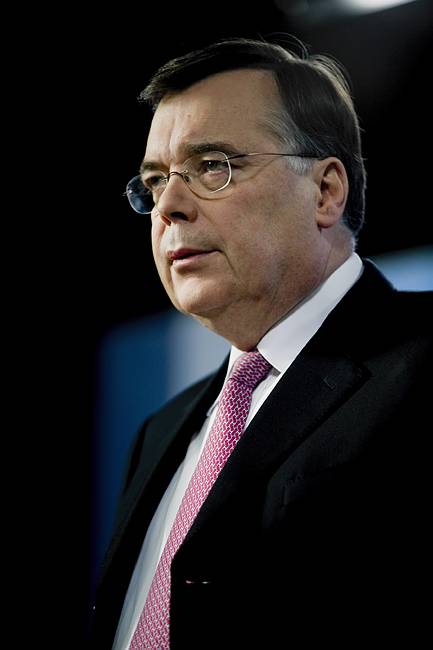
Prime Minister’s plea on oil prices as he tours the Middle East to secure IMF funding

By Nigel Morris

November 1 2008

Gordon Brown flies out to the Gulf today on a mission to persuade the region’s oil-rich states to help combat the global economic meltdown.

He is expected to meet the leaders of Qatar, Saudi Arabia and the United Arab Emirates and ask them to pump billions of pounds into the International Monetary Fund (IMF), which is struggling to cope with pleas for help from countries facing collapse in their financial system.

The Prime Minister will also urge them not to cut production in an effort to reverse the slide in oil prices over the past month. The size of the challenge facing the British economy was underlined on the eve of the tour, as Mr Brown was warned that levels of debt and borrowing will climb higher than during the last recession in the early 1990s.

A report by the independent Institute for Fiscal Studies concluded that the Government was going into the recession with a “significantly higher” level of debt than in 1990. Even excluding the cost of nationalising Northern Rock, public sector net debt is due to reach 39.7 per cent of gross domestic product this year and is “very likely” to rise above 46.2 per cent within the next couple of years.

The Prime Minister has sought to emphasise the “global” nature of the economic downturn. Ahead of his latest trip abroad he signalled fears that the $250bn (£155bn) fund available to the IMF to help fragile economies might not be enough to cope with the extent of global downturn. Hungary, Iceland and Ukraine have already agreed emergency loans, while other countries queuing up for help include Belarus, Turkey and – critically for regional security – Pakistan.

Mr Brown believes the IMF’s coffers should be topped up by the rapidly-growing economies of the Gulf region, whose revenues have soared as fuel prices leapt this year. He is also targeting China, which is sitting on large reserves of capital.

The extra cash required by the IMF to counter the international turbulence could amount to hundreds of billions of dollars. But Mr Brown will probably run into opposition in the region, whose leaders have already expressed dismay that they are being asked to tackle a problem that has its roots in the turmoil in the American sub-prime mortgage market.

The Prime Minister will also express his opposition to the decision of the Organisation of the Petroleum Exporting Countries to cut output from today by 1.5 million barrels a day.

The Gulf nations, which produce more than half of the world’s oil, have seen the price of a barrel fall from a high of $147 (£91) in July to below $65 yesterday. The Prime Minister’s spokesman said yesterday: “We recognise over that over the long-term global demand for oil is increasing, so over the long-term price is likely to increase. But what we want to avoid is the sharp increases we have seen in recent months.” Mr Brown is also planning to renew his call on the Gulf states to invest in renewable energy technology.

He is being accompanied by Peter Mandelson, the Business Secretary, and Ed Miliband, the Energy and Climate Change Secretary, and more than 20 business leaders.

During a visit to Edinburgh yesterday, Mr Brown said low interest rates and falling inflation, along with lower national debt than other countries, would help Britain survive the turbulence. “It is the first global crisis that we are having to deal with in this new industrial age where so much is global. I am confident that the opportunities for our economy are great in the years to come.”

The shadow Chancellor, George Osborne, yesterday accused the Prime Minister of trying to “spend his way out of recession” at the risk of exacerbating the downturn and saddling future generations with huge tax increases to combat rising national debt.

In a speech drawing dividing lines between Conservative and Labour approaches to the economic crisis, he denounced Mr Brown as irresponsible for suggesting that the Government can “borrow without limit” to stave off recession.

He said the policy of borrowing more to pay for a state “spending splurge” was “a cruise missile aimed at the heart of the economy”, which could require tax rises equivalent to 4p on income tax. But he was attacked by Labour and Liberal Democrat opponents for being “confused” and “out of his depth” in his analysis.

The credit crisis: Latest developments

*PM to urge Gulf states not to cut oil production as Opec reduces output by 1.5 million barrels a day

*Osborne accuses Brown of trying to ‘spend his way out of a recession’

*Barclays to take £7.3bn from investors in Abu Dhabi and Qatar in bid to maintain bonus packages

*Investors in the Middle East could end up owning as much as one-third of banking giant’s shares

Source

Published in: on November 1, 2008 at 4:03 pm  Comments Off on Prime Minister’s plea on oil prices as he tours the Middle East to secure IMF funding  
Tags: , , , , , , , , , , , , , , , , , , , , , , , ,

Coping with global financial crisis

By Patrick Kagenda

October 31 2008

As the American economy struggles to recover from the credit crunch and European economies jostle with rescuing their financial institutions, subsidiary of American companies operating in Uganda are maintaining an upbeat facade, claiming they are not affected by the American economic woes.

Mr. Erick Rakama, Business development manager at DHL an American courier service provider, told The Independent that despite DHL cutting operations in USA, the action will have no effect on DHL Uganda operations. “Each country operates autonomously,” said Rakama.

Ms Poonam, the operations manager at UPS Uganda, another American courier company said the effects are strictly on the American market and not on the local markets like the Ugandan market. “We are not affected at all”, she said.

At AIG Uganda, Alex Wanjohi, AIG Uganda Managing Director said AIG Inc has decided to refocus the company on its core property and casualty insurance businesses which includes AIG Uganda Limited. This means it is business as usual for AIG South African operations where AIG Uganda falls.

“We operate autonomously and throughout the challenges faced by AIG Inc, AIG Uganda’s financial position has not been affected at all,” he said, “We have retained a very strong financial position and we continue to pay claims and write new business as usual”.

The Chief Executive of the Uganda Securities exchange, Mr Simon Rutega, said the lack of confidence in financial markets poses a potential for turmoil.

“In the short run the global credit crunch may not affect Uganda because our securities, our companies and our economies have no direct correlation,” he said, “We are not entangled with those markets despite the remittances coming from those economies, however the effect would be in the long run if this problem progresses.”

Uganda exports mainly primary commodities.

He said there could be a reduction in donor aid and support to social services.

“We have also learned that we have to be careful with these derivatives so, we have to verify whether those instruments are effective or not,” he said.

Experts continue to echo Rutega’s claim that African stock exchanges are insulated from the financial turmoil because of their limited links to the global economy.

“All of Africa represents only one percent of global trade,” Willy Ontsia, head of the Central Africa Stock and Shares Market (BVMAC) in Libreville said;

“If the crisis is short, its impact on Africa and emerging market economies will be relatively weak.”

“But if the crisis is prolonged, that will have an impact on several indicators that affect growth in developing countries,” he said, noting that a global slowdown would affect trade in raw materials — the backbone of many of the continent’s economies.

“Africa is less exposed because of its limited links to the international financial community… but I have reason to worry about the economic effects of the financial crisis on the continent,” said Donald Kaberuka, head of the African Development Bank (ADB).

“It’s the long-term effects that cause us great worry,” he told a press conference in Tunis.

But World Bank President Robert Zoellick last week said that developing nations may be at “a tipping point”.

“We have seen the dark side of global connectedness,” he said as the turmoil battered markets from Cairo to Johannesburg, posing risks to foreign investment and trade that could threaten Africa’s recent economic gains.

Some economists insist that the financial crisis will hit poor and rich countries the same “because there is no decoupling between their performances”.

Due to differences in their starting situations, the outcome will be different and growth in developing economies will slow but not so much as in advanced countries as their trade and capital accounts suffer.

Egypt’s main index plunged more than 16 percent at one point last week, mirroring spectacular losses around the world amid worries about European banks and doubts about the 700 billion dollar US bailout package.

The main index in South Africa, the continent’s largest economy, fell by seven percent but stabilised with trading in marginally positive territory.

Other key markets, including oil-exporter Nigeria and Morocco, suffered far less dramatic declines, while some bourses in countries like Ivory Coast have actually posted small gains.

Economies like South Africa, which are more connected to international finance, are more easily affected by the global turmoil, seen in the volatility on the Johannesburg Stock Exchange, said Razia Khan of Standard Charter Bank in London.

“For the rest of Africa, the global financial market rout is likely to mean a rise in risk aversion,” she said, warning that international investors were likely to seek stability rather than the risks posed by emerging markets.

Daniel Makina, a risk management expert at the University of South Africa, said those indirect effects could prove just as damaging for African economies, especially if exports to the rest of the world slow down.

“South Africa does a lot of trade with US and Europe especially,” Makina told AFP. “A recession in the US and Europe will impact on South Africa exports.”

Crude oil accounts for more than 50 percent of Africa’s exports, with Angola and Nigeria the biggest producers, according to the World Bank.

Worries that weak global growth will reduce demand for fuel have already sent oil prices tumbling to eight-month lows.

“All these things have ripple effects that could hurt growth,” Ontsia said. “Our fear is that this crisis will continue.”

  • Due to a general shortage of credit, poor countries will increasingly find it difficult to access finance.
  • Inflation, which is the main problem for the poor, could be reduced.
  • General re-pricing of risk due to the crisis will increase the cost of borrowing
  • Economies that depend on exports will be most impacted, especially due to a softening in commodity prices

Source

Published in: on November 1, 2008 at 5:51 am  Comments Off on Coping with global financial crisis  
Tags: , , , , , , , , , , , , , , , , , , ,

Using Federal Money for Bonuses Is a ‘Betrayal

By DAVID MUIR

October 30 2008

News of the $700 billion financial rescue package funded by taxpayer dollars to bail out banks was already a tough pill for many critics to swallow.

But though members of Congress claim they have tackled the issues of CEO pay and “golden parachutes,” it turns out they have not taken substantial action to limit year-end bonus checks on Wall Street.

“People have been lining their pockets and are continuing to line their pockets today,” said Rep. Luis Guitierrez, D-Ill., who is raising concerns to Treasury Secretary Henry Paulson about executive compensation. “I want to make sure it doesn’t happen tomorrow, because, politically, that’s very embarrassing to me.”

Some industry analysts predict that the average managing director at an investment bank that is receiving government money could receive a bonus of $625,000 this year, according to data from Alan Johnson and Associates.

While that bonus is less than the $1.1 million investment bankers earned last year, it’s still 15 times the income of the average American household.

On Thursday, members of Congress, many of whom voted in favor of the bailout, demanded answers about how the bailout money will be put to use.

“We’re asking the hard question: What are you doing?” said Rep. Henry Waxman, D-Calif. “Are you actually going to be giving bonuses out and then coming to the government and saying, ‘Give us money because we’re short on cash?'”

About $125 billion from the $700 billion financial rescue package has been allocated to nine troubled banks, including Goldman Sachs and JP Morgan Chase, according to the Treasury Department.

Ed Lazear, chairman of the Council of Economic Advisers, ensured critics Thursday that the government will monitor and regulate how the banks use the bailout dollars.

“We’re going to follow the law and make sure there are not abuses, but we want to make sure we get the economy going,” Lazear said, defending the White House’s handling of the stimulus package.

But taxpayers, whose money has gone to give firms a lifeline, wonder why these issues were not addressed before the $700 billion financial rescue plan was passed.

Source

I think a lot of people might like to know where their money is really going.

And then we have this take on things.

The “Dirty Little Secret” Of the US Bank Bailout

By Barry Grey

In an unusually frank article published in Saturday’s New York Times, the newspaper’s economic columnist, Joe Nocera, reveals what he calls “the dirty little secret of the banking industry”–namely, that “it has no intention of using the [government bailout] money to make new loans.”

As Nocera explains, the plan announced October 13 by Treasury Secretary Henry Paulson to hand over $250 billion in taxpayer money to the biggest banks, in exchange for non-voting stock, was never really intended to get them to resume lending to businesses and consumers–the ostensible purpose of the bailout. Its essential aim was to engineer a rapid consolidation of the American banking system by subsidizing a wave of takeovers of smaller financial firms by the most powerful banks.

Nocera cites an employee-only conference call held October 17 by a top executive of JPMorgan Chase, the beneficiary of $25 billion in public funds. Nocera explains that he obtained the call-in number and was able to listen to a recording of the proceedings, unbeknownst to the executive, whom he declines to name.

Asked by one of the participants whether the $25 billion in federal funding will “change our strategic lending policy,” the executive replies: “What we do think, it will help us to be a little bit more active on the acquisition side or opportunistic side for some banks who are still struggling.”

Referring to JPMorgan’s recent government-backed acquisition of two large competitors, the executive continues: “And I would not assume that we are done on the acquisition side just because of the Washington Mutual and Bear Stearns mergers. I think there are going to be some great opportunities for us to grow in this environment, and I think we have an opportunity to use that $25 billion in that way, and obviously depending on whether recession turns into depression or what happens in the future, you know, we have that as a backstop.”

As Nocera notes: “Read that answer as many times as you want–you are not going to find a single word in there about making loans to help the American economy.”

Later in the conference call the same executive states, “We would think that loan volume will continue to go down as we continue to tighten credit to fully reflect the high cost of pricing on the loan side.”

“It is starting to appear,” the Times columnist writes, “as if one of the Treasury’s key rationales for the recapitalization program–namely, that it will cause banks to start lending again–is a fig leaf…. In fact, Treasury wants banks to acquire each other and is using its power to inject capital to force a new and wrenching round of bank consolidation.”

Early this month, he explains, “in a nearly unnoticed move,” Paulson, the former CEO of Goldman Sachs, put in place a new tax break worth billions of dollars that is designed to encourage bank mergers. It allows the acquiring bank to immediately deduct any losses on the books of the acquired bank.

Paulson and other Treasury officials have made public statements calling on the banks that receive public funds to use them to increase their lending activities. That, however, is for public consumption. The bailout program imposes no lending requirements on the banks in return for government cash.

Already, the credit crisis has been used to engineer the takeover of Bear Stearns and Washington Mutual by JPMorgan, Merrill Lynch by Bank of America, Wachovia by Wells Fargo and, last Friday, National City by PNC.

What the Wall Street Journal on Saturday called the “strong-arm sale” of National City provides a taste of what is to come. The Treasury Department sealed the fate of the Cleveland-based bank by deciding not to include it among the regional banks that will receive government handouts. It then gave Pittsburgh-based PNC $7.7 billion from the bailout fund to help defray the costs of a takeover of National City. PNC will also benefit greatly from the tax write-off on mergers enacted by Treasury.

All of the claims that were made to justify the bank bailout have been exposed as lies. President Bush, Federal Reserve Chairman Ben Bernanke and Paulson were joined by the Democratic congressional leadership and Barack Obama in warning that the bailout had to be passed, and passed immediately, despite massive popular opposition. Those who opposed the plan were denounced for jeopardizing the well being of the American people.

In a nationally televised speech delivered September 24, in advance of the congressional vote on the bailout plan, Bush said it would “help American consumers and businessmen get credit to meet their daily needs and create jobs.” If the bailout was not passed, he warned, “More banks could fail, including some in your community. The stock market would drop even more, which would reduce the value of your retirement account…. More businesses would close their doors, and millions of Americans could lose their jobs … ultimately, our country could experience a long and painful recession.”

One month later, the bailout has been enacted, and all of the dire developments–banks and businesses disappearing, the stock market plunging, unemployment skyrocketing–which the American people were told it would prevent are unfolding with accelerating speed.

While Obama talks about the need for all Americans to “come together” in a spirit of “shared sacrifice”–meaning drastic cuts in Medicare, Medicaid, Social Security and other social programs–and the cost of the bailout is cited to justify fiscal austerity, the bankers proceed to ruthlessly prosecute their class interests.

As the World Socialist Web Site warned when it was first proposed in mid-September, the “economic rescue” plan has been revealed to be a scheme to plunder society for the benefit of the financial aristocracy. The American ruling elite, utilizing its domination of the state and the two-party political system, is exploiting a crisis of its own making to carry through an economic agenda, long in preparation, that could not be imposed under normal conditions.

The result will be greater economic hardship for ordinary Americans. The big banks will have even greater market power to set interest rates and control access to credit for workers, students and small businesses.

While no serious measures are being proposed, either by the Bush administration, the Republican presidential candidate or his Democratic opponent, to prevent a social catastrophe from overtaking working people, the government is organizing a restructuring of the financial system that will enable a handful of mega-banks to increase their power over society.

Source

I really do think taxpayers should keep a watchful eye on things and events, to see what will actually transpire. What they say and what they actully do are two very different things.

De Menezes ‘was killed without warning’

Jean Charles de Menezes was killed by shots from two police officers on a London Underground Tube train at Stockwell station

Mr Mansfield has said the officers who killed Mr de Menezes did not “honestly and genuinely” believe the Brazilian electrician was an immediate threat at the time they pulled the trigger

By Mark Hughes

October 31 2008

Scotland Yard marksmen who shot dead Jean Charles de Menezes did not identify themselves as police officers before opening fire, according to three witnesses who saw the Brazilian electrician being killed.

The evidence, given by passengers who were in the same Tube train carriage as Mr de Menezes when he was shot on 22 July 2005, contradicts statements made by the Metropolitan Police. Both of the armed officers who shot Mr de Menezes have told the inquest they shouted “armed police” before firing. This claim has also been corroborated by other officers who were on the train on the day Mr de Menezes was killed.

But yesterday three witnesses said they heard no such shout. Their testimonies appear to lend weight to the accusation levelled by Michael Mansfield QC, representing Mr de Menezes’ family, earlier in the week that the Metropolitan Police officers have “embellished”, “exaggerated” and “lied” during their evidence.

Ralph Livock and his girlfriend Rachel Wilson were sitting opposite Mr de Menezes, 27, in the Tube carriage at Stockwell station in south London on 22 July, the inquest heard. Mr Livock recalled that the train was held up at the station, when four men, casually dressed and carrying guns, got on board and shot Mr de Menezes seven times in the head at point blank range. Asked by Nicholas Hilliard QC, counsel to the inquest, whether the men had said anything about being police officers before opening fire, Mr Livock said: “No, certainly not.

“And I remember that specifically because one of the conversations that Rachel and I had afterwards was that we had no idea whether these were police, whether they were terrorists, whether they were somebody else. We just had no idea.”

When Mr Hilliard asked Ms Wilson, “Did you ever hear anybody shout ‘armed police’?”, she answered, “If I had heard that, I would have thought they were police, so no”. Asked the same question later, she again insisted that no one had shouted “armed police” adding: “That’s one of the things I recall the most – the silence.”

The couple said they initially thought the officers were pranksters playing a game. Mr Livock said: “One of my initial thoughts was it was all a game and they were a group of lads who were just having a laugh – a very bad taste laugh, but just having a game on the Tube, because they were just dressed in jeans and T-shirts but with firearms. The thing that made me realise it wasn’t a group of lads playing around or something else happening was when the first shot was fired.” Ms Wilson added: “I thought they were messing around. Then I thought they were terrorists and it was only when I left the carriage and somebody moved me gently out of the way that I figured they must be good guys. Apart from that, I just didn’t know who they were.”

Mr Livock described the moments just before Mr de Menezes was killed. “He looked as if he was expecting somebody to say something but he didn’t look frightened,” he said. “He looked as if he was waiting for somebody to tell him what was going on.”

Another commuter, Wesley Merrill, told the court he saw a man come on to the train and point at Mr de Menezes, saying “that’s the guy”. He said he could not recall any of the officers saying anything to Mr de Menezes.

Mr Mansfield has said the officers who killed Mr de Menezes did not “honestly and genuinely” believe the Brazilian electrician was an immediate threat at the time they pulled the trigger. He says they are embellishing their version of events in statements and evidence in order to convince people that they believed Mr de Menezes was a suicide bomber.

The officers have denied this, with one, codenamed C5, saying: “I don’t think anyone was callous enough to think they would write themselves out of trouble.”

The inquest, at the Oval, in south London, continues.

Speaking with one voice: What the officers said

Delta9 (firearms officer): “I could hear people shouting ‘armed police'”

Ken (surveillance officer): “I heard ‘armed police’ shouted loudly”

Ivor (surveillance officer): “I could hear shouting”

Geoff (surveillance officer): “I then heard shouting from the direction of the open doors which included the word ‘police'”

C5 (firearms officer): “I heard shouts of ‘armed police'”

C12 (one of the two firearms officers who shot Mr de Menezes): “I did challenge ‘armed police'”

C2 (the other firearms officer who shot Mr de Menezes): “I shouted ‘armed police’ and I held my handgun to the head of the subject and I fired”

Source

Seems someone is lieing.

Yet another victim of the war on terroisim.  There certainly are a lot of them.

Published in: on October 31, 2008 at 9:24 am  Comments Off on De Menezes ‘was killed without warning’  
Tags: , , , , , , , , , , , , , , , , ,

CIA officers could face trial in Britain over torture allegations

Attorney General to investigate abuse claims

By Robert Verkaik

October 31 2008

Senior CIA officers could be put on trial in Britain after it emerged last night that the Attorney General is to investigate allegations that a British resident held in Guantanamo Bay was brutally tortured, after being arrested and questioned by American forces following the terrorist attacks on New York and Washington in 2001.

The Home Secretary Jacqui Smith has asked Baroness Scotland to consider bringing criminal proceedings against Americans allegedly responsible for the rendition and abuse of Binyam Mohamed, when he was held in prisons in Morocco and Afghanistan.

The development follows criticism of US prosecutors by British judges who have seen secret evidence of torture committed against Mr Mohamed, including allegations his torturers used a razor blade to repeatedly cut his penis. The Attorney’s investigation is expected to include allegations that MI5 colluded in Mr Mohamed’s rendition. Mr Mohamed, 30, an Ethiopian national and British resident, was arrested in Pakistan in 2002, when he was questioned by an MI5 officer.

On Tuesday, Government lawyers wrote to the judges hearing Mr Mohamed’s case against the UK government in the High Court. In the letter they said “the question of possible criminal wrongdoing to which these proceedings has given rise has been referred by the Home Secretary to the Attorney general for consideration as an independent minister of justice”. Baroness Scotland has been sent secret witness statements given to the court and public interest immunity certificates for the proceedings.

Mr Mohamed, 30, accuses MI5 agents of lying about what they knew of CIA plans to transfer him to a prison in north Africa, where he claims he was subjected to horrendous torture. Mr Mohamed, who won asylum in the UK in 1994, has been charged with terrorism-related offences. He awaits a decision on whether he is to face trial at the US naval base. He is officially the last Briton at Guantanamo. Last night his lawyer, Clive Stafford Smith, said: “This is a welcome recognition that the CIA cannot just go rendering British residents to secret torture chambers without consequences, and British agents cannot take part in US crimes without facing the music. Reprieve will be making submissions to the Attorney General to ensure those involved, from the US, Pakistan, Morocco, Britain, are held responsible.”

Richard Stein, of Leigh Day, representing Mr Mohamed in the High Court proceedings, said: “Ultimately the British Government had little choice once they conceded that a case had been made that Binyam Mohamed was tortured. The Convention Against Torture imposes an obligation on signatory states to investigate torture.”

In August two judges ruled allegations of torture were at least arguable and that MI5 had information relating to Mr Mohamed that was “not only necessary but essential for his defence”.

The judges have read statements and interviews with Mr Mohamed between 28 and 31 July, 2004 when he says he was forced to confess to terrorism. The judges said: “This was after a period of over two-and-a-half years of incommunicado detention during which Binyam Mohamed alleges he was tortured.”

He was first held in Pakistan in 2002, where a British agent interrogated him; he was then sent to Morocco by the CIA and allegedly tortured for 18 months. He was rendered to the secret “Dark Prison” in Afghanistan, where his torture is alleged to have continued. Since September 2004, he has been in Guantanamo Bay.

Source

Published in: on October 31, 2008 at 9:10 am  Comments Off on CIA officers could face trial in Britain over torture allegations  
Tags: , , , , , , , , , , , , , , , , ,

Scandal of six held in Guantanamo even after Bush plot claim is dropped

No evidence that men living in Bosnia plotted attack on Sarajevo embassy

By Robert Fisk

October 31 2008

In the dying days of the Bush administration, yet another presidential claim in the “war on terror” has been proved false by the withdrawal of the main charge against six Algerians held without trial for nearly seven years at Guantanamo prison camp.

George Bush’s assertion in his 2002 State of the Union address – the same speech in which he wrongly claimed that Saddam Hussein had tried to import aluminium tubes from Niger – was that “our soldiers, working with the Bosnian government, seized terrorists who were plotting to bomb our embassy [in Sarajevo].” Not only has the US government withdrawn that charge against the six Algerians, all of whom had taken citizenship or residence in Bosnia, but lawyers defending the Arabs – who had already been acquitted of such a plot in a Sarajevo court – have found that the US threatened to pull its troops out of the Nato peacekeeping force in Bosnia if the men were not handed over. According to testimony presented by the Bosnian Prime Minister, Alija Behman, the deputy US ambassador to Bosnia in 2001, Christopher Hoh, told him that if he did not hand the men to the Americans, “then let God protect Bosnia and Herzegovina”.

That such a threat should be made – and the international High Representative to Bosnia at the time, Wolfgang Petritsch, has also told lawyers it was – shows for the first time just how ruthless and unprincipled US foreign policy had become in Mr Bush’s “war on terror”. By withdrawing their military and diplomatic support for the Bosnian peace process, the Americans would have backed out of the Dayton accord which they themselves had negotiated. Then the Bosnian government would have lost its legitimacy and the country might have collapsed back into a civil war which claimed the lives of tens of thousands of civilians and involved mass rape as well as massacre. The people of Bosnia might then have endured “terror” on a scale far greater than the attacks of al-Qa’ida against the United States.

When the Bosnian court was preparing to release their six prisoners, Prime Minister Behman was informed that Mr Bush, Vice-President Richard Cheney and the Defence Secretary, Donald Rumsfeld, had been personally briefed and the White House had decided that, if they were freed, US troops in the Nato Stabilisation Force in Bosnia would seize them, using “whatever force is necessary”. So, despite a three-month investigation by the Bosnian police, their clearance and a specific demand by the Dayton-established Bosnian Human Rights Chamber that they should not be forced to leave Bosnia, US forces seized all six, shackled and blindfolded them and put them on a plane to Guantanamo.

Mustafa Idir, Mohamed Nechla, Hadj Boudella, Lakhdar Boumedienne, Belkacem Bensayah and Saber Lahmar have remained there since, the only European citizens still in Guanatanamo. Five of their wives are still waiting for them in Bosnia along with 20 of their children, two of whom their fathers have never seen. Their case will be put to a habeas corpus district court hearing in Washington next week – the six will appear in a live transmission from Guantanamo – where their lawyers will point out that another critical charge has also been withdrawn by the US government.

The administration has withdrawn evidence given by a federal prisoner, Enaam Arnaout, against Boudella – that he trained at an al-Qa’ida camp in Afghanistan – when lawyers were about to discover that the US Justice Department had said five years earlier that an FBI interview with the man was “not reliable”.

Even stranger is that the six prisoners are claimed by the US to be “enemy combatants” when – with the dropping of the embassy bomb-plot charge – there is no evidence they have ever fought US troops or planned to attack US interests anywhere in the world. Part of the case against Bensayah involved the alleged discovery of a piece of paper at his home, bearing a telephone number for an al-Qa’ida operative, Abu Zubayder. “The Bosnian police couldn’t get this number to work in Afghanistan or Pakistan,” one of the prisoners’ lawyers, Stephen Oleskey, says. “Now we believe an announcement that the paper had been discovered was made before it was ‘found’.”

Mr Oleskey says Clint Williamson, the US war crimes ambassador, met Bosnia’s Prime Minister, Nicola Spiric, this week. “There’s only one reason he makes these visits,” he said. “To negotiate the return of people in Guantanamo.” The White House may intend to save itself further embarrassment by ending the torment of six more apparently innocent young men.

Source

Longest-serving US senator found guilty in corruption case

Ted Stevens | AAP

October 28 2008

Just over a week from the US election, the longest serving Republican in the Senate has been convicted of seven corruption charges.
A jury’s found 84-year-old Alaskan senator Ted Stevens lied about free home renovations and other gifts from a wealthy oil contractor.

He faces up to five years’ jail on each count when he’s sentenced in January, but he’s expected to receive little, if any time behind bars.

There’s no rule barring convicted felons from serving in the US Congress, but a two-thirds vote in the Senate would see a re-elected Stevens expelled.

Source

Maybe they should get that rule fixed.

Published in: on October 31, 2008 at 3:42 am  Comments Off on Longest-serving US senator found guilty in corruption case  
Tags: , , , , , , , ,

Plot to kill Barack Obama, massacre African-Americans foiled

October 28 2008

US agents have broken up a plot to assassinate Democratic presidential candidate Barack Obama and shoot or decapitate 102 black people in a murder spree in the state of Tennessee.

In court records unsealed today, federal agents said they disrupted plans to rob a gun store and target a predominantly high school by two neo-Nazi skinheads.

Agents said the skinheads did not identify the school by name.

Jim Cavanaugh, special agent in charge of the Nashville field office for the Bureau of Alcohol, Tobacco, Firearms and Explosives, said the two men planned to shoot 88 black people and decapitate another 14.

The numbers 88 and 14 are symbolic in the white supremacist community.

The men also sought to go on a national killing spree, with Obama as their final target, Cavanaugh told The Associated Press.

“They said that would be their last, final act – that they would attempt to kill Sen. Obama,” Cavanaugh said.

“They didn’t believe they would be able to do it, but that they would get killed trying.”

Cavanaugh says the culmination of their plan was to dress in white tuxedos and top hats, and drive at top speed towards senator Obama, firing from the windows of their car.

He says the threats are being taken very seriously and even if they were just to attempt the plot it would have left a trail of tears around the South.

An Obama spokeswoman travelling with the senator in Pennsylvania had no immediate comment.

The men, Daniel Cowart, 20, and Paul Schlesselman 18, are being held without bond.

Agents seized a rifle, a sawed-off shotgun and three pistols from the men when they were arrested.

Authorities alleged the two men were preparing to break into a gun shop to steal more.

Attorney Joe Byrd, who has been hired to represent Cowart, did not immediately return a call seeking comment today.

Cowart and Schlesselman are charged with possessing an unregistered firearm, conspiring to steal firearms from a federally licensed gun dealer, and threatening a candidate for president.

Source

Assessing White Supremacist Groups In The U.S.

Federal authorities announced Monday that they had broken up a neo-Nazi plot to assassinate presidential candidate Barack Obama. Authorities say Obama was never in any danger.

Mark Potok, director of the intelligence project at the Southern Poverty Law Center, discusses the case and white supremacist groups present in the U.S.
Obama’s Candidacy Angers, Excites Hate Groups

The charges Monday against two neo-Nazi skinheads accused of plotting to kill Barack Obama drew attention to law enforcement’s simmering concerns over how white supremacists are reacting to the possibility of a black president.

The alleged plan that Daniel Cowart of Bells, Tenn., and Paul Schlesselman, of West Helena, Ark., were hatching was fantastic in its scope. Federal agents said Cowart and Schlesselman planned to rob a gun store, target students at a largely black high school and then try to kill Obama.

The two men did not expect to be successful, but they wanted to die trying, investigators said. They said the two planned to drive as fast as they could toward Obama and shoot at him from the windows of their car. They allegedly had discussed wearing white tuxedos and top hats for the occasion. The suspects are being held without bond on charges of possessing

an unregistered firearm, conspiring to steal firearms and threatening a presidential candidate.

This is the second white supremacist plot against Obama that authorities have revealed. In August, just days before Obama accepted the Democratic nomination in Denver, police arrested three men with white supremacist ties for possibly threatening him.

While law enforcement officials say Obama was never in any danger in either situation, they are also quick to say that they cannot afford to take these cases lightly. And they have been expecting new challenges from white supremacist groups.

“There is a probable hypothesis that in the event that Obama becomes president that you could have a galvanization of these white supremacist groups,” said John Karl, the officer in charge of the Los Angeles Police Department’s criminal conspiracy unit. “Obviously, law enforcement needs to be prepared, and how do you prepare? You need to become as resourceful and comprehensively understand the groups and individuals involved.”

Karl says the First Amendment ties law enforcement’s hands. Officers cannot move in until and unless these groups actually commit a crime.

“If no crime has been committed, no activity has come up on the radar screen, we can’t arbitrarily start rounding people up,” he said. “There is a little problem with the Constitution and things like that.”

Supremacist Groups In California

Travel out of metropolitan Los Angeles — to Southern California cities farther inland where supremacists have traditionally congregated — and it is clear that law enforcement is in a state of alert.

Chris Keeling is part of the FBI’s hate crimes task force in Santa Clarita. As he sees it, Obama’s effect on the hate movement is no longer theoretical; it has already happened.

“There is more on the Internet. There are more flyers, leafletting going out, because now they have a target,” he said. “Take Obama out of the situation, you’re still going to have leafletting. But having Obama in there and being a stone’s throw from being the president, has it increased the Internet activity? Absolutely, absolutely.”

These days, Keeling works about six hate crime calls a week. Some of them are serious. A couple of months ago, skinheads beat up a customer at a restaurant because he was black. Others are crimes of opportunity. Obama posters, for example, have become an easy target for vandals to deface.

The FBI set up a task force in Santa Clarita partly because racist skinhead gangs have long been a fixture there. For years, the Antelope Valley had been a white enclave — a refuge from Los Angeles. When immigrants began moving in, hate groups saw their membership ranks grow as whites in the neighborhoods banded together. Keeling said Obama’s candidacy is adding fear and uncertainty to an already volatile mix.

“This is different. This is new. This has never happened before,” Keeling said of Obama’s candidacy. “We’re not doing anything extra, but we’re kind of being more cognizant of things.”

Candidacy Fits Into Ideology

Part of the problem is that Obama is playing into the neo-Nazi and white supremacist narrative, said Brian Levin, who studies hate and extremism at California State University, San Bernardino.

What the groups were saying — “Jews and blacks coming out of the urban areas are going to take over this white nation of ours” — has occurred, he said.

You only have to look to the Internet to see how white supremacist leaders such as David Duke are using Obama to rally their troops. Duke has called Obama a “visual aid for hate groups.”

He says an Obama presidency would provide indisputable proof that whites have lost control of America.

“This is a cultural and racial battlefront,” said Levin. “Barack Obama is symbol No. 1 of the worst the future has to offer.”

While Obama may be an easy focus of discussion for haters, he hasn’t unified them. In fact, in many ways, he has managed to divide the movement.

Catalyst For A Race War

Tim Zaal, a former white supremacist from Los Angeles, says the split Obama has created is almost generational — between old-school Ku Klux Klan types who are viscerally against a black man running for president and a new wave of haters.

“You have the more — kind-of strange to say it — progressive white attitude: The worse it gets, the better,” said Zaal.

Zaal says the new generation is particularly focused on what they see as the coming race war. They have been trying to spark one for years. Some think, even hope, that an Obama presidency will do just that.

Zaal says some will actually vote for Obama to send the country into a tailspin. “The faster this country falls, the sooner white revolution will arise,” he said.

That mindset is all over the neo-Nazi Web sites. On one, a man with the pen name “LastOfMyKind” wrote, “Could it be that the nomination of Obama finally sparks a sense of unity in white voters? I would propose that this threat of black rule may very well be the thing that finally scares some sense back into complacent whites.”

This is what worries the police and the FBI.

Source

Published in: on October 31, 2008 at 3:01 am  Comments Off on Plot to kill Barack Obama, massacre African-Americans foiled  
Tags: , , , , , , , , , , , , , , ,

Sommet de la Francophonie in Canada

Harper welcomes Sarkozy ahead of talks on economy

Oct. 17 2008

Prime Minister Stephen Harper welcomed French President Nicolas Sarkozy in Quebec City Friday ahead of a working lunch where the leaders will discuss the economy and trade issues.

Sarkozy and Jose Manuel Barroso, the president of the European Commission, landed in Quebec City Friday morning and were greeted by Harper on the tarmac.

Harper has vowed to make sure Canadian banks are not negatively impacted by ongoing rescue efforts in Europe and the U.S., where governments are providing aid to financial institutions.

“The French president is the chairman of the EU commission on this whole issue right now so he’s trying to drum up support for different ideas on how to protect banks and the financial sector internationally,” CTV’s Rosemary Thompson said Friday from Quebec City.

The leaders are also expected to discuss a possible free trade deal between Canada and the EU.

“Obviously, the United States has always been our main trading partner but if we can do more with India, China and Asia and if we can do more with the European Union that would help to diversify the Canadian economy,” Environment Minister John Baird told CTV’s Canada AM on Friday.

According to The Globe and Mail, the discussions will focus on the free trade of services, rather than manufactured goods and agriculture, between Canada and France.

The Globe cites a French-language draft version of a joint-statement that says both countries are ready to take steps this year to ensure “operational launch of negotiations as soon as possible in 2009.”

The plan may include an “open skies” agreement for airlines, which would allow airlines from either country to have expanded rights to fly routes in the other’s jurisdiction, says The Globe.

Thompson said a labour mobility agreement between France and Quebec may also be negotiated today.

As part of the deal, Quebec and France would recognize 12 different trades and professions.

“For instance, if you were a doctor in France you could come and work in Quebec as a doctor and there wouldn’t be a hassle over credentials,” Thompson told CTV Newsnet from Quebec City.

After his meeting with Harper, Sarkozy will then deliver an address to the National Assembly in Quebec at 3 p.m.

“Apparently he’s going to take a very balanced approach today saying that he loves Canada but that, of course, Quebec is like a brother to France,” Thompson said.

In the evening, Sarkozy will attend the official opening of the summit of La Francophonie, an organization of 55 French-speaking nations.

However, the French leader has cut short his visit and will not attend the closing ceremonies of the summit — a first for any French president.

Instead, Sarkozy will travel to Camp David in Maryland on Saturday for meetings with U.S. President George Bush.

“It’s a bit disappointing,” Christine St-Pierre, Quebec’s minister responsible for the provincial language law, said Thursday.

Quebec Premier Jean Charest said the shortened visit was understandable given the “extraordinary circumstances.”

Sarkozy’s wife, Carla Bruni-Sarkozy, will not be travelling with her husband.

Source

CTV Newsnet: Leaders speak to media in Quebec  document.write(format_clip_duration(’00:15:12.00′)); // see common.js 15:12
CTV Montreal: John Grant reports from Quebec City and discusses Sarkozy’s plan to reform capitalism  document.write(format_clip_duration(’00:02:36.00′)); // see common.js 2:36
CTV Newsnet: Rosemary Thompson on the discussions expected at the Summit  document.write(format_clip_duration(’00:03:07.00′)); // see common.js 3:07
CTV Newsnet: Prime Minister Stephen Harper meets French President Nicolas Sarkozy in Quebec City  document.write(format_clip_duration(’00:03:52.00′)); // see common.js 3:52

Princes William and Harry set for charity motorcycle rally

Prince William and Prince Harry will take part in a demanding motorcycle rally along the coast of South Africa to raise money for charity.

William, 26, and Harry, 24, will join the Enduro Africa 08 event later this month.

They’ll join 100 other riders who will spend eight days crossing 1,300 kilometres of often rugged terrain on Honda off-road bikes. As many as six armed police officers will accompany the princes throughout the trek.

The ride will benefit four charities: the Nelson Mandela Children’s Fund, UNICEF, Touch Africa and Sentebale, an organization co-founded by Harry.

“The Princes are looking forward to the motorcycle ride that will raise money and the profile of Sentebale, a charity very close to their hearts,” said a spokesman for their office, Clarence House in London.

Sentebale helps orphaned children in the tiny African nation of Lesotho. Harry co-founded the charity along with Lesotho’s Prince Seeiso.

Enduro Africa organizers hope to raise hundreds of thousands of dollars for the charities. Each participant has to donate at least $3,000 to join the rally.

William has owned a motorbike for at least two years, while Harry has recently obtained his bike licence, said British media reports.

Source

B.C. court says homeless can camp in parks

Jim Gibson

October 14, 2008

VICTORIA – The city’s homeless can now set up camp in Victoria parks, according to a B.C. Supreme Court decision Tuesday.

“Yesterday it was illegal to set up my tent. Today it isn’t,” said David Johnston, one of the homeless activists who argued they have a right to sleep outdoors on public property.

Lawyer Catherine Boies Parker, who acted on behalf of the homeless campers in their court challenge of the city’s anti-camping bylaw, confirmed the 108-page judgment upheld their argument that a City of Victoria bylaw that prohibits using “temporary abodes” like tents and large tarpaulins for shelter in parks and public spaces violates the rights of the homeless.

She said the judgment noted that in the absence of sufficient safe and secure beds for the homeless, it was unconstitutional for the city to prevent them from erecting some form of shelter to protect themselves from the elements.

The decision came three years after a group was arrested in October 2005 for setting up a “tent city” in a Victoria park. The eviction sparked the court challenge.

“We don’t have to search every morning and night for a place to sleep,” Johnston said.

He predicted that tent cities will spring up in other municipalities once the decision becomes widely known.

Such encampments “might be the thing which saves us from the economic crush,” he said.

At a city hall news conference, Mayor Alan Lowe predicted the impact of the decision will be felt throughout Canada.

“This judgment demonstrates what years of cuts to social programming and housing programs has done. Municipal governments were never in the business of providing housing and social support services to individuals in need,” Lowe said, calling on higher levels of government to respond to the court decision.

The judgment does not bode well for city parks, Lowe warned. “Our city parks are not equipped to support camping of any kind.

“We’ve seen first hand the ill effects of tent cities. In 2005 . . . we saw a tent city that had become a hub of illegal activity, health concerns and vandalism,” he said.

“These are not acceptable conditions for our parks and green spaces, but even more importantly these conditions are not acceptable for the homeless.”

Lowe said there were no winners with the judgment. “This is still no way to accommodate our homeless and will be detrimental to the families and children that enjoy our park system.”

At the conference, acting police Chief Bill Naughton said police will respond “situationally” to any homeless encampments.

“We’ll see what confronts us and act accordingly,” he said.
Officers can still respond to criminal behaviours, infractions, despite ruling

Rob Shaw

October 16, 2008

Victoria’s police chief says his officers will still enforce existing laws and bylaws if the homeless community builds tent cities on public property in the wake of a recent Supreme Court ruling.

“The toolbox is not empty,” interim chief Bill Naughton said yesterday. “This is a very narrow judgment with very narrow impact, and it’s important to try to not extract more from the judgment than what it says.

“It is not a carte blanche for a tent city, or open season, or [any] of those things.”

On Tuesday, a B.C. Supreme Court judge ruled that a city of Victoria bylaw, which prohibits people from erecting tents and large tarpaulins for shelter in parks and public spaces, violates the rights of the homeless.

The ruling said that in the absence of sufficient safe and secure beds for the homeless, it was unconstitutional for the city to prevent them from erecting shelter for protection.

The court case was launched after city broke up a tent city in Cridge Park, at the corner of Blanshard and Belleville streets, in 2005. Yesterday, Naughton said what started then as a political movement was quickly compromised by drug addicts and criminals.

“What you saw was a downward spiral in terms of behaviour as the population began to shift,” he said.

There were assaults among campers and drug activity, he said, along with numerous at-risk vulnerable youth found living at the site.

Enforcing criminal laws — possession of drugs, assaults, etc. — and bylaw infractions, such as fires, was key to controlling the community, he said.

“All those behaviours are unaffected by this judgment,” said Naughton.

“You still can’t light a fire in a public park, or do any of those things. There are still existing bylaws to manage those behaviours. And obviously we’re going to respond to those behaviours. As I said, the [legal] decision doesn’t contemplate the establishment of a permanent tent city.”

Still, the police are looking for direction from city council once it decides how to deal with the campers, some of whom have already set up tents in Beacon Hill Park.

Recent police practice has been to generally let homeless people sleep undisturbed between 11 p.m. and 7 a.m., whereupon officers roust them from doorways and parks and ask them to move along.

That will continue, for now, said Naughton. But it will be up to council to decide whether the leniency continues or applies to future campers, he said.

Officers remain overworked as they handle numerous mental health and homelessness calls, said Naughton.

If a tent city does appear, and grows, the police workload will increase significantly, he said. “But at this point I think it’s premature to speculate,” said Naughton.

No special patrols were planned for tents erected at Beacon Hill Park last night.

Police are expected to seek direction from council today at a meeting at city hall.

Source

MoD should ‘hang heads in shame’ over corporal’s death

A photograph issued by the MoD of Corporal Mark Wright

A photograph issued by the MoD of Corporal Mark Wright

October 17 2008

A coroner today blamed the death of soldier in a minefield in Afghanistan on a lack of equipment and said those responsible “should hang their heads in shame”.

A catalogue of serious failures contributed to the death of Corporal Mark Wright, 27, who was killed by a blast as a Chinook helicopter attempted to rescue a platoon of Paras, coroner Andrew Walker said.

Recording a narrative verdict following the conclusion of a two-week inquest at Oxford Coroner’s Court, Mr Walker said the lack of resources “was simply about money”.

He highlighted three factors that caused Cpl Wright’s death – the lack of appropriate UK helicopters in Afghanistan fitted with a winch, the downwash from the Chinook sent to the minefield, and the administrative delay in sending a suitable helicopter.

Cpl Wright, from Edinburgh, was posthumously awarded a George Cross medal – the highest military honour for actions which are not in the face of the enemy.

Six others were hurt, including three who lost limbs, during the incident in the region of Kajaki in Helmand Province on September 6 2006.

Two American Blackhawk helicopters, fitted with winches, were eventually sent to rescue the soldiers – three and a half hours after the first explosion was reported.

Following the inquest his father Bob told reporters that he was proud of the courage his son showed in serving his country.

Reading a statement on behalf of him and his wife Jem he said: “We are satisfied that Mark did not cause his own death or contribute to it in any way. This will give us some peace of mind.

“As to the how, it has been painful to listen to the catalogue of errors that led to Mark’s death.

“However, the coroner has made recommendations that must be followed. Jem and I don’t want any other families to experience the loss of their child in similar circumstances.”

The inquest had heard that the Chinook had been sent in to rescue troops from the Parachute Regiment’s 3rd Battalion who had been injured by explosions after a sniper strayed into the unmarked danger zone.

The marooned soldiers had requested that a helicopter with a winch be sent to extract the sniper, whose leg had been blown off, but were told none was available.

Instead the Chinook, which was not fitted with a winch, was dispatched but was waved away for fear of causing further explosions as it tried to land.

As it took off, a mine exploded, causing Cpl Wright, who was trying to help injured comrades, severe shrapnel wounds from which he later died.

Mr Walker described Cpl Wright as an “exceptional soldier” and one of the “rare breeds” who act with “unhesitating courage in the most desperate circumstances”.

He said: “This selfless courage forms part of a tradition within our armed forces and Cpl Wright will continue to be an inspiration for those who follow.

“That a brave soldier is lost in battle is always a matter of deep sadness but when that life is lost where it need not have been because of a lack of equipment and assets, those responsible should hang their heads in shame.

“This tragedy has its roots in the expectation that a small force of dedicated professional soldiers would be expected to extend the scope and number of their operations without the necessary support.”

Mr Walker said there were a number of serious failures that contributed to the death of Cpl Wright.

He said the fact that there were insufficient batteries for radios at observation posts leaving soldiers having to resort to firing shots in the air to attract their colleagues “simply beggars belief”.

He also criticised the teaching methods used to train soldiers to locate and mark mines and said training failed to take account of the technology that was available to better address the detection of mines.

Another failure was the fact no assessment of the mine threat at Kajaki was made until an expert visited the area following Cpl Wright’s death, said Mr Walker.

Other criticisms included the individual failure of the officer responsible for passing updated information about the mine threat being unable to interpret the maps and that local knowledge had been ignored.

Source

Published in: on October 17, 2008 at 2:55 pm  Comments Off on MoD should ‘hang heads in shame’ over corporal’s death  
Tags: , , , , , , , , , , , ,

Senator John McCain’s Record on Troop and Veterans’ Issues


In recent presidential debates, Senator John McCain has said things like, “I know the veterans.  I know them well.  And, I know that they know that I’ll take care of them.”  It was stunning, because nothing could be further from the truth.  It’s something that our friend Charlie Fink even made an issue of in his new video at Lunatics and Liars.

A lot of you have asked VoteVets.org to explain why Senator McCain gets consistently low ratings from veterans groups.   Below is a full list of votes, statements, and positions of Senator McCain’s, which shows that Senator McCain has consistently bailed on troops and veterans.

It’s a very long, but comprehensive list.  I encourage you to take a look and pass it around.  An even more robust list, complete with video, can be found at VetVoice.com, as well.

Sincerely,

Brandon Friedman
Iraq and Afghanistan War Veteran
Vice Chairman, VoteVets.org

Senator John McCain’s Record on Troop and Veterans’ Issues

· Veterans Groups Give McCain Failing Grades. In its most recent legislative ratings, the non-partisan Disabled American Veterans gave Sen. McCain a 20 percent rating for his voting record on veterans’ issues.  Similarly, the non-partisan Iraq & Afghanistan Veterans of America gave McCain a “D” grade for his poor voting record on veterans’ issues, including McCain’s votes against additional body armor for troops in combat and additional funding for PTSD and TBI screening and treatment.

· McCain Voted Against Increased Funding for Veterans’ Health Care. Although McCain told voters at a campaign rally that improving veterans’ health care was his top domestic priority, he voted against increasing funding for veterans’ health care in 2004, 2005, 2006 and 2007. (Greenville News, 12/12/2007; S.Amdt. 2745 to S.C.R. 95, Vote 40, 3/10/04; Senate S.C.R. 18, Vote 55, 3/16/05; S.Amdt. 3007 to S.C.R. 83, Vote 41, 3/14/06; H.R. 1591, Vote 126, 3/29/07)

· McCain Voted At Least 28 Times Against Veterans’ Benefits, Including Healthcare. Since arriving in the U.S. Senate in 1987, McCain has voted at least 28 times against ensuring important benefits for America’s veterans, including providing adequate healthcare. (2006 Senate Vote #7, 41, 63, 67, 98, 222; 2005 Senate Votes #55, 89, 90, 251, 343; 2004 Senate Votes #40, 48, 145; 2003 Senate Votes #74, 81, 83; 1999 Senate Vote #328; 1998 Senate Vote #175; 1997 Senate Vote #168; 1996 Senate Votes #115, 275; 1995 Senate Votes #76, 226, 466; 1994 Senate Vote #306; 1992 Senate Vote #194; 1991 Senate Vote #259)

· McCain Voted Against Providing Automatic Cost-of-Living Adjustments to Veterans. McCain voted against providing automatic annual cost-of-living adjustments for certain veterans’ benefits. (S. 869, Vote 259, 11/20/91)

· McCain Voted to Underfund Department of Veterans Affairs. McCain voted for an appropriations bill that underfunded the Departments of Veterans Affairs and Housing and Urban Development by $8.9 billion. (H.R. 2099, Vote 470, 9/27/95)

· McCain Voted Against a $13 Billion Increase in Funding for Veterans Programs. McCain voted against an amendment to increase spending on veterans programs by $13 billion. (S.C.R. 57, Vote 115, 5/16/96)

· McCain Voted Against $44.3 Billion for Veterans Programs. McCain was one of five senators to vote against a bill providing $44.3 billion for the Department of Veterans Affairs, plus funding for other federal agencies. (H.R. 2684, Vote 328, 10/15/99)

· McCain Voted Against $47 Billion for the Department of Veterans Affairs. McCain was one of eight senators to vote against a bill that provided $47 billion for the Department of Veterans Affairs. (H.R. 4635, Vote 272, 10/12/00)

· McCain Voted Against $51 Billion in Veterans Funding. McCain was one of five senators to vote against the bill and seven to vote against the conference report that provided $51.1 billion for the Department of Veterans Affairs, as well as funding for the federal housing, environmental and emergency management agencies and NASA. (H.R. 2620, Vote 334, 11/8/01; Vote 269, 8/2/01)

· McCain Voted Against $122.7 Billion for Department of Veterans Affairs. McCain voted against an appropriations bill that included $122.7 billion in fiscal 2004 for the Department of Veterans Affairs, Housing and Urban Development and other related agencies. (H.R. 2861, Vote 449, 11/12/03)

· McCain Opposed $500 Million for Counseling Services for Veterans with Mental Disorders. McCain voted against an amendment to appropriate $500 million annually from 2006-2010 for counseling, mental health and rehabilitation services for veterans diagnosed with mental illness, posttraumatic stress disorder or substance abuse. (S. 2020, S.Amdt. 2634, Vote 343, 11/17/05)

· McCain opposed an Assured Funding Stream for Veterans’ Health Care. McCain opposed providing an assured funding stream for veterans’ health care, taking into account annual changes in veterans’ population and inflation. (S.Amdt. 3141 to S.C.R. 83, Vote 63, 3/16/06)

· McCain Voted Against Adding More Than $400 Million for Veterans’ Care. McCain was one of 13 Republicans to vote against providing an additional $430 million to the Department of Veterans Affairs for outpatient care and treatment for veterans. (S.Amdt. 3642 to H.R. 4939, Vote 98, 4/26/06)

· McCain Supported Outsourcing VA Jobs. McCain opposed an amendment that would have prevented the Department of Veterans Affairs from outsourcing jobs, many held by blue-collar veterans, without first giving the workers a chance to compete. (S.Amdt. 2673 to H.R. 2642, Vote 315, 9/6/07)

· McCain Opposed the 21st Century GI Bill Because It Was Too Generous. McCain did not vote on the GI Bill that will provide better educational opportunities to veterans of the Afghanistan and Iraq wars, paying full tuition at in-state schools and living expenses for those who have served at least three years since the 9/11 attacks. McCain said he opposes the bill because he thinks the generous benefits would “encourage more people to leave the military.” (S.Amdt. 4803 to H.R. 2642, Vote 137, 5/22/08; Chattanooga Times Free Press, 6/2/08; Boston Globe, 5/23/08; ABCNews.com, 5/26/08)

· Disabled American Veterans Legislative Director Said That McCain’s Proposal Would Increase Costs For Veterans Because His Plan Relies On Private Hospitals Which Are More Expensive and Which Could Also Lead To Further Rationing Of Care. “To help veterans who live far from VA hospitals or need specialized care the VA can’t provide, McCain proposed giving low-income veterans and those who incurred injury during their service a card they could use at private hospitals. The proposal is not an attempt to privatize the VA, as critics have alleged, but rather, an effort to improve care and access to it, he said. Joe Violanti, legislative director of the Disabled American Veterans, a nonpartisan organization, said the proposal would increase costs because private hospitals are more expensive. The increased cost could lead to further rationing of care, he said.” (Las Vegas Sun, 8/10/08)

Lack of Support for the Troops

· McCain co-sponsored the Use of Force Authorization. McCain supported the bill that gave President George W. Bush the green light–and a blank check–for going to war with Iraq. (SJ Res 46, 10/3/02)

· McCain Opposed Increasing Spending on TRICARE and Giving Greater Access to National Guard and Reservists. Although his campaign website devotes a large section to veterans issues, including expanding benefits for reservists and members of the National Guard, McCain voted against increasing spending on the TRICARE program by $20.3 billion over 10 years to give members of the National Guard and Reserves and their families greater access to the health care program. The increase would be offset by a reduction in tax cuts for the wealthy. (S.Amdt. 324 to S.C.R. 23, Vote 81, 3/25/03)

· McCain voted against holding Bush accountable for his actions in the war. McCain opposed the creation of an independent commission to investigate the development and use of intelligence leading up to the war in Iraq. (S.Amdt. 1275 to H.R. 2658, Vote 284, 7/16/03)

· McCain voted Against Establishing a $1 Billion Trust Fund for Military Health Facilities. McCain voted against establishing a $1 billion trust fund to improve military health facilities by refusing to repeal tax cuts for those making more than $1 million a year. (S.Amdt. 2735 to S.Amdt. 2707 to H.R. 4297, Vote 7, 2/2/06)

· Senator McCain opposed efforts to end the overextension of the military–a policy that is having a devastating impact on our troops. McCain voted against requiring mandatory minimum downtime between tours of duty for troops serving in Iraq. (S.Amdt.. 2909 to S.Amdt. 2011 to HR 1585, Vote 341, 9/19/07; S.Amdt. 2012 to S.Amdt. 2011 to HR 1585, Vote 241, 7/11/07)

· McCain announced his willingness to keep U.S. troops in Iraq for decades–a statement sure to inflame Iraqis and endanger American troops. McCain: “Make it a hundred” years in Iraq and “that would be fine with me.” (Derry, New Hampshire Town Hall meeting, 1/3/08)

· McCain voted against a ban on waterboarding–a form of torture–in a move that could eventually endanger American troops. According to ThinkProgress, “the Senate brought the Intelligence Authorization Bill to the floor, which contained a provision from Sen. Dianne Feinstein (D-CA) establishing one interrogation standard across the government. The bill requires the intelligence community to abide by the same standards as articulated in the Army Field Manual and bans waterboarding.”  McCain voted against the bill.  (H.R. 2082, Vote 22, 2/13/08)

· McCain Also Supported Outsourcing at Walter Reed. McCain opposed an amendment to prevent the outsourcing of 350 federal employee jobs at Walter Reed Army Medical Center–outsourcing that contributed to the scandalous treatment of veterans at Walter Reed that McCain called a “disgrace.” (S.Amdt. 4895 to H.R. 5631, Vote 234, 9/6/06; Speech to VFW in Kansas City, Mo., 4/4/08)

· Senator McCain has consistently opposed any plan to withdraw troops from Iraq–a policy that has directly weakened American efforts in Afghanistan. Senator McCain repeatedly voted against a timetable for withdrawing troops from Iraq. (S.Amdt. 3876 to S.Amdt. 3874 to H.R. 2764, Vote #438, 12/18/07; S.Amdt. 3875 to S.Amdt. 3874 to H.R. 2764, Vote #437, 12/18/07; S.Amdt.3164 to H.R. 3222, Vote #362, 10/3/07; S.Amdt. 2898 to S. Amdt. 2011 to H.R. 1585, Vote #346, 9/21/07; S. Amdt. 2924 to S.Amdt. 2011 to H.R.1585, Vote #345, 9/21/07; S.Amdt.2 087 to S.Amdt. 2011 to H.R. 1585, Vote #252, 7/18/07; S.Amdt. 643 to H.R. 1591, Vote #116, 3/27/07; S.Amdt. 4320 to S. 2766, Vote #182, 6/22/06; S.Amdt. 4442 to S. 2766, Vote #181, 6/22/06; S.Amdt. 2519 to S.1042, Vote #322, 11/15/05)

· McCain said it’s “not too important” when U.S. troops leave Iraq. This exchange occurred on NBC’s Today Show with Matt Lauer:

LAUER: If it’s working, senator, do you now have a better estimate of when American forces can come home from Iraq?
McCAIN: No, but that’s not too important.

(NBC, Today Show, 6/11/08)

Cheerleading for War with Iraq–While Afghanistan was Unfinished

· McCain suggested that the war in Iraq could be won with a “smaller” force. “But the fact is I think we could go in with much smaller numbers than we had to do in the past. But I don’t believe it’s going to be nearly the size and scope that it was in 1991.” (CBS News, Face the Nation, 9/15/02)

· McCain said winning the war would be “easy.” “I know that as successful as I believe we will be, and I believe that the success will be fairly easy, we will still lose some American young men or women.” (CNN, 9/24/02)

· McCain also said the actual fighting in Iraq would be easy. “We’re not going to get into house-to-house fighting in Baghdad.  We may have to take out buildings, but we’re not going to have a bloodletting of trading American bodies for Iraqi bodies.” (CNN, 9/29/02)

· Continuing his pattern, McCain also said on MSNBC that we would win the war in Iraq “easily.” “But the point is that, one, we will win this conflict. We will win it easily.” (MSNBC, 1/22/03)

· McCain argued Saddam was “a threat of the first order.” Senator McCain said that a policy of containing Iraq to blunt its weapons of mass destruction program is “unsustainable, ineffective, unworkable and dangerous.” McCain: “I believe Iraq is a threat of the first order, and only a change of regime will make Iraq a state that does not threaten us and others, and where liberated people assume the rights and responsibilities of freedom.” (Speech to the Center for Strategic & International Studies, 2/13/03)

· McCain echoed Bush and Cheney’s rationale for going to war. McCain: “We’re going to win this victory. Tragically, we will lose American lives. But it will be brief.  We’re going to find massive evidence of weapons of mass destruction . . . It’s going to send the message throughout the Middle East that democracy can take hold in the Middle East.” (Fox News, Hannity & Colmes, 2/21/03)

· “But I believe, Katie, that the Iraqi people will greet us as liberators.” (NBC, 3/20/03)

· March 2003: “I believe that this conflict is still going to be relatively short.” (NBC, Meet the Press, 3/30/03)

· McCain echoed Bush and Cheney’s talking points that the U.S. would only be in Iraq for a short time. McCain: “It’s clear that the end is very much in sight . . . It won’t be long . . . it’ll be a fairly short period of time.” (ABC, 4/9/03)

Staunch Defense of the Iraq Invasion

· McCain maintained that the war was a good idea and that George W. Bush deserved “admiration.” At the 2004 Republican National Convention, McCain, focusing on the war in Iraq, said that while weapons of mass destruction were not found, Saddam once had them and “he would have acquired them again.” McCain said the mission in Iraq “gave hope to people long oppressed” and it was “necessary, achievable and noble.” McCain: “For his determination to undertake it, and for his unflagging resolve to see it through to a just end, President Bush deserves not only our support, but our admiration.” (Speech, Republican National Convention, 8/31/04)

· Senator McCain: “The war, the invasion was not a mistake. (Meet the Press, 1/6/08)

· McCain said the war in Iraq was “worth” it. Asked if the war was a good idea worth the price in blood and treasure, McCain: “It was worth getting rid of Saddam Hussein. He had used weapons of mass destruction, and it’s clear that he was hell-bent on acquiring them.” (Republican Debate, 1/24/08)

Dangerous Lack of Foreign Policy Knowledge

· When questioned about Osama bin Laden after the 1998 U.S. missile strikes in Afghanistan, McCain surmised that the terrorist leader wasn’t as “bad” as “depicted.” “You could say, Look, is this guy, Laden, really the bad guy that’s depicted?  Most of us have never heard of him before.” (Interview with Mother Jones magazine, 11/1998)

· McCain was unaware of previous Sunni-Shia violence before the Iraq War. “There’s not a history of clashes that are violent between Sunnis and Shias. So I think they can probably get along.” (MSNBC, Hardball, 4/23/03)

· McCain said our military could just “muddle through” in Afghanistan. While giving a speech, McCain was asked about Afghanistan and replied, “I am concerned about it, but I’m not as concerned as I am about Iraq today, obviously, or I’d be talking about Afghanistan.  But I believe that if Karzai can make the progress that he is making, that in the long term, we may muddle through in Afghanistan.” (Speech to the Council on Foreign Relations, 11/5/03)

· McCain stated that Sunni al Qaeda was “supported” by the Shia Iranians. (2/2008)

· McCain again confused Sunni Muslim al Qaeda operatives with Shi’a Muslim insurgents. The Washington Post reported of McCain: “He said several times that Iran, a predominately Shiite country, was supplying the mostly Sunni militant group, al-Qaeda. In fact, officials have said they believe Iran is helping Shiite extremists in Iraq.

“Speaking to reporters in Amman, the Jordanian capital, McCain said he and two Senate colleagues traveling with him continue to be concerned about Iranian operatives ‘taking al-Qaeda into Iran, training them and sending them back.’

“Pressed to elaborate, McCain said it was ‘common knowledge and has been reported in the media that al-Qaeda is going back into Iran and receiving training and are coming back into Iraq from Iran, that’s well known. And it’s unfortunate.’” (Press conference, Amman, Jordan, 3/18/2008)

· Yet again, McCain demonstrated that he didn’t know whether al Qaeda was a Sunni or Shiite organization. While questioning General David Petraeus during a Senate hearing, the following exchange occurred:

MCCAIN: Do you still view al Qaeda in Iraq as a major threat?
PETRAEUS: It is still a major threat, though it is certainly not as major a threat as it was say 15 months ago.
MCCAIN: Certainly not an obscure sect of the Shi’ites overall?
PETREAUS: No.
MCCAIN: Or Sunnis or anybody else.

(Senate Armed Services Committee Hearing, 4/8/08)

· McCain incorrectly thought General David Petraeus was in charge of Afghanistan. The Army Times reported: “Speaking Monday at the annual meeting of the Associated Press, McCain was asked whether he, if elected, would shift combat troops from Iraq to Afghanistan to intensify the search for al-Qaida leader Osama bin Laden.

‘I would not do that unless Gen. (David) Petraeus said that he felt that the situation called for that,’ McCain said, referring to the top U.S. commander in Iraq.

“Petraeus, however, made clear last week that he has nothing to do with the decision. Testifying last week before four congressional committees, including the Senate Armed Services Committee on which McCain is the ranking Republican, Petraeus said the decision about whether troops could be shifted from Iraq to Afghanistan was not his responsibility because his portfolio is limited to the multi-national force in Iraq.” (Annual meeting of the Associated Press, 4/14/08)

· McCain credited the “surge” for the “Anbar Awakening”–even though the Anbar Awakening preceded the surge by nearly a year. (7/22/08)

· John McCain has also recently demonstrated either serious knowledge gaps in terms of foreign policy, or mounting confusion, when discussing an array of other countries:

Spain: McCain refused to commit to meeting with the president of Spain, a NATO ally, after becoming confused about America’s relationship with Spain, its leader, and, possibly, exactly where Spain is located. (9/17/08)


Czech Republic and Slovakia: McCain referred to the two countries using the name “Czechoslovakia” several times–despite the fact that Czechoslakia split apart and hasn’t existed since 1993. (
7/15/08; (7/14/08))


Venezuela: McCain said that Venezuela was a Middle Eastern country. (
9/30/08)

This man it seems would not protect our men and women who risk their lives every day.

Know who your voting for.  I would never vote for this man. I love my troops too much to leave them in his hands. The majority of the money in 612 billion budget for defense goes to contractors etc. The majority goes to the profiteers of war and there are many.

Not for the troops or the veterans. Very little actually is used to take care of them.

One can decide what they will but, always consider the running record of any candidate.

McCain’s record in this area is rather bleak. One would think of all the people, he would understand, the needs of these ones the most. But he doesn’t.

If he can’t fathom the needs of troops and veterans, I am afraid he would never be able to lead the American people into a new and brighter future. But that’s just my opinion.

Would you want the lives of you children, brothers, sisters, uncle, aunts, families or friends left in his hands?

That is the ultimate question we all have to ask ourselves.

Anyone who has had an adversarial relationship with John McCain will tell you that there are few with less self-control than the senator from Arizona. Many have questioned his ability to maintain a clear head in a time of crisis. For those of us who have seen these sparks of insanity from McCain, we know all too well that what lies beneath is something dark, ominous and certainly not presidential. John McCain makes reference to his service to our great nation by almost daily reminding us of his five and a half year captivity in the Hanoi Hilton. Yet few have been able to look beyond McCain, the POW, to examine his political record, as if it were taboo somehow to be critical of a former prisoner of war. But what about this former prisoner of war and his criticism of the very same people who fought to bring him home from the dark dank cell he likes to remind us about so much? – The POW/MIA Families of those less fortunate than McCain, those who still have yet to be returned to the soil they gave their lives for.

Since his return from Hanoi, McCain has …

~Ignored pleas of POW/MIA Family Members for his political influence in the overall POW/MIA Issue as well as with their individual cases

~Verbally abused POW/MIA Family Members in public and private

~Attempted to negatively influence those who testified before the 1992 Senate Select Committee on POW/MIA Affairs

~Diminished legislation that gave oversight and protection to the families

~Dismantled protection to any future servicemen that go missing.

Source

Published in: on October 17, 2008 at 12:46 pm  Comments Off on Senator John McCain’s Record on Troop and Veterans’ Issues  
Tags: , , , , , , , , , , , , , , , , , , , , , ,

Clashes erupt in Montenegro over Kosovo

Oct 14 2008
Clashes erupt in Montenegro over Kosovo

Blasts were heard and ambulances streaming out of the centre of Montenegro’s capital as pro-Serb demonstrators clashed with police during a rally against Montenegro’s recognition of Kosovo’s independence.

Some 10,000 pro-Serbian protesters took to the streets of Podgorica for a rally against the government’s decision last week to recognise the independence of Kosovo, as the opposition harshly criticised the ruling coalition for “stabbing Serbia in the back.”

The protesters chanted “Treason! Treason!” and “Kosovo is Serbia!”, as opposition leaders gave Premier Milo Djukanovic a 48 hour deadline to annul the recognition of Kosovo, or face a referendum on the issue.

Both demonstrators and police officers were among the injured and witnesses saw a number of ambulances taking the wounded to a nearby hospital.

It is not clear what exactly triggered the clashes, but the violence broke out as protesters marched by the government building, reportedly throwing firecrackers and molotov cocktails towards the police cordon which was securing the area.

Demonstrators also demolished the fence around the government building, and police responded by firing the tear gas into the crowd.

In addition, police helicopters hovered over the centre of Podgorica.

Police have made at least a dozen arrests.

Following the violence, protesters dispersed across the capital but sporadic clashes were still being reported.

Miodrag Vukovic, a high-ranking official from the ruling Democratic Party of Socialists, blamed the incidents on the opposition, saying their political rivals have chosen a wrong tactic to express their dissatisfaction.

“This looks like the 1997 attempt to overthrow the government… But Montenegro has matured since then,” Vukovic said.

About a third of Montenegro’s population declare themselves as Serbs, while ethnic Albanians make up around seven per cent of the population of this small coastal republic.

Montenegro was also in a loose federation with Serbia up until a referendum on independence in 2006.
Podgorica recognized Kosovo`s independence on October 9, leading Belgrade to expel Montenegro’s ambassador.

Montenegro’s decision came just a day after the United Nations General Assembly voted in favor of Belgrade’s request for the International Court of Justice to render an opinion on the legality of Kosovo’s unilaterally declared independence in mid-February.

Source

Montenegro opposition to rally over Kosovo

The pro-Serbian opposition in Montenegro will hold a rally in the afternoon of October 13, to urge the government to withdraw its decision to recognize Kosovo’s independence, or call a referendum on the issue.

Podgorica’s decision to recognise Kosovo as an independent state has seriously disrupted relations between the ruling coalition and the opposition, which has also called for early parliamentary elections.

“We want to articulate the popular will on this issue”, the president of the opposition Socialist Peoples Party Srdjan Milic said. He said most Montenegrins do not support the government’s move to recognise Kosovo’s independence.

Despite harsh language between the government and opposition over the weekend, local analysts expect the overall situation to remain calm, and both sides have called on their supporters to remain calm.

About a third of Montenegro’s population declare themselves as Serbs, while ethnic Albanians make up around seven per cent of the population of this small coastal republic.

Montenegro’s police chief, Veselin Veljovic, said that police were prepared to prevent any disturbances during the rally. “The organisers have been warned to respect their obligations and responsibilities regarding public order,” he said.

Podgorica recognised Kosovo’s independence on October 9, leading Belgrade to expel Montenegro’s ambassador.

Montenegro’s decision came just a day after the United Nations General Assembly voted in favor of Belgrade’s request for the International Court of Justice to render an opinion on the legality of Kosovo’s unilaterally declared independence in mid-February.


Serb Paramilitaries on Trial for Kosovo War Crimes
October 6 2008
Belgrade
The trial of the so-called ‘Scorpion’ paramilitary group, who are accused of crimes during the 1998-1999 Kosovo conflict, resumed Monday at Belgrade’s War Crimes Chamber.

Zeljko Djukic, Dragan Medic, Dragan Borojevic and Miodrag Solaja are accused of attacking 19 civilians, all women and children, in Podujevo on March 28, 1999. Fourteen people were killed during the attack although five children survived.

Six other members of the Scorpion Paramilitary have already been tried and sentenced for the same attack the four are standing trial for now.

Scorpion Unit Commander Slobodan Medic was sentenced to 20 years in prison, member Sasa Cvijetin was sentenced to 20 years behind bars, Pera Petrasevic received 13 years, Branislav Medic’s jail term was reduced from 20 to 15 years, Aleksandar Vukov was cleared of all charges and Aleksandar Medic, who was originally sentenced to five years, was granted a retrial by the court.
Source

Olli Rehn

Olli Rehn
October 16 2008
Brussels _ The EU has urged Serbian officials to be constructive over Kosovo, especially in regards to the deployment of the bloc’s EULEX law and order mission.

“It is important that we all, including the Serbian government, work towards making EULEX’s deployment a success, and in this regard we expect a constructive approach”, said the bloc’s Enlargement Commissioner, Olli Rehn.

“After the vote at the United Nations General Assembly, the result of which was no drama or no surprise, it is now important that we all work in order to ensure overall regional stability and the enhancement of rule of law in Kosovo and elsewhere in the region,” he added.

This was the commissioner’s response to the latest message from Serbian President Boris Tadic that they would cooperate with the mission but only under certain conditions.

In the interview for Belgrade daily Vecernje Novosti, Tadic emphasised that Belgrade would condition the European mission’s presence in Kosovo on a green light from the UN Security Council, ask the current United Nations Mission to retain its neutral stance towards the status of Serbia’s former province and, last but not least, call for plans to implement the blueprint for Kosovo’s independence devised by former UN envoy and Nobel Peace Prize laureate, Martti Ahtisaari, to be dropped.

Rehn also reminded Serbia’s politicians that good neighbourly relations are of outmost importance under a EU pre-membership deal called the Stabilisation and Association Agreement, which Belgrade signed with Brussels at the end of April.

“We underline the importance of overall regional stability, and for that it is important that Serbia has a constructive approach to the Kosovo issue and the deployment of the EULEX mission which aims to ensure stability in Kosovo and the region, and citizens rights and rule of law for all the citizens of Kosovo,” Rehn said in Brussels.

Rehn earlier met Serbian deputy prime minister Mladjan Dinkic on Thursday to whom he congratulated the decision of the government to unilaterally start the implementation of trade-related parts of the Stabilisation and Association Agreement.

According to Rehn, this will be very useful in building a convincing track record when Serbia gets EU candidate status.

October 16 2008

Belgrade _ Serbia’s President Boris Tadic says a compromise with Brussels is possible over the deployment of the European Union’s new law-and-order mission to Kosovo.

Tadic said Belgrade wants to find a compromise to the deployment of the 2,200-strong European Union mission to Kosovo, known as EULEX but with blessing of the United Nations Security Council.

The world’s top security body remains divided on the issue since veto-wielding member Russia, strongly backs Serbia’s territorial integrity and has previously echoed Belgrade’s concerns that EULEX seeks to formalise Kosovo’s independence.

“We are working on that in all international forums, with the UN Security Council and the EU, with officials from Russia and the United States, with everyone who is vitally important in the future of Kosovo and Serbia,” Tadic told Belgrade daily Vecernje Novosti.

However Tadic emphasised that Belgrade would condition the European mission’s presence in Kosovo on a green light from the UN Security Council, ask the current United Nations Mission to retain its neutral stance towards the status of Serbia’s former province and, last but not least, call for plans to implement the blueprint for Kosovo’s independence devised by former UN envoy and Nobel Peace Prize laureate, Martti Ahtisarri, to be dropped.

“Anyone who finds fault with these principles has a problem with logic. There are political parties that are trying to fool Serbian citizens and ‘guarantee’ that EULEX will implement independence in Kosovo. We are going to fight to make sure that does not happen,” Tadic said.

The move towards a compromise between Belgrade and Brussels was also signalled by the EU’s special representative in Kosovo, Pieter Feith, who said that “recent consultations” between Serbia, the EU and New York opened the possibility for a widely acceptable solution for EULEX.

“There is a possibility that consultations between Belgrade, the EU and New York result with some kind of solution and the UN’s authorisation for EULEX. But I believe there is no real need for that,” Feith said, adding that the EU looks forward to cooperation with Belgrade on the matter soon.

The positive signals followed warnings from international think-tanks such as the International Crisis Group that divisions between Kosovo’s ethnic Albanian majority and some 100,000 remaining Serbs have widened following Kosovo’s unilateral declaration of independence from Serbia on February 17.

The United Nations Mission in Kosovo, UNMIK, which has administered Kosovo since the end of the 1998-1999 conflict between Serb forces and ethnic Albanians, has been wrapping up its mission under a procedure it calls ‘reconfiguration.’

EULEX is due to become the main international body in Kosovo, although its powers will be largely supervisory – particularly relating to the fields of policing and the judiciary.

But EULEX’s ability to fully deploy some eight months after Brussels okayed its biggest ever security and defence policy operation has given western powers cause for concern.

Critically it lacks a mandate from the UN Security Council since Russia has vowed to block any changes to Kosovo’s status which do not have approval from Serbia.

Belgrade and Moscow have also used this shortcoming to argue Kosovo’s independence is in fact illegal under international law.

Adding to EULEX’s woes is the question of whether it could ever deploy across the whole territory of Kosovo.

Kosovo Serbs, particularly those living north of the River Ibar, where they make up a majority, have so far defied Kosovo’s independence thanks to political and financial assistance from Belgrade.

They are also likely to put up stiff resistance against the EULEX mission.

“UNMIK remains our only legitimate partner in Kosovo,” Serbia’s Minister for Kosovo Goran Bogdanovic said, rejecting the EU’s announcements that its mission will be fully operational by December on the whole territory of Kosovo.

The UN mission has tried to take up Serbia’s concerns by opening up direct negotiations on local governance in Serb-dominated areas of Kosovo.

Such talks are to focus on areas such as police, courts and customs but little progress has been made so far.

Not only have the areas of dispute proved too complex for both sides to address but Kosovo’s ethnic Albanian leaders have also vented their frustration at being left out of the talks, expressed in their arguments that Kosovo’s sovereignty ‘cannot be compromised.’
Rehn also reminded Serbia’s politicians that good neighbourly relations are of outmost importance under a EU pre-membership deal called the Stabilisation and Association Agreement, which Belgrade signed with Brussels at the end of April.

“We underline the importance of overall regional stability, and for that it is important that Serbia has a constructive approach to the Kosovo issue and the deployment of the EULEX mission which aims to ensure stability in Kosovo and the region, and citizens rights and rule of law for all the citizens of Kosovo,” Rehn said in Brussels.

Rehn earlier met Serbian deputy prime minister Mladjan Dinkic on Thursday to whom he congratulated the decision of the government to unilaterally start the implementation of trade-related parts of the Stabilisation and Association Agreement.


October 16 2008 Belgrade _ Serbia’s government has unanimously backed a move to begin implementing reforms outlined in a key pre-membership deal with the EU despite the bloc having frozen the agreement.

Serbia hopes that by unilaterally taking up the key reforms prescribed in the Stabilisation and Association Agreement, Belgrade will be able to become a European Union candidate once the deal is unfrozen.

“The main goal is to shorten the time between implementation of the agreement and Serbian candidature for EU membership,” Premier Mirko Cvetkovic said after the open session of the Serbian government.

The parts of the key agreement with the EU will be implemented immediately but the rest of package, including new, lower custom taxes on the import of cars, will come into force from January, Serbian officials said earlier.

European officials have urged Serbia to begin implementing the deal unilaterally, despite the fact that there has been no EU consensus on backing Belgrade’s drive for membership.

Only one country, the Netherlands, has opposed ratification of the interim trade agreement with Belgrade.

The main reason behind such a stance according to the Dutch Foreign Minister Maxime Verhagen, was Belgrade’s failure to arrest and extradite to The Hague the former military chief of Bosnian Serbs, Ratko Mladic, wanted for genocide and war crimes committed during the 1992-1995 conflict.

Serbia’s pro-European government has made EU integration its key priority. EU officials earlier signalled that Serbia could achieve candidate status next year.

When the Serbian parliament ratified the Stabilisation and Association Agreement last month, the hardline opposition Radical Party, which has traditionally opposed EU membership, abstained from voting, a move which may signal the emergence of a greater national consensus on Serbia’s European objectives.

Bulgarian analysts in Obama-McCain debate

October 16 2008
Clive Leviev-Sawyer
Associated Press

McCain and Obama during the final debate.
Photo: Associated Press

The American Chamber of Commerce in Bulgaria brought together four leading US expatriates and four Bulgarian analysts to share views on the Barack Obama-John McCain contest for the presidency.

The event, on October 16 2008, took place just a few hours after the third and final televised debate between the Democratic and Republican candidates.

Republican supporter Ken Lefkowitz, from Massachusetts, told the forum that the fall of the US stock market, eight per cent the previous day, had coincided with Obama taking the lead in the polls. He expressed misgivings about the choice of Sarah Palin as McCain’s vice-presidential nominee, saying that McCain had done so to pay attention to the conservative element in the Republican Party.

Lefkowitz said that Obama talked a lot about change, but the US was a conservative country and the ways of Washington were difficult to change. He doubted that Obama would be able to bring the change he promised.

Asked by moderator Boiko Vassilev about the implications for Bulgaria of a victory by the respective candidates, Lefkowitz said that he did a lot of business related to renewable energy, which Obama was strong on. However, one of the crucial matters for American business in Bulgaria was the overall political framework and level of engagement, and McCain knew the dynamics, how to deal with Russia and the historical changes in the region.

Tom Cangiano, also from Massachusetts, said that he had chosen to support Obama because given the US’s difficulties on the foreign policy and economic fronts, the Democratic candidate was best qualified to steer the US in a new and different direction.

On the financial crisis, Cangiano said that the depiction of “Wall Street vs Main Street’ was an over-simplification. One of the hazards of the televised debate format was that candidates seldom went into specifics. Both candidates were talking about greater oversight, but “what made me gravitate to Obama is his tax policy” – meaning tax breaks for the middle class, Cangiano said.

On foreign policy, Cangiano said that it troubled him that America showed an arrogance and an unwillingness to admit mistakes.

Alan Levy, a native Missourian and undecided about for whom he would vote on November 4, said that his reservation about Obama was his lack of experience. “He is a great motivator but I wonder if he has the experience to lead the country in the direction it needs to go.”

New Yorker Dana Leff, an Obama supporter, said that who was president made a difference. Responding to Lefkowitz’s point about how difficult it was to change Washington, Leff said that the Clinton and Bush presidencies had been very different. She believed that Obama could change the situation left by the Bush terms in office, which had seen the budget surplus bequeathed by the Clinton administration turned into a huge deficit.

Leff said that she had much more confidence in the people that Obama was likely to appoint in charge of the treasury and the economy, which the McCain people on these issues “didn’t seem serious”.

Political analyst Ivan Krastev of the Sofia-based Centre for Liberal Strategies told the forum that the crucial difference between the candidates was who potentially could get greater support internationally on foreign policy issues. Obama was better placed, he said, noting that Europe favoured Obama.

When members of the Bulgarian panel got into a discussion about US relations with Bulgaria, Krastev said that the issue had no relevance because a US president was likely to think of Bulgaria only when there was an official visit. “The focus of the next president is going to be the economy, including in Asia”.

The president able to see the world through different eyes would be the more successful. It was a time of a change of generations, Krastev said: “The 90s are well behind us”. Obama’s very lack of experience was a chance for America to see the world with different eyes.

Noting the entry into the parlance of the US election of “Joe the Plumber”, Krastev said: “In the US, politicians speak to plumbers; here, politicians speak to each other”.

Both Americans and Europeans were looking with fear into the future rather than with hope and expectation. “If Obama brings something, it is America as the way the world wants to see it.” McCain wanted the world to listen to America, while with Obama, America could get a new perspective on the world.

Source

Published in: on October 17, 2008 at 3:57 am  Comments Off on Bulgarian analysts in Obama-McCain debate  
Tags: , , , , , , , , ,

As Budgets Tighten, More People Decide Medical Care Can Wait

By Ceci Connolly and Kendra Marr

October 16, 2008

To monitor the multiple sclerosis attacking Ann Pietrangelo’s central nervous system, her doctor recommends an annual MRI. Last year, the 49-year-old Winchester, Va., woman had to pay a $3,000 co-payment to get the imaging done.

This year, she’s skipping the test. Even with insurance, it’s more than her budget can tolerate, especially with the roller coaster on Wall Street devouring her retirement savings.

“I’m doing everything I can to avoid going to the doctor,” she said.

From Park Avenue dental offices to the Arlington Free Clinic, the global economic crunch is forcing a growing number of Americans to scale back on medical care. Consumers are attempting their own form of triage, pushing off seemingly less-urgent services in the hope that their financial health will improve. But the danger, say physicians, is that the short-term savings may translate into more severe long-term health implications.

At the extreme are cases such as the Texas woman who went to the hospital complaining of back pain. Physician Doug Curran immediately spotted cancer on the X-ray.

“She’d had a lump in her breast for a while, but things were tight and she said she couldn’t get it looked at,” he recalled. “We’re going to see more of that.”

Nationwide, the number of consumers who went without a prescription, tapped into retirement savings to pay for health care or skipped a doctor visit for themselves or a child has risen since last year, according to a survey released this summer by the Rockefeller Foundation and Time magazine. One-quarter of the 2,000 respondents, for example, said they had decided not to see a doctor because of cost in 2008, up from 18 percent the year before. Ten percent said they did not take a child to the doctor for the same reason.

“When the economy is in the situation we have today, people make tough choices,” said Kansas Insurance Commissioner Sandy Praeger, who is head of the National Association of Insurance Commissioners.

“Things are just not going to get done.”pharmacists see a spike in cheaper gen

After nearly a decade of steady — often double-digit — increases in drug spending, the research company IMS Health this summer recorded the first actual decline. And a survey by the Center for Studying Health System Change found that nearly 20 percent of Americans report having difficulty paying medical bills.

Layoffs, shrinking bank accounts, rising medical prices and widespread anxiety that the economy is likely to worsen are prompting people to split pills, forgo screening tests such as colonoscopies, delay elective procedures such as laser eye surgery and turn to home remedies as cheaper alternatives. Hospitals report that unpaid medical bills are on the rise, pharmacists see a spike in cheaper generics, and demand for low-cost care is climbing.

Falls Church music teacher Lisa Emrich is coping with a dwindling number of piano students by cutting back on physician visits.

“I have too many doctors and specialists who all wish to see me twice a year,” said Emrich, who is being treated for multiple sclerosis and arthritis. “Sometimes I might skip one if I’m doing well in that area. . . . When I see my neurologist, I’ll ask about my arthritis, which doesn’t make much sense. But I try to get as much as possible out of my doctor visits.”

For Sandra Harrington, a waitress from Oxon Hill, the trade-off comes in treatment for an infected eye. Her doctor prescribed administering steroid drops twice a day. But as her tips have shrunk, she has decided that applying the $100 medication once a day is all she can afford.

“It’s a vicious cycle,” she said, explaining that because it is too painful for her eye to be exposed to direct sunlight, she works only night shifts. “People cut back. Then people like me suffer.”

In the past month, traffic on the five-year-old advice site JustAnswer.com rose 14 percent. The site, which allows customers to pose a health question and “bid” $9 to $30 for a doctor’s or a nurse’s response, had nearly 400,000 page views in 30 days, said chief executive and founder Andy Kurtzig. In a telling sign, inquiries related to stress, high blood pressure, drinking and heart pain jumped 33 percent.

At the Arlington Free Clinic, the surge in people seeking care has been overwhelming, said Executive Director Nancy Sanger Pallesen. Last week, the clinic provided free preventive screenings to 19 new patients, but it turned away 27 others, she said.

“Those numbers are higher than what we were seeing just this summer,” she said. “Unfortunately, we can’t take them all in.”

Even free care may not be a good deal for people with limited means. For some, the price of transportation is prohibitive; others fear discovering an illness they do not have the money to treat.

Many are forced to juggle competing medical needs. Pietrangelo must balance the importance of the MRI, which detects brain lesions, and the costly medications that prevent her from relapsing. She pays co-payments of $500 per drug per month. There are no generic alternatives.

“I can’t shop around,” she said. “My hands are tied.”

Most analysts expect the medical crunch to worsen.

“We know from past experience that an economic downturn drives more people to be uninsured,” said Len Nichols, director of health policy at the nonprofit, nonpartisan New America Foundation, a think tank. “They lose their jobs, they lose their income and their insurance.”

That is what happened to Tim Doss. On Sept. 18, after driving a cement truck for an Indiana company for 10 years, he was laid off.

“They told me, ‘As of midnight, your insurance is lapsed,’ ” he said. Doss, 50, and his wife have illnesses that require medications, regular doctor visits and tests. Creditors have come to their home trying to collect the $3,000 they owe in hospital co-payments from when they did have insurance.

The couple decided that Doss’s annual checkup took precedence because he needed it to keep his commercial driver’s license. The checkup, plus blood work for a fatty liver and high cholesterol, cost $300. He persuaded his doctor to provide free samples of his liver medicine.

Helen Doss does not plan to get an annual mammogram this year, even though her mother died of breast cancer at age 56. Doss was offered a free stress test at St. Vincent Indianapolis Hospital, but she is afraid it will turn up more problems that she can’t take care of.

“I’m just holding off for a year and hoping nothing happens,” she said.

Their primary-care physician, Steven Wilk, is devoting more time to helping patients decide what to postpone.

“Folks are asking us to try to limit what we order or pare it down to the bare-bones minimum,” he said. “As a doctor, I worry about the risk of missing something at an early stage. It could lead to more serious problems down the road.”

In past recessions, health-care spending briefly spiked — as people raced to doctors before their insurance ran out — and then fell sharply, according to industry analysts.

“Many times in health care there’s a lag of three to six months before it hits really hard,” said Donald Fisher, president of the American Medical Group Association, which represents large, multi-specialty providers. “If they have a problem, they get it fixed while they still have health insurance. Then we see a decline in elective procedures, and then we really see a drop-off.”

In Plano, Tex., life feels like an endless downward spiral, Victoria Freudiger said, for herself and her husband. Losing jobs meant eliminating health insurance. No insurance meant Thomas Freudiger went to the hospital when he developed pneumonia this summer. That resulted in a $363 bill they couldn’t pay. Now their credit is shot.

As the economy crumbled, both started canceling preventive screenings. She hasn’t had a pap smear or a mammogram for close to two years; he is overdue for a colonoscopy. They use do-it-yourself dental cement to patch their teeth and put their best face forward in job interviews. And although her doctor prescribed Neurontin for her seizures, Victoria Freudiger tries calming techniques instead of the pills.

“Instead of taking them every day, I wait until I start feeling sick, and then I take them again,” she said. “Both of us are suffering mentally, emotionally and physically.”

Though the burden is especially heavy for uninsured Americans, even those who have coverage are feeling the pinch as employers shift higher deductibles and co-payments onto employees.

“The reason why health care was immune [to recessions] in the past was because most people were covered under good insurance plans,” said Jean Mitchell, a professor of public policy at Georgetown University. Now, “people are realizing, ‘Oh my gosh, I have to pay for this out of pocket.’ “

In Durango, Colo., Marsha Porter-Norton and her husband, both entrepreneurs in their mid-40s, switched to a high-deductible plan when insurance premiums skyrocketed. Their new catastrophic policy costs $479 a month, but they have to pay the first $6,000 in expenses.

She is supposed to get ultrasounds twice a year to check on the fibroid tumors in her uterus. But the couple’s retirement portfolio “has taken a massive hit,” and they worry about their jobs, Porter-Norton said. So, for now, she’s going to wait on the $500 ultrasound.

“I’m going to take a gamble,” she said.

Source

Would you believe Insurance companies are corrupt, money grubbing, profiteers.

They care nothing for people, just the profits. Profiteers for sure.

The price paid for Drugs is also way too high. Of course drug companies are profiteers as well.  I am still trying to fathom the $100 for eye drops. What a rip off. TALK about over priced.

No wonder people are losing their homes, going bankrupt and dieing for lack of health care…..

Published in: on October 17, 2008 at 2:35 am  Comments Off on As Budgets Tighten, More People Decide Medical Care Can Wait  
Tags: , , , , , , , , , , , , , ,

Who Cares about Omar Khadr ?


By Debbie Menon

October 16, 2008

Omar Khadr is probably the greatest shame on Canada, because two governments, the Liberals under Paul Martin and the Conservatives under Harper have both made the overt decision to leave him in prison. The case against him is insane.

He was a child, aged 15. He was in Afghanistan because his parents took him there. His father and mother are militant Muslims. He was in a building that US commandos suddenly attacked. When people in the building shot back, they bombed the building and blew it to bits. Then they approached the building, and a US soldier got killed by a hand grenade thrown from the ruins of the building. When they entered the ruins Omar was still alive, but, others were too. In a revised report, they made him the only one left alive. He has been charged with murder. He was shot at close range by bullets (plural).

The case is insane for several reasons:

1) He is a child soldier, which means he is a victim of war not a war criminal.

2) Evidence was changed to make him the only person by inference who might have thrown a hand grenade.There is no witness that he did.

3) Soldiers killed while attacking a house in a foreign country cannot be victims of murder. They are casualties of war.

4) People in a house being attacked by foreigners are engaged in self-defense.

The US has made a category that a person is not a soldier and is not a civilian: unlawful enemy combatant. So laws of war and POW treatment do not apply and criminal laws also do not apply.

He has been tortured in Afghanistan and in Guantanamo.

There is not much evidence against him and there is lack of jurisdiction in US Law related to “child soldiers”. The only reason he is still in Guantanamo Bay is because the government is afraid they have turned him into a radical. He is young and can be rehabilitated. Everyone, even the Canadian officials who came to console him, have done nothing and he continues to be persecuted.

I received a plea from a woman Zainab Ali asking: “Who cares for this boy?”

http://cageprisoners.com/articles.php?id=25526

http://www.youtube.com/watch?v=aQHFFbD_-Pg

http://www.cbc.ca/news/background/khadr/omar-khadr.html

http://www.thestar.com/News/World/article/346020

http://www.thestar.com/article/512286

http://www.rollingstone.com/politics/story/11128331/follow_omar_khadr_from_an_al_qaeda_childhood_to_a_gitmo_cell

It is not that no one cares…Zainab cares… I care… Moazzem Begg cares… there are probably others, even his captors, who may care.

The problem is, none of us who care are in any position or hold any power to do anything for him. We are not even voters in America and do not even have the stilled voice of constituency, or a representative to write to, which would be futile anyway.

The editors we know are not going to be interested because this is not the kind of news which sells time and space in their media.

And, no one else is paid to care!

To even publish this kind of stuff more than once will get an editor the name of a “bleeding heart sympathizer with terrorists” and risk loss of readership, which his corporate bosses who need the sales numbers in order to sell space and time would not appreciate!

Yes, if they released him they would either have a new and dedicated enemy warrior on their hands, or a “Poster Boy” to inspire and recruit many more.
It is more than likely that they simply consider that they have a problem, and the longer they have kept him the more difficult it has become to release him. Think of the “Missing in Action POWs” whom John McCain and his Government left behind in Vietnam. The longer they denied their existence, the harder it became to bring them back in from the cold and, eventually, they had to write them off because it would have been too embarrassing to save them. This is what is happening in Gitmo.

The kid has no chance. Unless some Colonel, General, or someone with sufficient authority, if even for a moment, should step in, risk his neck, and sign a paper which gets the boy free long enough for him to make it back home to cover. This is extremely unlikely!

There must be some reason why this lad did not die from his wounds. A shotgun blast to the back with sufficient force to exit the chest is a pretty fatal event. Perhaps the Power which kept him alive this long will reveal

His purpose in time. Yeah, I know that is even more rhetorical crap, but then, that is my stock in trade!

Wars produce even worse things and casualties. He is one of them.

The  current dead, maimed, and homeless count this morning, in Iraq

Number Of Iraqis Slaughtered Since The U.S. Invaded Iraq “1,273,378”
http://www.justforeignpolicy.org/iraq/iraqdeaths.html

Number of U.S. Military Personnel Sacrificed (Officially acknowledged) In America’s War On Iraq 4,185
http://icasualties.org/oif/

The War And Occupation Of Iraq Costs
$563,004,340,867

See the cost in your community
http://nationalpriorities.org/index.php?option=com_wrapper&Itemid=182

1,273,378 Who cares about them? How many American youths have they sent to be killed? 4,180 Who cares about them? It has been 7 years and counting.

Do not expect the Americans to care. Very little, I can assure you!

Prayer may help…I’m not sure.

Source

This young man should be removed from US custody immediately. This should have never happened to him or any other child for that matter.

I am also thinking of the million plus people who are now dead because of the Bush Administration lies and propaganda. I am also thinking of the soldiers who also died because of Bush and his lies.

So why is Bush and his cronies, who manufactured the lies and deceit not being punished for murder, genocide, war crimes, fraud, etc etc etc?  I have to ask?

Harper hasn’t done enough to have this young man removed from US custody.

Canadians have been trying to get his attention. He isn’t listening however. Many have been trying from day one. What Bush Administration is doing to this young man, is illegal.

McCain scrapping to change course of election

Senator John McCain reacts to almost heading the wrong way off the stage at the conclusion of the final presidential debate at Hofstra University in Hempstead, New York

Reuters

Senator John McCain reacts to almost heading the wrong way off the stage at the conclusion of the final presidential debate at Hofstra University in Hempstead, New York

October 16 2008

A scrappy John McCain used the final presidential debate last night to try to unsettle his opponent, Barack Obama, with a fusillade of attacks, accusing him variously of threatening to weigh down Americans with new taxes, waging a historically negative campaign and taking extremist positions on abortion.

The ferocity of Mr McCain’s assaults, fuelled by his underdog status according to numerous new polls, seemed for the first portion of the debate to be having some impact. But by its end, Mr McCain may have erred on the wrong side of the dividing line between being aggressive and unpleasantly negative.

If Mr McCain, who may now face a deficit of as much as 14 points nationally according to New York Times/CBS poll yesterday, seemed at first to be more in his stride, by the time the clash was over, the spectators seem to have been left with a different impression. An instant CNN poll said that viewers gave the debate, held at Hofstra University in New York, to Mr Obama by 58 per cent to 31 per cent.

For some, however, it might at least been the feistiest and even most informative of the three presidential debates, although the scope of discussion was limited almost entirely to domestic issues with a heavy bent, of course, on the economy.

The star of the night may not have been either candidate, but rather ‘Joe the Plumber’. That would be Joe Wurzelbacher, whom Mr Obama met on the campaign trail in Ohio a few days ago only to hear him complain that his tax proposals may prevent him from buying the plumbing company he works for.

Over and over again, Mr McCain tried to turn the encounter into a metaphor of Mr Obama’s tax plan, ridiculing him for pledging to introduce higher taxes for richer Americans and his promise to “spread the wealth around”. Mr McCain called the approach “class warfare”.

While Mr McCain was revelling in his Joe the Plumber gambit, it is not clear that many voters will have understood why he kept raising him. As for Joe Wurzelbacher himself, he seemed more unimpressed than anyone. “I wasn’t swayed either way,” he said. “Obama speaks well, but, you know, there’s got to be action behind it.” He finally told one reporter he was leaning towards Mr McCain.

As the debate wore on, the energy of Mr McCain looked more pent-up and cross than productive. He tried to score a bulls-eye blow, excoriating Mr Obama for trying relentlessly to tie him to George Bush. “Senator Obama, I am not President Bush,” he exploded. “If you wanted to run against President Bush you should have run four years ago. I will take this country in a new direction.”

But here, as at many moments last night, Mr Obama refused to be put on his heels and with almost tedious moderation, hit directly back. “If I’ve occasionally mistaken your policies for George Bush’s policies, it’s because on the core economic issues that matter to the American people – on tax policy, on energy policy, on spending priorities – you have been a vigorous supporter of President Bush,” he said.

If this debate was livelier, credit might be given to the moderator, Bob Schieffer from CBS. Midway through, he asked both candidates to explain why each of them had chosen their respective running mates. Given the shaky record of Sarah Palin, number two to Mr McCain, it might have been an invitation to Mr Obama to make hay at her expense. He demurred, choosing to speak mostly about his choice, Joe Biden, and even congratulating Ms Palin for her work on behalf of special needs children.

A brief discussion about the negativity of the campaign over recent weeks may have surprised some because of Mr McCain’s attempt to put Mr Obama on the defensive. What ensued with a sharp tit for tat. “One hundred percent, John, of your ads, 100 percent of them have been negative,” Mr Obama insisted. “It’s not true,” McCain retorted. It absolutely is true,” said Obama, seeking the last word.

As expected, discussion also turned to Bill Ayers, a former domestic terrorist but, in more recent years, respected advocate for education reform. Mr McCain’s campaign has repeatedly attempted to tie Mr Obama to Mr Ayers, and not in a flattering way.

“The fact that this has become such an important part of your campaign, Sen. McCain, says more about your campaign than it says about me,” Obama suggested.

Source

I watched the debates myself and found McCain to be rather misinformed of some of the issues,  Or he just was lieing.

One the Free Trade issue Obama knew his issues and was correct.

Health Care  also another one of his strong points.

McCain on either of those two issues alone, was totally wrong and in my opinion. His comment England and Canada’s Health Care was an obvious one. Health Care in wither country would be the “Dream come true” for the American people. In this context the grass is greener on the other side of the wall. Universal Health care for all,  is far “superior” to the American insurance, greed, profiteering stance in America.  This leaves many without any  health care whatsoever. In essence the US has been breaking international Law.

On Free Trade the environmental issues do have be revisited. If a company pollutes and the Government wants to stop it  the Company has and will sue for lost profits and win. If people are dieing because of the pollution too bad for them. In essence Corporations pollute to their hearts content. Corporations have been given way to much power. Governments of all countries should be able to have the power to protect their citizens.

So on these two issues alone Obama knew exactly what he was talking about.

Published in: on October 16, 2008 at 9:15 pm  Comments Off on McCain scrapping to change course of election  
Tags: , , , , , , , ,

New State-Run Glitnir Bank Established


A new Glitnir, Nýr Glitnir banki hf., has been formally established as announced by the Financial Supervisory Authority (FME) yesterday. The new bank will take over Glitnir’s domestic assets to secure regular banking operations and the safety of deposits in Iceland.

The new bank will not be involved in Glitnir Bank’s international operations, ruv.is reports, but all branches in Iceland, service centers and online banks are open.

The new Glitnir has ISK 110 billion (USD 1.0 billion, EUR 0.7 billion) in equity as submitted by the state. The size of the balance sheet is ISK 1,200 billion (USD 10.9 billion, EUR 8.0 billion).

Birna Einarsdóttir is the new director of the bank. A woman has also been hired as the new director of Landsbanki and the Financial Times commented that women were now responsible for tidying up the mess created by their male colleagues.

Ninety-seven employees of Glitnir Bank were given notice yesterday. Around 500 people have lost their jobs in total at Glitnir and Landsbanki, which were nationalized last week. Earlier reports stated that 500 people at Landsbanki alone would lose their jobs.

Einarsdóttir told RÚV that the salaries of many of Glitnir’s remaining employees, including herself, will be reduced.

It is still unclear how many employees of Kaupthing Bank, which was also taken over by the state last week, will be left unemployed.

Source

Published in: on October 16, 2008 at 7:48 pm  Comments Off on New State-Run Glitnir Bank Established  
Tags: , , , , , , , , , , , , , ,

Iceland’s Kaupthing Prepares Lawsuit against Britain


October 16 2008

Representatives of Iceland’s largest bank, Kaupthing, are preparing a lawsuit against British authorities because of the harsh measures the UK took last week—seizing Kaupthing’s assets in the UK—which, Kaupthing claims, drove the bank into bankruptcy.

Kaupthing Bank will demand ISK 100 billion (USD 1.0 billion, EUR 0.7 billion, GBP 0.5 billion) in compensation, RÚV reports.

A group of lawyers from an international law firm are currently in Iceland working with Kaupthing Bank’s representatives to prepare the bank’s case against the British authorities. One of these lawyers is John Jarvis, a highly-respected lawyer in the UK.

“I think it’s safe to say we have formed some initial views. We are surprised that the order that was made, was made pursuant to an act which is commonly known now as the Northern Rock Act 2008,” Jarvis said in an interview with RÚV.

“It seems to be, to us at the moment, outside the purpose of that act that the order was made and there is a possible remedy there for a gain to the English court to have that order declared unlawful,” Jarvis continued.

“We are also looking to see whether there are the civil remedies for damages for such torts under English law as misfeasance in public office and negligence,” Jarvis concluded.

The team of lawyers is hopeful that Kaupthing Bank can win the case. “One can see from the use of the anti-terrorist legislation by the British government against Landsbanki that there was a degree of desperation in their actions last week,” said lawyer Richard Beresford.

“And certainly the language of the British government in relation to Icelandic banks was unfortunate and perhaps betrayed something underneath which was more than one would have thought should be proper behavior by the British government towards one of the major financial institutes in the UK,” Beresford added.

Click here to watch the news item on RÚV and listen to the interviews with Jarvis and Beresford (only available for two weeks from this date) and here to read about a potential lawsuit by Icelandic authorities against the British government.

Source

Published in: on October 16, 2008 at 7:39 pm  Comments Off on Iceland’s Kaupthing Prepares Lawsuit against Britain  
Tags: , , , , , , , , , , , , , , ,

Iceland Registers Complaint about Britain to NATO


October 16 2008

Icelandic authorities have filed a complaint with NATO because of Britain’s action to invoke anti-terrorism legislation in an effort to freeze the assets of Icelandic banks in the UK. The formal complaint was submitted at the meeting of the NATO Council yesterday.

Iceland’s Prime Minister Geir H. Haarde said at the Althingi parliament yesterday that it would have been “unthinkable” that Britain had treated a larger nation in such a way.

According to Morgunbladid’s sources, Iceland’s permanent representative at NATO, Thorsteinn Ingólfsson, cited public safety in Iceland in a broad context at the meeting, including an economical context, and said that Iceland was being threatened under the current circumstances, among other things because of one-sided actions taken by one NATO member state, Britain.

Icelandic authorities claim British authorities abused their anti-terrorism legislation, which is at odds with the joint fight of NATO member states against terrorism and does in fact jeopardize the credibility of that fight.

The NATO Council’s meeting was closed and only attended by the permanent representatives of the member states and the NATO Secretary General, but not by other officials. That kind of arrangement is unusual and only takes place when very serious matters are discussed.

After the meeting, NATO Secretary General Jaap de Hoop Scheffer called Iceland’s Prime Minister Geir H. Haarde and they discussed the matter. Haarde also discussed the matter with President of the European Commission José Manual Barroso.

Barroso said at a press conference yesterday that the European Union could not be involved in a debate between Iceland and Britain.

According to historian Gudni Th. Jóhannesson, Iceland has not complained to NATO about the actions of another NATO member state since the Cod Wars against Britain, 1975-1976, when Iceland fought for extending its fishing limits to 200 nautical miles.

Click here to read about Icelandic authorities preparing a lawsuit against Britain.

Source

Published in: on October 16, 2008 at 7:31 pm  Comments Off on Iceland Registers Complaint about Britain to NATO  
Tags: , , , , , , , , , , , , , , , ,

Unbowed Icelandic PM sends a strong message to UK

October 16 2008

Geir H. HaardeIn an emotional address to parliament today, Icelandic Prime Minister Geir H. Haarde summed up the tempestuous waves of misfortune that over the last weeks have shaken the nation’s financial foundations and threathened its sovereignty.

“It is at such times that the Icelandic nation will show what stuff it is made of – its fortitude and prudence in the face of these disasters inspires admiration everywhere. We may for a time be bloodied, but we are unbowed.”

Haarde went on to say that now that the worst of the storm was over, that the time to regain control over the raging economic situation and normalise the economy had arrived. Landsbanki and Glitnir have already begun operating in a changed form.

“…loan lines of up to 400 million euros were activated yesterday from the central banks of Denmark and Norway. We will strengthen the currency reserves considerably in addition to this and discussions are now in progress in Moscow on a possible currency loan,” said Geir. “Furthermore mentioning discussions with the IMF on the possible involvement of the Fund in the financial reconstruction work that lies ahead. All possibilities are being assessed without prejudice.”

The Prime Minister then reminded how the seriousness of Iceland’s situation has its roots in the financial upheavals across the world that have left no country unaffected and have brought larger economic entities to their knees.

“…dozens of banks around the world have had to throw in the towel and look to the state for assistance in their home countries. The problem which faced the Icelandic Government when this chain of events was unleashed was more serious than the problem facing other governments, because of how large the Icelandic banking system was in proportion to the economy. It was, therefore, clear that it was neither sensible nor feasible for the Icelandic state to shoulder the burdens of the entire banking system.”

In face of these facts Haarde stated that, “The Government decided to take another course with the long term interests of the Icelandic nation uppermost. The actions of the Icelandic authorities are among the most radical actions taken by a government in a banking crisis.”

Haarde then took this opportunity to thank the members of Althingi from all parties for working to ensure that the so-called emergency legislation was passed as quickly as it was.

He continued that the most important task was to retrieve as much value as possible from the operations of the banks in order to limit the damage caused by their collapse. “All of us, the administration, members of parliament, and others in leading positions must stand together in this task. In this work we will need to make use of the efforts of all those with experience and expertise in banking. We should not allow speculation about the causes of the fire to hinder the work of extinguishing it,” Haarde said.

Haarde then hit the topic of relations with UK. “…the way we were treated by the British Government last week had nothing to do with salvaging British interests and was absolutely unacceptable.”

“The British Government’s unprecedented actions against Kaupthing in the United Kingdom have led us to review our legal position vis-à-vis the British authorities. To that end, the Government of Iceland has appointed a British law firm, which is now working to prepare a case, and the Icelandic Government has also taken various measures to ensure that the British public is made aware of our point of view.”

“Despite the dispute that has arisen in relations between Iceland and the United Kingdom, both countries have emphasized resolving the issues connected to Landsbanki’s IceSave accounts. The same applies to IceSave accounts in the Netherlands.”

“No agreement has yet been concluded with the United Kingdom, but I am hopeful that an outcome will be achieved soon.”

“In the emergency legislation passed by the Althing last week, depositors’ claims were given priority during the receivership process. There are good prospects that Landsbanki’s assets in the Netherlands and Britain will go a long way toward covering the claims that savers in these countries have on the respective banks – which will in turn reduce the claim that falls on the Icelandic state. The Government has taken measures to ensure the value of the banks’ assets and in that way limit losses as far as possible.”

Haarde ended his speech by asking the nation to come together, learn from its mistakes and not to turn to anxiety.

“There are always opportunities in a difficult position. We have been forced onto the defensive in recent days, but with determined effort, we will slowly but surely regain the offensive.”

“The Icelandic nation has been confronted with great and difficult challenges in the past, and adversity has always fortified us and brought out the best in this nation. There are difficult times ahead, and they will put our solidarity to greater tests than ever before. But no one need be in any doubt that the people of Iceland will draw on their inherent strength and make their voice heard in the world once again.”

“In these difficult times it is essential to prevent fear and anxiety, which understandably effect people, from developing into confusion and panic.”

Source

Published in: on October 16, 2008 at 6:21 pm  Comments Off on Unbowed Icelandic PM sends a strong message to UK  
Tags: , , , , , , , , , , , , , , ,

Government set on collision course with Iceland over Landsbanki assets

October 15 2008
UK MEP gets emotional about Iceland

iceland-mount

Writing in The Times yesterday, Conservative MEP Daniel Hannan criticised Gordon Brown’s attitude towards Iceland in recent weeks in a impassioned column, published in whole below:

Shall I tell you the worst thing about this wretched business? Worse than the return of socialism, worse than the indenturing of our children? It’s the way we’ve treated Iceland, until last week perhaps the most Anglophile country in Europe.

To seize the assets of a friendly state was bad enough; to use anti-terrorist legislation was unforgivable. When the Crime and Security Act was passed in 2001, we were repeatedly told that it would be used only in cases of imminent danger: “If you’ve nothing to hide, you’ve nothing to fear.”

Nothing to fear, eh? Since then it has been invoked to eject a heckler from the Labour conference, to detain a woman walking on a cycle path and to prevent recitation of the names of fallen servicemen at the Cenotaph. Now this.

Gordon Brown claims that the expropriation was necessary because Iceland planned to default on British Icesave accounts. How he got this impression is a mystery. Iceland’s finance minister made clear in meetings with the British authorities that depositors would be paid. The Prime Minister, Geir Haarde, said in public: “We will immediately review the matter together to find a mutually satisfactory solution. We are determined to make sure that the current financial crisis does not overshadow the important and longstanding friendship that we have with the UK.”

Brown’s response? To seize the UK assets, not of the bank that ran Icesave, but of a wholly unrelated bank, Kaupthing, thereby collapsing it. Icelanders, who had been expecting to negotiate a guarantee to British depositors – eventually agreed on Monday – were stunned. They couldn’t bring themselves to believe that the leader of a country they admired would destroy their last solvent bank simply to give himself what Labour MPs have since called “his Falklands moment”. Except that Britain wasn’t the aggressor in the Falklands. To pick on a country with half the population of Wiltshire was cowardice, not courage.

For courage, ponder this message on my blog from an Icelandic fisherman who had saved up to attend university in Denmark. Suddenly, his savings are gone, his currency worthless. “We have lost our money, we may lose our economic freedom, but we will not lose our honour. Iceland will meet its obligations to the British people, no matter what. I will quit school and abandon my dreams, go back to my boat and work till my fingers bleed to play my part in paying off our debt.” Read those words, Prime Minister, and hang your head in shame.

Source

Brown may have totally destroyed Iceland. The method he used was not necessary.  Brown should be hanging his head in shame over this one.

Government set on collision course with Iceland over Landsbanki assets

October 16 2008
Also fro the Times
The Government has put Ernst & Young, the accountancy firm, on standby to step in as administrator of the UK assets of Landsbanki.

The administration would have huge implications for the embattled British high street because a large part of it, including the Icelandic retail group Baugur, is funded by Landsbanki and its Icelandic rival Kaupthing Singer & Friedlander, of which Ernst & Young is already administrator.

The problems surrounding the future of the Icelandic-backed stores groups is becoming increasingly politicised. Baugur employs 55,000 staff and City sources say a £100 million loan granted by the Bank of England to the struggling Landsbanki on Monday helped to give the bank sufficent liquidity to start relending to the British retailers that banked there.

The administration of Landsbanki would also have serious diplomatic repercussions for the already strained relationship between the UK and Iceland, which said yesterday that it would sue the British Government over the seizure of Kaupthing’s assets.

The Government’s call to E&Y at the weekend comes as the retail magnate Sir Philip Green seeks ministerial support to help him to buy Baugur, whose assets include House of Fraser, a stake in Debenhams and high street chains, including Whistles and Karen Millen.

It is understood that Sir Philip has approached Gordon Brown, Lord Mandelson, the Business Secretary, and Treasury officials to ask them to support his move for Baugur. He wants assurances that if he buys assets from the Icelandic Government he will not have to deal with the International Monetary Fund (IMF) if Iceland, as expected, turns to the IMF to stave off national bankruptcy.

Sources said that Sir Philip and rival bidders for Baugur’s assets – including Alchemy, Permira and TPG – fear that the IMF could try to claw back businesses sold by the Icelandic Government if the country went into default.

It is understood that Alan Bloom, an Ernst & Young partner, was asked by the Government to prepare to go into Landsbanki this week as administrator if necessary. Ernst & Young, the Treasury and the Financial Services Authority declined to comment on the standby appointment.

Mr Bloom and his team are already advising on the Kaupthing administration and the administration of Heritable bank, Landsbanki’s UK subsidiary.

On Monday the British Government lifted a freezing order on Landsbanki that was preventing all the bank’s corporate clients from drawing down more money on their overdrafts. Sources said the Government feared that restricted cash flow could put some retailers at risk of bankruptcy.

It is believed that the Government wants to seize and sell on Landsbanki’s assets to cover the £588 million of local councils’ money deposited in Icelandic banks and now in the hands of the Icelandic Government.

Source

CIA Torture Tactics Endorsed in Secret Memos


Waterboarding got nod from White House

By Joby Warrick

The Bush administration issued a pair of secret memos to the CIA in 2003 and 2004 that explicitly endorsed the agency’s use of interrogation techniques such as waterboarding against al-Qaeda suspects — documents prompted by worries among intelligence officials about a possible backlash if details of the program became public.

The classified memos, which have not been previously disclosed, were requested by then-CIA Director George J. Tenet more than a year after the start of the secret interrogations, according to four administration and intelligence officials familiar with the documents. Although Justice Department lawyers, beginning in 2002, had signed off on the agency’s interrogation methods, senior CIA officials were troubled that White House policymakers had never endorsed the program in writing.

The memos were the first — and, for years, the only — tangible expressions of the administration’s consent for the CIA’s use of harsh measures to extract information from captured al-Qaeda leaders, the sources said. As early as the spring of 2002, several White House officials, including then-national security adviser Condoleezza Rice and Vice President Cheney, were given individual briefings by Tenet and his deputies, the officials said. Rice, in a statement to congressional investigators last month, confirmed the briefings and acknowledged that the CIA director had pressed the White House for “policy approval.”

Worried about lack of paper trail
The repeated requests for a paper trail reflected growing worries within the CIA that the administration might later distance itself from key decisions about the handling of captured al-Qaeda leaders, former intelligence officials said. The concerns grew more pronounced after the revelations of mistreatment of detainees at the Abu Ghraib prison in Iraq, and further still as tensions grew between the administration and its intelligence advisers over the conduct of the Iraq war.

“It came up in the daily meetings. We heard it from our field officers,” said a former senior intelligence official familiar with the events. “We were already worried that we” were going to be blamed.

A. John Radsan, a lawyer in the CIA general counsel’s office until 2004, remembered the discussions but did not personally view the memos the agency received in response to its concerns. “The question was whether we had enough ‘top cover,’ ” Radsan said.

Tenet first pressed the White House for written approval in June 2003, during a meeting with members of the National Security Council, including Rice, the officials said. Days later, he got what he wanted: a brief memo conveying the administration’s approval for the CIA’s interrogation methods, the officials said.

Administration officials confirmed the existence of the memos, but neither they nor former intelligence officers would describe their contents in detail because they remain classified. The sources all spoke on the condition of anonymity because they were not cleared to discuss the events.

The second request from Tenet, in June 2004, reflected growing worries among agency officials who had just witnessed the public outcry over the Abu Ghraib scandal. Officials who held senior posts at the time also spoke of deteriorating relations between the CIA and the White House over the war in Iraq — a rift that prompted some to believe that the agency needed even more explicit proof of the administration’s support.

“The CIA by this time is using the word ‘insurgency’ to describe the Iraq conflict, so the White House is viewing the agency with suspicion,” said a second former senior intelligence official.

As recently as last month, the administration had never publicly acknowledged that its policymakers knew about the specific techniques, such as waterboarding, that the agency used against high-ranking terrorism suspects. In her unprecedented account to lawmakers last month, Rice, now secretary of state, portrayed the White House as initially uneasy about a controversial CIA plan for interrogating top al-Qaeda suspects.

After learning about waterboarding and similar tactics in early 2002, several White House officials questioned whether such harsh measures were “effective and necessary . . . and lawful,” Rice said. Her concerns led to an investigation by the Justice Department’s criminal division into whether the techniques were legal.

Misgivings apparently overcome
But whatever misgivings existed that spring were apparently overcome. Former and current CIA officials say no such reservations were voiced in their presence.

In interviews, the officials recounted a series of private briefings about the program with members of the administration’s security team, including Rice and Cheney, followed by more formal meetings before a larger group including then-Attorney General John D. Ashcroft, then-White House counsel Alberto R. Gonzales and then-Defense Secretary Donald H. Rumsfeld. None of the officials recalled President Bush being present at any of the discussions.

Several of the key meetings have been previously described in news articles and books, but Rice last month became the first Cabinet-level official to publicly confirm the White House’s awareness of the program in its earliest phases. In written responses to questions from the Senate Armed Services Committee, Rice said Tenet’s description of the agency’s interrogation methods prompted her to investigate further to see whether the program violated U.S. laws or international treaties, according to her written responses, dated Sept. 12 and released late last month.

“I asked that . . . Ashcroft personally advise the NSC principles whether the program was lawful,” Rice wrote.

‘CIA had the White House boxed in’
Current and former intelligence officials familiar with the briefings described Tenet as supportive of enhanced interrogation techniques, which the officials said were developed by CIA officers after the agency’s first high-level captive, al-Qaeda operative Zayn al-Abidin Muhammed Hussein, better known as Abu Zubaida, refused to cooperate with interrogators.

“The CIA believed then, and now, that the program was useful and helped save lives,” said a former senior intelligence official knowledgeable about the events. “But in the agency’s view, it was like this: ‘We don’t want to continue unless you tell us in writing that it’s not only legal but is the policy of the administration.’ “

One administration official familiar with the meetings said the CIA made such a convincing case that no one questioned whether the methods were necessary to prevent further terrorist attacks.

“The CIA had the White House boxed in,” said the official. “They were saying, ‘It’s the only way to get the information we needed, and — by the way — we think there’s another attack coming up.’ It left the principals in an extremely difficult position and put the decision-making on a very fast track.”

But others who were present said Tenet seemed more interested in protecting his subordinates than in selling the administration on a policy that administration lawyers had already authorized.

“The suggestion that someone from CIA came in and browbeat everybody is ridiculous,” said one former agency official familiar with the meeting. “The CIA understood that it was controversial and would be widely criticized if it became public,” the official said of the interrogation program. “But given the tenor of the times and the belief that more attacks were coming, they felt they had to do what they could to stop the attack.”

Anxiety
The CIA’s anxiety was partly fueled by the lack of explicit presidential authorization for the interrogation program. A secret White House “memorandum of notification” signed by Bush on Sept. 15, 2001, gave the agency broad authority to wage war against al-Qaeda, including killing and capturing its members. But it did not spell out how captives should be handled during interrogation.

But by the time the CIA requested written approval of its policy, in June 2003, the population of its secret prisons had grown from one to nine, including Khalid Sheik Mohammed, the alleged principal architect of the Sept. 11, 2001, attacks. Three of the detainees had been subjected to waterboarding, which involves strapping a prisoner to a board, covering his face and pouring water over his nose and mouth to simulate drowning.

By the spring of 2004, the concerns among agency officials had multiplied, in part because of shifting views among administration lawyers about what acts might constitute torture, leading Tenet to ask a second time for written confirmation from the White House. This time the reaction was far more reserved, recalled two former intelligence officials.

“The Justice Department in particular was resistant,” said one former intelligence official who participated in the discussions. “They said it doesn’t need to be in writing.”

Tenet and his deputies made their case in yet another briefing before the White House national security team in June 2004. It was to be one of the last such meetings for Tenet, who had already announced plans to step down as CIA director. Author Jane Mayer, who described the briefing in her recent book, “The Dark Side,” said the graphic accounts of interrogation appeared to make some participants uncomfortable. “History will not judge us kindly,” Mayer quoted Ashcroft as saying.

Participants in the meeting did not recall whether a vote was taken. Several weeks passed, and Tenet left the agency without receiving a formal response.

Finally, in mid-July, a memo was forwarded to the CIA reaffirming the administration’s backing for the interrogation program. Tenet had acquired the statement of support he sought.

Source

This was also Done.

Maher Arar is a 34-year-old wireless technology consultant. He was born in Syria and came to Canada with his family at the age of 17. He became a Canadian citizen in 1991. On Sept. 26, 2002, while in transit in New York’s JFK airport when returning home from a vacation, Arar was detained by US officials and interrogated about alleged links to al-Qaeda. Twelve days later, he was chained, shackled and flown to Syria, where he was held in a tiny “grave-like” cell for ten months and ten days before he was moved to a better cell in a different prison. In Syria, he was beaten, tortured and forced to make a false confession.

During his imprisonment, Arar’s wife, Monia Mazigh, campaigned relentlessly on his behalf until he was returned to Canada in October 2003. On Jan. 28, 2004, under pressure from Canadian human rights organizations and a growing number of citizens, the Government of Canada announced a Commission of Inquiry into the Actions of Canadian Officials in Relation to Maher Arar.

On September 18, 2006, the Commissioner of the Inquiry, Justice Dennis O’Connor, cleared Arar of all terrorism allegations, stating he was “able to say categorically that there is no evidence to indicate that Mr. Arar has committed any offence or that his activities constitute a threat to the security of Canada.” To read the Commissioner’s report, including his findings on the actions of Canadian officials, please visit the Arar Commission’s website or click here.

You can read the chronolgy of events that led to Maher’s arrest, deportation and return in pdf format here.
You can read Maher’s statement during the press conference held on November 4, 2003 in pdf format here.
You can watch a short video about what happened to Maher here.

What happened to Maher Arar was horrifying.

Bush said repeatedly they didn’t torture people.  They also new where to send someone to, to get the torturing done for them as well.  Of course we now, know the Bush administration did torture people.

Bush lied. If he lied about that. One has to wonder what else he lied about?

There is a bit of a list at the bottom.


Steering Committee To Seek Prosecution of Bush For War Crimes

October 14 2008

Massachusetts law school Dean Lawrence Velvel will chair a Steering Committee to pursue the prosecution for war crimes of President Bush and culpable high-ranking aides after they leave office Jan. 20th.

The Steering Committee was organized following a conference of leading legal authorities and scholars from the U.S. and abroad convened by Velvel on Sept. 13-14 in Andover, Mass., titled “The Justice Robert Jackson Conference On Planning For The Prosecution of High Level American War Criminals.”

“If Bush, Vice President Dick Cheney, and others are not prosecuted,” Velvel said, “the future could be threatened by additional examples of Executive lawlessness by leaders who need fear no personal consequences for their actions, including more illegal wars such as Iraq.”

Besides Velvel, members of the Steering Committee include:

Ben Davis, a law Professor at the University of Toledo College of Law, where he teaches Public International Law and International Business Transactions. He is the author of numerous articles on international and related domestic law.

Marjorie Cohn, a law Professor at Thomas Jefferson School of Law in San Diego, Calif., and President of the National Lawyers Guild.

Chris Pyle, a Professor at Mount Holyoke College, where he teaches Constitutional law, Civil Liberties, Rights of Privacy, American Politics and American Political Thought, and is the author of many books and articles.

Elaine Scarry, the Walter M. Cabot Professor of Aesthetics and the General Theory of Value at Harvard University, and winner of the Truman Capote Award for Literary Criticism.

Peter Weiss, vice president of the Center For Constitutional Rights, of New York City, which was recently involved with war crimes complaints filed in Germany and Japan against former Defense Secretary Donald Rumsfeld and others.

David Swanson, author, activist and founder of AfterDowningStreet.org/CensureBush.org coalition, of Charlottesville, Va.

Kristina Borjesson, an award-winning print and broadcast journalist for more than twenty years and editor of two recent books on the media.

Colleen Costello, Staff Attorney of Human Rights, USA, of Washington, D.C., and coordinator of its efforts involving torture by the American government.

Valeria Gheorghiu, attorney for Workers’ Rights Law Center.

Andy Worthington of Redress, a British historian and journalist and author of books dealing with human rights violations.

Initial actions considered by the Steering Committee, Velvel said, are as follows:

# Seeking prosecutions of high level officials, including George Bush, for the crimes they committed.

# Seeking disbarment of lawyers who were complicitous in facilitating torture.

# Seeking termination from faculty positions of high officials who were complicitous in torture.

# Issuing a recent statement saying any attempt by Bush to pardon himself and aides for war crimes prior to leaving office will result in efforts to obtain impeachment even after they leave office.

# Convening a major conference on the state secret and executive privilege doctrines, which have been pushed to record levels during the Bush administration.

# Designation of an Information Repository Coordinator to gather in one place all available information involving the Bush Administration’s war crimes.

# Possible impeachment of 9th Circuit Court of Appeals Judge Jay Bybee for co-authoring the infamous “torture memo.”

Source

List of a few Lies:

1. Bush: “We went into Russia, we said, ‘Here’s some IMF money,’ and it ended up in Viktor Chernomyrdin’s pocket and others.”

Fact: “Bush appears to have tangled up whispers about possible wrongdoing by Chernomyrdin — who co-chaired a commission with Gore on U.S.-Russian relations — with other unrelated allegations concerning the diversion of International Monetary Fund money. While there has been speculation that Chernomyrdin profited from his relationship with Gazprom, a big Russian energy concern, there have been no allegations that he stole IMF money.” Washingon Post, 10/12/00

2. Bush: “We got one [a hate crime law] in Texas, and guess what? The three men who murdered James Byrd, guess what’s going to happen to them? They’re going to be put to death … It’s going to be hard to punish them any worse after they get put to death….We’re happy with our laws on our books.”

Fact: “The three were convicted under Texas’ capital murder statute…The state has a hate crime statute, but it is vague.” LA Times, 10/12/00.
“The original Texas hate-crimes bill, signed into law by Democrat Ann Richards, boosted penalties for crimes motivated by bigotry. As Gore correctly noted, Bush maneuvered to make sure a new hate-crimes law related to the Byrd killing did not make it to his desk. The new bill would have included homosexuals among the groups covered, which would have been anathema to social conservatives in the state.” Washington Post, 10/12/00

3. Bush: bragged that in Texas he was signing up children for the Children’s Health Insurance Program (CHIP) as “fast as any other state.”

Fact: “As governor he fought to unsuccessfully to limit access to the program. He would have limited its coverage to children with family incomes up to 150 percent of the poverty level, though federal law permitted up to 200 percent. The practical effect of Bush’s efforts would have been to exclude 200,000 of the 500,000 possible enrollees.” Washington Post, 10/12/00

4. Bush: “He [Gore] is for registration of guns.”

Fact: “Gore actually favors licensing for new handgun purchasers but nothing as vast as registering all guns.” Salon, 10/12/00

5. Bush: Said he found Gore’s tendency to exaggerate “an issue in trying to defend my tax relief package. There was some exaggeration about the numbers” in the first debate.

Fact: “No, there wasn’t, and Bush himself acknowledged that the next day on ABC’s Good Morning America when Charlie Gibson pinned him on it.” Salon, 10/12/00

6. Bush: “I felt during his debate with Senator [Bill] Bradley saying he [Gore] authored the EITC [earned-income tax credit] when it didn’t happen.”

Fact: “Actually, Gore had claimed to have authored an ‘expansion of the earned-income tax credit,’ which he did in 1991.” Salon, 10/12/00

7. Fact: Gore noted that Texas “ranks 49th out of the 50 states in healthcare in children with healthcare, 49th for women with healthcare and 50th for families with healthcare”

Bush: “You can quote all the numbers you want but I’m telling you we care about our people in Texas. We spent a lot of money to make sure people get healthcare in the state of Texas.”

8. Fact: Gore said, “I’m no expert on the Texas procedures, but what my friends there tell me is that the governor opposed a measure put forward by Democrats in the Legislature to expand the number of children that would be covered … And instead [he] directed the money toward a tax cut, a significant part of which went to wealthy interests.”

Bush: “If he’s trying to allege I’m a hardhearted person and don’t care about children, he’s absolutely wrong.”

9. Bush: “The three men who murdered James Byrd, guess what’s going to happen to them? They’ll be put to death. A jury found them guilty.”

Fact: Two of the three are being put to death. The other was given life. Bush Watch, 10/12/00

10. Bush: said he favored “equal” rights for gays and lesbians, but not “special” rights.

Fact: “Bush has supported a Texas law that allows the state to take adopted children from gay and lesbian couples to place the kids with straight couples.” Salon, 10/12/00.
“Bush supports hate crime protections for other minorities! So Bush doesn’t believe that gays should have the same ‘special’ rights in this regard as blacks, Jews, Wiccans and others. Employment discrimination? Again, Bush supports those rights for other Americans, but not gays. Military service? Bush again supports the right to military service for all qualified people–as long as they don’t tell anyone they’re gay. Marriage? How on earth is that a special right when every heterosexual in America already has it? But again, Bush thinks it should be out-of-bounds for gays. What else is there? The right to privacy? Nuh-huh. Bush supports a gays-only sodomy law in his own state that criminalizes consensual sex in private between two homosexuals.” New Republic, 10/13/00

11. Bush. “We ought to do everything we can to end racial profiling.”

Fact: The Texas Department of Public Safety has just this year begun keeping detailed information about the race and sex of all people stopped by its troopers, the sixth year Bush has been in office. Salon, 10/12/00

12. Bush got caught not giving the full story on Texas air pollution laws. He was correct in saying the 1999 utility deregulation bill he signed into law had mandatory emissions standards.

Fact: “What was missing, as Gore’s campaign pointed out, was that many more non-utility industrial plants are not mandated to reduce air quality. The issue is an important one because Texas ranks near the bottom in air-quality standards. Bush instead approved a voluntary program allowing grandfathered oil, coal, and other industrial plants to cut down on pollution.” Boston Globe, 10/12/00

13. Bush: About the Balkans, “I think it ought to be one of our priorities to work with our European friends to convince them to put troops on the ground.”

Fact: “European forces already make up a large majority of the peacekeeping forces in Bosnia and Kosovo.” Washington Post, 10/12/00

14. Bush: “One of the problems we have in the military is we’re in a lot of places around the world” and cited Haiti as an example.

Fact: “Though approximately 20,000 U.S. troops went to Haiti in 1994, as of late August this year, there were only 109 U.S. troops in Haiti and most were rotating through as part of an exercise.” Washington Post, 10/12/00

15. Bush: “I don’t think we ought to be selling guns to people who shouldn’t have them. That’s why I support instant background checks at gun shows. One of the reasons we have an instant background check is so that we instantly know whether or not someone should have a gun or not.”

Fact: “Bush overstates the effectiveness of instant background checks for people trying to buy guns … The Los Angeles Times reported on Oct. 3 that during Bush’s term as governor, Texas granted licenses for carrying concealed guns to hundreds of people with criminal records and histories of drug problems, violence or psychological disorders.” Washington Post, 10/12/00
“He didn’t mention that Texas failed to perform full background checks on 407 people who had prior criminal convictions but were granted concealed handgun licenses under a law he signed in 1995. Of those, 71 had convictions that should have excluded them from having a concealed gun permit, the Texas Department of Public Safety acknowledged.” AP, 10/12/00

16. Bush:”Said the number of Texans without health insurance had declined while the number in the United States had risen.”

Fact: ” A new Census Bureau report says the number of uninsured Americans declined last year for the first time since statistics were kept in 1987. About 42.5 million people, or 15.5 percent of the population, lacked insurance in 1999, compared with 44.2 million, or 16.3 percent, in 1998, the agency reported. Texas ranked next-to-last in the nation last year with 23.3 percent of its residents uninsured. But that was an improvement from 1998, when it ranked 50th at 24.5 percent.” AP, 10/12/00

17. Bush: “Some of the scientists, I believe, Mr. Vice President, haven’t they been changing their opinion a little bit on global warming?”

Fact: “Bush’s dismissive comments about global warming could bolster the charge that he and fellow oilman Dick Cheney are in the pocket of the oil industry, which likewise pooh-poohs the issue. [While] there is no consensus about the impact of global warming, … most scientists agree that humans are contributing to the rising global temperature. ‘Most climate experts are certain that global warming is real and that it threatens ecology and human prosperity, and a growing number say it is well under way,’ wrote New York Times science writer Andrew Revkin.” Salon, 10/13/00

18. Bush: When Jim Lehrer asked Bush if he approved of the U.S. intervention in Lebanon during the Reagan years, Bush answered a quick “yes” and moved on.

Fact: “Lebanon was a disaster in the history of American foreign affairs. Next to Iran-Contra, it was the Reagan administration’s greatest overseas fiasco. Quoting from the Encyclopedia of the American Presidency: ‘[In 1983] Reagan stumbled into a disastrous intervention in the Middle East when he sent U.S. Marines into Lebanon on an ill-defined mission as part of an international peacekeeping force.’ In December, according to Reagan biographer Edmund Morris, ‘two days before Christmas, a Pentagon commission of inquiry into the Beirut barracks bombing humiliated [Secretary of State] Shultz [who had backed the intervention], and embarrassed Reagan, by concluding that the dead Marines had been victims of a myopic Middle Eastern policy.'” tompaine.com, 10/11/00

19. Bush: “I thought the president made the right decision in joining NATO and bombing Serbia. I supported him when they did so.”

Fact: The bombing of Serbia began on March 24, 1999, and Bush did not express even measured support until April 8, 1999 — nearly two weeks later. Prior to April 8, 1999, every comment by Bush about the bombing was non-committal. Finally, he offered a measured endorsement: “It’s important for the United States to be slow to engage the military, but once the military is engaged, it must be engaged with one thing in mind, and that is victory,” he said after being pressed by reporters. A Houston Chronicle story documented the Governor’s statements on the crisis and reported that “Bush has been widely criticized for being slow to adopt a position on Kosovo and then for making vague statements on the subject.” Houston Chronicle, 4/9/99

20. Bush: Discussing International Loans: “And there’s some pretty egregious examples recently, one being Russia where we had IMF loans that ended up in the pockets of a lot of powerful people and didn’t help the nation.”

Fact: Bush’s own vice presidential candidate, Dick Cheney, lobbied for U.S.-backed loan to Russia that helped his own company. “Halliburton Co. lobbied for and received $ 292 million in loan guarantees to develop one of the world’s largest oil fields in Russia. Cheney said: ‘This is exactly the type of project we should be encouraging if Russia is to succeed in reforming its economy … We at Halliburton appreciate the support of the Export-Import Bank and look forward to beginning work on this important project..” PR Newswire 4/6/2000.
The State Department, armed with a CIA report detailing corruption by Halliburton’s Russian partner, invoked a seldom-used prerogative and ordered suspension of the loan. The loan guarantee “ran counter to America’s ‘national interest,” the State Department ruled. New Republic, 8/7/00

21. Bush “There’s a lot of talk about trigger locks being on guns sold in the future. I support that.”

Fact: When asked in 1999, if he was in support of mandatory safety locks, Bush said, ” No, I’m not, I’m for voluntary safety locks on guns.” In March of 2000, Bush said he would not push for trigger lock legislation, but would sign it if it passed [Washington Post, 3/3/00;ABC, Good Morning America, 5/10/99]. When Bush was asked, “when two bills were introduced in the Texas legislature to require the sale of child safety locks with newly purchased handguns, and you never addressed the issue with the legislature, and both bills died. If you support it, why did that happen?” Bush said, “Because those bills had no votes in committee.” When asked again if he supported the bills, Bush said, “I wasn’t even aware of those bills because they never even got out of committee.” NBC, Today Show, 5/12/00

22. Bush: “Africa is important and we’ve got to do a lot of work in Africa to promote democracy and trade.” Fact “While Africa may be important, it doesn’t fit into the national strategic interests, as far as I can see them,” Bush said earlier. When he was asked for his vision of the U.S. national interests, he named every continent except Africa. According to Time magazine, “[Bush] focused exclusively on big ticket issues … Huge chunks of the globe — Africa and Latin America, for example — were not addressed at all.” Time, 12/6/99; PBS News Hour, 2/16/00; Toronto Star, 2/16/00

23. Bush: “There’s only been one governor ever elected to back-to-back four year terms and that was me.”

Fact: The governors who served two consecutive four-year terms (meeting Bush’s statement criteria are): Coke R. Stevenson (2 consecutive 4-year terms) August 4, 1941-January 21, 1947. Allan Shivers (2 consecutive four-year terms) July 11, 1949-January 15, 1957. Price Daniel (2 consecutive four-year terms) January 15, 1957-January 15, 1963. John Connally (2 consecutive four-year terms) January 15, 1963-January 21, 1969. Dolph Briscoe (2 consecutive four-year terms) January 16, 1973-January 16, 1979. George W. Bush (2 consecutive four-year terms) January 17, 1995 to present. Source: Texas State Libraries and Archives Commission.

24. Bush: “We spend $4.7 billion a year on the uninsured in the state of Texas.”

Fact: The state of Texas came up with less than $1B for this purpose. $3.5 came from local governments, private providers, and charities, $198M from the federal government, and just less than $1B from Texas state agencies. Source: Texas Comptroller of Public Accounts.

Source

Bush-Cheney Administration Lies About Iraq

“Simply stated, there is no doubt that Saddam Hussein now has weapons of mass destruction.”

– Dick Cheney, August 26 2002

“Right now, Iraq is expanding and improving facilities that were used for the production of biological weapons.”

– George W. Bush, September 12 2002

“If he declares he has none, then we will know that Saddam Hussein is once again misleading the world.”

– Ari Fleischer, December 2 2002

“We know for a fact that there are weapons there.”

– Ari Fleischer, January 9 2003

“Our intelligence officials estimate that Saddam Hussein had the materials to produce as much as 500 tons of sarin, mustard and VX nerve agent.”

– George W. Bush, State of the Union address, January 28 2003

“We know that Saddam Hussein is determined to keep his weapons of mass destruction, is determined to make more.”

– Colin Powell, February 5 2003

“We have sources that tell us that Saddam Hussein recently authorized Iraqi field commanders to use chemical weapons.”

– George Bush, February 8 2003

“Intelligence gathered by this and other governments leaves no doubt that the Iraq regime continues to possess and conceal some of the most lethal weapons ever devised.”

– George Bush, March 17 2003

“Well, there is no question that we have evidence and information that Iraq has weapons of mass destruction, biological and chemical particularly . . . all this will be made clear in the course of the operation, for whatever duration it takes.”

– Ari Fleischer, March 21 2003

“There is no doubt that the regime of Saddam Hussein possesses weapons of mass destruction. As this operation continues, those weapons will be identified, found, along with the people who have produced them and who guard them.”

– Gen. Tommy Franks, March 22 2003

“We know where they are. They are in the area around Tikrit and Baghdad.”

– Donald Rumsfeld, March 30 2003.

“Iraq has trained Al Qaeda members in bomb-making and poisons and deadly gases.”

– Bush in October 2002.

“Saddam Hussein aids and protects terrorists, including members of al Qaeda.”

– Bush in January 2003 State of the Union address.

“Iraq has also provided Al Qaeda with chemical and biological weapons training.”

– Bush in February 2003.

“sinister nexus between Iraq and the Al-Qaeda terrorist network.”

Powell in his U.N. speech prior to the Iraq War.

“We have removed an ally of Al Qaeda.”

Bush in May 2003.

Stated that the Iraqis were “providing bomb-making expertise and advice to the Al Qaeda organization.”

– Cheney in September 2003.

“Saddam had an established relationship with Al Qaeda, providing training to Al Qaeda members in the areas of poisons, gases, making conventional weapons.”

– Cheney in October 2003.

…….

Cheney said Saddam “had long established ties with Al Qaeda.”

– June 14, 2004.

Bush said, “The reason I keep insisting that there was a relationship between Iraq and Saddam and Al Qaeda, because there was a relationship between Iraq and Al Qaeda.”

– June 17, 2004.

Source

Portrait of an Army Cemetery

View of gravesites

“Gardens of stone” view at Arlington National Cemetery.  Source

Section 60

Government issued headstones in Section 60. More photos…

October 15, 2008

Most Americans have never heard of Section 60, let alone visited it. But thanks to filmmakers Jon Alpert and Matt O’Neill, you can now get a glimpse of the area in Arlington National Cemetery where the men and women who have died fighting in Afghanistan and Iraq are buried. “Section 60: Arlington National Cemetery” is the third of a trilogy of collaborations between the filmmakers and HBO that captures the costs of the current wars. “Section 60,” in fact, picks up where “Baghdad ER” left off. The tragic death from shrapnel wounds of 21-year-old Lance Cpl. Robert T. Mininger comes at the unforgettable end of “Baghdad ER.” Their latest documentary opens with a mother visiting the grave of her son “Bobby.” Unlike like the action-packed “Baghdad ER” or the stylized “Alive Day Memories: Home from Iraq,” “Section 60” offers an almost unmediated view into the lives of the men and women, mothers and fathers, sons and daughters, husbands and wives, who, week after week, day after day, find solace, community and a place to grieve and visit their lost loved ones in Section 60.

The Emmy-award winning directors are based in New York out of DCTV. They were recently in Washington, D.C., to attend a special TAPS (Tragedy Assistance Program for Survivors) screening of their film at the Navy Memorial. I caught up with Alpert and O’Neill over the phone as they got ready for the screening and talked to me about why “Section 60” matters now, how making this film affected them in a way no other documentary has, and what it’s like feeling “trapped in Section 60.”

“Section 60” aired on HBO on Monday. For more information on when you can watch it, go here.

Katie Halper: Why should Americans care about Section 60 and your film?

Matt O’Neill: The wars in Iraq and Afghanistan have become the background noise in this presidential election. No one is paying attention right now in the mainstream media to the costs that the military and their families are paying day in and day out, whether it’s the 5,000 lives lost or the hundreds of thousands who have spent years away from their friends and families. That’s why we’re proud to be working with HBO and Sheila Nevins to make this film. They’ve consistently brought attention to these issues when the rest of the media is ignoring them. And it’s an important time right now in the context of the presidential elections. Americans need to be paying attention to the two wars that we’re fighting overseas right now and the hundreds of thousands of men and women who are serving the county over there. No matter what you think politically, it’s essential that when you walk into the voting booth on Nov. 4, you remember that the person you’re voting for, whether it’s a congressional or the presidential election, will be deciding whether or not to send men and women to fight wars. We want the film to be watched by tens of millions of people, because that’s the type of attention we want to bring to Section 60. And we told the families, “Let us into your world because we want people to pay attention to it.” We think Section 60 deserves it.

KH: Your war-related recent films were very different. “Baghdad ER” was more dynamic and action-packed. And “Alive Day Memories” was much more stylized. How did this compare to those two experiences?

MO: The reality in “Baghdad ER” is very different than the reality in “Section 60.” In “Baghdad,” we tried to show what it’s like being in an emergency room in a war zone, with tons of action. It’s terrifying … riveting, it reminds you of the costs of the war in a visceral way. “Section 60” had a totally different energy. We’re trying to help the rest of the country enter the world that these families live in every day. The greatest praise that we received thus far was at a screening for a number of the families. Paula Zillinger is one of the mothers in this film; she’s in the first real scene in the film, and she goes to visit her son’s grave. Her son Bobby died in the end of “Baghdad ER.” At the screening, she got up and faced the audience and said, “Welcome to our world.” I hope it brings an audience into the reality that these families are living.

An Interview With the Directors of HBO’s “Section 60”

KH: Was it eerie? Did you feel like you were intruding?

MO: Approaching these families was one of the most difficult things that I’ve ever had to do as a filmmaker because their expressions of grief, their visits to the graves of their lost loved ones, are the most intimate moments you could possibly imagine. And we’re standing there … waiting … with a camera. So the way that we operated was as human beings first, documentarians second. We spent lots of time in the cemetery not filming, talking about why we were doing what we were doing, how we wanted to capture the cemetery as experienced on a day-to-day basis. We wanted to capture their love. And sometimes the first time we spoke to a family, they declined to be filmed. And maybe on the second time we spent a lot of time talking but didn’t film anything, and then maybe on the third time or the fourth time they said, “You know, we would like to be part of this. We would like to be filmed.” And eventually we became part of the fabric of the cemetery. So many of these families are returning week after week or day after day, so we became part of their community.

KH: What was your schedule like?

JA: Basically the schedule was, we were in the cemetery from the opening of the gates to the closing of the gates every single day for almost four months.

KH: What kind of toll did that take on you?

JA: Every American should visit Arlington and visit Section 60. I hope it would have the same impact that it had on us. … When you stand there and see the rows and rows of tombstones stretching toward the horizon, you really realize what the price of war can be — not only these wars but what it has been for centuries. That really goes deep into your being. Section 60 is such an open wound in the families of the fallen. People say, “You’ll get over it. With time you’ll heal.” The loss and the sadness of these families is not healing. That’s another thing we hope America will pick up. Because maybe we’re paying a price for the war in the way it’s affecting our economy, but it’s not something that has an impact. … I mean, people could watch a football game on Monday night instead of watching this documentary. But for these families, their lives have been altered and they will never, ever, ever be the same.

MO: I cried a lot in “Section 60.” I got the sense that a lot of these families were trapped by their loss and trapped by their love that couldn’t be requited, and I felt trapped to a certain extent. Over the course of four months I became somewhat overwhelmed by the sense of loss and the sense that nobody is paying attention. The loss is so profound in Section 60, so tangible. You understand that each of those numbers discussed in the media, whether they were talking about 3,000, 4,000, 5,000, have left a profound sense of emptiness and ripped a hole in the fabric of a community and the fabric of a family. And when I wasn’t there, I wanted to be there, paying respect and honoring the people who are buried there. Because a large swath of the country isn’t and isn’t even aware of it. It’s your responsibility as a citizen, an American, to know what’s happening with our service members overseas. So I became quite depressed at times.

KH: When you were running around doing “Baghdad ER,” you must have had a lot of adrenaline. With this film, the grief is unmitigated, with no action or suspense or chaos to distract you. It affected me, a viewer, in a way that “Baghdad ER” didn’t. How did it affect you as filmmakers differently? And how did it affect the way you filmed it?

MO: There’s very little that distracts these families from their love and their loss. And when they’re in Arlington, that’s a sacred time that they’re spending with their loved ones. There really isn’t anybody else there but the families, their memories, their efforts to celebrate lives lost too soon and, for four months in 2007, Jon and I and our cameras. There was a month where I was filming alone because of certain circumstances, and at the end of that month I was feeling totally crushed. This stuff plays out in slow motion. When you see the same grief, the same wounds that will never heal, acted out day after day after day, you realize it’s a pain that’s never going to go away. Paula talks about going to a meeting of Gold Star mothers (who have lost a child in war), where a mother was talking about her son she lost in Vietnam. And Paula said, “Forty years. I realized that I was going to feel this loss. … I was going to continue to love him for 40 years. It’s something that never ends.”

In the film there are no subtitles, no music, no graphics. You’re just sort of placed in the cemetery as we were for four months, and you begin to get a sense of what it might feel like to be trapped in Section 60.

KH: This film focuses as much, if not more, on the people who are left behind as it does on the people who they lose. You as documentary filmmakers often travel to dangerous places to capture important stories. Did seeing the way people reacted to the deaths of their loved ones, did being surrounded by the grief of those left behind, make you think about your own loved ones who would be left behind if something were to happen to you? Did it make you reconsider the types of projects you’d want to embark on?

MO: One thing, universally, regardless of their political persuasion or feelings on the war, that parent after parent, husband after husband and wife after wife said was, “my loved one died serving the people that he loved and trying to do some good in the world.” I never want to leave any of the people that I love behind. But I also think it’s very important to try to have a positive effect on the world. I think the positive effect that we can have as filmmakers is helping other people understand the world and enter places they couldn’t otherwise enter. Not everyone can spend four months in Section 60. Watching this film and participating in this film is a way to begin to get a sense of what is going on. There are lots of places in the world that we as Americans need to understand a heck of a lot better than we do. I hope this helps inform the American public and helps us understand other people. The better we understand other people, the more likely we are to all work together to build something useful and good.

JA: It compels you to go to the war zones. We’ve been lobbying to go to Afghanistan for three years. HBO is one of the few places that gives you the resources to tell these stories. And if we have a choice between going to Afghanistan and Alabama, we’ll go to Afghanistan. I certainly was left wondering what would happen if I died. What it really made me think about was what I would feel like if my daughter, who is the same age as these soldiers, died. And it haunted me because I saw that … it’s something that you can never be prepared for and something that you can never recover from.

KH: Besides watching the film, what else can people do?

MO: We have almost 200,000 people serving overseas right now. Write a letter saying thank you, send a package. Since the draft ended, only a small portion of American society is participating in war directly. And they’re participating in an enormous way. So many families have sent their sons, daughters, brothers, sisters, husbands, wives, mothers, fathers overseas not once, not twice, not three times, but even four different times. They’ve done four tours of duty in some combination in Iraq and Afghanistan, years away from families and friends and loved ones. It’s important, no matter what your political persuasion, to say thank you.

There are so many families that shared stories with us who are not in the film. We wish we could have included them. We want the whole world to come to Section 60.

The other thing I think about all the time is in Section 60 we’ve lost 5,000 people. The loss that the Iraqi people have suffered in the last five years is horrific. The loss the Afghani people have suffered in the last five years is horrific, and each one of those holes is just as personal and just as deep as they are in Section 60.

Source


Mountain Home National Cemetery

A bit of history om Mountain Home Cemetary
Interments Thru  Year 2007: 12,850

There are also others.

Department of Veterans Affairs National Cemeteries

The VA’s National Cemetery Administration maintains 125 national cemeteries in 39 states (and Puerto Rico) as well as 33 soldier’s lots and monument sites.

Iceland ‘working day and night’

October 14 2008

Iceland’s government is working “day and night” to solve the country’s financial crisis, Prime Minister Geir Haarde has told the BBC.

He said its priority was to get Iceland’s banking system working properly again following last week’s near-collapse.

The central bank has turned to its northern European neighbours for help in raising foreign currency.

Talks with Russia and the the IMF over possible loans continue.

“We need to make sure we have a functioning banking system – this is what we are working on day and night, ” Mr Haarde told the BBC’s Clive Myrie.

On the International Monetary Fund, which has sent a mission to evaluate the situation in Iceland, Mr Haarde said: “We have not decided whether or not we will apply for a loan, and they have not decided what conditions they will set if we do.”

Tuesday saw Iceland’s central bank use a swap facility to receive 200m euros ($273m; £156m) each from the central banks of Norway and Denmark.

The Nordic country’s stock exchange closed down 5.8% when trading resumed on Tuesday, five days after it was suspended.

UK savers

Iceland’s biggest banks were nationalised last week, and the central bank has imposed tight restrictions on the use of foreign currency at home and capped Icelanders’ credit card use overseas.

People can now only purchase foreign currency in Iceland if they have a valid overseas travel ticket.

Firms have to prove to the central bank that they want the money for essential foreign purchases such as food, fuel and medicine.

The difficulties in the Icelandic banking sector have also had a major impact on other European countries, as Iceland’s attractive interest rates had attracted a great many customers from overseas.

Local councils and other public bodies in the UK have about £1bn invested in Iceland, and hundreds of thousands of British savers have also been affected.

The UK Treasury is continuing to work with its Icelandic counterpart to ensure all its depositors get their money back as swiftly as possible. It has already said all British savers’ money is protected.

Source

Published in: on October 15, 2008 at 10:42 am  Comments Off on Iceland ‘working day and night’  
Tags: , , , , , , , , , , , ,

Devil Is in Bailout’s Details

OCTOBER 15, 2008

WASHINGTON — Upending the government’s relationship with the financial sector, the Bush administration outlined a plan Tuesday to prop up banks by injecting $250 billion into U.S. financial institutions, including nine of the nation’s largest banks, and to guarantee new debt issues and deposit accounts used by businesses.

The sweeping steps create a thicket of issues, most pressingly whether the banks will step up lending. The government is making clear it expects banks to lend out the funds it gets from Uncle Sam. Further exercising its clout, Treasury also extracted a promise that the financial firms would help struggling homeowners, continue lending and would sign up for loan guarantees offered by the Federal Deposit Insurance Corp.

[FDIC Chairperson Sheila Bair ] Reuters

FDIC Chairperson Sheila Bair speaks at a news conference as U.S. Treasury Secretary Henry Paulson (center) and Federal Reserve Chairman Ben Bernanke (right) look on.

“What we’re doing is making clear to the banks how important it is to deploy the capital,” Treasury Secretary Henry Paulson said in an interview.

Analysts, investors and some bankers applauded the government rescue. They said it would help rebuild confidence in the industry and could set the stage for a wave of consolidation in which stronger companies take over their weaker rivals.

Officials with some of the giant banks, whose CEOs were briefed Monday on the government’s plan, said they don’t expect that the government’s new role as a major shareholder will subject them to additional regulatory restrictions. They noted that top banks already face rigorous scrutiny, with bank regulators permanently stationed at their headquarters.

“Believe me, they have plenty of influence already,” said a top executive at a major New York bank, brushing off questions about whether his company will see tougher supervision.

[Kenneth Lewis]

Kenneth Lewis

Bank of America Corp. Chairman and Chief Executive Officer Kenneth Lewis was supportive of the new plan, while acknowledging that some conditions for the government help were not ideal. “Our interest is in anything that helps the system operate more normally at this point,” said Bank of America spokesman Robert Stickler. As for the possibility of government interference, “Who knows?” he said. “We are in unchartered territory.”

Edward J. Wehmer, chief executive of Wintrust Financial Corp., a bank-holding company in Lake Forest, Ill., said the government financing is likely to attract smaller banks that haven’t been able to raise new capital at reasonable prices. “The market was becoming very predatory with the private-equity guys,” Mr. Wehmer said. “You basically had to sell your soul.”

The Treasury Department said it intended to remain a passive investor in the financial institutions that get government cash. But its tentacles will influence aspects of how banks do business, by placing restrictions on dividend payments, executive compensation and the types of private investments that banks can receive.

WSJ’s Damian Paletta parses the latest moves by the Treasury Department, the Fed and the FDIC to help revive the banking sector and fight the global credit crunch. (Oct. 14)

In somber remarks in the Treasury Department’s ornate Cash Room, Mr. Paulson said the government’s latest moves were necessary given the deep financial crisis.

While he had been reluctant to take such steps, his actions Tuesday, coupled with the administration’s moves over the past six months, have injected the government more deeply into the financial sector than at any time since the 1930s. Mr. Paulson and other regulators said the steps were temporary.

But, historically, it’s often hard to undo new rules in Washington after businesses, consumers and policy makers adjust to changes.

Mr. Paulson said the government was not seeking an active role in the companies where it invests. “We’re not looking to come in and take meaningful ownership percentages,” he said. “We’re looking to put in place a very good private-sector money manager to manage these equities to be sold.”

At the core of Tuesday’s announcement is a plan to buy $250 billion of preferred stock in banks, a step the government sees as crucial to getting banks to make new loans and to lure private capital from the sidelines.

While the program is voluntary, Treasury essentially forced nine major U.S. banks to agree to take $125 billion from the federal government. Treasury will buy $25 billion in preferred stock from Bank of America — including soon-to-be acquired Merrill Lynch — as well as from J.P. Morgan and Citigroup; $25 billion from Wells Fargo & Co.; $10 billion from Goldman Sachs Group Inc. and Morgan Stanley; $3 billion from Bank of New York Mellon; and about $2 billion from State Street. The remainder will be available to small and medium-size institutions that apply for an investment.

The money will come from the $700 billion that Congress recently approved for Treasury to buy bad loans and other troubled assets from financial institutions. Treasury still intends to proceed with that program within the next few weeks. On Tuesday, President George W. Bush said he granted authority for Mr. Paulson to get access to an additional $100 billion to buy troubled assets, bringing the total commitment so far to $350 billion. Another $350 billion is available, although Congress can vote to deny the funds.

The government’s preferred stock will pay a 5% dividend for the first five years and then convert to 9%. Firms will not be able to increase their dividends for three years while the Treasury is an investor and cannot get rid of the investment for three years unless they raise high-quality private capital. Firms must also get Treasury’s consent to buy back their own stock.

[Image] Reuters

Paulson and Bernanke

Treasury also has the right to buy common stock equal to 15% of its total investment in the firm. Treasury can convert these so-called warrants to buy stock, which would give it a bigger stake in the company and dilute existing shareholders. It can also sell the warrants, which could make Treasury money if the stock price goes up.

The decision whether to convert the shares into common stock or sell the warrants will be made by the Treasury secretary. It is expected to be based on the health of the financial institution and what’s in the best interest of taxpayers, according to people familiar with the matter.

Banks will also face restrictions on what they can pay senior executives as long as Treasury is an investor. Companies can’t structure compensation programs that “encourage unnecessary and excessive risks” and must prohibit so-called golden-parachute payments to senior executives. Firms also are limited to $500,000 in executive-compensation tax deductions for each senior executive. They will also be restricted in the type of stock they can issue to private investors — no investment will be allowed to be senior to Treasury’s preferred stake.

The plan includes a move by the FDIC to temporarily offer banks unlimited deposit insurance for non-interest-bearing bank accounts, which are typically used by small businesses. A spate of bank failures and the market turmoil have raised anxiety levels for many account holders who could cause greater concerns for banks if they start to pull accounts from otherwise healthy institutions.

The FDIC also will guarantee, for three years and for a fee, the new senior unsecured debt issued by a wide range of banks, thrifts and financial holding companies through June 30.

The FDIC’s guarantees should ease anxiety about institutions’ creditworthiness, analysts said. The agency’s backing of deposits above the current $250,000 limit in non-interest-bearing checking accounts is intended to stem the tide of business owners yanking their money out of troubled financial institutions.

The Federal Reserve said Tuesday it would open a program on Oct. 27 to fund purchases of commercial paper — a form of short-term corporate borrowing — with three-month maturities. The commercial-paper market has come under intense pressure in recent weeks, constraining businesses and consumers from receiving credit.

The extent of government involvement in the banking sector now exceeds the role played by the U.S. during the savings-and-loan crisis in the late 1980s. Some in the banking industry say they are unsure what the new relationship will bring.

“Will the government be looking over my shoulder and second-guessing my lending policies and compensation policies?” said American Bankers Association President Edward Yingling. Most banks are well capitalized, he said, and do not need new cash infusions.

Wells Fargo & Co. Chairman Richard Kovacevich, who attended Monday’s meeting at the Treasury, expressed reservations about the plan, insisting that his company wasn’t in need of government funding, according to a person briefed on the meeting. “In general we believe the Treasury’s plan is a positive step,” San Francisco-based Wells Fargo said in a statement.

Ron Hermance, president of Hudson City Bancorp Inc., Paramus, N.J., said he stayed away from subprime mortgages during the housing boom and stuck to “dull and boring” lending that now supported the $51 billion bank. He said he worried the U.S. is propping up banks that would fail on their own, or may fail even with a new infusion of public money. Treasury says its program is aimed at healthy banks and that it has separate authority, under legislation approved by Congress, to help ailing financial institutions.

With many banks crippled by billions of dollars in losses on exotic loans and securities, and no longer able to sell their troubled assets, institutions have gone back to basics. They are now concentrating on making loans that are of high enough quality that they can reside on the banks’ books for years.

Some experts predicted that having the government as a major shareholder would spur banks to stop engaging in some risky behavior.

Comptroller of the Currency John Dugan, one of the nation’s top bank regulators, said the moves were necessary “because we did a number of very substantial, ‘one-off’ things, and they weren’t having a lasting effect.”

A key question is which midsize banks will be able to obtain the government funds. Treasury officials said Tuesday that the program is intended for “healthy” banks, but they didn’t clearly define what that means.

The government’s capital infusions could provide some struggling lenders with a bit of breathing room. In recent months, lenders like BankUnited Financial Corp. and Downey Financial Corp. have tried in vain to line up new capital, despite heavy pressure from regulators.

Dozens of regional banks have mountains of bad loans that are likely to keep growing at least until 2010, say bankers, analysts and investors. In a report Tuesday, analysts at Sanford C. Bernstein & Co. forecast that, in terms of loan losses, “2009 will rank as the weakest year since the Great Depression.”

[u.s. plan]

During the Depression, the Reconstruction Finance Corp. bought billions of dollars of preferred stock that came with voting rights. The government then barred banks from paying dividends until they had bought out the government’s stakes. This time, the government stakes are nonvoting and the dividend restrictions are less onerous.

“It looks like a pretty good deal for the recipients and probably a pretty tough deal for taxpayers,” said John Kanas, who was CEO of North Fork Bancorp until selling it to Capital One Financial Corp. in 2006. “It seems quite explicit that there’s no strings attached to this money…It seems like a gift.”

Mr. Kanas said banks are likely to use the government capital to retire outstanding debt that pays a higher yield than the 5% on the government’s preferred shares. That will reduce funding costs, boosting profits. Such moves will pad bank profits without supporting the overall economy, he said.

Already some politicians, including both presidential nominees, are suggesting the government’s investment should merit additional requirements.

“We will not merely inject billions of dollars into companies and walk away hoping for the best. We will require that those companies be reformed and restructured until they are sound assets again, and can be sold at no loss — or perhaps even a profit — to the taxpayers of America,” said Republican presidential nominee Sen. John McCain.

Democratic nominee Sen. Barack Obama said, “We must make sure this plan is implemented in a way that helps homeowners and does not enrich Wall Street CEOs at the taxpayers’ expense.”

Source

Exclusive: Storm over Big Brother database

By Robert Verkaik and Nigel Morris
October 15 2008

Early plans to create a giant “Big Brother” database holding information about every phone call, email and internet visit made in the UK were last night condemned by the Government’s own terrorism watchdog.

Lord Carlile of Berriew QC, the independent reviewer of anti-terrorist laws, said the “raw idea” of the database was “awful” and called for controls to stop government agencies using it to conduct fishing expeditions into the private lives of the public.

Today the Home Secretary, Jacqui Smith, is expected to signal the Government’s intention to press ahead with proposals to collect more details about people’s phone, email and web-browsing habits as she warns that the terrorist threat to Britain is growing.

The controversial measure will be included as a way of combating terrorism in the Data Communications Bill, which is to be introduced in the Queen’s Speech in December. Ministers are known to be considering the creation of a single database holding all the information, which would include phone numbers dialled and addresses to which emails are sent but not details of phone conversations or the contents of emails.

An increasing number of influential figures from across the political spectrum have expressed growing alarm over the scale of the proposals that would give the state unprecedented access into the lives of its citizens.

Lord Carlile described the government’s recent track record on handling public data as an “unhappy one”, and said that searches of a new database should only be carried out with the authority of a court warrant.

He told The Independent: “As a raw idea it is awful. However it is a question of degrees and how it is developed. Searches should be made on a case-by-case basis with appropriate reviewing measures so that they can’t be done willy-nilly by government.”

Under the proposal, internet service providers and telecoms companies would hand over millions of phone and internet records to the Home Office, which would store them for at least 12 months so that the police and security services could access them. It is understood that more than £1bn has been earmarked for the database.

Richard Thomas, the Information Commissioner, has described the plans as “a step too far for the British way of life”. Yesterday his office added: “It is clear that more needs to be done to protect people’s personal information, but creating big databases… means you can never eliminate the risk that the data will fall into the wrong hands.”

Shami Chakrabarti, director of the human rights group Liberty, said: “This is another example of the Government’s obsession with gathering as much information on each of us as possible in case it might prove useful in the future. Like the discredited ID card scheme this will have a massive impact on our privacy but will do nothing to make us safer.”

Lord Carlile acknowledged the value of using phone and internet intelligence in fighting crime, but he said it would be wrong to go as far as the US Patriot Acts. “[They] go much further so that they [US data searches] include everyone who has made contact with a terror suspect… There must be codes of practice… In counter-terrorism collation is everything but raw data only has a limited use.”

Dominic Grieve, the Shadow Home Secretary, said: “The Government must justify the case for any such massive increase in state acquisition, sharing and retention of data, spell out the safeguards to prevent abuse and – given its appalling record – explain how it will protect the integrity of any database holding sensitive personal data.”

Chris Huhne, the Liberal Democrat home affairs spokesman, said: “Ministers simply can’t be trusted with confidential data of this sort, as it has shown again and again.”

Plans for the giant database were first announced by the Prime Minister in February under the unprepossessing title of the Intercept Modernisation Programme. It is not clear where the database will be held but GCHQ, the government eavesdropping centre, may eventually be the home for the project.

The proposal emerged as part of plans to implement an EU directive developed after the 7 July bombings to bring uniformity to record-keeping. Since last October telecoms companies have been required to keep records of phone calls and text messages for 12 months. That requirement is to be extended to internet, email and voice-over-internet use and included in a Communications Data Bill.

* Lord West of Spithead, the Counter-terrorism minister, last night said “another great plot” was being investigated by police and security services.

How the Government wants to watch over us

What is the Communications Data Bill?

It will allow the authorities to collect and retain details of every phone number we have called or texted, as well as every address to which we have sent emails and internet site we have accessed. The Government is preparing to announce its inclusion in the Queen’s Speech legislative programme to be set out on 3 December.

What happens at the moment?

Under the Regulation of Investigatory Powers Act (RIPA), some 650 public bodies – including police and local authorities – can require internet service providers or mobile-phone companies to hand over details of their customers’ phone, email and internet habits. About 500,000 requests were made last year. The rules say public bodies can only access records if it is for a legitimate purpose and proportionate – criteria which critics complain are too vague. Under a voluntary agreement, the internet service providers and phone companies store such records for a year. But they have protested about the huge pressure they are under to store such vast amounts of material.

How does the Bill change this?

It puts the retention of data on a statutory – rather than voluntary – basis and, crucially, paves the way for the information being transferred to a giant government database. The Bill also turns into British law an EU directive requiring companies to keep communications data for up to two years.

How do ministers justify the plans?

They say police and security services need more up-to-date tools in tackling terrorist and criminal conspiracies that are more international in nature and rely on high-tech communications. It is in the security services’ interests to have a single point of access to track phone and internet records of suspects. It is harder to trace links between conspirators whose records are held by different companies.

Would contents of emails and phone calls be included?

No. Investigators can only intercept emails and tap phones under warrants approved by the Home Secretary. The aim is to monitor patterns of behaviour and establish links between conspirators.

What information might they recover?

Police or the security services could establish when a call was made and its length, as well as the number that was dialed. It is thought information could also be gathered as to the location of a mobile phone when a call was made. Information could be retrieved about when emails were sent and who the recipient was, as well as a full picture of internet sites visited.

How would access to such a database be governed?

The details are likely to be spelt out later this year by the Home Secretary. The Government promises there will be “strict safeguards” to “strike the proper balance between privacy and protecting the public”. The likelihood is that the RIPA rules requiring requests for information to be approved by senior officers within public bodies will continue to apply.

How much electronic communication is there?

About one trillion emails and more than 60 billion text messages will be sent in Britain this year. Most homes and offices now have a computer; there are an estimated 20 million broadband connections.

How does this information help solve crime?

Email and telephone data has proved vital in the fight against al-Qa’ida. Mobile-phone location data was used in January in the conviction of Colm Murphy for his part in the Omagh bombing. Telephone records helped to send the serial killer Harold Shipman to jail.

Source

Well there is insanity and then there is insanity. How bloody American.

Are all countires foolish enough to follow the American Fear Mongering upon their citizens?

I sure hope not.

Elements of Fascism include:

* Powerful idea of nationalism
* Powerful executive control in government
* Lower human rights outlook
* Military reigns supreme
* Corporations wield great power
* Idea that National Security is at great risk to some threat
* Identifying of enemies/scapegoats that unifies citizens in Patriotism
* Mass media controlled by State and Corporations
* Fixed elections
* Rampant corruption
* Unlimited power held by police force

Fascism Anyone?

Fascism’s principles are wafting in the air today, surreptitiously masquerading as something else, challenging everything we stand for.

By Laurence W. Britt

The cliché that people and nations learn from history is not only overused, but also overestimated; often we fail to learn from history, or draw the wrong conclusions. Sadly, historical amnesia is the norm.

We are two-and-a-half generations removed from the horrors of Nazi Germany, although constant reminders jog the consciousness. German and Italian fascism form the historical models that define this twisted political worldview. Although they no longer exist, this worldview and the characteristics of these models have been imitated by protofascist1 regimes at various times in the twentieth century. Both the original German and Italian models and the later protofascist regimes show remarkably similar characteristics. Although many scholars question any direct connection among these regimes, few can dispute their visual similarities.

Beyond the visual, even a cursory study of these fascist and protofascist regimes reveals the absolutely striking convergence of their modus operandi. This, of course, is not a revelation to the informed political observer, but it is sometimes useful in the interests of perspective to restate obvious facts and in so doing shed needed light on current circumstances.

For the purpose of this perspective, I will consider the following regimes: Nazi Germany, Fascist Italy, Franco’s Spain, Salazar’s Portugal, Papadopoulos’s Greece, Pinochet’s Chile, and Suharto’s Indonesia. To be sure, they constitute a mixed bag of national identities, cultures, developmental levels, and history. But they all followed the fascist or protofascist model in obtaining, expanding, and maintaining power. Further, all these regimes have been overthrown, so a more or less complete picture of their basic characteristics and abuses is possible.

Analysis of these seven regimes reveals fourteen common threads that link them in recognizable patterns of national behavior and abuse of power. These basic characteristics are more prevalent and intense in some regimes than in others, but they all share at least some level of similarity.

1. Powerful and continuing expressions of nationalism. From the prominent  displays of flags and bunting to the ubiquitous lapel pins, the fervor to show patriotic nationalism, both on the part of the regime itself and of citizens caught up in its frenzy, was always obvious. Catchy slogans, pride in the military, and demands for unity were common themes in expressing this nationalism. It was  usually coupled with a suspicion of things foreign that often bordered on  xenophobia.

2. Disdain for the importance of human rights. The regimes themselves viewed human rights as of little value and a hindrance to realizing the objectives of the ruling elite. Through clever use of propaganda, the population was brought to accept these human rights abuses by marginalizing, even demonizing, those being targeted. When abuse was egregious, the tactic was to use secrecy, denial, and disinformation.

3. Identification of enemies/scapegoats as a unifying cause. The most significant common thread among these regimes was the use of scapegoating as a  means to divert the people’s attention from other problems, to shift blame forfailures, and to channel frustration in controlled directions. The methods of choice—relentless propaganda and disinformation—were usually effective. Often the regimes would incite “spontaneous” acts against the target scapegoats, usually communists, socialists, liberals, Jews, ethnic and racial minorities, traditional  national enemies, members of other religions, secularists, homosexuals, and“terrorists.” Active opponents of these regimes were inevitably labeled as terrorists and dealt with accordingly.

4. The supremacy of the military/avid militarism. Ruling elites always identified closely with the military and the industrial infrastructure that supported it. A disproportionate share of national resources was allocated to the military, even  when domestic needs were acute. The military was seen as an expression of nationalism, and was used whenever possible to assert national goals, intimidate other nations, and increase the power and prestige of the ruling elite.

5. Rampant sexism. Beyond the simple fact that the political elite and the national culture were male-dominated, these regimes inevitably viewed women as second-class citizens. They were adamantly anti-abortion and also homophobic. These attitudes were usually codified in Draconian laws that enjoyed strong support by the orthodox religion of the country, thus lending the regime cover for its abuses.

6. A controlled mass media. Under some of the regimes, the mass media were  under strict direct control and could be relied upon never to stray from the party line. Other regimes exercised more subtle power to ensure media orthodoxy. Methods included the control of licensing and access to resources, economic pressure, appeals to patriotism, and implied threats. The leaders of the mass  media were often politically compatible with the power elite. The result was usually success in keeping the general public unaware of the regimes’ excesses.

7. Obsession with national security. Inevitably, a national security apparatus was under direct control of the ruling elite. It was usually an instrument of oppression, operating in secret and beyond any constraints. Its actions were justified under the rubric of protecting “national security,” and questioning its activities was portrayed as unpatriotic or even treasonous.

8. Religion and ruling elite tied together. Unlike communist regimes, the fascist and protofascist regimes were never proclaimed as godless by their opponents. In fact, most of the regimes attached themselves to the predominant religion of the country and chose to portray themselves as militant defenders of that religion. The fact that the ruling elite’s behavior was incompatible with the precepts of the religion was generally swept under the rug. Propaganda kept up the illusion that the ruling elites were defenders of the faith and opponents of the “godless.” A perception was manufactured that opposing the power elite was tantamount to an attack on religion.

9. Power of corporations protected. Although the personal life of ordinary citizens was under strict control, the ability of large corporations to operate in relative freedom was not compromised. The ruling elite saw the corporate structure as a way to not only ensure military production (in developed states), but also as an additional means of social control. Members of the economic elite were often pampered by the political elite to ensure a continued mutuality of interests, especially in the repression of “have-not” citizens.

10. Power of labor suppressed or eliminated. Since organized labor was seen as the one power center that could challenge the political hegemony of the ruling elite and its corporate allies, it was inevitably crushed or made powerless. The poor formed an underclass, viewed with suspicion or outright contempt. Under some regimes, being poor was considered akin to a vice.

11. Disdain and suppression of intellectuals and the arts. Intellectuals and the inherent freedom of ideas and expression associated with them were anathema to these regimes. Intellectual and academic freedom were considered subversive to national security and the patriotic ideal. Universities were tightly controlled; politically unreliable faculty harassed or eliminated. Unorthodox ideas or expressions of dissent were strongly attacked, silenced, or crushed. To these regimes, art and literature should serve the national interest or they had no right to exist.

12. Obsession with crime and punishment. Most of these regimes maintained Draconian systems of criminal justice with huge prison populations. The police were often glorified and had almost unchecked power, leading to rampant abuse. “Normal” and political crime were often merged into trumped-up criminal charges and sometimes used against political opponents of the regime. Fear, and hatred, of criminals or “traitors” was often promoted among the population as an excuse for more police power.

13. Rampant cronyism and corruption. Those in business circles and close to the power elite often used their position to enrich themselves. This corruption worked both ways; the power elite would receive financial gifts and property from the economic elite, who in turn would gain the benefit of government favoritism. Members of the power elite were in a position to obtain vast wealth from other sources as well: for example, by stealing national resources. With the national security apparatus under control and the media muzzled, this corruption was largely unconstrained and not well understood by the general population.

14. Fraudulent elections. Elections in the form of plebiscites or public opinion polls were usually bogus. When actual elections with candidates were held, they would usually be perverted by the power elite to get the desired result. Common methods included maintaining control of the election machinery, intimidating an disenfranchising opposition voters, destroying or disallowing legal votes, and, as a last resort, turning to a judiciary beholden to the power elite.

Does any of this ring alarm bells? Of course not. After all, this is America, officially a democracy with the rule of law, a constitution, a free press, honest elections, and a well-informed public constantly being put on guard against evils. Historical comparisons like these are just exercises in verbal gymnastics. Maybe, maybe not.

And then there is this little problem

MOD computer missing or could have been stolen, considering 658 have been stolen over the past 4 years.

October 13 2008

A missing Ministry of Defence computer hard drive may contain personal details of as many as 1.7 million people who have inquired about joining the armed forces, it was revealed today.

Opposition parties warned that the information contained on the drive represented “a potential goldmine for organised crime” and could even compromise national security.

When the loss of the disc from the premises of contractor EDS in Hook, Hampshire, was first announced last week, it was thought that it carried the names, addresses, passport numbers, dates of birth, next-of-kin and driving licence details of up to 100,000 Army, Navy and RAF personnel.

But armed forces minister Bob Ainsworth today announced that further investigations had revealed it contained data relating to large numbers of people who asked for information about careers in the forces.

In a written statement to Parliament, he said: “Whilst conducting an audit of storage media, EDS found that it could not find a removable hard disc drive. Under the terms of its contract EDS is required to protect all personal information in its care.

“The hard drive had been used with the TAFMIS recruitment system and may, in the worst case, contain details relating to 1.7 million individuals who have enquired about joining the Armed Forces.”

Where people simply made casual inquiries, only their name and contact numbers are likely to have been recorded, said Mr Ainsworth.

But for those who went on to apply to join up, the drive could include more extensive data, including next of kin details, passport and National Insurance numbers, drivers’ licence and bank details and NHS numbers.

It was unlikely that the details on the hard drive were encrypted for security.

The minister said that the incident “illustrates the need continually to review and enhance our arrangements for personal data”.

An investigation has been launched by the MoD Police and a helpline has been set up for those who may have been affected, said Mr Ainsworth.

Where bank account details are involved, banks have been informed through the Apacs system of the need for scrutiny against unauthorised access.

And he added: “The MoD is clear about the crucial need to implement wholesale improvements in how we store, protect and manage the use of personal data.

“We are also clear that we need to effect a significant behavioural change among our people at all levels. We are currently engaged in a comprehensive programme to do all of this.

“The MoD is a large department operating many complex data systems world-wide, often at very short notice and under extreme conditions. This presents additional challenges and risks in the implementation of rapid change.

“However we are determined to ensure that we effect that change.”

Liberal Democrat defence spokesman Nick Harvey said: “This data loss is an absolute scandal and on a far larger scale than previously feared. It is shameful that the minister made the admission in writing and not in person to the House of Commons.

“This information is a potential goldmine for organised crime and could even compromise national security.

“In the past soldiers have been targeted by extremists. One dreads to think what might happen if this information were to fall into the wrong hands.

“It is yet another unwelcome burden for our servicemen and women to worry about, at a time when they are already under great pressure because of overstretch.

“It beggars belief that the Government cannot competently manage such a basic task. There must be an urgent inquiry into how this happened.”

EDS informed the MoD on October 8 that it had discovered the hard drive was missing during an audit conducted to comply with a data handling review ordered by the Cabinet Office.

It was only the latest information security breach to hit the MoD in recent years.

In July the Ministry admitted 658 of its laptops had been stolen over the past four years and 26 portable memory sticks containing classified information had been either stolen or misplaced since January.

Source

Harper wins minority government

By Michael Stittle

Oct. 15 2008 1:46 AM ET

Stephen Harper says Canadians have “chartered the way forward” for Canada, after strong gains in Ontario gave the Conservatives a larger minority government.

“No matter what economic challenges we face from abroad, this is a land where people from every corner of the Earth have come together to build a peaceful and prosperous country without comparison,” the Conservative leader told cheering supporters in Calgary. “Canada will always be the true north, strong and free.”

He said the Conservatives would continue to ensure Canada is able to weather the global credit crisis, by enforcing firm regulations for banks and promoting business through low taxes.

“For Canada’s $1.5-trillion economy, for the protection of the earnings, savings and future opportunities of our 33 million people, we have a realistic, prudent and responsible plan,” he said.

Past midnight, the Tories had won or were leading in 143 ridings across the country, out of a possible 308. Harper needed at least 155 seats to form a majority government.

As the dust settled in Tuesday’s election, the NDP had 37 seats and the Bloc Quebecois 49. The Liberals were headed to a crushing defeat, losing about 18 ridings to fall to 77.

In Liberal Leader Stephane Dion’s concession speech, he promised to work closely with the Conservatives to tackle any economic troubles.

“We Liberals will do our part responsibly to make sure this government works,” he said in Montreal. “It’s clear our economy — indeed, the global economic crisis — is the most important issue facing our country. As the official opposition, we will work with the government to make sure Canadians are protected from the economic storm.”

NDP Leader Jack Layton also said he would work closely with Harper, telling supporters in Toronto that the Tories could not govern alone without a majority.

“No party has a mandate to implement an agenda without agreement from the other parties,” Layton said. “I believe the people of Canada have called upon all parties to put aside the acrimony that arises in campaigns, and to come together in the public interest. So we’re going to do exactly that.”

Harper needed to make strong gains in Quebec in order to secure a majority, but made missteps in the final weeks of the campaign by pledging to cut arts funding and crack down on young offenders.

The Bloc Quebecois appeared ready to dominate the election results in Quebec once again, while the Tories were leading or had won about 10 seats in the province — a loss of roughly one riding.

Bloc leader Gilles Duceppe boasted of his party’s strong performance, noting it was the sixth consecutive majority win in Quebec.

“I want to salute the work of all the candidates with the Bloc,” he told supporters. “It was a great campaign.”

Tory cabinet minister Michael Fortier was defeated in the Montreal-area riding of Vaudreuil-Soulanges, where he was defeated by incumbent Bloc MP Meili Faille.

But despite controversy, embattled Conservative candidate Maxime Bernier managed to keep his Quebec riding of Beauce. Bernier was removed from his post as foreign affairs minister earlier this year after he left sensitive government papers at the home of his former girlfriend, Julie Couillard.

“It’s a good feeling, I’m very happy,” said Bernier.

When asked if he hoped to return to cabinet, Bernier said “the prime minister will decide.”

Strong gains in Ontario

Ontario was key to a strong Conservative victory, with the province’s 106 seats. While Toronto was largely expected to remain a Liberal stronghold, early results suggested the Tories would pick up roughly nine more seats elsewhere in the province.

In one major loss for the Liberals, Garth Turner was defeated by Conservative candidate Lisa Raitt in the Ontario riding of Halton.

“I think the Liberal party, my party, failed to deliver a real, cogent response to the economic crisis,” he told CTV News.

But despite the Liberal losses, Bob Rae said the opposition parties had deprived Harper of his ultimate goal.

“I think it’s important for people to recognize that Mr. Harper started this campaign looking for a majority. He didn’t get it,” Rae told CTV News, after winning his riding of Toronto Centre. “Regardless of what anyone might want to say, tonight is a defeat for Mr. Harper because he didn’t get what he was seeking to get.”

In one hard-fought Liberal win, former leadership candidate Gerard Kennedy unseated NDP candidate Peggy Nash.

In British Columbia, the Conservatives were set to win 20 seats, including a win by Dona Cadman, the wife of the late Independent MP Chuck Cadman.

The Liberals largely held their ground in Atlantic Canada and swept Newfoundland, where Premier Danny Williams waged a fierce campaign against the Conservatives. But the Tories have made gains in New Brunswick.

Early results in the region showed the Conservatives completely shut out of Newfoundland and Labrador. One high-profile loss for the party was Fabian Manning.

Williams, a Progressive Conservative, has had a long-standing feud with Harper over rights to his province’s offshore energy revenues and the latest equalization formula. In the past month he had publicized an “Anything But Conservative” campaign.

But Conservatives had a strong showing in other parts of Atlantic Canada. Peter MacKay staved off a challenge from Green Party Leader Elizabeth May to hang on to his Nova Scotia riding of Central Nova.

“It’s overwhelming, it’s exhilarating,” he said. “All of these emotions come back every time.”

May had likened the fight to David and Goliath, after casting her ballot early Tuesday morning. If she had won, it would have made her Canada’s first elected Green MP.

While no Green Party candidates are headed to Parliament, the party did manage to increase its popular vote to 7 per cent from 5 per cent.

In New Brunswick, the Conservatives managed to unseat the Liberals in two ridings: Fredericton and Miramichi.

Before Parliament was dissolved on Sept. 7, the Conservatives had 127 seats, the Liberals had 95, the NDP 30 and Bloc 48. The Greens had one seat, but the MP had initially been elected as a Liberal.

Worst voter turnout in history

Only 58 per cent of eligible voters decided to cast their ballots Tuesday, the lowest in the country’s history. In 2006, it was 64 per cent.

An estimated 1.5 million Canadians cast their ballots in early voting.

The election followed a 37-day campaign — one of the shortest possible under Canadian law. Harper asked Canadians for a stronger mandate to govern the country, after two and a half years of minority rule.

He called an election after complaining that Parliament had become increasingly “dysfunctional,” making it difficult for him to lead the country.

“It’s difficult to see … how the prime minister comes back to the people of Canada, at the end, of the day and says this election was worth something,” former Liberal cabinet minister Brian Tobin told CTV News.

Source

POPULAR NATIONAL VOTE

Party Total Votes Percentage Difference / 2006
5,122,610 38% 1%
3,572,478 26% -4%
2,461,363 18% 1%
1,361,660 10% 0%
920,126 7% 2%
OTH 158,279 1% 1%
Published in: on October 15, 2008 at 5:56 am  Comments Off on Harper wins minority government  
Tags: , , , , , , , , , , ,

Petition to Eliminate the Federal Reserve

October 14, 2008

In view of what has happened over the past few weeks, the Federal Reserve owned and operated as a Private Bank and was greatly responsible for the Global melt down.

I do highly recommend that the US eliminate it, open and operate a Central Bank of its own. This is done in most countries and works far better and more efficiently then a private banks do.

Kennedy tried to do that very thing during his presidency and was right in doing so. The Federal Reserve is for profit not for the people of the US. They have been absolutely irresponsible and cannot be trusted any longer.

This was an intelligent and necessary move Kennedy made.  Just a pity it was stopped due to his death.

President John F.Kennedy, The Federal Reserve And Executive Order 11110

Every country should have its own Central Bank.

Do the sign the petition Take back what was stolen from Americans in December of 1913 By corruption, coercion and lies. Americans should be able to control their own money. Private banking systems like the Federal Reserve are there to serve their own self interests, not to serve the people.

Now is the time to have them removed as Kennedy tried to do.

Petition to Eliminate the Federal Reserve.

To:  U.S. Congress It Is Time To Abolish the Federal Reserve

Today in August 2007, the world financial systems and investment markets, real estate and the availability of credit are all under direct assault due to past actions of the Federal Reserve in the United States.

We the undersigned now call on Congress to Abolish the Federal Reserve System. The latest boom, mania and subsequent bust in the stock market, real estate, asset prices and now credit around the world are the direct result of easy money policies of the FED designed to enhance the profits of certain financial special interests. Now in 2007, ultimately as usual, the unsophisticated American middle and working class investors and borrowers who believed all the hype will pay the price in financial losses.

Wall Street’s” business as usual” call for the FED to intervene and bail out the corporate perpetrators of the scam is like asking a child molester to run a day care center or a drug dealer to teach our children all about drugs. The private banker owned FED is the cause of our problems not the solution.

Since the creation of the Federal Reserve in secret at Jekyll Island, Georgia in 1913, “middle and working-class Americans have been victimized by a boom-and-bust monetary policy. In addition, most Americans have suffered a steadily eroding purchasing power because of the Federal Reserve’s inflationary policies. This represents a real, if hidden, tax imposed on the American people….

From the Great Depression, to the stagflation of the seventies, to the burst of the dotcom bubble last year, every economic downturn suffered by the country over the last 80 years can be traced to Federal Reserve policy. The Fed has followed a consistent policy of flooding the economy with easy money, leading to a misallocation of resources and an artificial “boom” followed by a recession or depression when the Fed-created bubble bursts.” – Congressman Ron Paul, U.S. House of Representatives September 10, 2002

GOP Presidential Candidate Ron Paul was right back in 2002 and he is right today about abolishing the Federal Reserve and the necessity for the United State to return to a Gold Standard in order to protect the dollar from political and Wall Street banker manipulations which ultimately will destroy the dollar as a store of value and the financial security of millions of American investors and other innocent hard working citizens around the world.

Please Take the Time to Sign the Petition

There are currently 3811 Total Signatures

I would love to see a few million before the end of the week the race is on.

One person can make a difference.

One voice can become a million,

A million voices can become a billion voices.

A few billion voices are pretty hard to ignore.

Do pass this around to as many people as you can. Do this before the Federal Reserve and its private owners totally destroy Americas Way of life any further.

Also give them the link to my site so they can become educated on everything that has happened over the past few weeks and they can also learn about who operates the Federal Reserve.  Did You Know

In the interest of the Entire world the US needs it’s own Central Bank.

It is in fact everyones concern, so in my opinion everyone can sign.

Lets go for a few Billion Voices.

Call your Congressmen as well. Call anyone who will listen. Don’t take No for an answer.

Write your local newspapers, get people thinking about it.  Be vocal for the rights of Americans.